
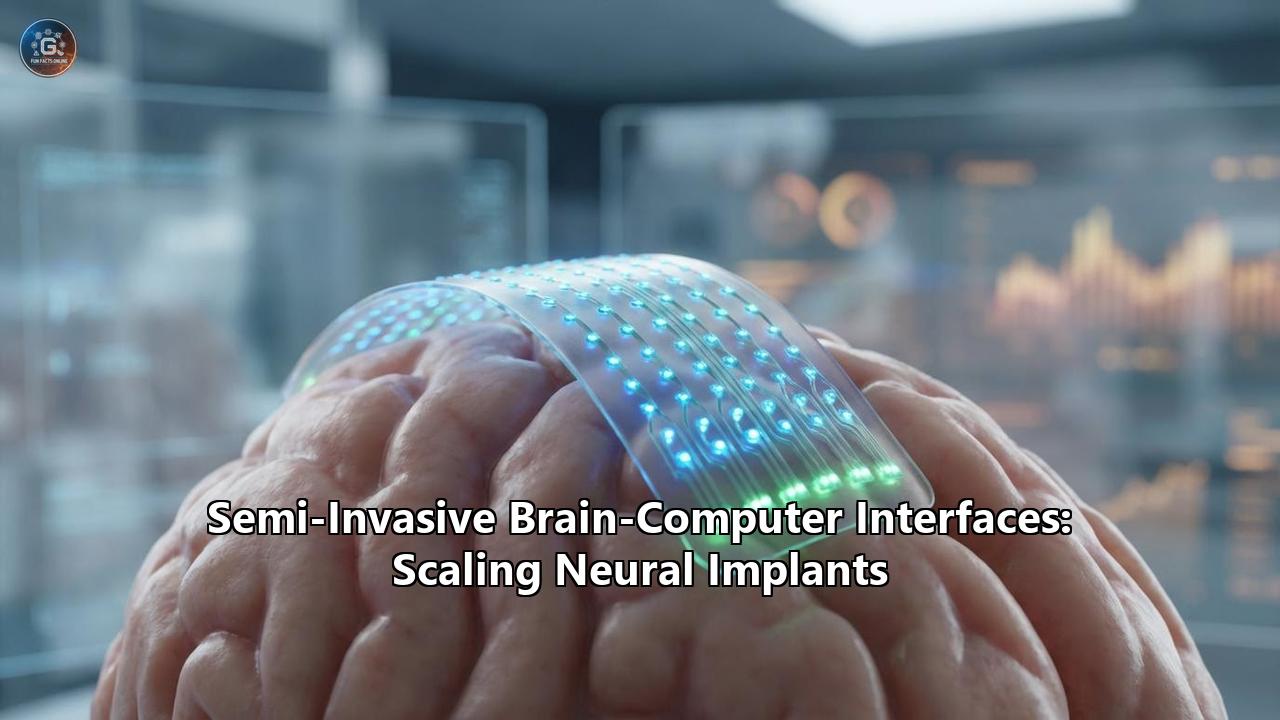
For decades, the field of Brain-Computer Interfaces (BCIs) has been caught in a technological tug-of-war. On one end of the spectrum lies non-invasive electroencephalography (EEG)—a technology as safe as wearing a hat, but akin to listening to a symphony orchestra from outside a thick brick wall. You can hear the booming crescendo of the bass, but the delicate intricacies of the flutes are entirely lost to the noise. On the other end of the spectrum are fully invasive intracortical implants, such as the Utah Array or Neuralink’s penetrating micro-threads. These devices pierce the brain tissue to record individual neurons with breathtaking clarity, but they carry significant clinical risks: open-brain surgery, localized tissue damage, and a cascading foreign-body immune response that gradually degrades the signal over time.
Enter the "Goldilocks Zone" of neurotechnology: semi-invasive brain-computer interfaces.
Resting on the surface of the brain or deployed through its surrounding blood vessels, semi-invasive BCIs capture high-fidelity neural signals without penetrating the delicate cortical tissue itself. Over the 2025–2026 period, this intermediate approach has transformed from a theoretical compromise into the most commercially viable and rapidly scaling frontier in neurotechnology. Driven by explosive advancements in materials science, custom microelectronics, and AI decoding, semi-invasive BCIs are currently breaking the channel-count barrier—scaling from dozens of electrodes to thousands—and moving aggressively out of the laboratory and into the lives of patients.
Here is a deep dive into how semi-invasive neural implants are scaling, the engineering marvels making it possible, and what the clinical landscape looks like today.
Architectures of Access: Tapping the Brain Without Piercing It
The defining characteristic of a semi-invasive BCI is its respect for the blood-brain barrier and the brain's parenchyma (the functional tissue in the brain). By refusing to puncture the cortex, developers face a distinct engineering challenge: how to get close enough to read high-resolution motor and speech intentions without doing harm. Two revolutionary architectures have emerged to solve this.
1. The Endovascular Highway: Synchron's Stentrode
Why drill through the skull when the brain already possesses a perfectly mapped, naturally occurring network of pathways? This is the founding premise of Synchron, a pioneer in endovascular BCIs. Synchron’s flagship device, the Stentrode, is delivered much like a cardiac stent. A neurointerventionalist guides the device through the jugular vein in the neck up into the brain's superior sagittal sinus—a large draining vein that sits directly adjacent to the primary motor cortex.
Once in position, the mesh-like Stentrode expands, pressing its electrodes against the vessel wall to record the electrical impulses radiating from the brain tissue just millimeters away. The signals are then routed down a microscopic wire to a receiver implanted in the patient’s chest, which transmits the data wirelessly to an external device.
This approach bypasses traditional neurosurgery entirely. By late 2025, Synchron successfully completed its FDA-approved COMMAND early feasibility study, demonstrating that patients with severe chronic paralysis could safely use the device long-term to browse the internet, text, and operate smart home devices. Remarkably, Synchron has now integrated its platform with mainstream consumer tech, allowing users to control an Apple iPad natively and navigate the Apple Vision Pro using only their motor-intent signals, backed by cutting-edge Nvidia AI processing.
2. The Micro-Slit and the Thin-Film: Precision Neuroscience
If Synchron is mastering the blood vessels, Precision Neuroscience is mastering the brain's surface via highly advanced micro-electrocorticography (µECoG). Precision’s "Layer 7 Cortical Interface" operates on a principle of extreme miniaturization. The device is a flexible polymer film containing 1,024 microscopic platinum electrodes packed into an area of just one square centimeter.
To understand just how delicate this is, the Layer 7 film is a mere 5 microns thick—roughly one-fifth the thickness of a human hair. Because it is so unimaginably thin, it can conform perfectly to the complex, grooved topography of the brain’s surface (the sulci and gyri).
Precision avoids a full craniotomy by utilizing a proprietary "micro-slit" technique. Surgeons make a sub-millimeter incision in the dura mater (the brain's protective lining) and gently slide the electrode array onto the cortical surface like a tiny slip of plastic wrap. Because the electrodes rest on the surface rather than plunging into the tissue, the array can be safely removed or upgraded in the future without damaging the underlying neurons. In 2025, Precision received FDA 510(k) clearance for the Layer 7 as a temporary mapping device, moving the company one massive step closer to permanent commercial implantation.
The Engineering Bottlenecks of Scaling
Scaling a semi-invasive BCI from a rudimentary control tool into a high-bandwidth pipeline requires overcoming severe physical and biological constraints. The leap from tens of channels to thousands (and soon, tens of thousands) introduces a host of fascinating engineering challenges.
The Wiring and Multiplexing Problem
In a traditional BCI, each electrode requires its own physical wire to carry the signal out of the brain. If an implant features 1,024 electrodes, routing 1,024 individual microscopic wires out of the skull would create a thick, rigid tether. This tether would apply dangerous mechanical strain on the brain—which naturally pulses and shifts with every heartbeat and breath—and create an unacceptable risk of infection.
To solve this, modern semi-invasive BCIs employ on-array multiplexing. Companies design custom Application-Specific Integrated Circuits (ASICs), such as Precision’s ML1664 chip, directly onto the flexible film. Multiplexing essentially takes the analog signals from hundreds of electrodes, digitizes them on the spot, and bundles them into a single, high-speed digital data stream. This drastically reduces the physical wire count by a factor of four or more, keeping the implant structurally un-intrusive while massively increasing the data bandwidth required to decode complex thoughts like speech.
Revolutionary Flexible and Soft Materials
The human brain has the physical consistency of soft gelatin, whereas traditional electronics are made of rigid silicon and heavy metals. This mechanical mismatch is the historical enemy of BCI longevity; rigid materials rub against soft tissue, provoking the brain's glial cells to form scar tissue that eventually walls off the implant and blocks the electrical signals.
Semi-invasive scaling relies heavily on breakthroughs in materials science. Engineers are moving away from rigid structures and turning toward highly conformable, biocompatible polymers and nanomaterials:
- Thin-Film Polyimide & Parylene-C: These flexible plastics are currently the industry standard for µECoG arrays. They act as exceptional insulators and can be manufactured using standard photolithography, allowing for the extreme miniaturization of electrode contacts.
- Hydrogels and Magnetorheological Materials: Pushing the boundaries of soft electronics, researchers are developing semi-invasive electrodes utilizing novel hydrogels. For example, recent developments involving $Fe_3O_4@GO/P(NIPAM–MAA)$ hydrogels feature magnetic-field-controlled rheology. These materials can be injected in a liquid-like state and actively expanded to form a precise, solid gel at body temperature, achieving stable signal-to-noise ratios while entirely eliminating the rigid mechanical stress of traditional solid metals.
- Nanocomposites: Innovations like gold-coated titanium dioxide nanowires embedded in silicone elastomers are allowing for "stretchable" grids. These grids maintain high electrical conductivity even when deformed, allowing them to ride the natural pulsations of the brain seamlessly for long-term chronic recording.
The Data Deluge: AI and High-Fidelity Decoding
When a BCI scales to over 1,000 channels, it stops generating simple, easily interpretable electrical spikes and starts generating a massive, continuous deluge of broadband data. ECoG and endovascular sensors detect "Local Field Potentials" (LFPs)—the aggregate electrical chatter of thousands of neurons firing in unison underneath an electrode.
Making sense of this noise in real-time is impossible without Artificial Intelligence. The true "brain" of a modern BCI system lives in the decoder.
In 2025 and 2026, the integration of advanced machine learning algorithms—specifically temporal convolutional networks and recurrent neural networks (like Riemannian-based LSTMs)—has allowed BCIs to move past primitive cursor control. AI decoders are now trained to recognize the specific spatiotemporal "fingerprint" of a neural intention.
Nowhere is this more evident than in speech restoration. Speech is one of the most mechanically complex motor actions a human can perform, involving the highly coordinated movement of the jaw, lips, tongue, and larynx. Precision Neuroscience recently demonstrated that by utilizing its high-density cortical surface arrays and awake-language mapping, their AI decoder could distinguish human speech events with 79% accuracy after just four minutes of training data. Similarly, Paradromics, another major player advancing high-bandwidth implantable BCIs, received FDA IDE approval to launch its Connect-One study specifically targeted at restoring speech for patients with severe paralysis, locked-in syndrome, and ALS.
The 2025–2026 Commercial Inflection Point
The neurotech landscape has accelerated at a staggering pace. The focus has rapidly shifted from "Can we safely put this in a human?" to "How quickly can we scale production and commercialize this therapy?"
In late 2025, Synchron closed an enormous $200 million Series D funding round, positioning the company to finalize its pivotal clinical trials and build the manufacturing infrastructure necessary to bring the Stentrode to the broader healthcare market. Their strategic decision to integrate directly with Apple’s native accessibility frameworks—rather than forcing users to learn a proprietary operating system—signals a monumental shift. BCIs are transitioning from bespoke medical experiments into universal interfaces for standard consumer electronics.
Simultaneously, modularity is becoming a standard feature. Because devices like Precision's Layer 7 arrays are minimally invasive and sit on the surface, surgeons can “tile” multiple arrays across different functional areas of the cortex simultaneously. This means a patient could feasibly have thousands of channels covering their motor cortex for movement, their Broca’s area for speech, and their sensory cortex for eventual bidirectional feedback—all connected to the same subdermal processing hub.
Beyond Paralysis: The Expanding Horizon
While the immediate clinical target for scaling semi-invasive BCIs remains patients suffering from severe motor impairments (ALS, spinal cord injuries, stroke), the high-channel-count future unlocks applications far beyond cursor control.
- Bidirectional Interfaces (Sensory Feedback): True human-computer interaction requires not just reading from the brain, but writing to it. Because semi-invasive arrays rest on the cortical surface, they are uniquely positioned to safely deliver micro-electrical stimulation. Researchers are heavily pursuing "closed-loop" systems where a robotic prosthetic hand not only moves via thought but also sends tactile sensations back to the brain's sensory cortex, allowing the user to "feel" what the robotic hand is touching.
- Epilepsy and Neurological Monitoring: High-density arrays offer an unprecedented window into the onset of neurological events. With thousands of channels monitoring the brain continuously, AI can detect the subtle electrical precursors to an epileptic seizure minutes before it happens, potentially stimulating the cortex to disrupt the seizure before the patient even knows they are in danger.
- Mental Health and Neuro-Modulation: As the map of the brain's network becomes clearer, the high-resolution ECoG grids could eventually be placed over regions responsible for mood regulation, offering highly targeted, closed-loop neuromodulation for treatment-resistant depression or PTSD.
The Dawn of the Brain-Computer Era
The narrative surrounding Brain-Computer Interfaces is often dominated by the loudest voices and the most invasive, sci-fi-esque methods. Yet, the quiet revolution is happening right on the surface of the brain and inside its blood vessels. Semi-invasive BCIs represent the pragmatic, highly scalable, and structurally elegant compromise that is actually reaching patients today.
By leveraging sub-millimeter surgical techniques, flexible nanomaterials, and intelligent AI decoders, engineers have successfully mitigated the historical trade-offs between signal quality and patient safety. As channel counts push past the thousands and hardware seamlessly integrates with our daily digital ecosystems, the scaling of semi-invasive neural implants proves that the future of human-computer interaction doesn't require us to severely alter the brain. It only requires us to listen a little more closely.
Reference:
- https://manroopkalsi.medium.com/the-future-is-wild-772943db4669
- https://specialtycareus.com/blog-neuralink-bci-future-neurology/
- https://bryantmcgill.xyz/articles/2026+Annual+Report+on+Brain-Computer+Interfaces
- https://www.azolifesciences.com/article/Insight-into-Brain-Computer-Interfaces-(BCI).aspx.aspx)
- https://andersenlab.com/blueprint/bci-challenges-and-opportunities
- https://www.techlifesci.com/p/2025-neurotech-review
- https://www.neurofounders.co/landscape/brain-computer-interface
- https://time.com/collections/best-inventions-2025/7318456/synchron-stentrode/
- https://www.bioworld.com/articles/724793-precision-neuros-minimally-invasive-bci-effective-in-early-studies?v=preview
- https://auctoresonline.com/article/precision-neurosciences-layer-7-cortical-interface-technical-design-surgical-integration-and-clinical-outcomes
- https://auctoresonline.com/uploads/articles/17671724601757074784JNNS-25-RW-383-Galley_Proof__.pdf
- https://www.advancedsciencenews.com/flexible-brain-machine-interface/
- https://www.researchgate.net/publication/389147210_Advancements_in_Materials_for_Flexible_and_Soft_Brain-Computer_Interface
- https://pubs.aip.org/aip/apm/article/10/9/090901/2834980/Flexible-electrodes-for-non-invasive-brain
- https://www.frontiersin.org/journals/human-neuroscience/articles/10.3389/fnhum.2024.1429130/full
- https://pmc.ncbi.nlm.nih.gov/articles/PMC12859206/
- https://www.healio.com/news/neurology/20251114/synchron-raises-200m-to-advance-braincomputer-interface-tech-for-paralysis