
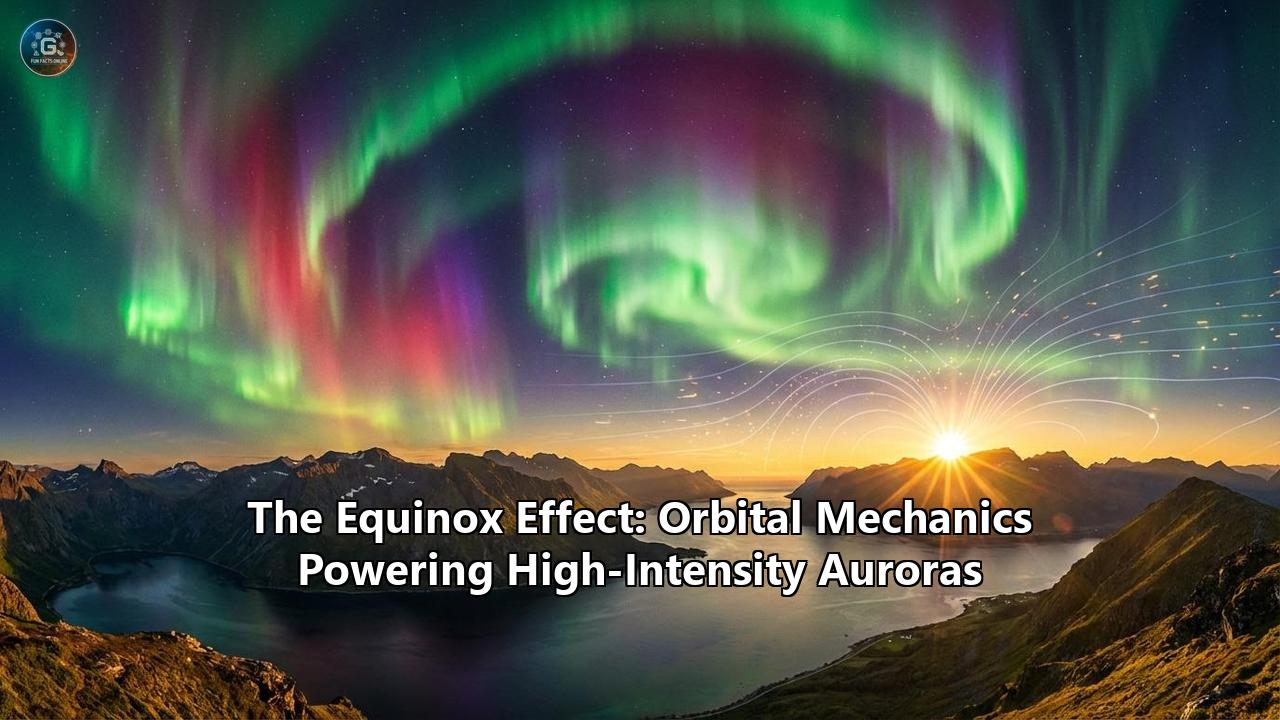
For millennia, humanity has looked to the night sky in awe of the auroras. The mesmerizing ribbons of green, crimson, and violet that dance across the polar horizons have inspired countless myths, legends, and works of art. From the perspective of an observer standing on the frozen tundra, the northern and southern lights appear as unpredictable, whimsical spirits of the atmosphere. Yet, modern astrophysics tells a different, far more intricate story. The aurora is not magic; it is the visible manifestation of a brutal and beautiful cosmic collision. It is a story of charged plasma, invisible magnetic force fields, and the relentless stream of energy pouring from our local star.
But beneath this chaotic space weather lies a strange and elegant pattern. Longtime aurora chasers and scientists alike have noticed a distinct rhythm to the celestial light shows: auroral activity reliably surges twice a year. These peaks do not occur during the freezing depths of the solstices, as one might assume, but rather during the transitional periods of the spring and autumn equinoxes.
Why does a phenomenon driven by the volatile eruptions of the Sun care about the calendar of the Earth?
The answer lies in a captivating intersection of orbital mechanics, geometry, and electromagnetism known primarily as the Russell-McPherron Effect, supported by the Equinoctial Effect. Together, these mechanisms explain why the weeks surrounding the March and September equinoxes are undeniably the best times of the year to witness high-intensity auroras.
The Engine of the Aurora: A Primer on Space Weather
To understand why the equinox supercharges the aurora, we must first understand the fundamental machinery of the lights themselves. The aurora borealis (northern lights) and aurora australis (southern lights) are the spectacular byproducts of the Earth defending itself against the Sun.
Our Sun is a tempestuous sphere of superheated plasma, constantly boiling and churning. It continuously blows a stream of charged particles—mostly electrons and protons—outward into the solar system. This stream is known as the solar wind. Occasionally, the Sun's magnetic fields twist and snap, resulting in massive explosions like solar flares or Coronal Mass Ejections (CMEs), which hurl billions of tons of solar material into space at millions of miles per hour.
As this solar wind hurtles toward Earth, it encounters our planet’s ultimate line of defense: the magnetosphere. Generated by the swirling liquid iron in Earth's outer core, the magnetic field forms an invisible, teardrop-shaped shield around the planet. When the solar wind slams into the magnetosphere, the vast majority of the dangerous charged particles are deflected away, sliding around Earth like water around the bow of a ship.
However, the shield is not impenetrable. Under the right conditions, the magnetic field of the solar wind interacts with the magnetic field of the Earth in a process called magnetic reconnection. This process essentially opens temporary "cracks" or funnels in the magnetosphere, allowing the highly energetic solar particles to pour inside.
Once inside, these particles are caught in Earth's magnetic field lines and accelerated downward toward the north and south magnetic poles. As they crash into the upper atmosphere, they collide with atoms and molecules of atmospheric gases, transferring their energy. When those gases release that excess energy, they emit photons of light.
- Collisions with Oxygen at lower altitudes (around 60 miles up) produce the most common yellow-green auroras, while high-altitude oxygen (up to 200 miles) produces rare, ruby-red glows.
- Collisions with Nitrogen produce stunning hues of blue and purplish-pink, often seen at the lower, faster-moving edges of auroral curtains.
The intensity of this light show relies entirely on how much energy the solar wind can inject into the magnetosphere. And that is precisely where the geometry of the equinox comes into play.
The Russell-McPherron Effect: Cracking the Magnetic Shield
For over a century, scientists noted the bi-annual surge in auroral activity. As early as 1912, the English Jesuit astronomer Aloysius Cortie published a journal paper linking the equinoxes to a rise in geomagnetic storms. In 1940, the famed mathematicians Sydney Chapman and Julius Bartels documented the same twice-yearly pattern. Yet, the exact physical mechanism driving this "equinox aurora season" remained one of the great mysteries of space weather.
The breakthrough arrived in 1973, when geophysicists Christopher Russell and Robert McPherron published a landmark paper detailing a brilliantly elegant theory. They hypothesized that the seasonal spike in auroras was a matter of sheer geometric alignment between the Interplanetary Magnetic Field (IMF) and Earth's own magnetic field.
To visualize the Russell-McPherron effect, we have to look at the invisible magnetic forces flowing through the solar system. The solar wind doesn't just carry particles; it carries the Sun's magnetic field with it. This IMF is a complex, three-dimensional structure. Space physicists measure the IMF using a coordinate system, but the most crucial component for auroral activity is the north-south axis, known as the $B_z$ (B-sub-z) component.
Earth’s magnetic field at the dayside equator points unequivocally northward. Therefore, according to the fundamental rules of magnetism (where opposite poles attract and like poles repel), if the solar wind's magnetic field also points northward, the two fields clash and repel each other. The Earth's shield acts like a closed door.
But if the solar wind's magnetic field tilts southward—a condition known as a negative $B_z$—the opposite magnetic poles attract. The southward IMF links directly with Earth's northward magnetic field lines. This is magnetic reconnection. The door is flung wide open, and solar energy floods into the terrestrial system, triggering fierce geomagnetic storms and vibrant auroras.
What Russell and McPherron discovered is that the physical tilt of the Earth during the equinoxes artificially creates more southward $B_z$ connections.
Here is the mechanical breakdown of this cosmic lock-picking:
- The Earth's rotational axis is tilted by 23.5 degrees relative to its orbital plane (the ecliptic).
- Furthermore, Earth's magnetic dipole axis is tilted by another 11 degrees relative to its rotational axis.
- During the summer and winter solstices, the Earth's magnetic poles are angled heavily toward or away from the Sun. This misalignment makes it difficult for the Sun's magnetic field to perfectly oppose Earth's.
- However, during the spring and fall equinoxes (around March 20 and September 22), the Earth is positioned sideways to the Sun. Its rotational axis points neither toward nor away from our star.
- Because of this broadside orientation, as the Earth rotates, its magnetic dipole undergoes a maximum wobble relative to the incoming solar wind.
- This geometry means that even if the Sun's magnetic field is traveling perfectly parallel to the Earth's orbital plane (an east-west direction, which usually wouldn't trigger an aurora), the tilt of the Earth itself effectively twists that solar magnetic field into a southward ($B_z$) orientation from the perspective of our magnetosphere.
In simple terms: The equinox geometry tricks the solar wind into picking the lock of Earth’s magnetic shield. By aligning the magnetic fields in opposing directions more frequently and effectively, the Earth accepts a massive influx of solar plasma, resulting in a dramatic increase in high-intensity auroras.
The Equinoctial Effect: The Wind Tunnel of the Magnetosphere
While the Russell-McPherron effect explains the magnetic "key" to the magnetosphere, it works in tandem with another powerful orbital dynamic known as the Equinoctial Effect.
If the Russell-McPherron effect is about opening the door, the Equinoctial effect is about how wide the door swings open.
The solar wind is a continuous, rushing river of plasma. The amount of energy transferred from this river to the Earth depends heavily on the aerodynamic (or rather, magnetohydrodynamic) profile our planet presents to the wind.
- During the solstices in June and December, Earth's magnetic axis is tilted toward or away from the solar wind. The magnetosphere is effectively striking the wind at an awkward, slanted angle. The coupling between the two forces is inefficient, and much of the solar wind's kinetic energy simply slides off the magnetosphere.
- During the equinoxes, the Earth's magnetic poles sit at a perfect 90-degree right angle to the flow of the solar wind twice a day.
When the magnetic dipole is strictly perpendicular to the solar wind, the Earth’s magnetosphere presents its maximum possible cross-section to the incoming plasma. This orientation optimizes the energy transfer. The solar wind can grip the Earth's magnetic field lines with maximum leverage, stretching them far back into the night side of the Earth (the magnetotail) like a rubber band.
When those overstretched magnetic field lines inevitably snap back toward the Earth, they act as a particle accelerator, slingshotting electrons into the upper atmosphere at unimaginable speeds. Because the equinoctial geometry maximizes this "stretching" effect, the resulting auroras are not just more frequent—they are vastly more intense, dynamic, and explosive.
The Synergy of the Solar Maximum
The equinox effects alone guarantee that March and September will statistically host the best auroral displays of any given year. However, this orbital geometry does not operate in a vacuum. It interacts directly with the Sun's own internal heartbeat: the solar cycle.
The Sun undergoes a roughly 11-year cycle of magnetic activity, driven by the complex dynamo of plasma swirling within its interior. At the beginning of the cycle (Solar Minimum), the Sun's surface is relatively calm, largely devoid of sunspots, and solar flares are rare. As the cycle progresses toward its peak (Solar Maximum), the Sun's magnetic field becomes tangled and chaotic. Sunspots pepper the solar disk, and violent CMEs erupt with startling regularity.
Currently, in the 2024–2026 timeframe, we are experiencing the tumultuous peak of Solar Cycle 25.
When the raw, explosive power of a Solar Maximum coincides with the geometric vulnerability of the equinox, the results are historically spectacular. A CME that might only produce a moderate geomagnetic storm (G2) in July or December can be amplified into a severe (G4) or extreme (G5) geomagnetic storm if it strikes in late March or late September. The Russell-McPherron effect acts as a cosmic amplifier for the Sun's fury.
During these peak equinoctial periods, the auroral oval—the ring of light that typically sits strictly over the Arctic and Antarctic circles—expands dramatically toward the equator. High-intensity auroras fueled by this perfect storm of orbital mechanics and solar max have been witnessed as far south as Florida, Texas, and even the Mediterranean in the Northern Hemisphere, and deep into mainland Australia in the Southern Hemisphere.
For astrophotographers, scientists, and casual skywatchers, an equinox during a Solar Maximum is the holy grail of space weather. The combination ensures that the skies are not merely painted with faint, static glows, but with violent, rapidly shifting coronas, towering pillars of red and purple light, and pulsating waves that seem to breathe across the entire firmament.
Beyond the Beauty: The Consequences of Equinox Storms
While the high-intensity auroras of the equinox are a visual marvel, the mechanics that power them carry profound implications for modern human civilization. The very same magnetic reconnection that creates beautiful light in the sky also induces massive electrical currents in the ground and in the atmosphere.
When the Russell-McPherron effect opens the floodgates to a barrage of solar wind, the resulting geomagnetic storms can wreak havoc on our increasingly technology-dependent world.
1. Power Grid VulnerabilityAs the magnetosphere is battered by solar wind, it rapidly compresses and expands. These fluctuations generate powerful electromagnetic fields that induce direct currents (DC) in long, conductive structures on the Earth's surface—most notably, high-voltage power lines. If a severe equinox geomagnetic storm hits, these geomagnetically induced currents (GICs) can overload electrical transformers, causing them to overheat, melt, or catastrophically fail. The infamous March 1989 geomagnetic storm—a perfect example of an equinox-amplified event—tripped circuit breakers across Quebec, plunging 6 million people into freezing darkness for nine hours.
2. Satellite Drag and Orbital DecayThe influx of energy during an equinoctial geomagnetic storm physically heats the Earth's upper atmosphere (the thermosphere). As it heats up, the atmosphere expands outward into space. Low Earth Orbit (LEO) satellites suddenly find themselves flying through thicker, denser air. This increased aerodynamic drag slows the satellites down, causing their orbits to decay prematurely. In recent years, companies operating mega-constellations of satellites have lost dozens of newly launched spacecraft because they were caught in the expanded atmosphere triggered by seemingly moderate space weather events amplified by seasonal geometry.
3. GPS and Communication BlackoutsThe aurora itself is a highly charged plasma. When high-frequency radio waves (such as those used by transoceanic flights or amateur radio operators) attempt to pass through the ionosphere during an intense auroral event, the signals are scattered, absorbed, or degraded. Similarly, the signals from Global Positioning System (GPS) satellites can experience severe scintillation, leading to massive inaccuracies in navigation systems used by everything from commercial shipping to precision agriculture.
Because the Russell-McPherron effect makes the Earth highly receptive to space weather in March and September, satellite operators, power grid managers, and aviation authorities treat the equinoxes with a heightened state of vigilance. The beauty of the aurora is inextricably linked to the hazard of the storm.
A Guide to Chasing the Equinox Aurora
Understanding the orbital mechanics powering the equinox effect transforms aurora hunting from a game of blind luck into an exercise of applied science. If you wish to witness the raw power of a high-intensity equinox aurora, you must learn to read the signs of the cosmos.
1. Timing the SeasonThe equinoxes fall around March 20 and September 22. However, the Russell-McPherron effect is not limited to a single day. The geometry remains highly favorable for several weeks before and after the exact equinox. Therefore, planning expeditions between late February and mid-April, or late August through October, provides the highest statistical probability of encountering an open magnetosphere.
2. Monitoring Space Weather DataModern aurora hunters rely on real-time data from satellites positioned between the Earth and the Sun, such as the DSCOVR (Deep Space Climate Observatory) satellite. To predict a high-intensity equinox display, you must look for three critical metrics:
- Solar Wind Speed: Normal solar wind blows around 300 to 400 kilometers per second. During a CME, speeds can exceed 700 to 1,000 km/s. Faster wind means more kinetic energy slamming into the magnetosphere.
- Density: Measured in protons per cubic centimeter. A denser solar wind provides more "fuel" for the auroral collisions.
- The $B_z$ Component: This is the master key. Even at the equinox, an aurora will be subdued if the IMF is pointing north (positive $B_z$). You must wait for the $B_z$ metric to flip south (negative $B_z$). A $B_z$ of -10 nT or lower, sustained for several hours, combined with equinox geometry, practically guarantees a spectacular, widespread aurora.
The Kp index is a scale from 0 to 9 that measures global geomagnetic activity.
- Kp 1-3: Minor activity, visible only in the extreme high latitudes (Alaska, Northern Norway, Iceland).
- Kp 4-5: Moderate storms. The auroral oval expands.
- Kp 6-7: Strong storms. Auroras become visible in the mid-latitudes (Northern US, UK, Southern New Zealand).
- Kp 8-9: Severe to extreme storms. Auroras visible near the tropics. Thanks to the equinox effect, CMEs that arrive in March or September are highly prone to pushing the Kp index into the 7–9 range.
The most intense geomagnetic storm in history will be invisible if you are standing under a dense canopy of clouds or the glaring lights of a major city. To maximize your viewing potential, you must seek out Dark Sky reserves or remote wilderness areas. Furthermore, the moon phase plays a crucial role. A full moon can wash out the subtle purples and blues of a high-intensity display. Aiming for an equinox aurora during a new moon phase is the ultimate astronomical alignment.
The Cosmic Clockwork
There is a profound, almost poetic realization that comes from understanding the Equinox Effect. When we stand beneath the shivering, kaleidoscopic curtains of the aurora borealis, we are not merely watching pretty lights. We are acting as localized witnesses to an event of massive, planetary scale.
We are seeing the breath of the Sun washing over the Earth. We are watching the invisible magnetic bones of our planet flex and bend under the pressure of the solar wind. And, most remarkably, we are experiencing the physical reality of our planet's tilt and orbit. The same 23.5-degree axial tilt that thaws the ice in spring and yellows the leaves in autumn is the very mechanism that reaches out into the void of space, grabs the magnetic field of the Sun, and pulls the fire down into our atmosphere.
The Russell-McPherron and Equinoctial effects remind us that we do not exist in isolation. The Earth is a dynamic spacecraft navigating a complex, highly charged cosmic environment. Every March and every September, as we round the curve of our orbit and present our flank to the star that gives us life, the magnetic locks align, the shields part, and the sky ignites. It is the grandest light show in nature, powered entirely by the silent, relentless perfection of orbital mechanics.
Reference:
- https://earthsky.org/sun/aurora-season-auroras-equinox-connection/
- https://www.space.com/aurora-equinox-earth-magnetism-russell-mcpherron
- https://www.iflscience.com/russell-mcpherron-effect-why-cracks-in-earths-magnetic-field-mean-we-get-peak-auroras-at-equinox-78459
- https://www.timeanddate.com/news/astronomy/aurora-equinox-2025
- https://www.space.com/stargazing/auroras/northern-lights-could-get-a-boost-from-the-spring-equinox-this-weekend-heres-why
- https://www.northernshotstours.com/equinox-effect/
- https://www.sciencing.com/1975563/equinox-effect-makes-cosmic-phenomenon-stunning-twice-a-year/
- https://nordnorge.com/en/artikkel/the-aurora-leaves-the-night-sky-stage-in-a-grand-finale/
- https://www.livescience.com/space/the-sun/powerful-equinox-auroras-may-arrive-soon-why-changing-seasons-can-bring-the-best-northern-lights
- https://www.forbes.com.au/news/lifestyle/northern-lights-alert-why-aurora-could-now-suddenly-spike/