
For centuries, the popular imagination of mummification has been dominated by the golden sands of Egypt. We envision the elaborate wrappings of pharaohs, the canopic jars, and the dry, arid heat of the Sahara preserving the dead for eternity. Alternatively, we might think of the Chinchorro mummies of Chile, naturally desiccated by the world’s driest desert. In these narratives, preservation is a gift of the dry earth.
But deep in the humid, sweltering rainforests of prehistoric Asia, a different, more visceral story was being written—not with gold and linen, but with fire, smoke, and shadow.
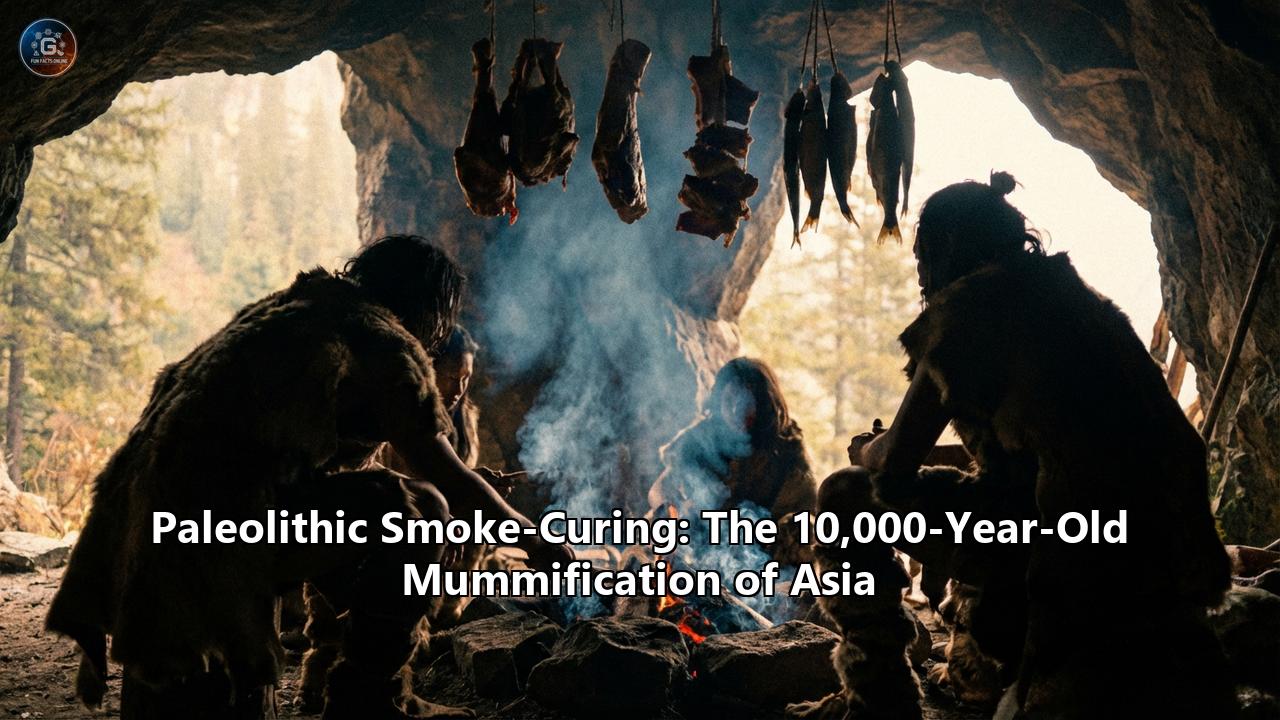
Recent groundbreaking archaeological inquiries have shattered our timeline of human mortuary practices. Long before the first stone was laid for the Pyramids of Giza, and millennia before the Chinchorro people laid their dead in the Atacama sands, hunter-gatherers in the tropical jungles of Southeast Asia and Southern China were defying nature. They developed a sophisticated, labor-intensive technology to stop the relentless decay of the tropics. They did not bury their fresh dead; they smoked them.
This is the story of the "Fire Mummies" of the Paleolithic—a tradition stretching back over 10,000 years, revealing that the human drive to preserve the beloved dead is far older, and far more universal, than we ever dared to imagine.
Part I: The Discovery That Rewrote History
The revelation did not come from a single golden tomb, but from the silent, chemical whispers hidden inside ancient bones.
For decades, archaeologists excavating caves in Southern China, Northern Vietnam, and Thailand had been puzzled by a recurring anomaly. They found skeletons, dating back to the late Pleistocene and early Holocene (roughly 14,000 to 6,000 years ago), arranged in impossible positions. These were not bodies laid out at rest. The knees were pulled tight against the chest, the arms locked around the shins, the spine curved into a tight fetal ball. This "hyper-flexed" position was so compact that it would be nearly impossible to achieve with a fresh corpse without breaking bones—unless the body had been processed first.
Even more strange were the colors. Many of these bones were not the ivory-white of sun-bleached remains, nor the brown of soil-stained fossils. They were splotched with black and brown, patterns that looked suspiciously like charring, yet the bones themselves had not been calcined by the high heat of a cremation fire.
In a landmark study published around 2025, a team of international researchers led by anthropologists such as Dr. Hsiao-chun Hung used advanced forensic technology—X-ray diffraction and Fourier-transform infrared spectroscopy—to peer into the molecular structure of these bones.
What they found was the "smoking gun" of archaeology.
The analysis revealed that the crystal structure of the bone mineral (hydroxyapatite) had been altered by heat, but only slightly. The collagen within the bones had degraded in a specific way consistent with long-term exposure to low temperatures—essentially, a slow roast. These bodies had not been burned; they had been cured.
The conclusion was staggering: These were not simple burials. These were mummies. The soft tissue had long since decayed in the aggressive tropical soil, leaving only the skeleton behind, but the chemical signature remained. These hunter-gatherers, living in the dawn of the Holocene, had mastered the art of smoke-curing human bodies, effectively turning their ancestors into smoked jerky to preserve them against the rot of the rainforest.
Part II: The Science of Smoke and Survival
To understand why this discovery is so profound, one must first understand the enemy: moisture.
In the deserts of Egypt or Peru, nature does the work for you. If you bury a body in hot, dry sand, the moisture evaporates rapidly, halting the bacteria and enzymes that cause decomposition. But in the tropical monsoon forests of Asia, nature is a voracious recycler. The heat, humidity, and teeming microbial life can reduce a body to a skeleton in weeks. To preserve a body here requires active, aggressive intervention.
The Paleolithic people of Asia turned to the one tool they had mastered: Fire.
The Chemistry of Curing
Smoke-curing is, at its heart, a preservation technique usually reserved for food. The same principles that turn raw pork into ham or fresh salmon into smoked lox were applied to human beings.
- Desiccation: The primary goal is dehydration. By suspending a body over a smoldering fire, the gentle, constant heat drives water out of the tissues. Without water, the bacteria that drive putrefaction cannot survive.
- Chemical Preservation: Wood smoke is a complex cocktail of chemicals. It contains phenols and other antimicrobial compounds. As the smoke washes over the skin and penetrates the tissues, these chemicals kill surface bacteria and fungi.
- Physical Barrier: The smoke and heat cause the skin to harden, creating a leather-like shell (a process similar to tanning) that acts as a barrier against insects, maggots, and moisture.
This was not a crude burning. It was a precise, controlled scientific process. The fires had to be kept low and smoldering—too hot, and the body would burn and crack; too cool, and the rot would win. It required days, perhaps weeks, of constant vigilance.
Part III: A Paleolithic Funeral
Based on the archaeological evidence and ethnographic parallels, we can reconstruct what a funeral might have looked like in the Spirit Cave region of Thailand or the limestone karsts of Guangxi, China, 12,000 years ago.
Death in a small hunter-gatherer band was a seismic event. When an elder or a beloved child died, the group did not simply dig a hole and move on. The process of separation was slow.
The Binding: Immediately after death, before rigor mortis could fully set in or perhaps by manipulating the joints afterward, the body was folded. The knees were pressed into the chest, the chin tucked down. The limbs were bound tightly with cords woven from vines or bark. This "fetal position" might have symbolized a return to the womb, but it also had a practical purpose: it made the body a compact bundle, easier to smoke evenly and easier to transport. The Scaffold: A special structure was built within the rock shelter or cave mouth. A fire was kindled beneath a slat-wood platform—not a roaring blaze, but a bed of glowing coals fueled by specific aromatic woods, perhaps chosen for their preservative properties or ritual scent. The Vigil: For weeks, the community would tend the fire. The smoke would billow up, enveloping the bound ancestor. The smell would be intense—a mix of roasting meat, woodsmoke, and perhaps herbs. This was a visceral, sensory engagement with death. The mourners would watch the body transform. The skin would darken to the color of mahogany, then to charcoal black. The fluids would drip away, hissing into the fire. The body would shrink, becoming lighter, harder, imperishable.Only when the process was complete—when the ancestor was transformed from a decaying corpse into a hard, smoked statue—would they be laid to rest in the earth, often still in their bound, crouching pose.
Part IV: The Living Links – From the Cordilleras to Papua
One of the most compelling aspects of this discovery is that this "extinct" practice never actually went extinct. The tradition of fire-curing the dead survived in pockets of Asia and Oceania into the 20th century, providing us with a living window into the Paleolithic past.
The Kabayan Fire Mummies (Philippines)
High in the misty mountains of Benguet in the Philippines, the Ibaloi people practiced a form of mummification that mirrors the ancient technique with eerie precision. Known as the "Fire Mummies" or Meking, these remains date back centuries (some estimates suggest the tradition is thousands of years old, though the surviving mummies are from the 12th-15th centuries AD).
The Ibaloi process was agonizingly intricate. It reportedly began before death, with the dying person drinking a strong brine solution to begin dehydrating the organs. After death, the body was washed and seated in a "death chair" over a low fire.
But the Ibaloi added a step that speaks to incredible anatomical knowledge: they would blow tobacco smoke into the mouth of the deceased. This wasn't just ritual; it was internal fumigation. The smoke would dry the internal organs from the inside out, while the fire dried the skin from the outside. The process took months. The result is a body preserved with skin intact, tattoos still visible, teeth grinning in a timeless grimace. These mummies were then placed in log coffins in caves like Timbac and Tinongchol, where they sit to this day, guardians of the mountain.
The Smoked Ancestors of the Dani (Papua)
Travel further south to the highlands of West Papua, Indonesia, and the link becomes even more direct. Among the Dani and the Anga (Kukukuku) tribes, smoked mummification was practiced well into the modern era.
Here, the mummies are not buried. They are kept.
The smoked corpse of a village leader or great warrior is anointed with pig fat and red clay, then placed in a seated position in a special hut. The villagers continue to live with him. They speak to him, offer him cigarettes, and bring him out for great celebrations. The smoke-curing allows the dead to remain a physical part of the community.
The 2025 study explicitly drew connections between the hyper-flexed skeletons of 12,000-year-old China and these modern Papuan mummies. The physical distortion of the bones caused by the tight binding and heating in the ancient samples is identical to what is seen in the Dani mummies. It suggests a continuous cultural lineage—or at least a convergent evolution of technology—spanning an entire continent and ten millennia.
Part V: Why Mummify? The Hoabinhian Mindset
Why did these ancient hunter-gatherers go to such lengths?
The people of this era are often grouped under the "Hoabinhian" technocomplex—a term for the stone-tool-using hunter-gatherers of Southeast Asia. We know they were adaptable, utilizing the rich resources of the rainforest. They ate wild almonds, betel nuts, and hunted monkeys, deer, and cattle.
The decision to mummify speaks to a complex spiritual life and a specific relationship with the land.
- Mobility and Portability: Hunter-gatherers are mobile. If a loved one dies, you may not want to leave them behind in a shallow grave to be dug up by scavengers. A smoke-cured body is light, dry, and hygienic. It can be carried. It allows the ancestors to move with the tribe.
- ancestor Worship: In many Asian animist traditions, the dead are intermediaries between the physical and spiritual worlds. To let the body rot is to lose the vessel of that power. Preserving the face and form of the ancestor helps maintain the connection. The ancestor is not "gone"; they are simply "dried."
- Defying the Rainforest: There is a defiance in this act. In an environment that destroys organic matter rapidly, mummification is a technological assertion of human will over nature. It is a refusal to let the jungle erase a person.
Part VI: The Spirit Cave Connection
The connection to sites like Spirit Cave in Thailand is particularly fascinating. Excavated by Chester Gorman in the 1960s, Spirit Cave was one of the first sites to prove that Southeast Asians had complex plant knowledge (and possibly early agriculture) far earlier than previously thought.
While Spirit Cave is famous for its seeds and stone tools, the "Log Coffin Culture" that appears in the same region (Pang Mapha) much later (Iron Age, approx. 1,500-2,000 years ago) shows how the idea of complex preservation persisted. The Log Coffin people hoisted massive teak coffins onto high stilts within caves. While they didn't always use the full smoke-cure method of the Paleolithic, the location—the high dry caves—and the elaborate treatment of the dead show a direct line of cultural heritage. The caves were portals, and the dead were the guardians.
Part VII: A Global Paradigm Shift
The discovery of 10,000-year-old mummification in Asia forces us to rethink the history of human "civilization."
We often associate complex mortuary rituals with settled, agricultural societies (like Egypt). We assume that hunter-gatherers were too busy surviving to spend weeks tending a fire for a corpse. This discovery proves that assumption wrong.
These Paleolithic foragers had the surplus time, the resources, and the social cohesion to perform elaborate, months-long funeral rites. They cared deeply for their dead. They possessed a sophisticated understanding of chemistry (using smoke as a preservative) and anatomy.
This was not a primitive act. It was advanced biotechnology for its time.
Conclusion: The Smoke Fades, The Bones Remain
Today, the smoke of those Paleolithic fires has long since dissipated. The flesh of the ancestors has finally succumbed to time, leaving only the chemically altered bones to tell the tale.
But the story they tell is one of profound love and ingenuity. Across the vast, green expanse of prehistoric Asia, from the rivers of Vietnam to the highlands of the Philippines, humans looked at the inevitability of death and decay, lit a fire, and said, "No."
They used the smoke of the hearth—the center of their lives—to wrap their dead in a protective layer of carbon and heat. In doing so, they created the world's oldest mummies, defying the rot of the rainforest to keep their loved ones close for just a little while longer.
As we stare into the empty eye sockets of the Kabayan Fire Mummies or the blackened bones of the Hoabinhian burials, we are not looking at monsters or curiosities. We are looking at the enduring evidence of human grief, and the lengths to which we will go to preserve the memory of those we have lost. The 10,000-year-old mummification of Asia is not just a scientific curiosity; it is a testament to the eternal human struggle against oblivion.
Reference:
- https://english.gujaratsamachar.com/news/science-technology/worlds-oldest-evidence-of-smoke-dried-mummification-found-in-southern-china
- https://www.livescience.com/archaeology/worlds-oldest-mummies-were-smoke-dried-10-000-years-ago-in-china-and-southeast-asia-researchers-find
- https://www.miamiherald.com/news/nation-world/world/article312122008.html
- https://news.ssbcrack.com/worlds-oldest-human-mummies-created-by-smoke-drying-in-southeast-asia-and-china-study-reveals/
- https://www.youtube.com/watch?v=0D4l1LNjANA
- https://au.news.yahoo.com/12-000-old-smoked-mummies-200801927.html
- https://www.scienceasia.org/2007.33.n1/v33_047_056.pdf
- https://www.earth.com/news/evidence-of-smoked-mummies-created-by-smoke-dried-mummification-of-humans/
- https://www.thearchaeologist.org/blog/fire-mummies-the-smoked-human-remains-of-the-kabayan-caves
- https://en.wikipedia.org/wiki/Kabayan_Mummies
- https://sciencespectrumu.com/the-worlds-oldest-mummies-were-smoked-12-000-years-ago-a6519c6e3f7e
- https://www.ancient-origins.net/news-history-archaeology/kabayan-caves-mummies-002734
- https://www.pnas.org/doi/10.1073/pnas.2515103122
- https://grokipedia.com/page/Kabayan_Mummies
- https://scitechdaily.com/the-genetic-footprint-of-thailands-lost-civilizations-revealed-in-iron-age-log-coffins/