
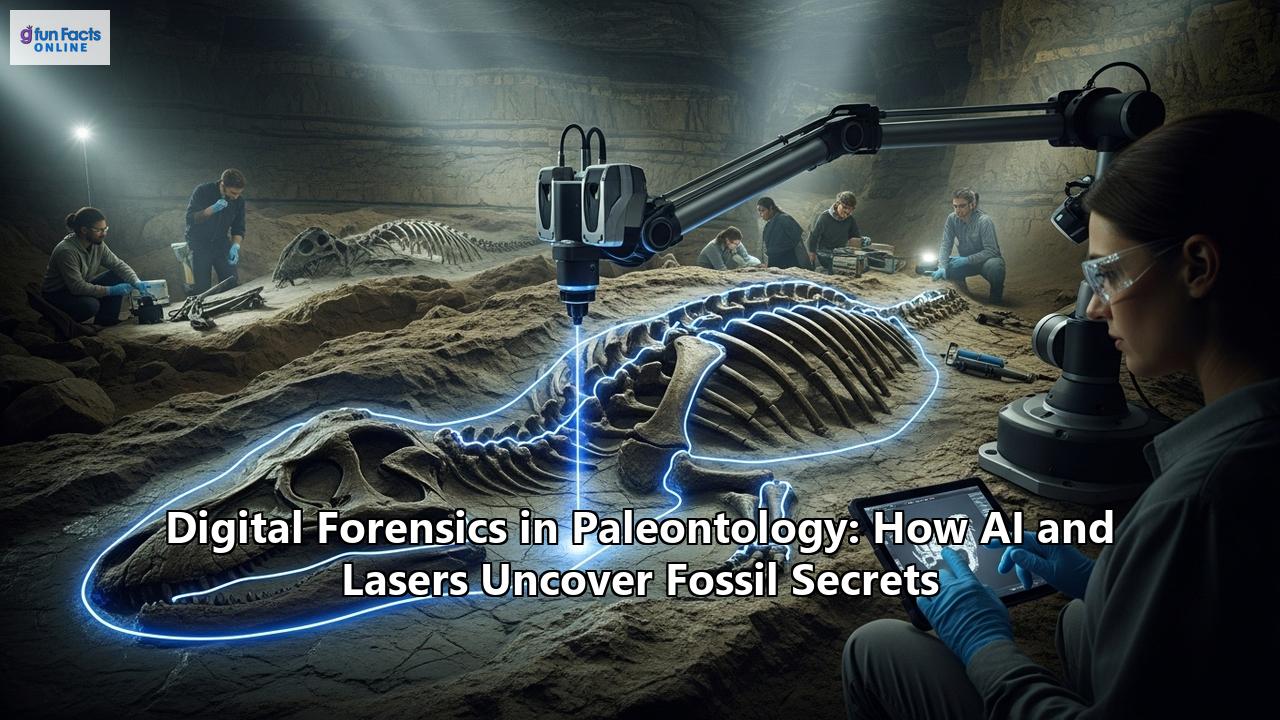
The New Age of Discovery: How Digital Forensics, AI, and Lasers Are Rewriting Prehistory
The classic image of a paleontologist is one of adventurous, dusty fieldwork—a lone figure chipping away at rock with a hammer and brush, slowly revealing the petrified remains of a creature dead for millions of years. This image, while romantic, is rapidly becoming a fossil itself. Today, the field of paleontology is undergoing a profound transformation, driven by a technological revolution that would seem more at home in a crime lab or a Silicon Valley startup than a remote dig site. We are entering the era of digital paleontology, a discipline where the primary tools are no longer just picks and shovels, but powerful lasers, high-resolution scanners, and sophisticated artificial intelligence. This is the world of digital forensics in paleontology, a new frontier where the secrets of ancient life are being unlocked not by breaking rock, but by decoding data.
The term "digital forensics" typically conjures images of investigating cybercrimes or retrieving data from a damaged hard drive. However, its core principles—the non-destructive identification, preservation, collection, analysis, and interpretation of digital evidence to reconstruct past events—are perfectly suited to the goals of modern paleontology. In this context, the "crime scene" is a fossil bed, the "victim" is an extinct organism, and the "evidence" is the vast trove of digital data extracted from its remains. Instead of reconstructing the final moments of a crime, these digital detectives are reconstructing the life, behavior, evolution, and even the diseases of creatures that vanished from the Earth tens or hundreds of millions of years ago.
This revolution is built on the synergy of two transformative technologies: advanced scanning technologies, particularly lasers and Computed Tomography (CT), and Artificial Intelligence (AI). Lasers and CT scanners act as the primary evidence collectors, peering inside and across the surface of fossils to capture their intricate details in three dimensions without causing any damage. This process of "virtual paleontology" creates a digital twin of the fossil, a perfect replica that can be examined, shared, and analyzed in ways the physical object never could. Then, AI enters the scene as the lead investigator. Machine learning algorithms, especially deep neural networks, sift through these massive digital datasets with superhuman speed and precision, identifying fossils, segmenting them from their rocky tombs, and revealing subtle clues that would be invisible to the human eye.
This article will delve into this exciting intersection of ancient life and cutting-edge technology. We will explore how digital forensics is being redefined in the paleontological context, witness the power of AI and lasers in uncovering fossil secrets through compelling case studies, understand the mechanics behind these revolutionary tools, and look ahead to the future of a science that is, in every sense, being reborn in the digital age.
The Digital Detective's Toolkit: Lasers, Scanners, and the Birth of the Virtual Fossil
Before any digital analysis can begin, paleontologists must first translate the physical fossil into the digital realm. This crucial first step, akin to securing evidence at a crime scene, relies on a suite of non-destructive imaging technologies that can capture every minute detail of a specimen without inflicting harm. For centuries, studying the internal structures of a fossil often required its destruction through methods like thin-sectioning. Today, technologies like X-ray Computed Tomography (CT) and a variety of laser scanning techniques allow scientists to create what is known as a "virtual fossil."
Peering Inside: The Power of Computed Tomography (CT)Borrowed from the medical field, CT scanning has become one of the most powerful tools in the paleontologist's arsenal. A CT scanner uses X-rays to create a series of 2D cross-sectional images, or "slices," of a fossil. A computer then stitches these slices together to generate a detailed 3D model that reveals not only the external surface but also the intricate internal anatomy. For smaller specimens or when exceptionally high resolution is needed, paleontologists turn to micro-CT scanning, which can resolve features down to just a few microns.
These "volumetric" scans are invaluable. They allow researchers to peer inside a dinosaur's skull to map its brain cavity, examine the inner ear to understand its hearing capabilities, or trace the path of nerves and blood vessels. They can reveal unerupted teeth within a jaw or even delicate embryonic skeletons curled up inside a fossilized egg. This non-destructive approach means that rare, fragile, and priceless specimens can be studied inside and out, preserving them for future generations while making their data globally accessible.
Painting with Light: Laser Scanning and PhotogrammetryWhile CT scanning excels at revealing internal structures, other techniques are masters of capturing surface topography with astonishing detail.
- 3D Laser Scanning: This technology works by projecting a laser beam onto the surface of a fossil and measuring the reflected light to determine the precise shape and location of millions of points. These points form a "point cloud," a dense digital replica of the fossil's surface geometry. Hand-held laser scanners offer portability and flexibility, allowing researchers to digitize large and awkwardly shaped fossils that cannot be moved easily. This method is perfect for capturing the subtle textures of skin impressions, the sharp edges of teeth, or the complex sutures of a skull.
- LiDAR (Light Detection and Ranging): Often used for large-scale mapping, LiDAR is also being applied in paleontology to scan entire excavation sites or massive mounted skeletons. By firing pulses of laser light, LiDAR can create detailed 3D topographic maps of a dig site, helping paleontologists plan their excavations with greater accuracy and understand the geological context of their finds. For enormous skeletons like those of a Tyrannosaurus rex, LiDAR can capture the entire mounted structure, providing a precise skeletal framework for further analysis. While traditionally used for larger objects, the recent integration of LiDAR into consumer devices like smartphones and tablets is democratizing 3D scanning, although it currently struggles with specimens smaller than about 10 cm in diameter.
- Structured Light Scanning: This technique projects a pattern of light (often a grid or stripes) onto the fossil. The distortions in the pattern as it drapes over the object's surface are captured by a camera, and software uses this information to calculate the 3D shape. It's known for producing high-resolution and accurate models.
- Photogrammetry: A highly accessible and cost-effective method, photogrammetry creates 3D models from a series of overlapping photographs taken from different angles. While it may not capture internal structures, it excels at creating photorealistic models with accurate color and texture, providing valuable morphometric information.
One of the most groundbreaking laser techniques is Laser-Stimulated Fluorescence (LSF), pioneered by paleontologist Tom Kaye. This method uses high-powered lasers of specific wavelengths to excite the minerals within a fossil, causing them to fluoresce, or glow, in different colors. By viewing the fossil through special filters that block the laser's primary color, researchers can capture images of this fluorescence, revealing features that are completely invisible under normal light.
LSF acts as a "geochemical fingerprint," instantly highlighting differences between the fossilized bone and the surrounding rock matrix. This has proven revolutionary for several reasons:
- Revealing Soft Tissues: LSF can illuminate the faint chemical traces left behind by soft tissues like skin, feathers, and even eyeballs. In one remarkable case, LSF revealed the interlocking barbules on fossilized feathers, details that were missing under standard light and might have led to incorrect assumptions about the feathers' evolution.
- Identifying Hidden Fossils: The technique is powerful enough to penetrate some rock, causing fossils buried just beneath the surface to fluoresce, allowing paleontologists to "see" inside the matrix without touching it.
- Detecting Fakes: Because fossils from different locations or times will have different mineral compositions, they fluoresce differently. This allows researchers to easily spot forgeries or composite fossils cobbled together from multiple specimens.
- Automating Discovery: The technology can even be used to speed up the painstaking process of sorting microfossils from gravel. A machine can use a laser to identify fluorescing bone fragments and automatically separate them.
The affordability and accessibility of LSF, with a basic setup costing as little as a few hundred dollars, are helping to make it a standard tool in the paleontological toolkit. As Tom Kaye puts it, "Laser fluorescence opens the door to discovering previously unseen and unknown features in ancient fossils.”
Together, these scanning technologies form the foundation of digital paleontology. They are the digital eyes that allow scientists to collect vast amounts of precise, non-destructive data, creating virtual fossils that are not just copies, but enhanced versions of the originals, ready for the forensic analysis of an artificial intelligence.
The AI Analyst: Training Machines to Think Like Paleontologists
Once a fossil is digitized, the next challenge emerges: making sense of the colossal amount of data. A single high-resolution CT scan can consist of thousands of individual image slices, and manually analyzing them is an arduous, time-consuming, and subjective process. This is where Artificial Intelligence, particularly a subfield called deep learning, is making its most significant impact. AI models, specifically Convolutional Neural Networks (CNNs), are being trained to perform complex analytical tasks with a speed and consistency that far surpasses human capabilities.
The Digital Chisel: AI for Fossil SegmentationOne of the most laborious tasks in digital paleontology is segmentation—the process of digitally separating the fossil from the surrounding rock, or matrix, in a CT scan. The fossil and matrix often have very similar densities, making it difficult to distinguish between them based on the grayscale values in the scan images. This manual process can take a researcher months of painstaking work, clicking voxel by voxel to outline the specimen.
AI is turning this months-long marathon into a sprint that can be completed in minutes or days. Researchers are using CNNs, a type of AI inspired by the human brain's visual cortex, to automate segmentation. Here’s a simplified look at how it works:
- Training the AI: Scientists feed the CNN a set of training data—CT scan slices that have been manually segmented by human experts. In a recent study on Protoceratops embryonic skulls, researchers trained a deep learning model on over 10,000 CT scans. The AI learns by example, recognizing the patterns, textures, and boundary characteristics that define "fossil" versus "rock."
- Feature Extraction: The "convolutional" layers of the network act like a series of filters. They automatically scan the images to detect basic features like edges, corners, and textures. As the data passes through deeper layers of the network, these basic features are combined to recognize more complex structures, like the curve of a specific bone or the porous texture of fossilized material.
- Segmentation and Prediction: Once trained, the AI can be given a completely new, unsegmented scan. It applies what it has learned to predict, on a pixel-by-pixel basis, which parts of the image belong to the fossil and which belong to the matrix. Models like the U-Net architecture are particularly effective, as they are designed to process an image and output a corresponding "segmentation map" where each pixel is assigned to a specific class (e.g., bone, dentin, matrix).
The results have been transformative. In a study published in Scientific Reports, researchers achieved a highly precise 3D model of a 240-million-year-old reptile skull in days, a task that would have previously taken months. While the AI's performance may not yet perfectly match a human expert in every nuanced case, its accuracy combined with its incredible speed is revolutionizing the workflow. This frees up researchers from tedious manual labor, allowing them to focus on the more interpretive aspects of their work and ask bigger scientific questions.
From Pixels to Species: AI-Powered Classification and IdentificationBeyond just separating fossil from rock, AI is also being trained to identify and classify fossils. Traditional fossil classification relies on the meticulous eye of a trained specialist, comparing the morphology of a new specimen to known examples—a process that can be subjective and incredibly time-consuming.
Now, CNNs are being trained on vast image libraries of different fossil species.
- Automated Identification: These AI models can learn the subtle morphological differences—a specific curve in a vertebra, a unique pattern on a tooth—that distinguish one species from another. For example, deep learning models have been used to successfully classify different types of microfossils, like foraminifera and dinoflagellates, from microscopic images with high precision.
- Solving Cold Cases: This technology can help solve long-standing mysteries. In a fascinating case at the Florida Museum of Natural History, a single, puzzling vertebra sat in a collection for twenty years, its identity unknown. By using machine learning to compare a CT scan of the fossil to over 100 modern tegu vertebrae, researchers confirmed it belonged to a tegu. More excitingly, it wasn't an exact match, leading to the discovery of a new prehistoric species that roamed Florida 16 million years ago.
- Classifying Dinosaur Tracks: AI is even learning to read the footprints of dinosaurs. Deep convolutional neural networks have been trained to distinguish between the three-toed tracks of plant-eating ornithischians and meat-eating theropods, a notoriously difficult task where the AI now outperforms human experts.
Congyu Yu, a researcher at the American Museum of Natural History who has worked on AI segmentation of Protoceratops fossils, notes that AI can also help standardize research. “Different researchers may have different interpretations on the same structure," he explains, which can lead to conflicting reconstructions of evolutionary history. By using a standardized, objective AI model, the field can establish a more consistent benchmark for data processing.
Predicting the Past: Reconstructing Missing DataThe fossil record is notoriously incomplete. AI is helping to fill in the gaps. By training on data from more complete skeletons and their living relatives, AI models can predict the structure of missing bones or even reconstruct the entire musculature of an extinct animal. These AI-driven reconstructions of soft tissues provide the crucial data needed for the next step: bringing these digital fossils to life.
Bringing Ghosts to Life: Biomechanics and Reconstructing Ancient Behavior
Creating a beautiful, high-resolution digital model of a dinosaur is only the beginning. The ultimate goal is to resurrect the animal, not in flesh and blood, but in dynamic simulation. By combining detailed 3D models with the principles of physics and engineering, a field known as biomechanics allows scientists to test how these ancient creatures lived and moved. This is where the digital forensic investigation truly pays off, as the meticulously collected data is used to reconstruct behavior.
From Digital Bones to Virtual FleshThe process begins with the digital skeleton captured through CT or laser scanning. Researchers then embark on a process of digital "fleshing out":
- Articulating the Skeleton: The individual digital bones are articulated into a complete, jointed skeleton within computer-aided design (CAD) software.
- Reconstructing Muscles: This is one of the most challenging steps. Since muscles rarely fossilize, scientists must infer their size and attachment points based on clues left on the bones, such as scars, crests, and bumps where tendons and ligaments once attached. They also rely heavily on the "Extant Phylogenetic Bracket," a method where they study the musculature of the creature's closest living relatives (like birds and crocodiles for dinosaurs) to make informed reconstructions.
- Calculating Mass and Center of Mass: Once the digital body is fleshed out, including internal organs and air sacs which are particularly important in dinosaurs, software can calculate crucial biomechanical properties. It can determine the animal's total body mass, the mass of each individual segment (head, tail, legs), and, critically, its center of mass. This information is fundamental to understanding its posture and stability. For example, extensive 3D modeling of theropod dinosaurs has consistently shown that their center of mass was located low and in front of the hips, confirming the classic, forward-leaning posture.
With a complete, fleshed-out digital model, scientists can unleash powerful simulation tools.
- Finite Element Analysis (FEA): This is an engineering technique used to understand how a structure responds to stress. In paleontology, researchers can use FEA to analyze the strength of a dinosaur's skull. By applying virtual forces, they can simulate the bite force of a Tyrannosaurus rex and see how the stress distributes across its skull, revealing which parts were strongest and how it was adapted to crush bone. Professor Emily Rayfield at the University of Bristol is a pioneer in using FEA to deduce the function of extinct animal skeletons.
- Musculoskeletal Simulation: This is where the animal truly comes to life. Using the reconstructed muscles and the laws of physics, scientists can create dynamic simulations to test hypotheses about locomotion. They can make the virtual dinosaur walk, run, and turn, analyzing its gait, speed, and agility. These simulations can help answer long-standing questions: How fast could a T. rex really run? How did the massive, long-necked sauropods support their own weight?
*A Case Study in Motion: Resurrecting Orobates pabsti---
A remarkable example of this technology in action is the study of Orobates pabsti, a 290-million-year-old reptilian creature that lived before the dinosaurs. Scientists had an exceptionally well-preserved fossil skeleton and, crucially, a set of fossilized footprints believed to have been made by the same species.
A research team led by scientists from EPFL in Switzerland and Humboldt-Universität in Germany embarked on a project to reverse-engineer its walk.
- Data Collection: They created a high-resolution 3D scan of the fossil skeleton.
- Digital Marionette: They built an animated digital model of the skeleton, which they could manipulate like a marionette.
- Footprint Constraints: They programmed the "marionette" to walk within the fossilized footprints, which significantly narrowed down the possible gaits.
- Learning from the Living: To refine the movement further, they studied the locomotion of living animals with similar body plans, like salamanders and lizards, using X-ray videos to identify key parameters of sprawling movement.
- Dynamic Simulation and Robotics: They fed all this data into a dynamic computer simulation that accounted for forces like gravity and ground reaction. To validate their digital findings in the real world, they even built a robot, "OroBot," to test the gaits physically.
The result was a stunningly realistic reconstruction of how Orobates moved. The study revealed it had a more upright and advanced gait than expected for such an early land animal, suggesting it was more mobile and might have been able to travel farther from water than previously thought. The researchers have even made their simulation interactive and available online, allowing anyone to see this ancient creature walk again.
These biomechanical studies, built upon the foundation of digital fossil data, represent the pinnacle of this new forensic approach. They move beyond anatomy to reconstruct behavior, providing our most vivid and dynamic glimpses into the lost worlds of prehistory.
The Digital Frontier: Challenges, Ethics, and the Future of Paleontology
The integration of digital forensics, AI, and advanced scanning is not just a novelty; it represents a fundamental paradigm shift in paleontology. This technological wave is pushing the boundaries of what we can learn from the fossil record, but it also brings a new set of challenges, ethical considerations, and a thrilling vision for the future.
Challenges on the Digital Dig SiteWhile the potential is immense, the path forward is not without its obstacles.
- Data Quality and Availability: The old adage "garbage in, garbage out" holds true for AI. Deep learning models require vast amounts of high-quality, accurately labeled data for training. The fossil record, however, is inherently incomplete and often fragmented. Creating these large, expert-annotated datasets is a major bottleneck.
- The "Black Box" Problem: Some AI models can be a "black box," meaning it's not always clear how they arrived at a particular conclusion. For science to be robust, researchers need to understand the AI's reasoning process. Efforts are underway to create more "explainable AI" (XAI) that can highlight which features it used for identification, making the process more transparent and scientifically verifiable.
- Cost and Accessibility: While some technologies like LSF and photogrammetry are becoming more affordable, high-end CT scanners and the powerful computers needed to process large datasets and run complex simulations represent a significant financial investment, potentially creating a "digital divide" between well-funded institutions and smaller ones.
The new digital landscape also raises important ethical questions that the paleontological community is beginning to address.
- Data Ownership and Access: Who owns a digital fossil? Is it the museum that houses the physical specimen, the researcher who scanned it, or should it be open-access for the global scientific community? The ease with which digital data can be copied and shared brings up complex issues of copyright and intellectual property that are still being debated.
- The Role of the Human Expert: There is a concern that an over-reliance on AI could devalue the hard-won expertise of traditional paleontologists. The consensus, however, is that AI should be a tool to augment, not replace, human experts. The critical thinking, creativity, and interpretive skills of a trained scientist are still essential for formulating hypotheses and placing findings within a broader evolutionary context. As American Museum of Natural History paleontologist Mark Norell notes, much of the work is intellectual, involving classification and understanding relationships, tasks that are guided by, but not solely dependent on, technology.
- Digital Colonialism: The ability to scan a fossil in one country and analyze it anywhere in the world could exacerbate historical inequalities, where fossils from developing nations are studied primarily by researchers in wealthier countries. Establishing equitable international collaborations and ensuring that digital data benefits the source country are crucial ethical imperatives.
Despite the challenges, the future of digital paleontology is incredibly bright. The pace of technological advancement is exponential, and what seems like science fiction today will be standard practice tomorrow.
- AI-Driven Discovery: AI will likely become even more proactive, not just analyzing fossils but predicting where to find them. By analyzing geological maps, satellite imagery, and past fossil records, AI models could pinpoint new, fossil-rich locations with high probability, making fieldwork more efficient and targeted.
- Robotics in the Field and Lab: The future of fossil excavation and preparation may involve AI-driven robotics. Imagine intelligent drones equipped with LSF scanners surveying vast, inaccessible landscapes, or delicate robotic arms meticulously removing matrix from a fossil 24 hours a day with a precision no human could match.
- From Genes to Ecosystems: The analysis won't stop at bones and movement. AI is already being used in the emerging field of paleoproteomics to analyze fragments of ancient proteins preserved in fossils, offering clues about diseases like cancer in dinosaurs. In the future, AI could help reconstruct entire ancient ecosystems, simulating the complex interactions between different species and their environment based on all available fossil, geological, and climate data.
- The Virtual Museum: Digital fossils are democratizing paleontology. High-resolution 3D models can be shared online, allowing researchers, students, and the public from anywhere in the world to examine priceless specimens. Augmented reality (AR) and virtual reality (VR) will create immersive educational experiences, allowing you to hold a virtual T. rex tooth in your hand or walk through a Cretaceous forest.
The hammer and brush will always have a place in paleontology. The thrill of discovering a fossil in the field will never be replaced by a computer. But the subsequent journey of that fossil—from a piece of rock to a window into a lost world—has been irrevocably changed.
The fusion of digital forensics, artificial intelligence, and laser technology is catalyzing a renaissance in paleontology, akin to the invention of the microscope for biology. It allows us to see the unseen, to resurrect the dead in stunningly realistic simulations, and to analyze the epic story of life on Earth with a clarity and depth that were unimaginable just a generation ago. We are moving from a science of static bones to a science of dynamic, living systems. The digital detectives of paleontology are on the case, and they are uncovering the secrets of prehistory, one voxel, one laser pulse, and one algorithm at a time. The discoveries have only just begun.
Reference:
- https://physicsworld.com/a/lasers-reveal-previously-unseen-fossil-details/
- http://www.ipa-assoc.com/news/news/av/202501/t20250117_377390.html
- https://www.researchgate.net/publication/309672522_Reconstructing_hypothetical_sauropod_tails_by_means_of_3D_digitization_Lirainosaurus_astibiae_as_case_study
- https://www.frontiersin.org/journals/earth-science/articles/10.3389/feart.2022.783481/full
- https://www.tandfonline.com/doi/full/10.1080/23311886.2025.2495188
- https://biss.pensoft.net/article/135060/
- https://www.burkemuseum.org/news/dinosaurs-laser-beams-their-heads
- https://laughingsquid.com/reverse-engineering-movement-of-prehistoric-reptile/
- https://www.frontiersin.org/journals/earth-science/articles/10.3389/feart.2021.805271/full
- https://evolutionoftheprogress.com/role-of-ai-in-paleontology/
- https://www.youtube.com/watch?v=yWN_7ik0qsQ
- https://www.biorxiv.org/content/10.1101/2023.08.07.552217.full
- https://bioone.org/journals/paleobiology/volume-47/issue-1/pab.2020.46/How-to-build-a-dinosaur--Musculoskeletal-modeling-and-simulation/10.1017/pab.2020.46.full
- https://www.inverse.com/article/6848-laser-fluorescence-is-changing-how-we-look-at-fossils
- https://www.6sqft.com/new-yorker-spotlight-paleontologist-mark-norell-spends-his-days-with-dinosaurs-at-the-american-museum-of-natural-history/
- https://www.youtube.com/watch?v=-Fz3JlGABrs
- https://www.optica-opn.org/home/articles/volume_20/issue_10/features/lasers_in_paleontology/
- https://www.isprs.org/proceedings/xxxviii/part5/papers/193.pdf
- https://journals.plos.org/plosone/article?id=10.1371/journal.pone.0004532
- https://www.researchgate.net/publication/225683160_Application_of_high-resolution_laser_scanning_and_photogrammetric_techniques_to_data_acquisition_analysis_and_interpretation_in_palaeontology
- https://www.researchgate.net/profile/Leif-Tapanila/publication/316516467_Laser_and_Structured_Light_Scanning_to_Acquire_3-D_Morphology/links/5d0d139a299bf1547c73af98/Laser-and-Structured-Light-Scanning-to-Acquire-3-D-Morphology.pdf
- https://www.palaeocast.com/laser-stimulated-fluorescence/
- https://news.ku.edu/news/article/2015/05/24/paleontologists-pioneer-laser-beam-scanning-dinosaur-fossils
- https://pmc.ncbi.nlm.nih.gov/articles/PMC4446324/
- https://www.paleonerds.com/podcast/tomkaye
- https://www.reddit.com/r/science/comments/3ntyze/plos_science_wednesday_hi_reddit_im_tom_kaye_here/
- https://www.ijfmr.com/papers/2024/6/32770.pdf
- https://www.tandfonline.com/doi/full/10.1080/16583655.2022.2096391
- https://www.frontiersin.org/news/2022/01/27/frontiers-earth-science-ai-reconstruct-dinosaur-fossils
- https://www.researchgate.net/figure/Deep-CNN-structure-for-fossil-osteon-segmentation_fig2_358226182
- https://jm.copernicus.org/articles/40/163/2021/jm-40-163-2021.pdf
- https://www.paleoitalia.it/wp-content/uploads/2024/12/Barucci_et_al_2024_BSPI_ONLINE.pdf
- https://pmc.ncbi.nlm.nih.gov/articles/PMC11732409/
- https://oumnh.ox.ac.uk/event/digital-fossils-using-x-ray-to-uncover-secrets-of-the-past
- https://www.youtube.com/watch?v=xztrtNxyZqQ
- https://www.amnh.org/explore/ology/paleontology/being-a-paleontologist-mark-norell
- https://pmc.ncbi.nlm.nih.gov/articles/PMC9534629/