
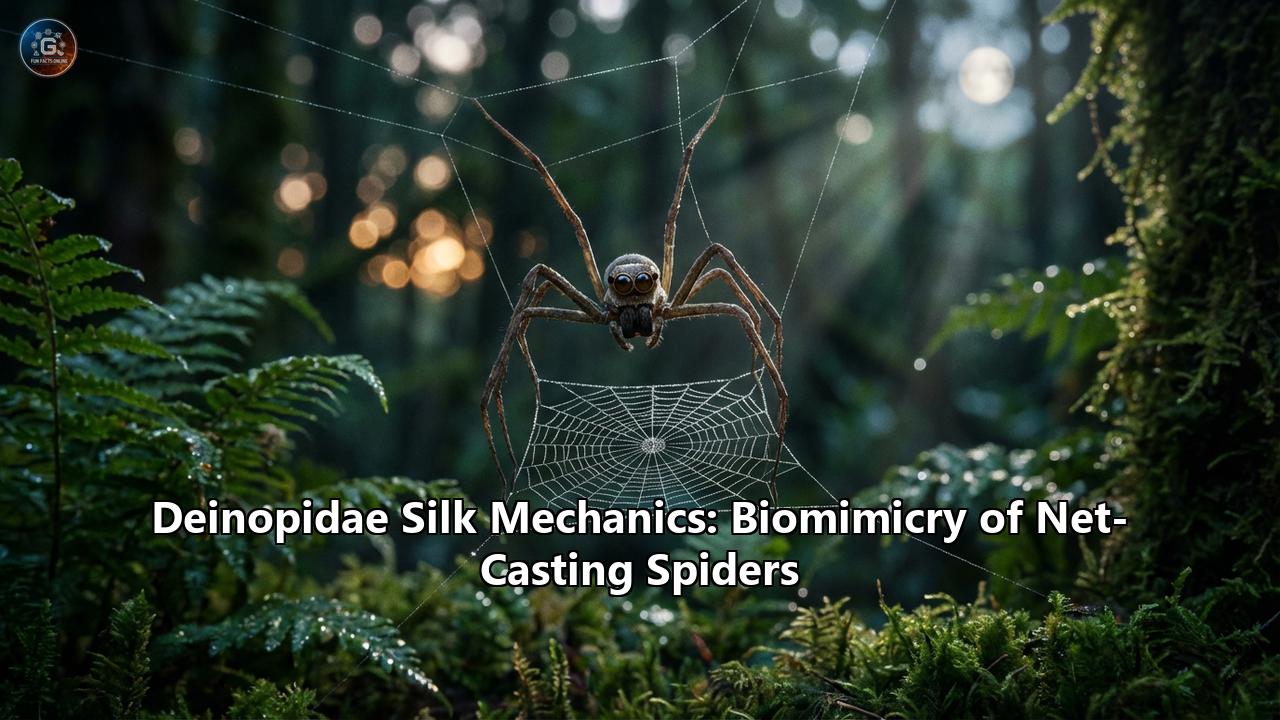
In the deep stillness of a tropical night, an extraordinary predator hangs upside down from a silken trapeze, motionless and virtually invisible. This is the net-casting spider, a member of the family Deinopidae, commonly known as the ogre-faced spider. With its long, twig-like body and exceptional camouflage, it blends seamlessly into the rainforest understory. But when darkness falls, this arachnid abandons its disguise to deploy one of the most astonishing hunting strategies in the animal kingdom. Instead of weaving a passive web and waiting for victims to blunder into it, the net-casting spider actively weaves a rectangular net of highly specialized silk, holds it between its four front legs, and hurls it over unsuspecting prey with explosive speed.
While the spider’s predatory acrobatics are a marvel of biomechanics, the true star of this nocturnal spectacle is the silk itself. For decades, material scientists and engineers have sought to understand how spider silk achieves its legendary balance of strength, elasticity, and toughness. However, the silk of the Deinopidae pushes the boundaries of material science even further. Recent discoveries regarding its nanoscale architecture, its dry-adhesive properties, and its intricate shock-absorbing mechanics have ignited a surge of interest in biomimicry. By decoding the mechanical secrets of the net-casting spider, engineers are unlocking a new era of advanced materials—from revolutionary wound dressings and dynamic body armor to robotic space-debris catchers.
The Architect of the Night: Sensory and Biomechanical Marvels
To understand the immense mechanical demands placed upon deinopid silk, one must first understand the spider’s extreme lifestyle. Net-casting spiders are obligate nocturnal hunters. They detect prey—ranging from walking insects like crickets to flying targets like moths—through a combination of acute hearing and unparalleled vision. Their visual system is dominated by their posterior median eyes (PME), which are the largest simple eyes among all arthropods. Facing forward to maximize light capture, these colossal eyes are up to 2,000 times more sensitive to light than human photoreceptors, and significantly more efficient than the eyes of owls or diurnal jumping spiders. This allows them to track the precise movements of prey in near-total darkness.
Once a target is locked in, the spider executes its strike. Hanging from a non-sticky frame web via a dragline gripped by its hind legs, the spider suspends itself directly over a thoroughfare. It uses its first two pairs of legs to stretch the rectangular capture net. Depending on the location of the prey, the spider will either lunge downward to pin a walking insect or execute a "backward strike" to snatch a flying insect out of the air.
During this violent kinetic event, the spider expands the area of the silken net up to ten times its resting size. The prey is violently entangled, and the spider immediately begins to bite and wrap it. For a material to survive being stretched to ten times its original size in a fraction of a second, while simultaneously absorbing the kinetic energy of a struggling, armored insect, it requires an architectural blueprint that defies conventional engineering trade-offs between strength and elasticity.
The Secret of Cribellate Silk: Dry Adhesion Without Glue
If you touch the web of a common garden spider, you will feel a sticky, wet residue. These spiders are "ecribellate," relying on microscopic droplets of viscous glue to ensnare their prey. The net-casting spider, however, belongs to an ancient lineage of "cribellate" spiders that manufacture a completely dry, glue-free capture silk.
The secret to this dry adhesion lies at the nanoscale. Net-casting spiders possess a specialized spinning organ called the cribellum, a flattened plate located anterior to their spinnerets. The cribellum is covered in thousands of microscopic spigots. From these spigots, the spider extrudes thousands of ultra-fine nanofibrils, some measuring an unimaginably thin 10 to 30 nanometers in diameter—thinner than any synthetic fiber produced by humans, and capable of extreme extensibility.
To process this massive bundle of nanofibrils, the spider uses a specialized comb-like structure on the metatarsus of its fourth pair of legs, known as the calamistrum. As the silk is extruded, the calamistrum vigorously brushes it, teasing the fibrils into a tangled, wool-like structure.
But if there is no glue, how does the net ensnare prey? The answer is rooted in quantum physics: Van der Waals forces. When the incredibly dense network of nanofibrils comes into contact with the surface of an insect, temporary fluctuations in electron distribution create instantaneous dipole moments. These temporary dipoles induce opposite dipoles in the atoms of the insect's exoskeleton. Because the surface area of the millions of tiny combed fibrils is so astronomically high, these weak atomic attractions multiply into an overwhelming adhesive force.
Furthermore, the silk relies on capillary forces. The surface of most insects is coated in microscopic layers of protective cuticular waxes. When the net strikes, the dense nanopores of the cribellate silk act like a sponge, rapidly absorbing the insect’s own protective wax and turning the prey's biological defenses against it to seal the bond.
Because this adhesion relies on nanoscale proximity, it is highly sensitive to the environment. Studies have shown that when cribellate silk is exposed to moisture, the water causes the highly textured "puffs" of nanofibrils to collapse. This reduces the surface area, drastically dropping the stress forces and strain displacements, essentially switching "off" the van der Waals adhesion. The fact that spiders can tune and adapt these silks to function effectively in humid, tropical environments is another feature currently driving intense scientific inquiry.
Mechanical Mastery: The Shock-Absorbing Nanofibers
Creating a net that is sticky is only half the battle; the net must also possess the structural integrity to withstand explosive stretching and the thrashing of heavy prey. Deinopid capture silk is not a monolithic material; it is a highly engineered composite consisting of up to eight distinct silk types. The framework relies on highly extensible "pseudoflagelliform" core fibers, bound together by paracribellate connective fibers, and swathed in the dense cloud of cribellar adhesive nanofibrils.
For years, materials scientists operated under a fundamental paradox: in synthetic materials, high elasticity usually comes at the cost of tensile strength, while strong materials tend to be brittle. In 2026, researchers analyzing the silk of the rufous net-casting spider (Asianopis subrufa) uncovered how nature bypassed this limitation.
Using advanced scanning electron microscopy, researchers discovered a brilliant dual-component design. The core of the thread is made of a highly elastic spidroin protein fiber. Surrounding this elastic core is a secondary system of coiled and looped silk strands, extruded from an entirely different set of silk glands.
When the spider lunges and the web is subjected to massive kinetic force, the elastic core does not immediately take the strain. Instead, the coiled loops enveloping the core gradually straighten out. This progressive unspooling acts as a sophisticated mechanical shock-absorbing system, bleeding off the destructive kinetic energy of the impact and preventing the core from snapping prematurely. Only once these structural loops are fully straightened out does the highly elastic core fiber begin to stretch to its maximum capacity.
This level of customization is a testament to millions of years of evolutionary biological engineering. By separating the components into distinct biological pathways, the spider weaves a composite fiber that vastly outperforms single-material synthetic equivalents.
Biomimicry: Engineering the Future
The revelation of the net-casting spider’s structural and chemical mechanics has opened up highly lucrative avenues in the field of biomimetics—the design of materials and systems modeled on biological entities. By replicating the mechanics of Deinopidae silk, researchers are developing disruptive technologies across multiple industries.
1. Next-Generation Adhesives and Biomedicine
The dry adhesion capabilities of cribellate silk offer a blueprint for creating incredibly strong, glue-free adhesives. Traditional chemical glues degrade over time, leave sticky residues, and can be highly toxic to human tissue. By replicating the 10-to-30 nanometer fibril structure of the net-casting spider’s web, engineers are developing synthetic dry adhesives powered by van der Waals forces.
In biomedicine, this could lead to revolutionary wound dressings and surgical tapes. A bandage mimicking cribellate silk could grip the skin securely without requiring chemical adhesives that trigger allergic reactions or damage fragile tissue upon removal. Furthermore, because the van der Waals adhesion of these structures naturally weakens when wetted, such bandages could be designed to securely hold a wound closed when dry, but release painlessly when exposed to a specific medical solvent or sterile water.
2. Extreme Shock Absorption and Protective Gear
The discovery of the "coiled loop" shock-absorbing system in the silk of Asianopis subrufa is currently reshaping structural engineering and protective textiles.
Imagine synthetic fibers woven into body armor or Kevlar vests. Currently, Kevlar stops bullets through sheer tensile strength, but the blunt force trauma transferred to the wearer can still shatter ribs. By engineering synthetic cables with an elastic core surrounded by coiled, unspooling loops, researchers are conceptualizing armor that can incrementally absorb the kinetic energy of a ballistic impact before relying on the core's tensile strength. This biomimetic principle is also being explored for aerospace applications, such as lightweight shielding for satellites to absorb the impact of micrometeorites, and for automotive crash structures designed to dissipate the energy of high-speed collisions smoothly.
3. Bionic Robotics and Aerial Capture Systems
The net-casting spider is literally inspiring the future of robotics and automated defense. One of the greatest challenges in modern security and aerospace is safely neutralizing non-cooperative flying objects—such as rogue unmanned aerial vehicles (UAVs) trespassing in restricted airspace, or hazardous space debris orbiting the Earth.
Taking direct inspiration from the predatory behavior of Deinopidae, engineers have developed bionic robotic capturing systems. Utilizing advanced optical tracking devices that mimic the extreme motion-sensitivity of the spider's posterior median eyes, these automated drone-interceptors dynamically track targets. Instead of using hard-capture claws that might break or deflect off the target, the interceptor deploys a flexible, highly elastic net—a Tethered Space Net Robot (TSNR)—to entangle the rogue drone or space debris securely. The adaptive algorithms powering these nets are deeply informed by the forward and backward strike mechanics of the spider, ensuring that the net completely closes and avoids catastrophic mechanical failure during the high-speed kinetic capture.
4. Advanced Nanofiber Manufacturing
While the spider’s web is a marvel, the tools it uses to weave it are equally revolutionary. When humans attempt to manufacture nanofibers using a process called electrospinning, the incredibly sticky fibers frequently adhere to the manufacturing machinery, clogging nozzles and halting production.
To solve this, researchers turned their microscopes onto the spider’s calamistrum—the comb used to manipulate the sticky nanoscale threads. They discovered that the calamistrum features a specialized microscopic "ripple" and teeth-like structure that prevents the sticky nanofibers from adhering to the spider’s own legs. By engineering synthetic biomimetic combs with these exact anti-adhesive ripples, manufacturing facilities are now able to seamlessly manipulate, comb, and weave synthetic nanofibers without catastrophic sticking.
5. Smart Wearables and Chromogenic Textiles
With the exponential rise in wearable technologies, there is a push to replace petrochemical-derived synthetic fabrics with smart, sustainable materials. Spider silk biomimetics is leading the charge in developing fabrics that adapt to environmental stimuli.
By analyzing how spider silk blends hydrophobic and hydrophilic properties to survive in fluctuating humid environments, engineers are looking to weave silk-like micro-fibers into smart celluloses. These adaptive fabrics could alter their thermal and moisture-wicking properties based on the wearer's body heat and sweat output. Furthermore, analyzing the crystalline structures of various silks has shown that their specific surface textures interact with light to produce structural colors without the need for toxic chemical dyes. In the near future, "chromogenic fabrics" utilizing micro-scale biomimetic weave structures could provide vibrant, fade-proof clothing that reduces the massive environmental footprint of the textile dyeing industry.
The Genomic Frontier
While we can observe and mimic these structural designs, producing genuine synthetic spider silk at a commercial scale remains a formidable challenge. Spider silk fibers are composed of highly complex, repetitive structural proteins called spidroins. Because spiders are cannibalistic and territorial, they cannot be farmed like silkworms.
Consequently, the focus has shifted to the genetic level. Recent advances in arachnid genomics have prioritized the sequencing of the Deinopidae genomes. By isolating the exact genetic sequences that code for the highly extensible pseudoflagelliform core and the thousands of cribellar nanofibrils, scientists are working to genetically engineer bacteria, yeast, and even plants to mass-produce these miraculous spidroin proteins in industrial bioreactors.
Conclusion
The net-casting spider is a testament to the boundless ingenuity of natural selection. In its quest to secure its next meal in the dark, this unassuming arachnid evolved a hunting mechanism and an architectural material that effortlessly outperforms centuries of human engineering.
From its massive, light-devouring eyes to the microscopic van der Waals interactions of its dry-adhesive silk, every aspect of the Deinopidae is optimized for dynamic, explosive energy management. As material science catches up to biology, the biomimetic applications of the ogre-faced spider's silk are set to revolutionize our modern world. In the delicate, tangled fibers of a rainforest web, we are finding the blueprints for indestructible armor, life-saving medical devices, and robotic sentinels in the sky. Nature has already conducted millions of years of research and development; humanity simply needs to cast a wider net and learn to read the results.
Reference:
- https://grokipedia.com/page/deinopis_spinosa
- https://bugswithmike.com/factsheet/deinopidae
- https://www.ekhbary.com/news/intricate-silk-structures-allow-net-casting-spiders-to-capture-prey-with-unprecedented-strength-and--902-2.html
- https://pmc.ncbi.nlm.nih.gov/articles/PMC6658092/
- https://lkcnhm.nus.edu.sg/wp-content/uploads/sites/11/app/uploads/2017/06/2009nis247-255.pdf
- https://www.frontiersin.org/journals/materials/articles/10.3389/fmats.2020.00029/full
- https://www.researchgate.net/publication/376344995_Design_and_Experimental_Validation_of_a_Bionic_Robotic_Capturing_System_Inspired_by_Net-Casting_Spiders
- https://www.researchgate.net/publication/374625327_Silk_gland_morphology_of_the_net-casting_spider_Deinopis_spinosa
- https://journals.biologists.com/jeb/article/209/16/3131/16224/Unraveling-the-mechanical-properties-of-composite
- https://ec.europa.eu/research/participants/documents/downloadPublic?documentIds=080166e5cd3cbfb4&appId=PPGMS
- https://www.researchgate.net/publication/345149721_Adhesion_of_dry_and_wet_cribellate_capture_silk
- https://pmc.ncbi.nlm.nih.gov/articles/PMC8046689/
- https://www.researchgate.net/publication/384840353_The_Cribellate_Nanofibrils_of_the_Southern_House_Spider_Extremely_Thin_Natural_Silks_with_Outstanding_Extensibility
- https://ec.europa.eu/research/participants/documents/downloadPublic?documentIds=080166e5e0b8a950&appId=PPGMS