
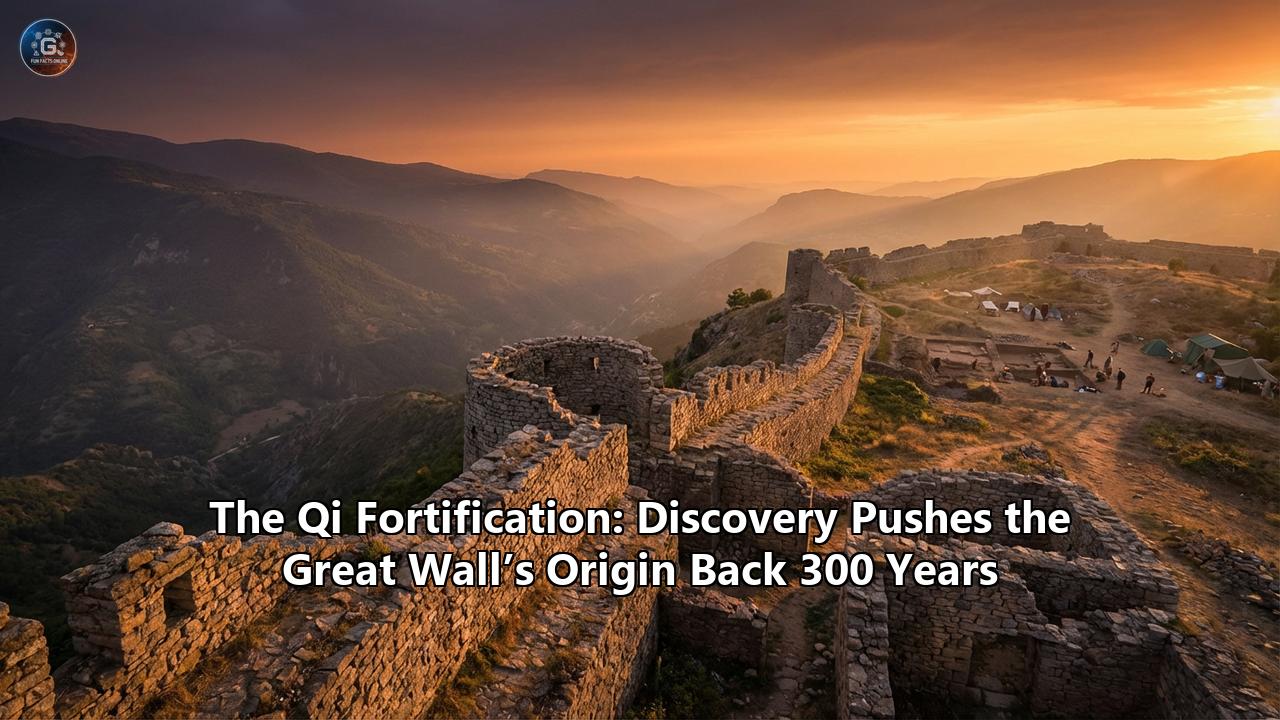
The wind sweeps across the terraced hills of the Taiyi Mountain range in Shandong Province, whistling through the gaps in ancient stone and compacted earth. For millennia, these crumbling ramparts have stood as silent witnesses to the rise and fall of dynasties, known to locals and historians alike as the Great Wall of Qi (齐长城). Long recognized as the oldest existing section of the "Great Wall" concept in China—predating the world-famous Ming Dynasty wall by nearly two thousand years—it was believed to have been born in the fires of the Warring States period, around 441 BC.
But in 2024, the earth gave up a secret that shattered this timeline.
An archaeological excavation in Guangli Village (广里村), within the Changqing District of Jinan, unearthed evidence that has rewritten the history books. Deep beneath the soil, archaeologists discovered rammed earth foundations and artifacts dating back not to the Warring States, but to the late Western Zhou Dynasty (1046–771 BC). This revelation pushes the origin of China’s Great Wall construction back by an astounding 300 years, placing its genesis in an era of myth, bronze, and the very dawn of organized Chinese statehood.
This is the story of that discovery, the ancient empire that built it, and the enduring legacy of the Wall that Time forgot.
---
Part I: The Discovery at Guangli Village
The Dig That Changed History
In the spring of 2024, a team from the Shandong Provincial Institute of Cultural Relics and Archaeology, led by project leader Zhang Su, descended upon the quiet village of Guangli. The site was known to lie along the path of the Qi Great Wall, but for centuries, it was assumed that the visible ruins were the "original" structure. The team’s mission was proactive: to excavate a 1,100-square-meter area to understand the stratification of the wall's construction.
As they peeled back the layers of yellow earth, they found something unexpected. The wall was not a single, monolithic structure built at one time. Instead, it was a palimpsest of history—a layer cake of defensive engineering.
1. The Warring States Layer: The topmost ancient layer corresponded to the known history of the Qi Wall—massive, wide (up to 30 meters), and sophisticated. This was the wall of a superpower state at its peak.
2. The Spring and Autumn Layer: Below that lay a narrower, rougher wall, dating to the era of Duke Huan of Qi (7th century BC).
3. The Western Zhou Layer: At the very bottom, preserved by the crushing weight of the centuries above, lay the shocker. Rammed earth foundations, ash pits, and pottery shards that unmistakably belonged to the Western Zhou Dynasty.
Using Optically Stimulated Luminescence (OSL)—a technique that determines the last time quartz sediment was exposed to sunlight—and Carbon-14 dating on animal bones and plant silica (phytoliths) found in the rammed earth, the scientists confirmed the date. The roots of this wall were laid between 1046 BC and 771 BC.
What Was Found?
The excavation revealed more than just a wall; it revealed a military system.
- Rammed Earth Walls: The earliest sections were about 10 meters wide, built using a primitive but effective technique of pounding soil between wooden frames until it was as hard as stone.
- Semi-Subterranean Barracks: Perhaps the most humanizing discovery was the remains of semi-subterranean houses found beneath and alongside the later wall layers. These square foundations with rounded corners are characteristic of Zhou Dynasty architecture. They likely served as the first garrisons—homes for the soldiers who stood watch on this frontier 3,000 years ago.
- The "Pingyin" Connection: Just 1.5 kilometers north of the wall, the team identified the ruins of Pingyin City. Previously known only from cryptic mentions in ancient texts like the Zuo Zhuan and the Water Classic Commentary, the physical discovery of Pingyin's western city wall (stretching 500 meters) confirmed that the Great Wall of Qi was not an isolated barrier. It was part of a "defense-in-depth" strategy, linked to fortified cities that controlled trade routes and river crossings.
---
Part II: The World of the Western Zhou
To understand why this discovery is so significant, we must transport ourselves back to the 11th century BC. This was not the unified China of the Terracotta Warriors (which would come 800 years later). This was a feudal world, a patchwork of vassal states loyal to the Zhou King in his western capital (near modern-day Xi'an).
The Birth of Qi
When the Zhou dynasty overthrew the corrupt Shang dynasty (c. 1046 BC), the new King Wu distributed land to his most loyal generals and family members. One of the most prized territories—the rich lands of the east, bordering the sea—was given to Jiang Ziya, the legendary strategist and prime minister who had masterminded the Zhou victory.
This territory became the State of Qi (齐).
Jiang Ziya’s Qi was a frontier state. To its east lay the vast ocean; to its south and west lay hostile tribes and rival lords. The discovery at Guangli suggests that the early dukes of Qi didn't just rely on diplomatic treaties for safety. They began digging. They began building.
The Strategic Necessity
Why build a wall so early? The popular image of the Great Wall is a defense against Mongol hordes from the north. But the Qi Wall faces south and west.
- The Threat of Chu: To the south lay the State of Chu, a rapidly expanding power in the Yangtze River valley. The people of the Central Plains considered Chu to be semi-barbarian, a terrifying force of expansion.
- The Threat of Lu and Jin: To the west and southwest lay the states of Lu (Confucius’s home state) and the powerful Jin.
- The "Yi" Peoples: The Shandong peninsula was also home to the Dongyi (Eastern Barbarians), indigenous tribes that the Zhou colonizers had to subdue or assimilate.
The wall was not just a border; it was a statement. It said: "Here ends the chaos; here begins the Order of Qi."
---
Part III: Duke Huan and the Golden Age
While the foundations date to the Western Zhou, the Qi Wall truly became a "Great Wall" during the Spring and Autumn Period (770–476 BC). This era is synonymous with one man: Duke Huan of Qi.
The First Hegemon
Duke Huan was a visionary. With his brilliant prime minister Guan Zhong, he reformed the Qi economy, monopolizing salt and iron, and turning Qi into the wealthiest state in China. His slogan, "Revere the King, Expel the Barbarians" (尊王攘夷), became the rallying cry of the age.
It is highly probable that Duke Huan expanded the early Western Zhou fortifications into a cohesive defensive line. The excavation at Guangli supports this, showing a second, wider layer of construction from this period.
- Strategic Checkmate: In 656 BC, Duke Huan led a coalition of states south to confront the rising power of Chu. The Zuo Zhuan records a famous exchange where the Chu envoy asks, "You live by the North Sea, and we by the South Sea; why are you here?" Duke Huan’s power—backed by his defensive infrastructure—forced Chu to sign a covenant of peace.
The Wall allowed Qi to project power outward while ensuring its heartland—the fertile plains of Shandong—remained untouchable.
---
Part IV: Anatomy of the Ancient Wall
How did they build a structure that would last 3,000 years without modern machinery? The Guangli excavation provides a masterclass in ancient engineering.
The "Hangtu" (Rammed Earth) Technique
The core of the Qi Wall is rammed earth.
1. Formwork: Laborers would construct wooden frames, similar to modern concrete molds, along the desired path.
2. The Mix: Local soil (loess) was mixed with sand, gravel, and sometimes binding agents like sticky rice soup or plant juices (though this is more common in later periods, early binders were likely lime or clay-rich mud).
3. The Ramming: Teams of workers would pour a layer of earth about 10-20 centimeters thick into the frame. Then, using heavy wooden or stone pestles, they would pound the earth until it was compressed to half its original thickness. This process was repeated, layer by layer.
4. The Result: A material almost as hard as concrete. The "tamping" marks are still visible in the cross-sections at Guangli, looking like the rings of a tree.
Mountain-Supported Design
The Qi Wall is unique because it traverses the Taiyi Mountains. The builders followed the principle of "acting according to the terrain."
- The Ridge Line: Where the mountains were steep, the ridge itself served as the wall. The builders would simply use a knife-edge of stone to connect sheer cliffs.
- The Valleys: In the passes and valleys (like at Guangli), they built the thickest, highest walls to plug the gaps.
- Stone vs. Earth: While Guangli is rammed earth (being in the plains/foothills), the higher mountain sections used dry-laid stone, millions of tons of it, quarried directly from the peaks.
---
Part V: Pingyin City – The Forgotten Fortress
The discovery of Pingyin City 1.5km north of the wall changes our understanding of how the wall functioned. It wasn't just a passive barrier; it was an active trap.
The "Defense-in-Depth" Strategy:
If an enemy army (say, the Jin or Chu forces) breached the Great Wall, they would immediately face the fortified city of Pingyin.
- The Kill Zone: The space between the Wall and the City would become a "kill zone" where invaders could be pinned down by archers from the city walls and reinforcements from the Wall's barracks.
- Logistics Hub: Pingyin likely served as the supply depot. The semi-subterranean houses found at the wall site would have been rotated troops, fed and armed by the city.
- Transport Control: The site is near the Yellow River. The Wall and City together acted as a toll gate, controlling the lucrative river trade. This aligns with Guan Zhong’s economic theories—control the flow of goods, and you control the world.
---
Part VI: The Legend of Meng Jiangnu
No article on the Qi Great Wall is complete without the story of Meng Jiangnu (孟姜女). While most tourists associate her with the Ming Dynasty wall near Beijing or the Qin wall, folklore scholars believe the story originated here, in the state of Qi.
The Story:
Meng Jiangnu was a beauty of the Qi state. Her husband, Fan Qiliang, was conscripted to build the Great Wall. When winter came, she packed warm clothes and traveled hundreds of miles to find him. Upon arriving, she was told he had died of exhaustion and was buried inside the wall.
Overcome with grief, she wept at the foot of the wall. Her sorrow was so powerful that the heavens were moved; a section of the wall collapsed, revealing her husband's bones.
The Connection:
The Zuo Zhuan (a history of the Spring and Autumn period) mentions a general of Qi named Qi Liang who died in battle. His wife refused to accept condolences in the suburbs, insisting on a proper rite in the family home. Over centuries, this historical figure (Qi Liang) morphed into the legendary husband (Fan Qiliang), and the "wall" of the city morphed into the Great Wall.
The Guangli discovery adds a poignant layer to this myth. The "semi-subterranean houses" and the grueling labor required to build these rammed earth structures in the 8th century BC provide the brutal reality behind the tears of the legend.
---
Part VII: From Ruins to Renaissance
For centuries, the Qi Great Wall was scavenged. Farmers dug out the nutrient-rich rammed earth to fertilize their fields. Villagers took the stones to build pigsties and houses. In the 1960s and 70s, miles of the wall were flattened for agriculture.
The Turning Point:
In the late 1980s and 90s, China began to recognize the value of its cultural heritage. The Qi Great Wall was inscribed as part of the UNESCO World Heritage "Great Wall" site in 1987.
- 2022 Regulation: In 2022, Shandong Province passed a landmark regulation specifically protecting the Qi Great Wall. It established "no-build zones," mandated local patrols (farmers hired as "Wall Rangers"), and set strict penalties for damaging the ruins.
- Tourism: Today, sections like the Dafeng Mountain segment (near the Guangli dig) are open to tourists. Unlike the crowded Badaling section in Beijing, the Qi Wall offers a "wild" hike. You walk on grass-covered mounds that were once formidable ramparts, looking out over the same valleys Duke Huan surveyed 2,700 years ago.
---
Conclusion: The Wall That Was First
The discovery at Guangli Village is more than just a date change. It fundamentally alters the narrative of Chinese civilization. It proves that the concept of the "Great Wall"—a unified, massive defensive line—was not the invention of the tyrannical First Emperor Qin Shi Huang in 221 BC. It was a concept pioneered by the thinkers and engineers of the Qi State, 500 to 800 years earlier.
It speaks to a civilization that, even in its infancy, possessed the organizational capacity to mobilize thousands of workers, the engineering skill to reshape the landscape, and the strategic foresight to think in centuries rather than seasons.
As the wind blows over the newly excavated pits in Guangli, swirling the dust of the Western Zhou, we are reminded that history is never truly written in stone. It is waiting in the earth, ready to be discovered.
The Great Wall of China is long. But the Great Wall of Qi is deep—deep in time, deep in strategy, and deep in the soul of Chinese history.
Visiting Guide: The Qi Great Wall
- Best Place to See the Ruins: The Dafeng Mountain (大峰山) Scenic Area in Changqing District, Jinan. Here, you can see the stone-built barracks (over 200 of them) and the "Gate of the Wall."
- The Excavation Site: Guangli Village is currently an active archaeological zone. While not open for general tourism, the nearby Qi Great Wall Cultural Park is in development.
- Best Time to Visit: Autumn (September-October) or Spring (April-May) for the best hiking weather and visibility.
- Getting There: High-speed train to Jinan West Station, then a taxi or hired car to Changqing (approx. 40 minutes).
Reference:
- https://www.visitourchina.com/special/china-great-wall/stories-and-legends.html
- https://arkeonews.net/new-evidence-pushes-the-origins-of-the-great-wall-back-by-300-years/
- https://www.popularmechanics.com/science/a63975972/oldest-section-great-wall-of-china/
- https://archaeologymag.com/2025/02/oldest-section-of-chinas-great-wall-discovered/
- https://www.trip.com/travel-guide/attraction/jinan/great-wall-of-qi-changqing-10554211/
- https://www.youtube.com/watch?v=d6S6maOVjv8
- https://www.travelchinaguide.com/china_great_wall/culture/mengjiangnu.htm
- https://en.wikipedia.org/wiki/Rammed_earth
- https://www.archdaily.com/933353/how-rammed-earth-walls-are-built
- https://china1953.wordpress.com/2012/12/14/rammed-earth-structures-chinese-and-western/
- https://www.visitaroundchina.com/Legend_Myth/3317.html
- https://scholarworks.iu.edu/iuswrrest/api/core/bitstreams/d8910f96-a4d0-4c6a-82df-c0fa3f1b2125/content
- https://www.chinadailyhk.com/hk/article/295190
- https://global.chinadaily.com.cn/a/202210/17/WS634cf3afa310fd2b29e7cf16.html
- https://www.sentinelassam.com/more-news/international/regulation-passed-to-protect-great-wall-of-chinas-oldest-section-614718
- http://global.chinadaily.com.cn/a/202210/17/WS634cf3afa310fd2b29e7cf16_2.html
- https://www.synotrip.com/ycy6073/great-wall-qi
- https://www.cits.net/china-travel-guide/jinan/the-great-wall-of-qi-in-changqing.html
- https://www.chipchick.com/2025/02/the-great-wall-of-china-is-300-years-older-than-we-thought
- https://en.wikipedia.org/wiki/Lady_Meng_Jiang