
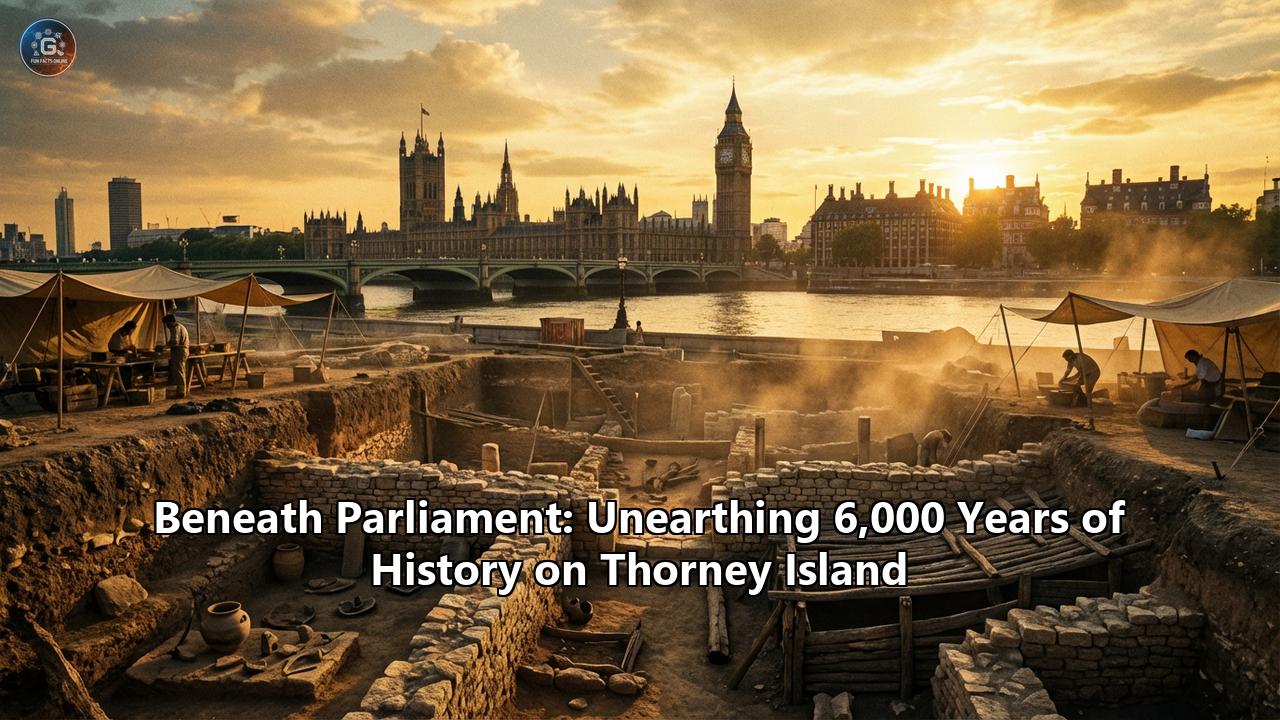
For centuries, the Palace of Westminster has stood as the iconic heart of British democracy, a Gothic Revival masterpiece dominating the London skyline. To the millions of tourists who flock to its gates and the politicians who walk its corridors, it is a symbol of permanence and power. But beneath the Victorian limestone and the medieval beams of Westminster Hall lies a secret history—a narrative written not in Hansard, but in the soil itself.
Recent excavations driven by the massive Restoration and Renewal Programme have peeled back the layers of London’s geology and history, revealing a stunning truth: the political center of the United Kingdom sits atop a site that has been a hub of human activity for 6,000 years. From the flint tools of prehistoric hunter-gatherers to the lost dining halls of medieval kings, the ground beneath Parliament is a time capsule that challenges everything we thought we knew about the origins of Westminster.
This is the story of Thorney Island—the "terrible place" that became the seat of an empire—and the remarkable treasures that have recently been brought to light.
Part I: The Island of Thorns
The Geography of a Lost Landscape
To understand the history of Parliament, one must first forget the modern map of London. Today, Westminster is firmly anchored to the north bank of the River Thames, a seamless part of the urban sprawl. But 6,000 years ago, this area was a wild, untamed wetland.
The site was originally an eyot—a small gravel island formed by the confluence of the River Thames and the now-lost River Tyburn. The Tyburn, rising from the hills of Hampstead, wound its way south, splitting into two distributaries as it reached the Thames. These arms wrapped around a patch of sand and gravel, isolating it from the mainland.
For millennia, this island was known as Thorney Island (Anglo-Saxon Þorn-īeg), named for the dense, impenetrable thickets of bramble and hawthorn that covered it. It was a place apart—marshy, difficult to access, and prone to flooding. An 8th-century charter famously described it as a "terrible place," a description that stands in stark contrast to the "delightful place" it would later become under royal patronage.
It was here, on this sandy rise surrounded by water, that the recent archaeological teams made their most startling discovery.
The First Londoners: The Mesolithic Discovery
During the preliminary boreholes and trial pits dug to assess the foundations for the palace's restoration, archaeologists hit a layer of deep, undisturbed sand. Embedded within this prehistoric beach were over 60 flint flakes and a perfectly preserved shaped tool.
These were not random stones. They were the debris of industry. Analysis placed these artifacts in the Late Mesolithic to Early Neolithic transition period, approximately 4300 BCE. This date is staggering; it predates the construction of Stonehenge by over a thousand years and the Great Pyramid of Giza by nearly two thousand.
Who were the people who left these stones? They were likely semi-nomadic hunter-gatherers who used the river not as a barrier, but as a highway. Thorney Island, with its position at the junction of two rivers, would have been a prime location for fishing, fowling, and hunting the game that frequented the marshes. The discovery of the shaped tool suggests they were camping here, repairing their weapons and processing food.
This find rewrites the preamble of Westminster’s history. It proves that long before it was a seat of kings or a house of laws, this patch of land was a critical survival ground for the first Londoners. It was not merely a swamp to be bypassed, but a destination.
Part II: The Roman Enigma
As we move up through the layers of soil, the silence of the prehistoric era gives way to the bustle of the Roman occupation. Londinium, founded around 47 CE, was centered further east, in what is now the City of London. Westminster has typically been viewed as the rural hinterland of the Roman capital.
However, the recent excavations have added a tantalizing piece to the puzzle: a fragment of a Roman altar.
Dating back roughly 2,000 years, this stone fragment was found reused in the foundations of a later medieval structure. Its presence on Thorney Island raises fascinating questions. Was there a Roman temple here?
Historians have long debated the existence of a Roman ford at Thorney Island. Before the construction of the first London Bridge, the Thames was wider and shallower. The gravel shoals of Thorney Island may have provided a natural crossing point for the Roman Watling Street, the great road running from Dover to the northwest. If a ford existed, it would have been a strategic choke point, likely guarded by a military outpost or a shrine to ensure safe passage.
The discovery of the altar fragment suggests that Thorney Island was not abandoned during the Roman era. Whether it was a sacred site dedicated to a river deity or a waystation for legions marching north, the "terrible place" was already beginning to hold significance.
Part III: The Confessor’s Vision
The Taming of the Island
The transformation of Thorney Island from a briar-choked islet to a center of power began in earnest with the Anglo-Saxons. By the 10th century, a small community of monks had established a foothold here, fighting back the thorns to create a "minster" in the west—Westminster.
Legend tells us that King Canute (Cnut the Great), the Viking king of England, built the first royal residence on the island. It is even whispered that Thorney Island was the setting for the famous story of Canute commanding the tide. While he likely performed this stunt to demonstrate the limits of kingly power to his sycophantic courtiers, the choice of location is telling: a place where the land and the river were in constant battle.
But the true architect of Westminster was King Edward the Confessor.
In the 1040s, Edward made a vow to go on a pilgrimage to Rome. When political instability prevented him from leaving England, the Pope absolved him of his vow on one condition: that he build or restore a monastery dedicated to St. Peter. Edward chose Thorney Island.
To oversee the construction of his grand abbey—the precursor to the current Westminster Abbey—Edward built a royal palace nearby. This decision was fateful. It tethered the monarchy to the church and established Westminster as the dual seat of royal and divine power.
The Divide: City vs. Court
Edward’s move created a unique dichotomy in London that persists to this day. To the east lay the City of London, the center of commerce, trade, and finance. To the west, on Thorney Island, lay the center of court, government, and religion. The road connecting them, the Strand, became the axis upon which London turned.
The archaeological evidence from this period helps us visualize the "delightful place" Edward created. The land was drained, the marshes tamed into fertile fields, and the first stone buildings began to rise, their foundations sinking deep into the prehistoric sands.
Part IV: The Medieval Powerhouse
The Resurrection of the Lesser Hall
One of the most sensational discoveries of the current Restoration and Renewal Programme is the re-emergence of the Lesser Hall.
For nearly two centuries, historians believed that the Lesser Hall (also known as the White Hall) had been completely obliterated. Built in 1167 during the reign of Henry II, this hall was a pivotal structure in the medieval palace complex. It served originally as a private dining hall for the King, a more intimate counterpart to the cavernous Westminster Hall where public business was conducted.
As the centuries passed, the Lesser Hall’s function evolved. It became the home of the Court of Requests, a court of equity that was famously known as the "court of poor men's causes," designed to provide swift and cheap justice to those who could not afford the Court of Chancery.
In 1834, a catastrophic fire ripped through the Palace of Westminster. The standard historical narrative was that the Lesser Hall was a casualty of this blaze, its stones turned to rubble and cleared away by Victorian builders.
But the archaeologists found something different. Hidden beneath the 19th-century architecture were the substantial remains of the Lesser Hall’s walls. Not only had they survived the fire, but evidence showed they had been repaired and incorporated into later buildings, surviving until a final demolition in 1851. Even more remarkably, sections of this medieval stonework had survived a World War II bomb that struck nearby.
This discovery is architectural alchemy. It turns a "lost" building into a tangible reality. We can now trace the footprint of the room where medieval kings dined and where the common people of England once came to beg for royal justice.
A Walk in Their Shoes: The Medieval Artifacts
While the walls tell the story of institutions, the smaller artifacts recovered from the mud tell the story of individuals. Among the most evocative finds was a medieval leather boot, estimated to be around 800 years old.
This was not a peasant's shoe. In the medieval period, footwear was a powerful marker of status. The boot, along with several other shoe soles found in the wet, oxygen-free soil that preserves leather perfectly, speaks to the fashion of the court.
In the 14th and 15th centuries, London saw the rise of the "poulaine" or "cracow"—shoes with ridiculously long, pointed toes. These were the Ferraris of their day; impractical, expensive, and a direct signal that the wearer did not need to perform manual labor. While the specific boot found may not be an extreme poulaine, its quality indicates a person of substance walking the palace grounds.
Alongside the footwear, archaeologists found:
- Floor Tiles: Intricately decorated encaustic tiles, likely from the royal apartments or the chapels. These tiles, with their heraldic and geometric designs, were so beautiful that they actually inspired the Victorian architect Augustus Pugin when he designed the encaustic tiles that line the current Palace corridors. It is a beautiful continuity—the Victorians walking on copies of the floors their ancestors trod.
- A Lead Badge: An ornate badge in the shape of a flowering heart. These were mass-produced in the 14th and 15th centuries, often sold at pilgrimage sites or given as love tokens. Finding one here humanizes the stark history of the palace; perhaps it was dropped by a courtier in a moment of distraction, or lost by a pilgrim visiting the shrine of St. Edward.
Part V: The Great Fire and the Victorian Rebirth
The Catastrophe of 1834
The timeline of Thorney Island is bisected by one date: October 16, 1834.
Workmen were burning tally sticks (ancient wooden accounting devices) in the furnaces beneath the House of Lords. The heat grew too intense, the flues overheated, and within hours, the medieval Palace of Westminster was an inferno. Turner painted it; Londoners watched in awe as the sky turned orange. By morning, most of the complex was a smoking ruin. Only Westminster Hall, the Jewel Tower, and the Undercroft Chapel survived.
The Stonemasons’ Pipes
The rebuilding of the Palace was the greatest architectural project of the 19th century. Charles Barry and Augustus Pugin created the Neo-Gothic wonder we see today. The recent excavations have provided a glimpse into the workforce that built it.
Archaeologists recovered fragments of clay tobacco pipes dating to the mid-19th century. These were the disposable vapes of the Victorian era—cheap, fragile, and sold pre-stuffed with tobacco. They were likely smoked by the stonemasons, carpenters, and laborers who spent decades erecting the new Houses of Parliament.
One can imagine a mason taking a break from carving the intricate limestone detailing, leaning against a half-finished wall, smoking his pipe, and then tossing the broken stem into the rubble fill—unaware that 150 years later, it would be cataloged as a historical treasure.
The Mystery of Geo Painter
One of the most charming finds is a ceramic beer jug inscribed with the name "Geo Painter."
Research suggests George Painter was the landlord of a nearby tavern. The presence of this jug on the parliamentary estate paints a vivid picture of Victorian labor. The rebuilding of Parliament was thirsty work. It was common practice for "pot boys" from local pubs to run beers to construction sites.
This jug connects the high politics of Parliament with the street life of Victorian London. It reminds us that the Palace was built not just by architects and lords, but by men who needed a pint of porter at the end of a long shift.
Part VI: The Science of the Deep
Archaeology in a Living Building
Conducting an archaeological dig in a cow pasture is difficult; conducting one underneath a functioning parliament in the middle of a World Heritage Site is an engineering high-wire act.
The discoveries described above were made possible by the Restoration and Renewal Programme, a multi-billion pound project to save the crumbling palace. The building is sinking, its mechanical services are obsolete, and its fire safety is compromised.
To plan the restoration, engineers needed to understand the ground conditions. This involved drilling boreholes up to 70 meters deep and sinking trial pits in basements, courtyards, and even the river terrace.
The team used Ground Penetrating Radar (GPR) and advanced 3D Building Information Modeling (BIM). They created a "digital twin" of the palace, mapping every void and wall. When they drilled, they did so with surgical precision, often working in confined spaces with low ceilings, hand-digging layers of history while MPs debated legislation just floors above them.
The conditions were challenging. The water table on Thorney Island is high—it is, after all, still an island at heart. The wet soil, however, is a blessing for archaeologists. It creates anaerobic (oxygen-free) conditions that preserve organic materials like wood, leather, and seeds that would otherwise rot away. This is why the medieval boot and the prehistoric flint tool handles survived in such remarkable condition.
The Tier 1 Priority
The Palace of Westminster sits within a Tier 1 Archaeological Priority Area. This designation means it is recognized as one of the most sensitive and significant archaeological sites in London. Every spade put into the ground must be watched.
The current work is just the beginning. As the full restoration project gets underway (likely involving the temporary relocation of Parliament), much larger areas will be excavated. Archaeologists expect to find more: perhaps the foundations of Saxon churches, lost wharves from the medieval riverfront, or even more evidence of the prehistoric people who called Thorney Island home.
Conclusion: The Continuity of Thorney Island
The 6,000-year narrative of Thorney Island is one of extraordinary continuity.
- 4300 BCE: A gathering place for people to exploit the resources of the river.
- 47 CE - 400 CE: A strategic crossing point for an empire.
- 1040s: A spiritual and royal center for the Anglo-Saxons.
- 1100s - 1800s: The engine room of medieval and early modern law and government.
- Today: The democratic heart of a modern nation.
The recent discoveries remind us that the Palace of Westminster is not just a building; it is a layer cake of civilization. The MPs of today stand on the shoulders of Victorians, who built on the ruins of medieval halls, which were raised on Saxon earth, which covered Roman stones, all resting on the sand where a Neolithic hunter once sat to sharpen a piece of flint.
Thorney Island may no longer be visible, its thorns cleared and its rivers buried in pipes, but its legacy is undeniable. Beneath the feet of power, the history of Britain is still waiting to be read.
Reference:
- https://archaeologymag.com/2025/11/history-beneath-the-palace-of-westminster/
- https://thethorneyislandsociety.org.uk/ttis/index.php/thorney-tales/35-thorney-tales-2-the-river-tyburn
- https://en.wikipedia.org/wiki/Thorney_Island_(Westminster))
- https://en.wikipedia.org/wiki/River_Tyburn
- https://bdcmagazine.com/2025/11/6000-years-of-history-unearthed-beneath-the-houses-of-parliament/
- https://www.restorationandrenewal.uk/news/6000-years-history-unearthed-beneath-houses-parliament
- https://en.wikipedia.org/wiki/New_Palace_Yard
- https://news.artnet.com/art-world/palace-of-westminster-dig-6000-years-history-2720582
- https://en.wikipedia.org/wiki/History_of_the_Palace_of_Westminster
- https://www.cambridge.org/core/journals/journal-of-british-studies/article/halls-of-power-changing-political-and-administrative-culture-at-the-palace-of-westminster-in-the-sixteenth-century/73AFEA6818E30B41E54C7E737259FE7E
- https://www.parliament.uk/about/living-heritage/building/palace/estatehistory/the-middle-ages/oldandnewpalaceyards-/
- https://www.battlemerchant.com/en/blog/shoe-styles-through-the-ages-rome-and-the-middle-ages
- https://www.battlemerchant.com/en/blog/shoes-in-the-middle-ages-function-and-status
- https://www.battlemerchant.com/en/blog/medieval-shoes-the-fashion-from-bundschuhe-to-poulaines
- https://thethorneyislandsociety.org.uk/ttis/index.php?start=90