
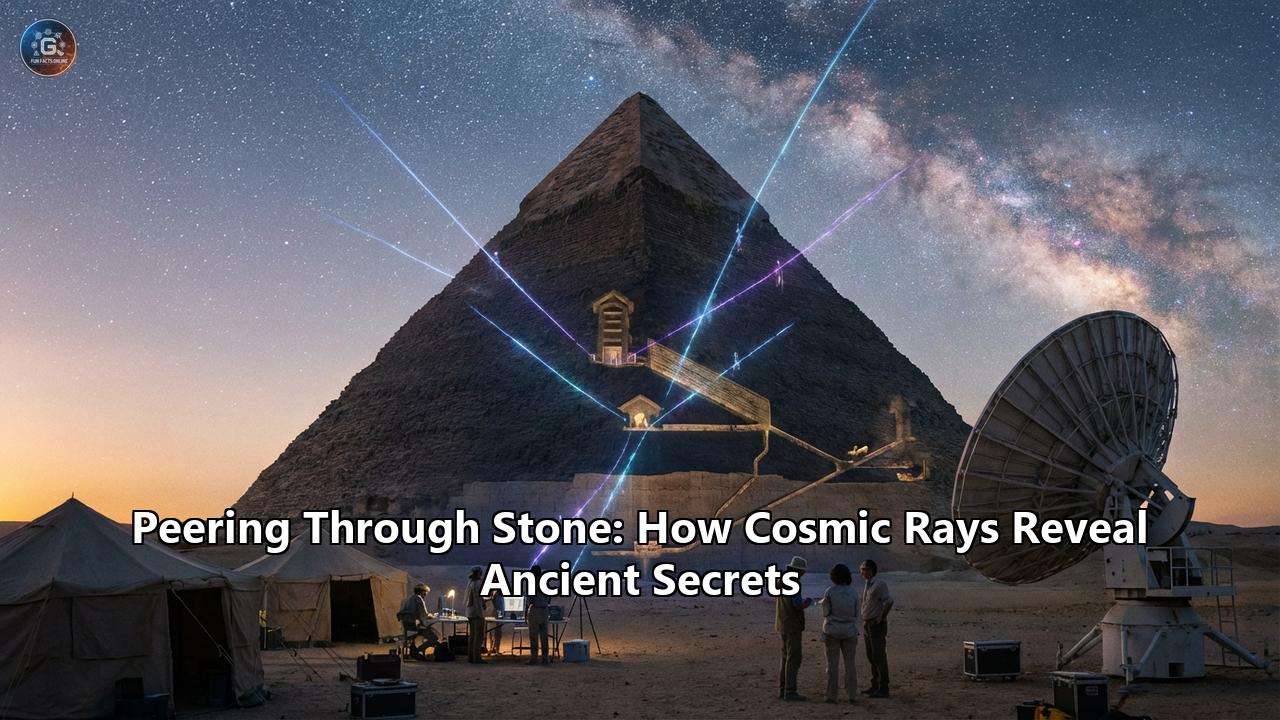
The dust of the desert has settled, but the questions remain. For millennia, the Great Pyramid of Giza has stood as a silent sentinel, a geometric mountain of limestone concealing the ambitions of a god-king. We have measured it, climbed it, and speculated endlessly about its purpose. But until recently, we could only scratch the surface. To see inside, to truly know what lies behind those millions of tons of stone, would require a power we didn't possess—or so we thought.
As it turns out, the universe has been raining the key down upon us all along. Every second, ghost-like particles from deep space pass through your body, through your home, and through the solid bedrock of the Earth. They are called muons, and they are the cosmic keys that are finally unlocking the ancient world.
This is the story of how particle physics crashed into archaeology, revealing secret chambers in Egypt, hidden tunnels in Mexico, and the fiery heart of volcanoes. It is a story of "peering through stone," where the most advanced technology of the 21st century is helping us read the lost chapters of human history without lifting a single shovel.
Part I: The Cosmic Rain
To understand how we can see through a pyramid, we must first look up. Far beyond our solar system, cataclysmic events—supernovae explosions, colliding black holes, the violent churning of active galactic nuclei—act as the universe's particle accelerators. They blast protons and atomic nuclei across the cosmos at near light-speed. These are cosmic rays.
For eons, they travel through the vacuum of space. When they finally collide with Earth's atmosphere, they smash into nitrogen and oxygen atoms, triggering a subatomic cascade. This collision shatters the atmospheric atoms, creating a shower of short-lived particles: pions and kaons. These decay almost instantly into muons.
The Ghost Particle
The muon is a heavy cousin of the electron—about 207 times more massive. But unlike the electron, which is content to orbit an atomic nucleus, the muon is a traveler. Because of its high mass and lack of strong nuclear interaction, it doesn't get easily stopped.
- Alpha particles (helium nuclei) can be stopped by a sheet of paper.
- Beta particles (electrons) can be stopped by a sheet of aluminum.
- Gamma rays can be stopped by lead.
- Muons can punch through hundreds of meters of solid rock.
They rain down on the Earth constantly. Approximately 10,000 muons pass through every square meter of the Earth's surface every minute. They are passing through you right now. You cannot feel them, see them, or hear them. But if you have the right eyes—the right detectors—you can use them to see the invisible.
Shadows in the Stone
The principle of muon radiography (or muography) is elegantly simple. It is effectively an X-ray for mountains.
When you get an X-ray at the doctor’s office, a machine shoots radiation through your body. Your bones, being dense, absorb more X-rays than your soft tissue. The film behind you records the "shadow" of your skeleton.
Muography works the same way, but the source is the sky, and the "film" is a detector placed below or beside the object you want to scan.
- The Source: The cosmic muon rain is uniform and constant.
- The Object: A pyramid, a volcano, or a sealed container.
- The Absorption: As muons pass through the object, some are absorbed or deflected by the atoms in the material. The denser the material (like granite), the more muons are stopped. The less dense (like a hollow cavity or air), the more muons pass through.
- The Image: A detector counts the number of muons arriving from different angles. If the detector sees a "hot spot" with more muons than expected coming from a specific direction, it means there is less matter in that path—a void. If it sees a "cold spot," it means there is something incredibly dense blocking the way.
It is a passive, non-destructive technique. We don't need to drill holes or set off explosives. We just have to be patient. Because muons are random and relatively sparse compared to the flood of photons from an X-ray machine, building a high-resolution image can take weeks or even months of exposure time. But for a monument that has waited 4,500 years, a few months is a blink of an eye.
Part II: The Physicist Who X-Rayed a Pharaoh
The marriage of high-energy physics and archaeology began not in the 21st century, but in the swinging sixties. The visionary was Luis Alvarez, a Nobel Prize-winning physicist from the University of California, Berkeley. Alvarez was a man of big ideas—he would later become famous for the hypothesis that an asteroid impact killed the dinosaurs. But in 1965, his sights were set on Giza.
Alvarez was bothered by a mystery surrounding the Pyramid of Khafre, the second-largest at Giza. While the Great Pyramid of Khufu was riddled with complex chambers and corridors, Khafre’s pyramid appeared strangely solid, with only one simple known chamber at the base. "It seemed to me unlikely," Alvarez mused, "that Chephren [Khafre] would have built a pyramid of the same size as his father's without the complex internal structure."
He proposed a daring experiment: place a cosmic ray detector inside the known burial chamber of Khafre’s pyramid and "look up." If there were hidden chambers above, the detector would record a surplus of muons coming from that direction.
The 1968 Experiment
It was a logistical nightmare. Alvarez and his team had to build a spark chamber—a device that creates visible electrical sparks along the path of a particle—that could withstand the humidity and dust of an ancient tomb. They installed it deep in the limestone belly of the pyramid.
For months, the equipment hummed in the silence of the tomb, recording the silent rain of particles on magnetic tape. The data was flown to Cairo and then to Berkeley for analysis by IBM computers—cutting-edge tech for the time.
The result? Nothing.
The "muon X-ray" showed that the Pyramid of Khafre was solid. There were no secret chambers, no hidden treasuries above the Belzoni Chamber.
While some might call this a failure, it was a scientific triumph. Alvarez had proven that the technique worked. He had successfully scanned millions of tons of rock and proved a negative—a notoriously difficult thing to do in archaeology. He established a baseline: cosmic rays could peer through stone.
The field then went dormant for decades. The detectors were too bulky, the electronics too slow, and the computers too weak to handle complex 3D reconstruction. But the idea didn't die. It just waited for technology to catch up.
Part III: The ScanPyramids Revolution
Fast forward to October 2015. A new international coalition called ScanPyramids was launched, bringing together the Egyptian Ministry of Antiquities, the HIP Institute of France, and physicists from Japan’s Nagoya University and KEK. Their mission: to apply modern particle physics to the Old Kingdom pyramids.
The technology had evolved massively since Alvarez’s day. We now had:
- Nuclear Emulsion Plates: Like photographic film but for particles. They are ultra-precise, electricity-free, and can be placed in tight crevices.
- Scintillator Detectors: Plastic panels that light up when a muon hits them, allowing for real-time electronic counting.
- Gas Detectors: Telescopes that track the trajectory of muons with high angular precision.
The team started with the Bent Pyramid at Dahshur to calibrate their equipment. The results were crystal clear. They could see the internal structure of the chambers perfectly. Emboldened, they moved to the big prize: The Great Pyramid of Khufu.
The Discovery of the Century
The Great Pyramid is a labyrinth. It contains the King’s Chamber, the Queen’s Chamber, the Grand Gallery, and the Subterranean Chamber. But architects have long suspected there might be more.
The team placed muon detectors in the Queen’s Chamber and outside the pyramid. They waited. They collected data. And then, they saw anomalies.
1. The North Face Corridor (2016)The first hit came from the north face. Behind the massive chevrons that mark the original entrance, the muons revealed a void. It wasn't just a crack; it was a corridor. In 2023, endoscopic cameras were finally snaked into a small gap, confirming the muon data: a pristine, gabled corridor, 9 meters long, that no human had seen for 4,500 years. Its purpose is still debated—likely a relieving structure to distribute the weight of the massive stones above the entrance—but the accuracy of the muons was undeniable.
2. The Big Void (2017)The second anomaly was shocking.
High above the Grand Gallery—the magnificent, cathedral-like sloping hall in the center of the pyramid—the detectors began to pick up a massive "shadow of nothing." A huge surplus of muons was coming from a region where there should have been solid stone.
They cross-checked. They used different detectors. They invited independent teams to verify the data. The conclusion was inescapable.
There is a cavity, at least 30 meters (100 feet) long, situated directly above the Grand Gallery. It is dubbed the "ScanPyramids Big Void."
It is the first major structure found in the Great Pyramid since the 19th century.
- Is it a second Grand Gallery? The dimensions are eerily similar.
- Is it a construction ramp? Some theories suggest an internal ramp was used to haul blocks to the top.
- Is it a relieving chamber? A structural gap to protect the gallery below from collapsing?
We still don't know what it is, because there are no corridors connecting to it. It is a sealed pocket of time. But we know it is there. The muons have proven it.
The discovery sent shockwaves through the world. It validated muography as a primary tool for heritage science. It wasn't just a neat trick; it was a way to rewrite history books.
Part IV: Beyond Egypt – A Global X-Ray
The success at Giza ignited a global gold rush. Archaeologists and physicists began looking at other opaque monuments around the world, realizing that many "solid" structures might not be solid at all.
Mexico: The Pyramid of the Sun
At the ancient city of Teotihuacan, north of Mexico City, stands the colossal Pyramid of the Sun. Unlike the Egyptian pyramids, which are built of cut stone blocks, this Mesoamerican giant is a mound of earth, rubble, and adobe faced with stone.
In the 2010s, a team led by Arturo Menchaca-Rocha from the National Autonomous University of Mexico (UNAM) decided to follow in Alvarez’s footsteps. They were lucky: there was already a tunnel running under the pyramid (excavated in the 1930s). They installed a muon detector in this tunnel, effectively "looking up" through the entire bulk of the pyramid.
Their goal was to find a royal tomb. Teotihuacan is a city without a history—we don't even know what its builders called themselves (the Aztecs named it "City of the Gods" centuries later). Finding a ruler's tomb would be the Rosetta Stone of Mesoamerican archaeology.
After years of data collection, the results were mixed but fascinating. They identified a low-density region on the south side of the pyramid. Was it a collapsed chamber? A pile of loose rubble? The data suggested a structural weakness or a void, possibly looted centuries ago or perhaps a chamber filled with lighter soil. While they haven't yet found a "King of Teotihuacan," the project proved that muography could work even on the messy, chaotic internal structure of an earthen pyramid.
China: The XiXia Imperial Tombs
In the steppes of Ningxia, China, lie the beehive-shaped tombs of the Western Xia dynasty (1038–1227 AD). These unique earthen mausoleums have been eroded by time and weather.
Recently, Chinese researchers applied muon transmission imaging to the No. 2 Mausoleum. Their results, published in the mid-2020s, identified density anomalies consistent with a burial chamber. The scan revealed the internal structure of the rammed earth, distinguishing between the compacted soil of the tomb and the surrounding loose earth. This non-invasive peek allows conservators to understand the structural integrity of these fragile monuments without risking a collapse by digging.
Naples: The City Below the City
Naples, Italy, is a layer cake of history. Beneath the modern chaotic streets lies a Greco-Roman city, and beneath that, a labyrinth of tuff caves, cisterns, and tunnels.
The Mt. Echia project took muon detectors underground. Unlike pyramids where you look up, here they looked sideways and through the hills. The project successfully mapped the known aqueducts and tunnels of the Bourbon period.
But more excitingly, they found hints of unknown voids. In a city as dense as Naples, drilling blindly is dangerous. Muography provides a "treasure map" for urban speleologists, pointing them toward lost hypogea (underground chambers) that have been sealed for centuries.
Jerusalem: The City of David
In one of the most politically and religiously sensitive archaeological sites on Earth, digging is often impossible. In the City of David, researchers recently used underground muon detectors to scan the bedrock from within ancient cisterns. They successfully mapped the "Jeremiah’s Cistern" area, identifying ventilation shafts and voids in the overburden. This application is crucial: it allows archaeology to proceed in places where excavation is forbidden due to modern structures or religious sensitivities.
Part V: The Breathing Earth – Volcano Muography
While archaeologists look for the dead, geophysicists are using muons to save the living.
A volcano is essentially a geological pyramid—a conical mountain with complex internal plumbing. Understanding that plumbing is the key to predicting eruptions.
Traditional monitoring uses seismometers (to hear rock cracking) and GPS (to see the ground swelling). But these are indirect. They tell you the volcano is moving, but not what is moving. Is it magma? Is it gas? Is it just groundwater?
Muons can tell the difference.
Magma is dense. Gas is light.
If you place a muon detector on the side of a volcano and look through the cone, you can see the magma conduit.
Japan and the Caribbean
Japan has been a pioneer in this field. Researchers at the University of Tokyo successfully imaged the internal structure of Mount Asama and Mount Unzen.
- The Plug: They could see the dense "lava plug" blocking the vent.
- The Rise: By taking continuous images (timelapse muography), they could watch the density change over time. If the conduit gets denser, magma is rising. If it gets lighter, the magma is draining or gas is building up.
In the Caribbean, the Diaphane project monitored the Soufrière Hills volcano in Guadeloupe. The muon scans revealed the hydrothermal system inside the dome—the boiling cauldron of water and gas that often triggers explosive steam eruptions. This "X-ray vision" gives civil defense authorities a crucial new data point. Instead of guessing if the pressure building up is dangerous magma or just steam, they can see the density changes in real-time.
Vesuvius: The Sleeping Giant
Perhaps the most high-stakes application is the MURAVES project at Mount Vesuvius. Vesuvius is the most dangerous volcano in Europe, with millions of people living in its shadow. The project uses large muon telescopes to peer into the "Great Cone." The goal is to define the shape of the interface between the volcanic rocks and the sedimentary basement—to understand the structural stability of the volcano. If Vesuvius wakes up, these muon eyes will be the first to know if the magma is breaking through new pathways.
Part VI: Industrial Vision and Future Security
The cosmic key is not just for ancient stones and mountains. It has become a valuable tool for modern industry. The spin-off technologies from these scientific experiments are now commercial realities.
Mining the Depths
Finding minerals is expensive. You have to drill hundreds of boreholes, which is costly and environmentally damaging. Enter companies like Ideon Technologies. They have miniaturized muon detectors to fit inside standard boreholes.
By lowering a string of detectors down a hole, they can scan the rock between holes.
- Uranium: In Saskatchewan's McClean Lake, they successfully imaged high-grade uranium deposits 200 meters underground. The uranium ore is much denser than the surrounding sandstone, showing up as a dark shadow in the muon data.
- Block Caving: In the New Afton gold and copper mine, detectors monitor the movement of rock deep underground. Block caving involves undercutting an ore body and letting it collapse under its own weight. It is a controlled earthquake. Muons allow engineers to "see" the cave shape and ensure the rock is falling predictably, preventing catastrophic collapses that could kill miners.
Guardians of the Atom
Perhaps the most vital modern application is in nuclear security.
Special Nuclear Material (uranium-235 and plutonium) is incredibly dense. It is also easy to shield from normal radiation detectors using lead. But you cannot shield against muons.
In fact, lead makes the signal stronger.
Why? Because of Muon Scattering Tomography.
When a muon hits a heavy atom like uranium or lead, it doesn't just stop; it scatters (changes direction).
Detectors placed above and below a truck or shipping container can track the path of every muon. If the muons suddenly make sharp angles in the middle of a cargo of bananas, you know there is something heavy and dangerous hiding there.
This technology is now being deployed at borders and ports. It is passive, safe for humans (no added radiation), and impossible to fool. It is also being used to inspect Dry Storage Casks—the concrete and steel silos where spent nuclear fuel is stored. Inspectors can use muons to verify that the fuel bundles are still inside without ever opening the radioactive seal.
Infrastructure Health
Bridges, dams, and tunnels age. Concrete cracks and steel rusts.
In Japan, muography was used to inspect the Karasu River Sabo Dam. The scan revealed regions where the concrete had degraded and "cement release" had occurred, creating low-density weak spots that were invisible from the surface.
This offers a future where our crumbling infrastructure can be continuously monitored by silent, passive boxes, warning us of a bridge failure long before the first crack appears to the naked eye.
Part VII: The Future of the Invisible
We are still in the infancy of this technology. The detectors are getting smaller, cheaper, and more sensitive.
- AI and Machine Learning are being applied to the data, cleaning up the "noise" and creating sharper 3D images faster than ever before.
- Next-Gen Detectors: New materials like portable "resistive plate chambers" are making it possible to backpack a muon detector into the jungle or up a mountain peak.
We stand on the brink of a new era of exploration. There are thousands of unexcavated tumuli in Turkey, sealed kofun tombs in Japan, and overgrown temples in the Amazon that have never been opened. With cosmic ray muons, we can explore them all without disturbing a grain of dust.
The Philosophical ShiftThere is something profound about using the stars to read the earth.
For centuries, archaeology was a destructive science. To know what was in the tell, you had to dig it up. To find the mummy, you had to break the seal.
Muography changes the paradigm. It allows us to respect the sanctity of the seal. We can know the geometry of the tomb of the First Emperor of China (which remains unexcavated due to fears of damaging the mercury rivers inside) without exposing it to the air. We can map the structural health of the Dome of Santa Maria del Fiore in Florence without drilling into Brunelleschi’s brickwork.
We are entering the age of Transparent History.
The Great Pyramid has held its breath for 4,500 years. The ScanPyramids Big Void hangs in the darkness, a ghost chamber waiting for a name. We may not enter it in our lifetime. We may never walk its floor. But thanks to the invisible rain from the cosmos, we know it is there.
The stone is no longer opaque. The past is no longer silent. All we had to do was stop looking with our eyes, and start looking with the universe's own light.
Glossary of Terms
- Cosmic Ray: High-energy protons and atomic nuclei moving through space at nearly the speed of light.
- Muon: An unstable subatomic particle of the lepton class, similar to an electron but 207 times heavier.
- Muography (Muon Radiography): An imaging technique that uses the absorption or scattering of cosmic ray muons to create density maps of large objects.
- Scintillator: A material that exhibits luminescence (emits light) when excited by ionizing radiation, used to detect muons.
- Spark Chamber: A historical particle detector that makes the path of a particle visible as a trail of electrical sparks.
- Nuclear Emulsion: A photographic plate with a very thick emulsion layer, capable of recording the tracks of charged particles with high precision.
- Big Void: A large, previously unknown cavity discovered in the Great Pyramid of Giza by the ScanPyramids project in 2017.
Reference:
- https://www.osti.gov/biblio/22991850
- https://ideon.ai/post/2023/05/17/ideon-delivers-worlds-first-borehole-muon-tomography-results/
- https://www.eri.u-tokyo.ac.jp/people/ht/MUOGRAPHERS16/General-Assembly/PPT/Imaging%20underground.pdf
- https://www.researchgate.net/publication/303376825_A_study_of_using_cosmic-ray_muon_radiography_to_detect_CO2_leakage_from_a_primary_storage_into_geological_formations
- https://www.youtube.com/watch?v=TrvywYOU81c
- https://pmc.ncbi.nlm.nih.gov/articles/PMC6335304/
- https://www.researchgate.net/publication/290309451_Searching_for_cavities_in_the_teotihuacan_pyramid_of_the_sun_using_cosmic_muons
- https://pmc.ncbi.nlm.nih.gov/articles/PMC10570126/
- https://www.researchgate.net/publication/386206869_Research_on_ground_penetrating_radar_and_Muon_detection_method_in_Xixia_Mausoleum
- https://opus4.kobv.de/opus4-bam/frontdoor/deliver/index/docId/56322/file/NDT-CE_2022_paper_Niederleithinger_20220627.pdf
- https://royalsocietypublishing.org/doi/pdf/10.1098/rsta.2018.0057
- https://pmc.ncbi.nlm.nih.gov/articles/PMC11350125/
- https://www.innovatebc.ca/blog/ideon-technologies-is-leading-the-transition-to-sustainable-mining
- https://ideon.ai/
- https://www.napolisotterranea.org/en/underground-x-rays-of-naples-muon-project-to-uncover-disruptions/
- https://www.google.com/search?q=time+in+Naples,+IT
- https://smallcaps.com.au/article/ideon-technologies-muon-tomography-global-transition-low-cost-mining
- https://research.engr.oregonstate.edu/yang/muon-tomography-system
- https://www.mdpi.com/2410-390X/6/4/77
- https://www.researchgate.net/figure/Diagrams-of-different-positions-of-the-detector-in-the-muon-detection-simulation_fig4_394576622
- https://www.researchgate.net/figure/Modeling-diagram-of-the-XiXia-imperial-tombs-a-Front-view-of-the-modeling-diagram-of_fig2_394576622