
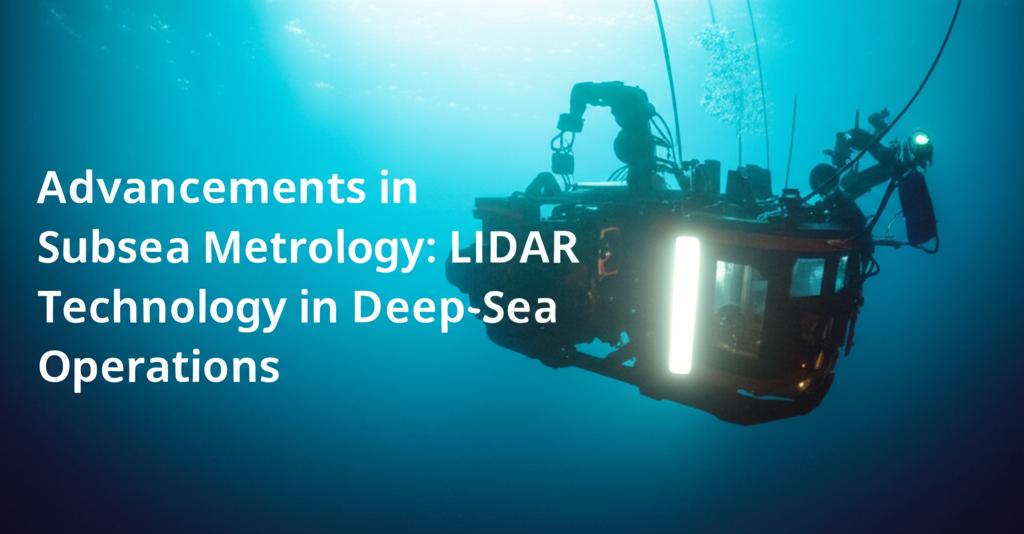
Subsea Light Detection and Ranging (LiDAR) technology is significantly transforming deep-sea operations by providing unprecedented accuracy and detail in underwater surveying and measurement. This technology utilizes laser light to generate high-resolution 3D maps of subsea environments, offering considerable advantages over traditional sonar systems.
Key Advancements and Capabilities:- High-Resolution Imaging: Subsea LiDAR can capture details at the millimeter to centimeter level, creating precise 3D models of underwater structures, geology, and marine habitats. This is crucial for tasks like inspecting pipelines for corrosion or deformation, assessing seabed morphology, and identifying marine archaeological sites.
- Rapid Data Collection: Compared to conventional methods like ROV visual inspections or sonar, LiDAR allows for significantly faster survey speeds, improving operational efficiency and reducing costs. Some systems can complete scans and deliver data within hours.
- Versatility in Deployment: LiDAR systems can be integrated onto various platforms, including Remotely Operated Vehicles (ROVs), Autonomous Underwater Vehicles (AUVs), and diver-deployed frames. This flexibility allows for surveys in a wide range of water depths and often inaccessible locations.
- Improved Performance in Turbid Waters: LiDAR can perform well even in murky waters where other optical systems might struggle, enhancing its an_ESplicability in diverse underwater conditions.
- Enhanced Data Processing and Real-Time Capabilities: Advancements in algorithms and data processing now allow for quicker, sometimes near real-time, analysis and generation of 3D maps. This facilitates faster decision-making for offshore operations.
- Extended Operational Depths: Ongoing research and development are pushing the operational depth limits of underwater LiDAR, making it increasingly viable for deep-sea exploration and industrial applications. Some systems are already rated for depths of several thousand meters. For instance, a recent project by 3D at Depth for TotalEnergies involved a LiDAR spool metrology at a depth of 1,350 meters.
- Integration with Other Technologies: LiDAR is increasingly being combined with other sensor technologies to provide more comprehensive subsea data. This includes integration with sonar and camera systems on ROVs and AUVs.
- Digital Twin Integration: The high-resolution data captured by subsea LiDAR is invaluable for creating and updating digital twins of underwater assets. These digital models allow for ongoing monitoring, simulation, and predictive maintenance.
Subsea LiDAR technology has a wide array of applications, including:
- Offshore Energy: Inspecting and monitoring subsea infrastructure such as pipelines, wellheads, and platforms for integrity, deformation, and damage. It is also used for precise metrology for tasks like spool-piece fabrication and installation.
- Marine Science and Archaeology: Mapping deep-sea ecosystems, coral reefs, hydrothermal vents, and underwater archaeological sites with high detail. This aids in understanding marine biology, geology, and preserving underwater cultural heritage.
- Environmental Monitoring: Detecting and identifying substances like oil spills or dissolved CO2 through specialized LiDAR systems (e.g., single-photon Raman LiDAR). It also helps in assessing the environmental impact of offshore activities.
- Defense and Security: Used for underwater surveillance, object detection, and mapping for defense purposes.
- Sensor Miniaturization: Efforts are underway to develop smaller, lighter, and more power-efficient LiDAR sensors. This will enable integration into a broader range of underwater vehicles, including smaller AUVs, making surveys more flexible and cost-effective.
- AI-Powered AUVs: The development of AI-powered AUVs equipped with LiDAR is paving the way for fully autonomous subsea surveys, further enhancing efficiency and data collection capabilities.
- Next-Generation Systems: Companies and research institutions are collaborating to create next-generation subsea LiDAR systems with enhanced capabilities, such as wider swath coverage, higher pulse rates, increased point density, and improved performance in challenging deep-ocean environments. For example, the Monterey Bay Aquarium Research Institute (MBARI) is working with 3D at Depth (now part of Kraken Robotics) to develop a next-generation subsea LiDAR customized for marine science, aiming for centimeter-scale resolution and suitability for AUV deployment.
- Focus on Efficiency and Reduced Environmental Impact: Recent projects highlight the efficiency of subsea LiDAR, with rapid mobilization, scanning, and data delivery times, contributing to reduced operational time and environmental footprint.
- Industry Consolidation: The acquisition of 3D at Depth by Kraken Robotics in early 2025 signifies a move towards more comprehensive subsea imaging and robotics solutions, combining LiDAR with other technologies like synthetic aperture sonar.
Despite the advancements, some challenges remain:
- Initial Investment Costs: The high cost of advanced subsea LiDAR technology can be a barrier, particularly for smaller companies.
- Specialized Expertise: Operating and interpreting data from advanced subsea systems requires specialized training and personnel.
- Environmental Factors: Water clarity remains a significant factor affecting LiDAR performance, with turbidity and suspended particles potentially limiting penetration depth and data quality. External environmental effects like tides and sea state can also impact measurements.
- Data Management: The vast amounts of high-resolution data generated by LiDAR systems require robust data processing, storage, and management solutions.
In conclusion, subsea LiDAR technology is rapidly evolving, offering transformative capabilities for deep-sea metrology and operations. Its ability to provide fast, accurate, and detailed 3D measurements is revolutionizing how industries explore, monitor, and interact with the underwater world, with ongoing advancements promising even greater efficiency and an_ESlicability in the future.