
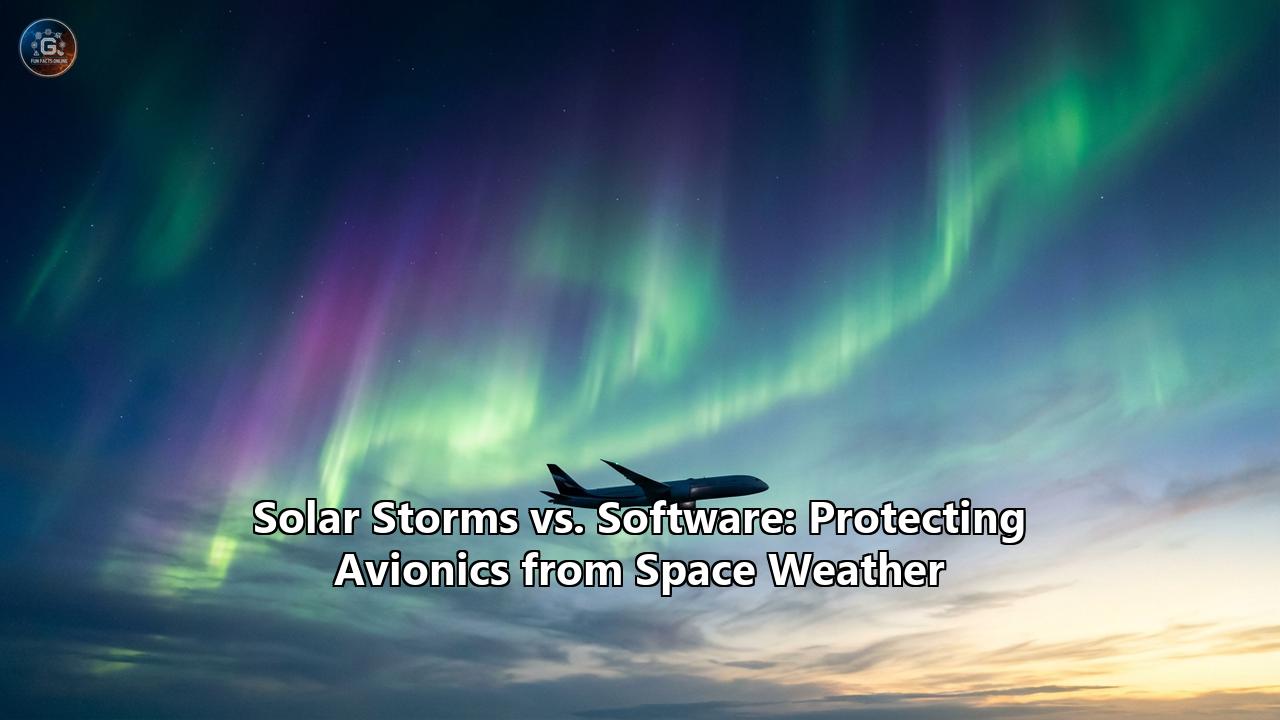
Introduction: The Invisible Battlefield at 35,000 Feet
Imagine you are cruising at 37,000 feet, sipping a coffee while the autopilot gently guides your aircraft toward its destination. Outside, the sky is a serene, deep blue. But unseen to the naked eye, a violent storm is raging. It is not made of wind, rain, or lightning, but of high-energy particles accelerated to near-light speed by a massive explosion on the surface of the Sun—93 million miles away.
For decades, aviation safety focused on tangible threats: bird strikes, engine failures, icing, and thunderstorms. But as modern aircraft have transformed into flying data centers, a new, silent adversary has emerged. It is a threat that passes through the aluminum skin of the fuselage as if it weren't there, striking the microscopic transistors of flight control computers with the precision of a sniper. This is the world of space weather, and for the avionics engineers responsible for keeping planes in the sky, it is an escalating war between solar physics and software reliability.
In recent years, the aviation industry has received wake-up calls that sound more like science fiction than engineering bulletins. From the mysterious "ghost" commands that pitched Qantas Flight 72 into a sudden dive, to the massive 2025 software recall of Airbus A320 fleets triggered by vulnerabilities to solar radiation, the sun is forcing a rewrite of the rulebook.
This article delves deep into the invisible war between solar storms and aircraft software. We will explore the physics of the threat, the terrifying mechanisms by which a single sub-atomic particle can crash a system, and the ingenious "digital shields"—from triple-redundant voting logic to self-healing memory—that engineers are deploying to protect the future of flight.
Part I: The Physics of the Threat – When the Sun Attacks
To understand why a line of code in a flight computer needs to be "hardened," one must first understand the enemy. Space weather is not a rare anomaly; it is the dynamic, often violent, environment of our solar system.
1.1 The Solar Arsenal
The Sun is a magnetic variable star that periodically unleashes energy in three primary forms that impact aviation:
- Solar Flares: These are sudden flashes of brightness observed near the Sun's surface. They are explosions of electromagnetic radiation—X-rays and extreme ultraviolet light. Traveling at the speed of light, they reach Earth in eight minutes. Their primary impact on aviation is High-Frequency (HF) Radio Blackouts. When these X-rays hit Earth's upper atmosphere (the ionosphere), they increase its density, absorbing radio waves rather than reflecting them. For a pilot over the Atlantic trying to contact Air Traffic Control (ATC) via HF radio, the line simply goes dead.
- Coronal Mass Ejections (CMEs): If a flare is the muzzle flash, the CME is the cannonball. A CME is a massive cloud of magnetized plasma (billions of tons of solar material) hurled into space. It travels slower than light, taking 1 to 3 days to reach Earth. When it arrives, it slams into Earth's magnetic field, causing a Geomagnetic Storm. This can induce dangerous electrical currents in power grids and disrupt the magnetic compasses and GPS systems aircraft rely on.
- Solar Energetic Particles (SEPs): This is the most critical threat to avionics hardware. Accelerated by the shockwaves of flares and CMEs, protons and heavy ions stream toward Earth at relativistic speeds. These particles are the "bullets" in this battlefield. They possess enough kinetic energy to penetrate the fuselage of an aircraft, the plastic casing of a microchip, and the silicon die itself.
1.2 The Shield That Leaks: Earth's Magnetosphere
On the ground, we are protected from this bombardment by Earth's magnetosphere—a magnetic bubble that deflects most solar particles—and the thick blanket of the atmosphere, which absorbs the rest.
However, commercial airliners do not fly on the ground. They operate in the upper troposphere and lower stratosphere, where the atmosphere is thin. Furthermore, Earth’s magnetic shield is not uniform.
- The Polar Weakness: Magnetic field lines funnel downward at the North and South Poles. This creates a "particle funnel" where solar radiation can penetrate much deeper into the atmosphere. This is why polar routes—critical for connecting North America to Asia—are the most dangerous sectors for space weather.
- The South Atlantic Anomaly (SAA): Often called the "Bermuda Triangle of Space," this is a region over South America and the southern Atlantic Ocean where the inner Van Allen radiation belt dips dangerously close to Earth's surface. Satellites passing through here frequently shut down to avoid damage, and aircraft flying through it experience significantly higher radiation fluxes.
As aircraft fly higher (to save fuel) and take more polar routes (to save time), they are venturing further into the line of fire.
Part II: The Ghost in the Machine – Single Event Effects (SEEs)
The interaction between a high-energy particle and a microchip is a probabilistic game of Russian roulette known as a Single Event Effect (SEE).
2.1 The Mechanism of a Bit Flip
Modern avionics rely on microprocessors containing billions of transistors. These transistors act as switches, representing binary data (1s and 0s) by holding a tiny electrical charge.
When a high-energy neutron (generated when solar protons smash into the atmosphere) strikes the silicon of a chip, it leaves behind a wake of ionization—a trail of electrical charge.
If this charge is deposited directly into the "sensitive volume" of a transistor, it can overload the circuit's voltage state. A transistor representing a "0" (low voltage) might suddenly read as a "1" (high voltage).
This is a Single Event Upset (SEU), colloquially known as a "bit flip."
- The Silent Corrupter: In a photo file, a bit flip might just change the color of a single pixel—unnoticeable.
- The Mission Killer: In a flight control computer, if that specific bit represents the sign (+/-) of the aircraft's pitch angle, a plane flying level (0 degrees) might suddenly "think" it is pitching up 15 degrees. The software, reacting to this false reality, commands the elevators to pitch the nose down violently to "correct" an error that never existed.
2.2 Types of SEEs
- SEU (Single Event Upset): A "soft error." The hardware is physically fine, but the data is corrupted. A reboot or rewriting the memory fixes it.
- MBU (Multiple Bit Upset): As chips get smaller, transistors are packed closer together. A single particle can now pass through multiple adjacent transistors, flipping several bits at once. This is much harder for traditional error-checking software to detect.
- SEL (Single Event Latch-up): A "hard error." The particle strike triggers a parasitic short circuit, causing the device to draw massive current. This can burn out the chip physically unless power is cut immediately. In an aircraft, this looks like a permanent hardware failure requiring a system reset or swap to a backup.
2.3 The Paradox of Modernization
One might assume that newer, more advanced computers are more resistant to these errors. The opposite is true.
- Smaller is Weaker: To make computers faster and lighter, manufacturers shrink transistors (Moore's Law). Smaller transistors require less electrical charge to switch states. This means a lower-energy particle—one that would have bounced off a 1990s chip—can easily flip a bit in a 2025 chip.
- More Targets: A modern flight management system has gigabytes of memory. That’s billions of potential targets for a particle strike. The probability of some bit flipping somewhere on the plane during a long flight has transitioned from "negligible" to "statistically inevitable."
Part III: Case Studies from the Stratosphere
The threat of space weather is not theoretical. It is written in the flight logs and incident reports of aviation history.
3.1 The Qantas Flight 72 Mystery (2008)
Perhaps the most famous "ghost in the machine" incident. An Airbus A330 cruising over Western Australia suddenly pitched nose-down twice, hurling unbuckled passengers into the ceiling. The investigation found that one of the aircraft's three Air Data Inertial Reference Units (ADIRUs) had started outputting spikes of garbage data—specifically, erroneous angle-of-attack values.
While the exact cause was never definitively physically recovered (particles leave no trace), the failure mode was consistent with a Single Event Upset in the unit's memory. The computer was "confused" by a bit flip, and the software handling that data did not filter out the physically impossible spike (e.g., a 50-degree pitch change in 1 second) effectively enough. This incident reshaped how manufacturers view "data validity" software logic.
3.2 The "Halloween Storms" of 2003
In late October 2003, the sun unleashed a series of X-class flares and CMEs that battered Earth for days.
- Operational Chaos: The FAA's Wide Area Augmentation System (WAAS)—which improves GPS accuracy for landing—was knocked offline for 30 hours due to ionospheric distortion.
- Polar Shutdown: Airlines had to reroute flights away from the poles to lower latitudes to avoid radiation and radio blackouts. This cost the industry millions in extra fuel and delays.
- Pilot Reports: Pilots over the Atlantic reported "hearing the sun"—static and interference on headsets—and HF radios became useless bricks for hours, forcing reliance on tenuous satellite links or relaying messages through other aircraft.
3.3 The Airbus A320 "Solar Recall" (2025 Context)
Recent industry reports highlight a massive precautionary update for thousands of Airbus A320 family aircraft. Investigations into a specific uncommanded flight control event (linked to a JetBlue flight in some reports) traced the root cause to the Elevator Aileron Computer (ELAC).
It was discovered that intense solar radiation could corrupt specific data registers in the ELAC. The vulnerability wasn't that the chip failed, but that the software running on it didn't perform a "redundancy check" often enough to catch the bit flip before acting on it. The solution wasn't to replace the hardware (which would take years) but to patch the software to "double-check" the math—a perfect example of software being the shield for hardware vulnerability.
Part IV: The First Line of Defense – Hardware Hardening
Before we look at software, we must look at the physical avionics themselves. How do engineers build computers that survive a radioactive warzone?
4.1 Radiation-Hardened (Rad-Hard) Chips
In space exploration (satellites, Mars rovers), engineers use "Rad-Hard" chips. These are custom-built processors using:
- Sapphire Substrates: Instead of silicon, chips are built on insulating sapphire (Silicon-on-Insulator) to prevent latch-ups.
- Larger Transistors: Deliberately using older, larger manufacturing nodes (e.g., 90nm or larger) because they are harder to flip.
- Shielded Packaging: Ceramic or heavy metal caps to physically block particles.
4.2 Commercial Off-The-Shelf (COTS) with a Twist
Aviation has moved toward COTS components to save weight and cost. To compensate for their vulnerability, they are adopting new materials:
- Wide Bandgap Semiconductors (GaN & SiC):
Gallium Nitride (GaN) and Silicon Carbide (SiC) are the future of avionics power electronics.
Unlike silicon, GaN has very strong chemical bonds. It requires much higher energy to displace an atom in its lattice.
Search insight: GaN transistors are naturally "radiation transparent"—they don't accumulate charge in the same way silicon does, making them nearly immune to total ionizing dose effects and far more resistant to SEEs. This makes them perfect for the power converters in "More Electric Aircraft" (MEA).
4.3 The Limits of Physical Shielding
Why not just line the avionics bay with lead?
- Weight: Lead is heavy. In aviation, every kilogram burns fuel.
- Particle Showers: High-energy cosmic rays hitting a lead shield can actually make things worse. When a fast proton hits a heavy lead nucleus, it shatters it, creating a "shower" of secondary particles (neutrons, pions) that spray into the electronics like shotgun pellets. Sometimes, less shielding is safer.
Part V: The Digital Shield – Software-Based Protection
If the hardware is vulnerable, the software must be invincible. This is where the true ingenuity of modern avionics lies. If a bit flip is inevitable, the software must be designed to treat it not as a catastrophe, but as a routine annoyance to be swatted away.
5.1 Triple Modular Redundancy (TMR) & Voting Logic
The gold standard of avionics safety.
- The Concept: Instead of one computer flying the plane, you have three (or more).
- The Vote: Computer A, B, and C all calculate the elevator position.
Computer A says: "Move up 5 degrees."
Computer B says: "Move up 5 degrees."
Computer C (hit by a solar particle) says: "Move down 10 degrees."
- The Verdict: The voting logic sees that A and B agree, while C is the outlier. It ignores C, executes the command from A/B, and resets Computer C to fix its memory.
- Dissimilarity: To prevent a generic software bug from crashing all three, they often run different software builds, or use different processors (e.g., one Intel, one AMD, one PowerPC) so they don't all have the same physical weaknesses.
5.2 Lockstep Processing
For smaller components where you can't fit three computers, engineers use Lockstep Dual-Cores.
- How it works: Two processor cores on the same chip run the exact same code, line by line, synchronized to the same clock cycle.
- The Check: At every single operation, a comparator circuit checks if the output of Core 1 matches Core 2.
- The Reaction: If a solar particle flips a bit in Core 1, the outputs will mismatch instantly. The system detects the fault within microseconds, freezes the output to prevent the "bad" command from reaching the wings, and triggers a "rollback" to the last known good state. This is standard in ARM Cortex-R processors used in safety-critical systems.
5.3 Algorithm-Based Fault Tolerance (ABFT)
As AI and Machine Learning enter the cockpit (for autonomous landing or fuel optimization), the math gets complex. TMR is too "expensive" computationally for massive AI matrices.
- The Solution: ABFT uses mathematical checksums embedded within matrix operations. When the Flight Management System multiplies two huge matrices to calculate a fuel-efficient route, it also calculates a checksum row. If a bit flip corrupts a number in the matrix, the checksum won't balance at the end. The software knows the answer is wrong without needing to run the whole calculation twice.
5.4 SWIFT (Software-Implemented Fault Tolerance)
This involves compiling the software with "immune system" features:
- Control Flow Assertions: The software knows it must go from Step A to Step B to Step C. If a particle strike makes the processor jump from Step A directly to Step C, "ghost variables" inserted into the code will detect that Step B was skipped and trigger a reset.
- Heartbeat Monitoring: A separate, tiny, hardened circuit watches the main software. The main software must send a "pulse" signal every 10 milliseconds. If the software gets stuck in a loop or crashes due to radiation, the pulse stops, and the monitor reboots the system.
5.5 Error Correcting Code (ECC) Memory
Every stick of RAM in an avionics box uses ECC.
- Hamming Codes: For every 64 bits of data, the memory stores extra "parity" bits. If one bit flips, the math of the parity bits reveals exactly which one it was. The memory controller flips it back to the correct value instantly, often without the main CPU even knowing it happened. This is "transparent scrubbing."
Part VI: The Regulatory Framework – The Law of the Sky
Aviation is built on standards. Recognizing the solar threat, regulators have moved from "awareness" to "mandate."
6.1 IEC 62396: The Bible of Atmospheric Radiation
This is the primary international standard titled "Process management for avionics – Atmospheric radiation effects."
- It forces manufacturers to calculate the FIT Rate (Failures In Time) due to neutrons for every component.
- It mandates that if a critical system (like the autopilot) has a predicted upset rate higher than 1 in a billion flight hours, it must have architectural mitigation (like TMR).
6.2 DO-178C and DO-254
- DO-254 (Hardware): Ensures the physical chips are tested against radiation models.
- DO-178C (Software): While primarily about coding bugs, recent supplements require the software to handle "abnormal inputs" robustness. A bit flip is essentially the ultimate abnormal input. Software must be proven to recover from these "Hardware-Software Interface" faults.
Part VII: Operational Countermeasures – Dodging the Storm
Hardware and software can only do so much. Sometimes, the only winning move is not to be there.
7.1 Forecasting the Space Weather
Airlines now have "Space Weather Desks" alongside their terrestrial weather teams. They rely on data from:
- NOAA Space Weather Prediction Center (SWPC): Issues "G-Scale" (Geomagnetic), "S-Scale" (Radiation), and "R-Scale" (Radio Blackout) alerts.
- DSCOVR Satellite: Parked 1 million miles from Earth at Lagrange Point 1, this satellite acts as a tsunami buoy. It detects the solar wind speed and magnetic field 15–60 minutes before it hits Earth, giving airlines just enough time to ground a flight or change a route.
7.2 Flight Planning in the AI Era
New platforms like Flash Weather AI and Tomorrow.io are integrating space weather into flight planning.
- Dynamic Rerouting: If a G4 geomagnetic storm is predicted, the software automatically calculates a non-polar route (e.g., flying over the Pacific instead of the Arctic) for a New York to Hong Kong flight. It balances the extra fuel cost against the risk of radio loss and radiation exposure.
- Altitude Caps: During a radiation storm, flying lower (e.g., 28,000 ft instead of 39,000 ft) drastically reduces the neutron flux. Dispatchers will cap flight altitudes during solar events.
7.3 The Human Element: Pilot Protocols
When the HF radio goes dead over the North Pole:
- SATCOM Fallback: Most modern polar jets have Iridium satellite phones. However, massive solar storms can sometimes jam these too.
- Blind Broadcasting: Pilots continue to transmit position reports "in the blind" on designated frequencies, hoping nearby aircraft hear them and can relay messages.
- The Decision: In 2003, many Captains made the call to turn around or divert when comms were lost. Today, better protocols allow them to continue if navigation accuracy (GPS) remains within limits (RNP).
Part VIII: The Future Horizon – Solar Cycle 25 and Beyond
We are currently entering the peak of Solar Cycle 25, predicted to be one of the most active in recent history. The stakes are getting higher.
8.1 The Rise of Autonomous Flight (UAM)
Urban Air Mobility (flying taxis) and autonomous cargo drones are the next frontier. These vehicles will not have a pilot to reset a computer or take manual control if the GPS fails.
- Requirement: Their software must be "Fail-Operational," meaning it can suffer a radiation hit and keep flying without a millisecond of interruption. This will drive the adoption of advanced AI-based fault tolerance (ABFT) and dissimilar redundancy.
8.2 Real-Time Dosimeters
Currently, airlines rely on models to guess radiation levels. The future is Active Sensing.
- New "Chip-Scale" radiation sensors (based on Teledyne or CERN technology) will be embedded directly into avionics suites.
- Instead of a forecast, the plane will feel the radiation spike in real-time and automatically request a lower altitude from ATC, just like it avoids turbulence today.
8.3 The Threat of a "Carrington Event"
In 1859, a solar super-storm (The Carrington Event) set telegraph wires on fire. If such an event happened today, it would likely overwhelm even TMR systems. GPS constellations could fail; HF radio would be dead globally.
- The Ultimate Hardening: Aviation aims to ensure that even in this doomsday scenario, the "Basic Analog Backup" (or the most hardened, simple digital core) remains alive enough to allow pilots to land the plane visually.
Conclusion
The battle between solar storms and software is a testament to human ingenuity. We have taken the chaos of a star—random, violent, radioactive explosions—and tamed it with the logic of mathematics and redundancy.
Every time you fly, you are being protected by a silent shield. It is built of Gallium Nitride atoms, error-correcting memory algorithms, and triple-voted decision logic. The Sun will always be throwing punches at our technology. But as long as the software engineers keep writing code that expects the unexpected, the planes will keep flying, safe above the clouds, indifferent to the storm raging in the void above.
This is the new era of aviation: where meteorology meets astrophysics, and where software is the only thing standing between a bit flip and a bad day.Reference:
- https://www.youtube.com/watch?v=xu0oCOQhC_A
- https://spaceweatherarchive.com/2021/10/28/the-day-earth-lost-half-its-satellites-halloween-storms-2003/
- https://www.ncei.noaa.gov/news/great-halloween-solar-storm-2003
- https://www.news9live.com/science/influence-of-solar-flare-on-electronics-prompts-airbus-fleet-upgrade-2908110
- https://epc-co.com/epc/about-epc/events-and-news/news/artmid/1627/articleid/3116/gan-transistors-bring-newest-rad-hard-technology-to-demanding-space-applications
- https://www.youtube.com/watch?v=WJHGoTB0Ux0
- https://science.nasa.gov/mission/dscovr/