
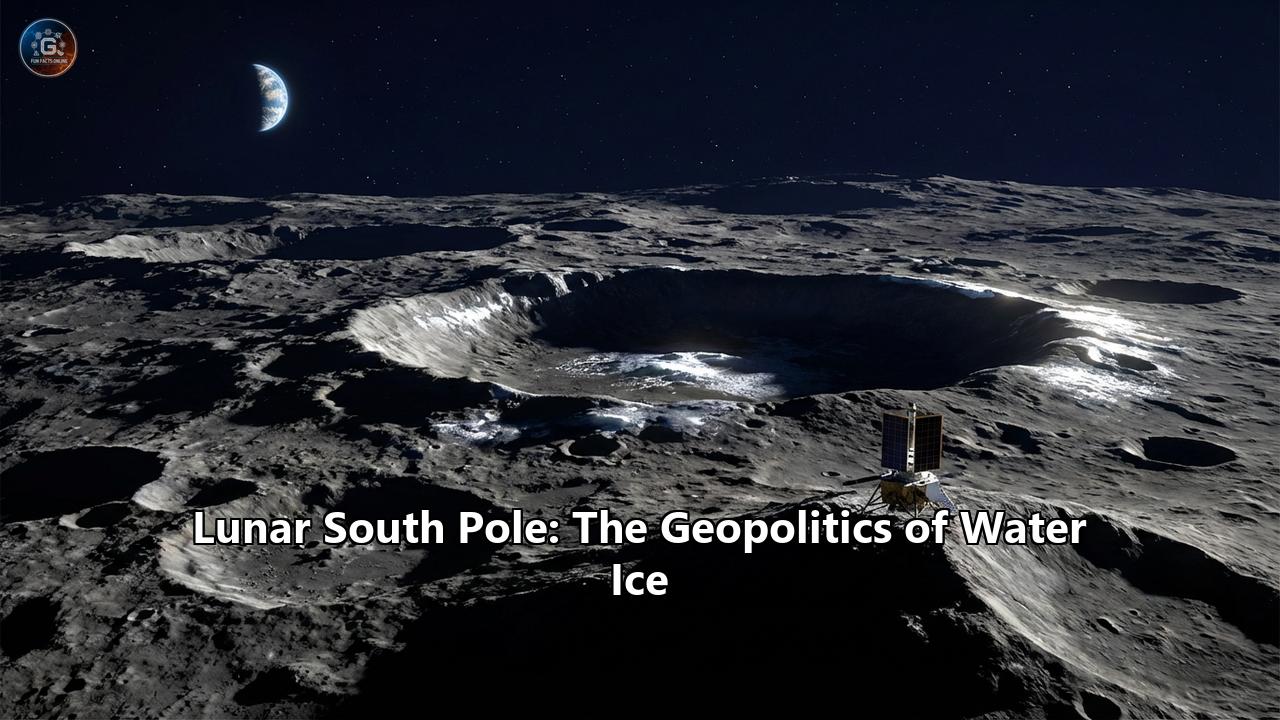
The Shackleton Crater is a place of eternal paradox. Its rim, towering miles above the lunar floor, is bathed in a perpetual, blinding sunlight that has not broken for billions of years. Yet, just a few thousand meters below, the crater floor is a realm of absolute, crushing darkness—a "cold trap" where the temperature hovers near absolute zero, colder than the surface of Pluto. It is here, in these Permanently Shadowed Regions (PSRs), that humanity has found its new oil, its new gold, and its most dangerous geopolitical flashpoint: water ice.
For decades, the Moon was dismissed as a "magnificent desolation"—a dry, dead rock of gray dust and silent history. The Apollo missions brought back dry rocks; the early probes saw a parched surface. But the discovery of water ice at the lunar poles has fundamentally rewritten the destiny of our species in space. Ice is not just water to drink; it is oxygen to breathe and, most critically, hydrogen for rocket fuel. It is the only substance that can break the "tyranny of the rocket equation," allowing humanity to refuel in orbit and travel to Mars and beyond without hauling every ounce of propellant from the crushing gravity well of Earth.
In the year 2026, the silence of the Lunar South Pole is about to be broken. The scramble for these shadowed craters is no longer science fiction; it is the central theater of a new, high-stakes Cold War that makes the terrestrial resource conflicts of the 20th century look merely provincial.
I. The Physics of the Prize: Why Ice is Power
To understand the geopolitics, one must first understand the physics. Launching mass from Earth is exorbitantly expensive. Even with the reusable revolution ushered in by SpaceX, the cost of putting a kilogram of payload onto the lunar surface is measured in the tens of thousands to hundreds of thousands of dollars. Water, however, is heavy. A human settlement requires tons of it for life support, radiation shielding, and agriculture. If every drop must be launched from Kennedy Space Center or Wenchang, a permanent moon base remains an economic impossibility.
Enter the lunar poles. The water ice trapped in the regolith of craters like Shackleton, Shoemaker, and Haworth is "In-Situ Resource Utilization" (ISRU) gold. If this ice can be mined, melted, and electrolyzed, it splits into hydrogen and oxygen—the most efficient chemical rocket propellant known to man. A depot at the Lunar South Pole effectively turns the Moon into a gas station in the sky.
The nation that controls the most accessible ice deposits controls the gateway to the solar system. They determine the price of transit to Mars. They hold the logistical keys to the cislunar economy. This reality has transformed the jagged, cratered highlands of the South Pole into the most valuable real estate in the solar system. Unlike the equator, where landing sites are plentiful and resources are scarce, the South Pole has limited "peaks of eternal light" (for solar power) adjacent to accessible ice. These sites are small, finite, and strategically priceless. The first to land and set up infrastructure effectively claims them, creating a "first mover" monopoly that current international law is ill-equipped to prevent.
II. The Contenders: A Bifurcated World
As we stand in early 2026, the geopolitical landscape of lunar exploration has fractured into two distinct, competing blocs. The era of the single hyperpower is over; the Moon is now a contested multipolar domain.
The Artemis Accords: The Western AllianceLed by the United States and NASA, the Artemis program is not just a series of rocket launches; it is a diplomatic offensive. The "Artemis Accords," a set of bilateral agreements rooted in the 1967 Outer Space Treaty but expanding upon it, establish the "rules of the road" as seen by Washington. Signatories agree to transparency, interoperability, and the release of scientific data. Crucially, they also introduce the concept of "Safety Zones"—areas around lunar operations where other actors are warned not to interfere. Critics, particularly in Beijing and Moscow, view these Safety Zones as de facto territorial claims, a "keep out" sign on common celestial ground.
The Artemis coalition is vast, including traditional allies like the European Space Agency (ESA), Japan (JAXA), and Canada (CSA), but also newer space players like the United Arab Emirates and India. However, the program has faced significant headwinds. The delay of Artemis II to April 2026 and Artemis III to mid-2027—driven by heat shield erosion issues on the Orion capsule and development hurdles with the SpaceX Starship lander—has eroded the American lead. The confirmation of Jared Isaacman as NASA Administrator in late 2025 signaled a pivot toward a more aggressive, commercial-heavy approach to regain lost time, but the clock is ticking.
The ILRS: The Dragon and the BearOpposing Artemis is the International Lunar Research Station (ILRS), a joint initiative led by China (CNSA) and Russia (Roscosmos). While Russia's space program has suffered from funding atrophy and the humiliating crash of Luna-25 in 2023, China has surged ahead with clockwork precision. The Chang'e program has been a masterclass in incremental engineering success.
- Chang'e 4 (2019): First landing on the far side.
- Chang'e 5 (2020): Sample return.
- Chang'e 6 (2024): A historic triumph, returning the first-ever samples from the lunar far side, proving China’s ability to operate complex robotic relays in deep space.
The ILRS envisions a fully robotic base by 2035, eventually staffed by humans. China has successfully courted the "Global South" for this initiative, signing up partners like Pakistan, Egypt, Venezuela, and Nicaragua. The narrative Beijing offers is one of "true multilateralism," contrasting the ILRS as a United Nations-style inclusive project against the "US-centric" Artemis rules. With Chang'e 7 scheduled to launch later in 2026 to hunt for water ice directly at the South Pole, China is threatening to beat the US to the most promising dig sites.
III. The Strategic Pivot: 2023-2026
The last three years have been decisive in shaping this competition. The "Sputnik moment" of the 2020s was arguably not a launch, but a landing—specifically, the contrasting fortunes of August 2023.
In that month, Russia's Luna-25, intended to signal Moscow's return to great power status in space, spun out of control and smashed into the lunar surface. Days later, India's Chandrayaan-3 touched down softly near the South Pole. This was a changing of the guard. India, an Artemis Accords signatory, suddenly possessed hard data on the polar regolith that neither the US nor China had fresh access to.
By 2025, the pressure on NASA had intensified. The "gap" between the American and Chinese human landing dates began to close. China’s announcement that it would land taikonauts by 2030, paired with the successful testing of their new human-rated spacecraft and lander, caused alarm in Congress. The perception that China might "win" the race to the ice—and potentially invoke "safety zones" of their own to bar US access—forced a strategic rethink in Washington. The reopening of the lunar lander competition in late 2025, moving away from sole reliance on SpaceX, was a direct response to this anxiety. The goal was redundancy; if Starship stumbled, Blue Origin or another player needed to be ready.
IV. The Legal Vacuum: Who Owns the Ice?
The most volatile element of this race is the legal ambiguity surrounding it. The Outer Space Treaty of 1967 (OST) states that no nation can claim sovereignty over a celestial body. The Moon belongs to everyone.
However, the OST says nothing about extracting resources. The US interprets this gap like the "high seas" of international waters: no one owns the ocean, but if you fish a tuna out of it, the tuna is yours. The Artemis Accords codify this view, asserting that space resource extraction is legal and does not constitute national appropriation.
China and Russia have historically pushed back, sometimes arguing for a new treaty to manage resources collectively (similar to the Deep Seabed Authority on Earth). Yet, practically, China is moving toward the "high seas" model as well. If the ILRS sets up mining drills on the rim of Shackleton Crater, they will inevitably require a perimeter for safety—drilling kicks up dangerous, high-velocity dust in low gravity. Whether you call it a "Safety Zone" or a "Non-Interference Area," the effect is the same: exclusive use of a specific territory.
This creates a "first come, first served" reality. If the best ice is concentrated in just three or four accessible craters, the first superpower to land and deploy infrastructure effectively owns the resource. There is no space police to stop them. The potential for friction is high. What happens if a Chinese rover "accidentally" dusts a nearby American solar array? What happens if an American "safety zone" blocks the optimal approach path for a Chinese lander? The mechanisms to resolve these disputes do not currently exist.
V. The Technological Crucible
Beyond the politics, the Lunar South Pole represents the ultimate engineering challenge. The environment is actively hostile to machinery.
The Thermal Shock:Equipment must survive the "lunar night"—fourteen days of darkness where temperatures plunge to -250°C—or operate in the permanent shadow where the sun never rises at all. Standard electronics die instantly in these conditions. Both the US and China are rushing to develop nuclear power sources (Fission Surface Power) because solar panels are useless in the shadowed craters where the ice hides.
The Dust:Lunar regolith is not like sand; it is jagged, electrostatic shards of glass. It clings to everything, jams gears, and shreds spacesuits. At the South Pole, the low sun angle creates strange electrical charging effects that can levitate dust, creating a constant, abrasive fog that coats sensors and lenses.
The Communications Shadow:Direct line-of-sight to Earth is difficult from the South Pole's deep craters. This has necessitated a new infrastructure race: the deployment of relay satellites. China’s Queqiao-2 satellite, launched to support Chang'e 6, now provides a dedicated comms link for the South Pole. The US and Europe are scrambling to deploy their own "Moonlight" constellation to ensure they aren't dependent on spotty coverage.
VI. The Future: Cooperation or Conflict?
As we look toward the latter half of the 2020s, three scenarios emerge for the geopolitics of lunar ice.
Scenario A: The Separate SpheresThe most likely immediate outcome is a "balkanized" Moon. The US and its allies establish a cluster of bases near one set of craters (likely near Shackleton or de Gerlache), while China and Russia establish the ILRS at a distant but equally valuable site (perhaps near Amundsen or Malapert). They ignore each other, maintaining a cold, watchful distance. The Moon becomes divided into "Blue" and "Red" zones, with little scientific sharing and high suspicion.
Scenario B: The FlashpointA collision of interests occurs. Perhaps a highly specific location—a "Peak of Eternal Light" that offers 90% solar visibility—is targeted by both sides. If Artemis III and Chang'e 7 both attempt to claim the same ridgeline, the situation could escalate diplomatically or even physically (via cyber-interference or jamming). This would force the world to rapidly draft new space laws under the threat of conflict.
Scenario C: The Uneasy TruceThe harshness of the lunar environment forces cooperation. When a life-support system fails or a rover gets stuck, the only help available is the "enemy" base 50 kilometers away. Much like Antarctica, where geopolitical rivals cooperate for survival and science, the Moon might force a détente. The "Rescue Agreement" of 1968 requires astronauts to help each other; the practical application of this treaty could be the bridge that prevents war.
Conclusion: The Eighth Continent
The Lunar South Pole is no longer just a destination for scientific curiosity; it is the "Eighth Continent," a land of immense resource potential waiting to be claimed. The water ice buried in its dark craters is the fuel for humanity's expansion into the galaxy.
But as with the New World or the Scramble for Africa, the rush for resources brings the baggage of terrestrial politics. The flags planted in the lunar dust in the coming decade will represent more than national pride; they will represent claims to the future energy market of the solar system. Whether this new frontier becomes a model of shared human heritage or a battlefield of exclusion depends on the decisions made in Washington, Beijing, New Delhi, and Moscow in the next few critical years. The rockets are fueled; the launch windows are open. The race for the ice has begun.
Reference:
- https://www.planetary.org/space-missions/change-6
- https://compass.rauias.com/current-affairs/chandrayaan-4-mission/
- https://news.satnews.com/2025/12/03/new-geopolitical-divide-in-lunar-exploration/
- https://payloadspace.com/international-competition-is-driving-the-moon-race/
- https://www.humanmars.net/2025/04/can-china-beat-us-in-2nd-space-race-to.html
- https://en.wikipedia.org/wiki/Chandrayaan-4
- https://www.britannica.com/technology/Change-Chinese-lunar-probes
- https://www.studyiq.com/articles/chandrayaan-4-mission/