
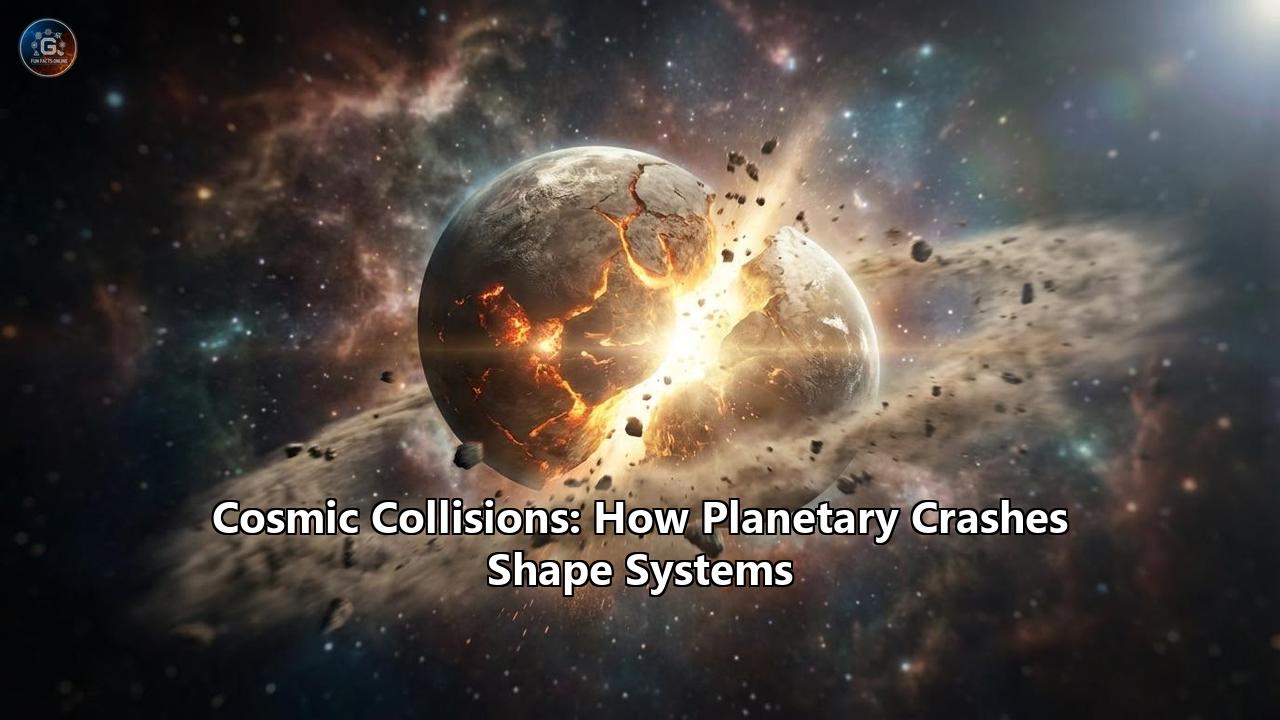
When we look up at the night sky, the universe appears serene, a quiet tapestry of distant stars and wandering planets gliding along their predictable orbits. But this modern tranquility is a grand illusion. The architecture of our solar system—and of the thousands of exoplanetary systems we have discovered—was forged in an era of unimaginable violence. Planetary bodies did not gently assemble themselves in peaceful isolation. They grew, evolved, and were permanently scarred by a chaotic game of cosmic billiards. From stripped atmospheres and missing planetary mantles to worlds knocked completely on their sides, cosmic collisions are the ultimate sculptors of the universe.
To understand the profound role of these planetary crashes, we must rewind the clock to the infancy of a star system. When a new star ignites, it is surrounded by a swirling protoplanetary disk of gas and dust. Over millions of years, electrostatic forces and gravity pull microscopic grains together, forming pebbles, then boulders, and eventually planetesimals. As these bodies grow into planetary embryos, their gravitational pulls begin to overlap. The system becomes crowded and unstable. Orbits intersect, and the inevitable outcome is a series of cataclysmic impacts.
Far from being mere destructive accidents, these giant impacts are the final, transformative strokes in planet formation. They dictate a planet’s final mass, its internal composition, the presence of moons, and even its potential to harbor life.
One of the most consequential collisions in the history of the cosmos happened right beneath our feet. Around 4.5 billion years ago, the infant Earth was a molten, hostile world. According to the prevailing Giant Impact Hypothesis, a Mars-sized protoplanet named Theia drifted into Earth’s orbital path. The resulting collision was so energetic that it liquefied both bodies, merging their cores and blasting millions of megatons of vaporized rock into space. This orbiting ring of debris rapidly coalesced and cooled to form our Moon.
For decades, scientists debated the exact nature of this collision and the mysterious origins of Theia. Was it a rogue wanderer from the icy outer reaches of the solar system, or a local sibling? In late 2025, groundbreaking research analyzing the high-precision iron isotopic signatures of Apollo lunar rocks and terrestrial mantle samples revealed that Earth and Theia were actually cosmic neighbors. Theia formed in the inner solar system, sharing a nearly identical chemical environment with the proto-Earth before their fatal convergence.
But Theia did not just disappear into the void; it became a permanent part of us. Advanced geophysical modeling and seismic mapping have identified Large Low-Shear-Velocity Provinces (LLSVPs)—two colossal, ultra-dense masses buried deep within Earth's lower mantle, one beneath Africa and the other under the Pacific Ocean. Recent high-resolution simulations strongly suggest these anomalies are the unmixed, sunken remnants of Theia’s mantle. We are literally walking over the grave of an ancient, obliterated planet. Furthermore, studies show that this massive impact may have been the crucial event that delivered or redistributed essential carbonaceous materials to Earth, effectively enriching our planet with the chemical prerequisites for life.
While Earth absorbed its impactor and gained a moon, the smallest planet in our solar system tells a very different story of orbital violence. Mercury has long baffled astronomers. It is a planetary anomaly, possessing an oversized metallic iron core that accounts for 65% to 70% of its total mass, leaving only a razor-thin rocky silicate mantle. By comparison, Earth's core makes up roughly 32% of its mass.
How did Mercury lose its rocky exterior? While some hypotheses suggest the Sun's early magnetic field drew heavier iron inward during the solar system's formation, the most compelling and heavily simulated explanation is a colossal "hit-and-run" collision. Tens of millions of years after the solar system formed, a proto-Mercury—roughly twice its current mass—suffered a grazing impact with a similarly sized or larger protoplanet.
Because the collision was a glancing blow rather than a head-on merger, the impactor did not absorb Mercury. Instead, the intense kinetic energy of the crash sheared off over 60% of Mercury's original rocky mantle, blasting it into space where it was likely swept up by Venus or the Sun. What remained was the dense, iron-rich heart of the planet we see today. The hit-and-run theory elegantly explains why Mercury retained volatile elements like potassium and sulfur on its surface; a direct, obliterating impact would have vaporized these compounds entirely, but a swift, grazing blow allowed the dense core and a thin crust of volatiles to survive.
Journeying outward to the frigid, dark realms of the solar system, we encounter Uranus—a gas and ice giant that literally spins on its side. While Earth has a moderate axial tilt of 23.5 degrees, giving us our seasons, Uranus is tilted at a staggering 98 degrees. Its poles take turns pointing directly at the Sun for 42 years at a time, creating bizarre atmospheric dynamics. Furthermore, its entire system of rings and 27 known moons orbits around this sideways equator.
Planetary physics dictates that gas giants form spinning relatively upright, accreting material from the flat disk of the solar nebula. A 98-degree tilt does not happen by accident; it requires an astronomical level of force. Detailed supercomputer simulations indicate that around 4 billion years ago, an icy protoplanet one to three times the mass of Earth slammed into the young Uranus.
The impact was likely an oblique, grazing blow. This strike transferred immense angular momentum, tipping the planet onto its side while preserving most of its atmosphere. The debris ejected from this cataclysm formed a disk around the newly tilted equator, which eventually clumped together to form Uranus's current array of moons and its faint ring system. Moreover, the debris from the impactor may have settled deep within the ice giant, acting as a thermal blanket. This trapped internal heat may explain why Uranus has a surprisingly low temperature today compared to Neptune, as the thermal shield prevents the core's heat from radiating outward into space.
For centuries, our understanding of planetary collisions was limited to the forensics of our own solar system. But today, powerful observatories like the James Webb Space Telescope (JWST) and networks of ground-based surveys are witnessing the devastation of planetary crashes in distant star systems, proving that the violent mechanics of our local neighborhood are a universal standard.
In the Kepler-107 system, located roughly 1,670 light-years away, astronomers discovered a pair of twin planets orbiting closely to their host star. Though Kepler-107b and Kepler-107c are roughly the same size, their densities are wildly different. Kepler-107c is more than twice as dense as its inner sibling, composed of up to 70% iron. Standard planet formation models dictate that the densest planets should form closest to the star, but Kepler-107c breaks this rule. The verdict? A high-speed, head-on collision between two planetary embryos, each about 10 times the mass of Earth. The tremendous energy of the impact stripped away the lighter silicate mantle of Kepler-107c, leaving behind a heavy, iron-packed remnant that mirrors the violent origin of our own Mercury.
Even more dramatic are systems caught in the immediate aftermath of a collision. In 2021, astronomers investigating the 23-million-year-old star HD 172555, located just 95 light-years from Earth, discovered unusual dust and a massive ring of carbon monoxide gas orbiting astonishingly close to the star. Carbon monoxide is highly vulnerable to stellar radiation and should have been broken down quickly, meaning the gas had to be the result of a very recent event. The data revealed that about 200,000 years ago—a blink of an eye in cosmic time—an Earth-sized planet was struck by a smaller body at speeds exceeding 22,000 miles per hour. The catastrophic impact was so violent that it physically blew away part of the larger planet's primordial atmosphere, creating the sprawling clouds of gas and fine silica dust we observe today. This marked the first time humanity had ever directly detected the atmospheric stripping of an exoplanet by a giant impact.
More recently, the cosmos offered an unprecedented light show. In December 2021, an amateur astronomer noticed that a sun-like star named ASASSN-21qj, located 1,850 light-years away, suddenly dimmed in visible light. Archival data showed that three years prior, the same system had brightened dramatically in infrared light, doubling its thermal emissions. Astrophyiscists deduced the extraordinary cause: two Neptune-sized ice giant planets had collided in a catastrophic merger. The initial crash produced a super-heated, glowing remnant—a newborn planet—radiating intense infrared heat. Over the next three years, the massive, expanding cloud of pulverized rock, ice, and vaporized debris drifted along its orbit until it eclipsed the host star, causing the sudden dimming event seen from Earth.
Discoveries like these are accelerating. In early 2026, researchers published findings on Gaia20ehk, a distant system where a debris cloud mirrors the exact orbital distance of Earth from the Sun. Astronomers suspect they are watching a moon-forming impact unfold in real time, with the system experiencing grazing encounters before a final catastrophic collision, offering a spectacular mirror into Earth’s own ancient history.
It is tempting to view these immense collisions purely as engines of apocalypse. Yet, without this cosmic violence, rocky planets might remain barren, arid rocks. One of the most critical questions in astrobiology is how early planets, which form in hot, dry environments close to their stars, acquire water and the organic building blocks necessary for life.
For decades, it was assumed that icy comets and water-rich asteroids gently delivered water to Earth much later in its history. However, high-velocity impact experiments using powerful projectile cannons have proven that destructive impacts can actually trap and preserve water. When water-rich carbonaceous chondrite asteroids strike a dry rocky surface at hyper-velocity, the immense heat and pressure flash-melt the rock into glass and breccia. Rather than all the water vaporizing and escaping into the vacuum of space, up to 30% of the asteroid's water is driven deep into the impact melts and captured within the resulting rock formations.
Furthermore, isotopic evidence from the Earth and the Moon suggests that the vast majority of our planet's water was already present before the Moon-forming collision with Theia. Far from boiling away the oceans, liquid water is remarkably resilient and can survive the global liquefaction of a giant planetary collision. This realization is a massive boon for the search for extraterrestrial life, implying that exoplanets subjected to violent accretion phases can still emerge as water-rich, habitable blue marbles.
The architecture of planetary systems is not a product of gentle assembly, but of survival. The worlds that populate our universe today—from the iron-dense heart of Mercury and the sideways rings of Uranus, to the life-sustaining oceans of Earth and the glowing, shattered skies of distant exoplanets—are the survivors of an ancient and brutal cosmic gauntlet.
By observing the remnants of these collisions, both beneath our feet and across the light-years, we are learning to read the history of the galaxy. Every crater, every tilted axis, and every anomalously dense core is a testament to the dynamic, destructive, and ultimately creative forces that shape the heavens. The same chaotic forces that shatter worlds are the ones that forge the moons that stabilize our seasons, strip away suffocating primordial gases, and deliver the very molecules required to spark life. In the grand mechanics of the cosmos, to create a world, you must first be willing to break one.
Reference:
- https://www.livescience.com/16473-planet-uranus-knocked-sideways-impacts.html
- https://www.sci.news/space/earths-water-moon-forming-impact-05867.html
- https://www.reddit.com/r/askscience/comments/6ix9ev/why_do_astronomers_think_a_collision_caused/
- https://earthsky.org/space/mercury-collision-solar-system/
- https://www.sciencedaily.com/releases/2025/09/250928095654.htm
- https://spherex.caltech.edu/page/the-origin-of-water-in-planetary-systems
- https://www.snexplores.org/article/asteroids-may-have-delivered-water-early-earth
- https://watchers.news/2025/04/19/mercury-iron-rich-core-formed-after-an-ancient-hit-and-run-collision-with-protoplanet/
- https://news.asu.edu/content/planet-mercury-result-early-hit-and-run-collisions
- https://newatlas.com/space/mercury-planet-iron-core-magnetism/
- https://www.sciencedaily.com/releases/2021/07/210702154314.htm
- https://medium.com/global-science-news/the-tilted-giant-investigating-the-catastrophic-past-of-uranus-a782401e69c0
- https://www.iflscience.com/uranus-experienced-a-colossal-impact-that-knocked-it-on-its-side-48602
- https://www.space.com/uranus-giant-impact-from-icy-massive-object.html
- https://news.mit.edu/2021/astronomers-detect-atmosphere-stripped-planet-giant-impact-1020
- https://earthsky.org/space/exoplanet-lost-its-atmosphere-hd-172555-giant-impact/
- https://www.sciencealert.com/two-planets-smashed-together-so-hard-one-of-them-lost-its-atmosphere
- https://www.newsweek.com/small-planet-strips-earth-sized-world-atmosphere-collision-hd-172555-alma-1641213
- https://www.slashgear.com/researchers-discover-a-planet-losing-its-atmosphere-after-a-massive-impact-21696105/
- https://pubmed.ncbi.nlm.nih.gov/29707636/