
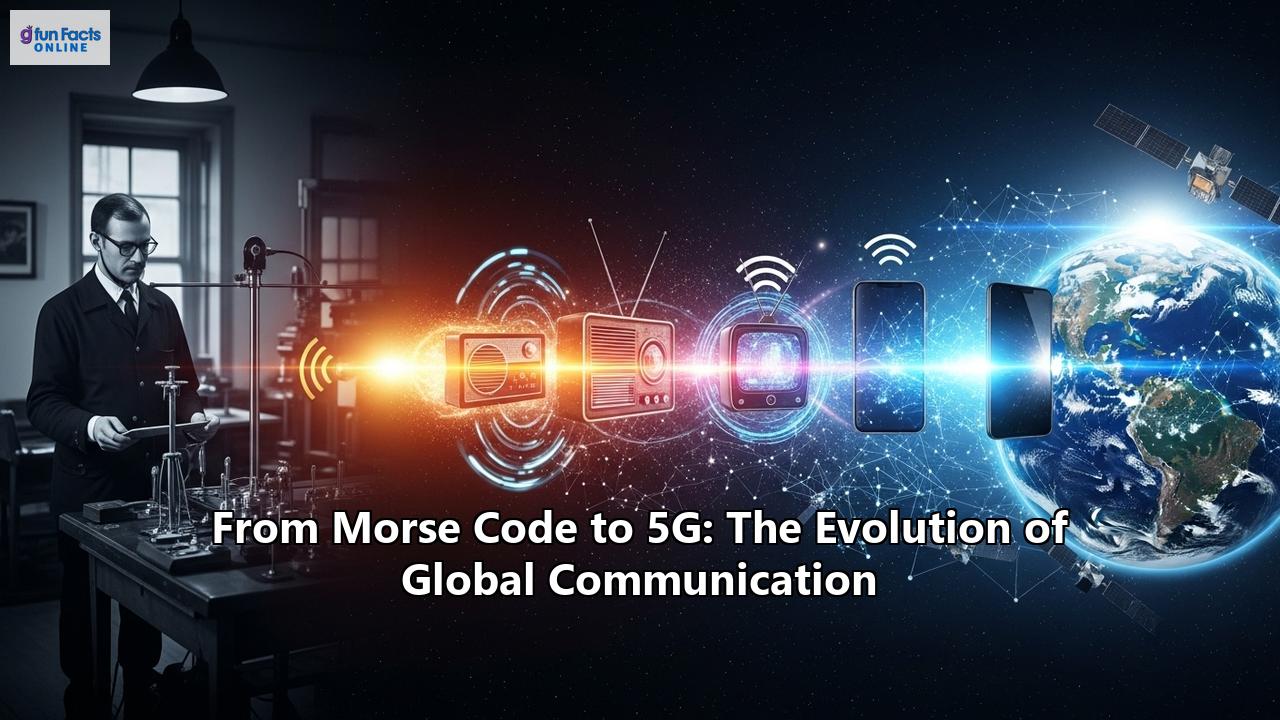
From Morse Code to 5G: The Evolution of Global Communication
The story of global communication is a riveting saga of human ingenuity, a relentless quest to conquer distance and time. It's a journey that has transformed societies, reshaped economies, and woven an intricate, invisible web connecting every corner of our planet. From the staccato clicks of the first telegraphs to the seamless, high-speed data streams of 5G networks, this evolution is not merely a tale of technological advancement but a fundamental chapter in the history of human connection itself.
The Dawn of Instantaneous Communication: The Telegraph and Morse Code
Before the mid-19th century, the speed of communication was tethered to the speed of transportation. Messages traveled at the pace of a horse, a train, or a ship. This paradigm was shattered by the invention of the electrical telegraph. While the concept of sending signals through wires had been explored since the early 1700s, it was the perseverance and vision of inventors like Samuel F.B. Morse that brought the telegraph to the forefront of innovation.
In the 1830s, Morse, a professor at New York University, developed a version of the telegraph that utilized an electric current to control an electromagnet. This electromagnet would mark a strip of paper with a series of dots and dashes, a system that would become universally known as Morse Code. Morse, along with his assistant Alfred Vail, created this code, which assigned a unique combination of dots and dashes to each letter of the alphabet, numerals, and punctuation marks. This system allowed for the transmission of complex messages across telegraph lines.
After securing financial support from the U.S. Congress, Morse conducted the first public demonstration of his invention on May 24, 1844. He sent the now-famous message, "What hath God wrought?," from Washington, D.C., to Baltimore, Maryland, in an instant, heralding a new era of communication. The telegraph's impact was monumental. By 1861, Western Union had constructed its first transcontinental telegraph line, and by 1866, a permanent telegraph cable had been successfully laid across the Atlantic Ocean, connecting North America and Europe. This ability to transmit information almost instantaneously dramatically altered business, politics, and personal relationships across continents.
Bridging Continents: The Transatlantic Cable
The dream of a transatlantic cable, a physical link that would allow for near-instant communication between the Old and New Worlds, was a monumental undertaking. Early proposals for such a cable emerged in the 1840s, championed by figures like Samuel F.B. Morse himself. The first successful ocean cable was laid across the English Channel in 1850, fueling ambitions for a transatlantic connection.
The Atlantic Telegraph Company, led by American entrepreneur Cyrus West Field, embarked on this audacious project in 1854. The initial attempt in 1857 was fraught with difficulties. However, in August 1858, a cable was successfully laid between Ireland and Newfoundland. The first official message was a congratulatory note from Queen Victoria to U.S. President James Buchanan on August 16, 1858. Unfortunately, this early success was short-lived, as the cable's insulation failed, and it ceased to function within weeks.
Despite this setback, the vision persisted. A more reliable and permanent transatlantic telegraph cable was finally completed in 1866. This achievement was a turning point in global communication. Before the cable, messages between Europe and the Americas relied on ships, a journey that could take weeks. The transatlantic cable reduced this communication time to mere minutes, making it possible to send a message and receive a response on the same day. This had a profound impact on international trade, diplomacy, and news dissemination, effectively shrinking the world.
The Human Voice Across the Miles: The Invention of the Telephone
While the telegraph was revolutionary, it was still limited to coded messages that required trained operators. The next great leap forward was the transmission of the human voice itself. The invention of the telephone in the 1870s is most famously credited to Alexander Graham Bell, though it was the culmination of work by several inventors who were seeking to improve upon the telegraph. Bell's groundbreaking patent was registered in 1876, just hours before a competitor, Elisha Gray, filed for a similar invention.
The initial use of the telephone was primarily by wealthy individuals and large corporations who could afford to run their own direct lines between locations. However, as telephone networks grew and the technology became more accessible, it fundamentally transformed society. Businesses could now communicate with each other and their customers with unprecedented speed and ease, fostering stronger networks and expanding their reach.
The telephone also had a profound social impact, allowing for real-time conversations with friends and family over long distances. This fostered a greater sense of closeness and immediacy in personal relationships. The ability to share news and events almost instantaneously began to shift societal expectations about the speed of information, paving the way for the development of even faster communication technologies like radio and television.
The Airwaves Come Alive: Marconi and the Birth of Radio
The late 19th and early 20th centuries witnessed the dawn of an even more revolutionary communication technology: wireless telegraphy, or radio. The theoretical foundations for radio were laid by scientists like James Clerk Maxwell and Heinrich Hertz, who studied electromagnetic waves. However, it was the Italian inventor Guglielmo Marconi who is widely credited with developing the first practical and commercially successful wireless telegraphy system.
In 1895, Marconi began his experiments, successfully transmitting electrical signals through the air within his home and then to his garden. He soon realized the potential for long-distance wireless communication. After moving to England and securing a patent in 1896, he conducted a series of demonstrations for the British government, transmitting Morse code signals over increasing distances. In 1897, he sent the first wireless communication over open sea.
Marconi's ambition, however, was to conquer the Atlantic. In December 1901, he achieved what many believed to be impossible. He successfully transmitted a wireless signal from Poldhu, Cornwall, in England to a receiving station in St. John's, Newfoundland. The historic first message was the Morse code for the letter "S"—three simple dots that marked the beginning of the radio age. This achievement was groundbreaking, as it demonstrated that radio waves could follow the curvature of the Earth, opening up the potential for global wireless communication. Marconi's work laid the foundation for the development of radio, television, and all modern wireless communication systems.
The initial applications of radio were for telegraphic communication, but the technology quickly evolved. On Christmas Eve 1906, Reginald Fessenden made the first public wireless broadcast of audio, marking a significant step towards the radio we know today. The sinking of the Titanic in 1912 tragically highlighted the life-saving importance of wireless communication, as the ship's radio operator was able to transmit distress signals to nearby vessels. Over the following decades, radio broadcasting flourished, becoming a powerful medium for news, entertainment, and cultural exchange, further connecting the world and shaping public opinion.
This journey from the simple clicks of Morse code to the global reach of radio laid the groundwork for the even more transformative communication technologies that would emerge in the 20th and 21st centuries. The relentless human drive to connect, to share information, and to bridge vast distances continued to push the boundaries of what was possible, leading to the development of television, satellites, the internet, and the mobile revolution that defines our modern world. The evolution of global communication is a testament to the power of human innovation to create a more interconnected and informed global community. The subsequent chapters of this story would see the addition of moving pictures, the conquering of space to relay signals, and ultimately, the creation of a global network that would put the sum of human knowledge at our fingertips.
(The article will continue to explore the development of television, satellite communication, the internet, and the progression from 1G to 5G mobile networks, along with their societal impacts.)Reference:
- https://www.elon.edu/u/imagining/time-capsule/150-years/back-1830-1860/
- https://nationalmaglab.org/magnet-academy/history-of-electricity-magnetism/museum/morse-telegraph-1844/
- https://longislandcwclub.org/morse-code-telegraph-history/
- https://www.britannica.com/topic/Morse-Code
- https://artsandculture.google.com/story/the-invention-of-morse-code-and-the-advent-of-german-telegraphy-museum-for-communication-berlin/qQWBl-0PURQMIw?hl=en
- https://en.wikipedia.org/wiki/Transatlantic_telegraph_cable
- https://www.britannica.com/technology/transatlantic-cable
- https://www.history.com/articles/first-transatlantic-telegraph-cable
- https://www.mitel.com/articles/history-telephone-and-communication-businesses
- https://www.techtarget.com/whatis/feature/The-history-of-telephones-explained
- https://opentextbooks.clemson.edu/sciencetechnologyandsociety/chapter/the-invention-of-the-telephone/
- https://blogs.ubc.ca/etec540sept13/2013/10/27/the-effect-the-telephone-had-on-literacy-and-society/
- https://en.wikipedia.org/wiki/Invention_of_radio
- https://nationalmaglab.org/magnet-academy/history-of-electricity-magnetism/museum/marconi-radio-1897/
- https://en.wikipedia.org/wiki/Guglielmo_Marconi
- https://www.invent.org/inductees/guglielmo-marconi
- https://www.biography.com/inventors/guglielmo-marconi