
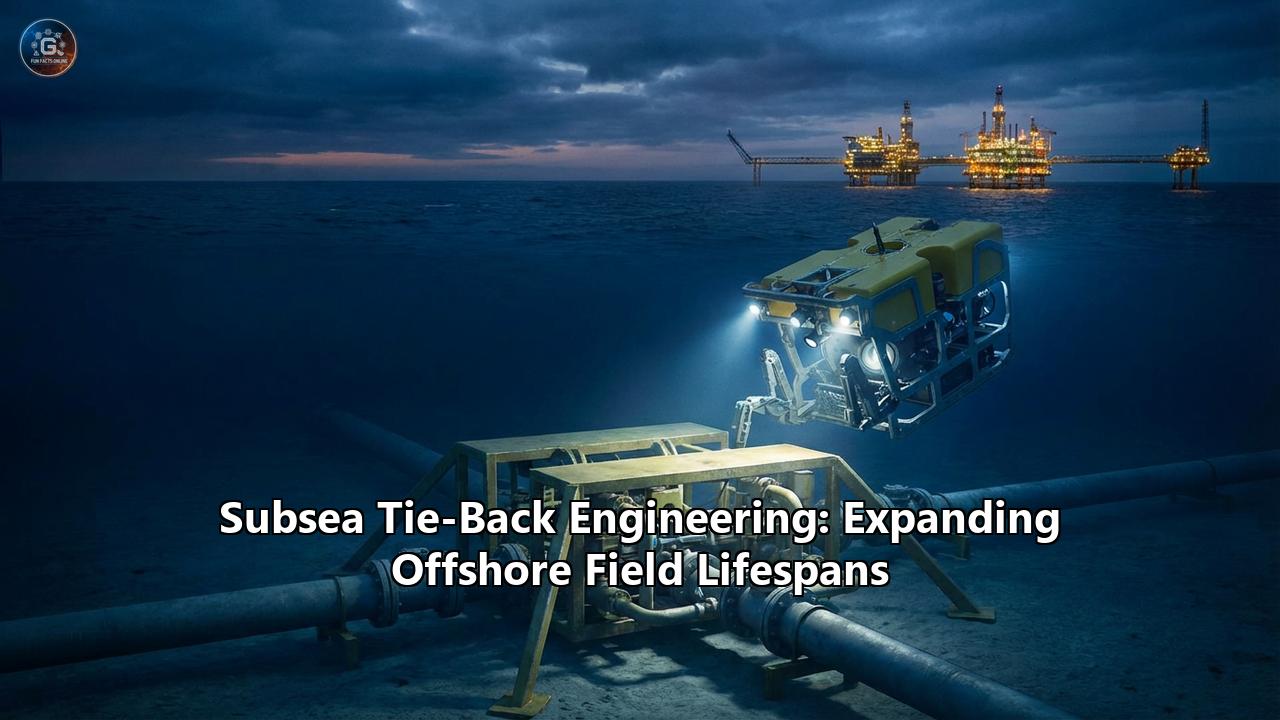
The global offshore energy industry is undergoing a profound transformation. As mature shallow-water basins face declining production and new, standalone mega-projects become increasingly capital-intensive, operators are turning their attention to the dark, freezing, and immensely pressurized depths of the ocean floor. At the heart of this evolution lies subsea tie-back engineering—a technological marvel that essentially moves the production factory to the seabed. By connecting newly discovered, remote hydrocarbon reservoirs to existing offshore platforms or onshore facilities, subsea tie-backs are dramatically expanding the lifespans of mature offshore fields, slashing capital expenditures, and redefining the geographical limits of offshore exploration.
A subsea tie-back is an architectural concept wherein wells drilled in a new, satellite reservoir are completed with subsea wellheads and connected via a network of pipelines and control cables to a pre-existing "host" facility. This host can be a traditional fixed platform, a Floating Production Storage and Offloading (FPSO) vessel, or even an onshore processing plant. Rather than spending billions of dollars and several years constructing a brand-new topside facility to process the oil and gas from a relatively small or marginal field, engineers can simply "tie it back" to an aging platform that has spare processing capacity.
This approach serves a dual purpose. First, it makes the development of smaller, distant reservoirs economically viable by drastically reducing the upfront Capital Expenditure (CAPEX) and accelerating the time to first oil. Second, it breathes new life into mature platforms. As a host platform’s primary reservoir depletes over time, the facility risks becoming an economic liability, edging closer to costly decommissioning. By funneling new production from satellite fields into the aging platform, operators can keep the facility profitable for decades beyond its original design life.
To truly appreciate the complexity of a subsea tie-back, one must understand the anatomy of the equipment operating thousands of meters below the ocean surface. These systems are designed to function flawlessly for 20 to 30 years in extreme environments where hydrostatic pressures can exceed 15,000 psi and temperatures hover just above freezing.
The primary interface with the reservoir is the subsea tree—a massive, multi-ton assembly of valves, spools, and fittings installed directly on the wellhead. Subsea trees control the flow of fluids out of the well and allow for the injection of chemicals or gas to stimulate production.
When multiple wells are drilled in a single satellite field, their individual outputs are typically routed to a subsea manifold. The manifold acts as a centralized gathering station, commingling the hydrocarbons from various wells into a single, larger pipeline—the flowline—which carries the fluids across the seabed toward the host facility.
Running parallel to the flowlines are the umbilicals. If the flowlines are the arteries of the subsea system, the umbilical is the central nervous system. This highly complex, continuously manufactured bundle of tubes and cables delivers electrical power, hydraulic fluid, chemical inhibitors, and fiber-optic data communications from the host facility to the subsea equipment. It is through the umbilical that a human operator sitting in a control room miles away—or even onshore—can monitor well pressures, actuate subsea valves, and inject critical chemicals.
Transporting a mixture of oil, natural gas, and produced water across miles of freezing seabed presents one of the most formidable engineering hurdles in offshore operations: flow assurance. In the high-pressure, low-temperature environment of the deep ocean, the physical chemistry of hydrocarbon fluids can turn volatile.
The greatest threat comes from gas hydrates. When natural gas and water mix under high pressure and low temperature, they form hydrates—ice-like crystalline structures that can rapidly accumulate and completely block a pipeline. A hydrate plug can take weeks or even months to safely dissolve, leading to millions of dollars in lost production. Similarly, waxy crude oils can precipitate paraffin waxes, and asphaltenes can settle out of the fluid, coating the inside of the pipeline and restricting flow.
Engineers deploy several strategies to win the flow assurance battle. The most common is the continuous injection of thermodynamic inhibitors, such as Monoethylene Glycol (MEG) or methanol, delivered via the subsea umbilical. These chemicals act like antifreeze, lowering the temperature at which hydrates can form.
Thermal management is equally critical. To keep the fluids warm as they travel long distances, subsea flowlines are wrapped in advanced insulation materials like aerogels or polyurethanes. For extremely long tie-backs, passive insulation is not enough. The industry has increasingly adopted Pipe-in-Pipe (PiP) technology, where the hydrocarbon-carrying pipe is encased within a larger outer pipe, creating an insulating vacuum or housing high-efficiency insulation materials. Taking this a step further, modern mega-tiebacks utilize Electrically Trace-Heated Pipe-in-Pipe (ETH-PiP) or Direct Electrical Heating (DEH) systems, which use electrical currents to actively heat the pipeline, ensuring fluids remain above critical crystallization temperatures even during unexpected shutdowns.
While chemical injection and insulation can protect the fluids, moving those fluids over vast distances requires immense energy. Historically, tie-back distances were limited by the natural pressure of the reservoir. If the reservoir lacked the pressure to push the fluids 30 or 50 miles across the seabed and up a vertical riser to a floating platform, the field could not be developed as a tie-back.
This limitation sparked the development of subsea processing—a suite of technologies that has revolutionized deepwater field development. Subsea processing comprises separation, boosting, compression, and water reinjection, all executed directly on the seafloor.
Subsea multiphase boosting pumps are installed directly into the tie-back architecture to impart energy to the fluid. Unlike traditional pumps that can only handle liquids, subsea multiphase pumps are engineered to handle chaotic, churning mixtures of oil, gas, and water. By boosting the pressure of the fluid at the seabed, these pumps counteract the friction losses inherent in long pipelines, allowing operators to extend tie-back distances significantly and increase the ultimate recovery rate of the reservoir. Projects like the Barracuda multiphase boosting system have successfully demonstrated the ability to pump high-gas-volume fluids over considerable distances, making marginal deepwater oil fields profitable.
For ultra-long tie-backs, transporting a heavy column of produced water alongside valuable hydrocarbons is wildly inefficient. Subsea separation technology addresses this by separating the fluids at the seabed. Large subsea separator vessels allow gravity to separate the gas, oil, and water. The water can be injected back into a secondary well to maintain reservoir pressure, while the oil and gas are boosted and sent to the host facility. The Pazflor project, located in deep waters off the coast of West Africa, became a landmark achievement in this space, incorporating deepwater subsea separation from the very start to manage different crude types and ensure flow assurance. By removing the water early, the payload is lightened, the risk of hydrate formation is reduced, and the topside facility is spared the burden of processing massive volumes of wastewater.
In gas fields, subsea compression is the ultimate enabler. As gas reservoirs deplete, the pressure drops. A subsea gas compressor actively sucks the gas out of the reservoir, compressing it and pushing it through the pipeline. The Ormen Lange field in the Norwegian Sea represents the absolute pinnacle of this technology. OneSubsea was awarded an engineering and construction contract to supply a subsea multiphase compression system for the field, which features a staggering 120-kilometer tie-back distance to the Nyhamna onshore gas processing plant. This project set a world record for transmitting variable-speed power from an onshore facility to equipment on the seabed. The 16-megawatt subsea compression stations are surge tolerant and do not require the wellstream to be pre-processed, proving that heavy industrial gas compression can be executed safely under 850 meters of ocean water.
The evolution of subsea tie-backs is a story of constantly shattering distance records. In the early 2000s, Shell’s Mensa project in the Gulf of Mexico set an industry benchmark with a 108.8-kilometer tie-back. This was soon challenged by BG’s West Delta Deep Marine concession offshore Egypt, where the Scarab Saffron and later the Simian Sienna fields pushed large-diameter subsea tie-backs to 112 kilometers.
Eventually, the industry realized that if a field could be tied back 120 kilometers to an offshore platform, it could also be tied back straight to the beach, eliminating the offshore platform entirely. The Snøhvit development in the Barents Sea did exactly that, taking production via a record-breaking 143-kilometer tie-back directly to a liquefied natural gas (LNG) plant at Hammerfest on the Norwegian coast. Future satellite expansions to the Snøhvit field are expected to push this distance to nearly 195 kilometers. The horizon continues to expand; concepts for ultra-long tie-backs, such as the proposed Petrel field off northern Australia, envision a phenomenal 285-kilometer subsea tie-back directly into an LNG plant in Darwin.
As the physical infrastructure of subsea engineering pushes new boundaries, the digital infrastructure is experiencing a renaissance. The sheer complexity and extreme cost of subsea operations demand unprecedented reliability, paving the way for advanced digitalization, remote monitoring, and Artificial Intelligence (AI).
Digital twin technology is now a standard requirement for complex tie-back developments. A digital twin is a highly accurate, real-time virtual replica of the entire subsea network. By feeding live data from sensors located on the subsea trees and manifolds into advanced multiphase flow simulators, engineers can visualize exactly what is happening inside the pipeline. The digital twin can predict the formation of a hydrate plug hours before it occurs, alert operators to abnormal vibrations in a multiphase pump, or optimize the flow rate to maximize efficiency.
This digital leap is accelerating through high-profile industry partnerships. In late 2025, SLB entered a strategic collaboration with Shell to develop agentic AI solutions for upstream operations. Utilizing SLB’s Lumi™ AI platform, this initiative unifies subsea workflows, utilizing artificial intelligence to parse vast amounts of subsurface and production data. Such AI-driven insights allow operators to shift from reactive maintenance to predictive asset management, drastically reducing costly downtime.
Simultaneously, the physical maintenance of these sprawling subsea networks is being handed over to robotics. Autonomous Underwater Vehicles (AUVs) and advanced Remotely Operated Vehicles (ROVs) are becoming mainstays of field life extension. Instead of deploying a costly surface support vessel every time a subsea valve needs an inspection, operators are deploying "resident" AUVs. These robotic systems live in subsea garages on the ocean floor, constantly charging their batteries. When an anomaly is detected, the AUV deploys autonomously, swims to the subsea tree, conducts high-definition visual and sonar inspections, and returns to its garage to upload the data.
Because subsea tie-backs extend the life of fields, the wells themselves must be maintained over decades of operation. This has spawned a massive secondary industry: Subsea Well Intervention. Over time, wellbores can scale up, produce excessive water, or experience mechanical failures. To restore production, operators must re-enter the well.
The Global Subsea Well Intervention Technology Market has experienced aggressive growth, driven by the requirement to maximize recovery from mature subsea reservoirs. In regions like the Norwegian Continental Shelf, which boasts over 500 subsea wells, intervention campaigns are a routine operational necessity. Historically, well intervention required leasing a massive drilling rig at a cost of hundreds of thousands of dollars per day. Today, the industry relies heavily on Riserless Light Well Intervention (RLWI) vessels. These dynamically positioned ships utilize a subsea lubricator system connected directly to the subsea tree, allowing engineers to drop wireline tools into the wellbore without a traditional riser pipe. In 2024, specialized subsea tie-backs and intervention-ready infrastructure saw investments exceeding $8.5 billion in Norwegian waters alone, with digitalized intervention vessels reducing campaign turnaround times by up to 35%.
Beyond economics and technical ambition, the expansion of subsea tie-back engineering is fundamentally intertwined with the global energy transition. Oil and gas operators are under intense pressure to reduce their Scope 1 and Scope 2 carbon emissions. Building a new, 30,000-ton steel offshore platform from scratch requires a colossal amount of energy, steel manufacturing, and logistical emissions.
By contrast, utilizing an existing host facility via a subsea tie-back inherently lowers the carbon footprint of a new field development. The industry is taking this a step further through subsea electrification. Traditionally, the umbilical cables that supply hydraulic fluids were driven by massive, gas-burning hydraulic power units on the host platform. Today, next-generation subsea systems are transitioning to all-electric controls. Electric subsea trees and manifolds replace bulky hydraulic actuators with highly efficient electric motors. Furthermore, powering mega-tiebacks directly from onshore renewable grids or nearby floating wind turbines eliminates the need for offshore gas turbines entirely. In the North Sea, the integration of electrified subsea systems is reducing operational emissions by nearly 30% per project, proving that subsea engineering is a critical lever in decarbonizing offshore hydrocarbon extraction.
The financial landscape of the mid-2020s heavily favors the subsea tie-back model. Offshore engineering, procurement, and construction (EPC) contract award values remained exceptionally robust in 2024 and 2025, hovering around the $52 to $54 billion mark. Despite global economic headwinds and volatile oil prices, subsea investments are resilient. Because tie-backs require less upfront capital and generate quicker returns, they provide operators with a lower break-even price per barrel.
As we look toward 2026 and beyond, market data indicates that subsea tie-back systems will continue to see the strongest adoption rates across the sector. This growth is driven by rising deepwater exploration, particularly in the Gulf of Mexico, offshore Guyana, the North Sea, and emerging basins in the Asia-Pacific. Engineering firms and EPC contractors like TechnipFMC, Subsea7, and OneSubsea are securing continuous contracts to support deepwater tie-backs, leveraging innovations in high-strength, corrosion-resistant alloys capable of withstanding ultra-deepwater pressures.
As reservoirs become more complex, step-out distances become longer, and operating environments become more extreme, subsea tie-back engineering will remain the absolute backbone of offshore energy. By merging advanced fluid dynamics, robotic autonomy, artificial intelligence, and heavy subsea machinery, the industry has successfully turned the hostile ocean floor into a sophisticated, interconnected factory. The ongoing advancement of subsea separation, multiphase boosting, and ultra-long-distance power transmission ensures that no matter how isolated a hydrocarbon reservoir may be, it can be safely and economically brought to surface, dramatically expanding the operational lifespan of the world's offshore energy infrastructure.
Reference:
- https://mescenergy.com/importance-of-the-mechanics-lien-to-construction-industry/
- https://ww2.eagle.org/en/innovation-and-technology/technology-advancements/subsea-processing-systems.html
- https://www.intelmarketresearch.com/tie-back-drilling-riser-market-32383
- https://www.worldoil.com/news/2019/11/1/onesubsea-wins-industry-s-longest-deepwater-tieback-project-for-ormen-lange
- https://www.spe.org/media/filer_public/7f/22/7f221c0c-08af-4ffa-a53e-c4affd39d0c7/16_spe-181749-pa.pdf
- https://www.researchgate.net/publication/344275240_New_Technologies_for_Enhanced_Production_in_Deepwater_and_Long_Subsea_Tiebacks
- https://www.viperinnovations.com/industries/oil-gas
- https://www.pipeliner.com.au/internationalnews/longest-subsea-tie-back-using-large-diameter-pipe/
- https://www.congruencemarketinsights.com/report/subsea-well-intervention-technology-market
- https://www.openpr.com/news/4389377/subsea-market-outlook-2026-opportunities-for-oil-gas-energy
- https://www.offshore-energy.biz/54-billion-in-engineering-procurement-and-construction-contracting-opportunities-on-offshore-oil-gas-agenda-for-2025/