
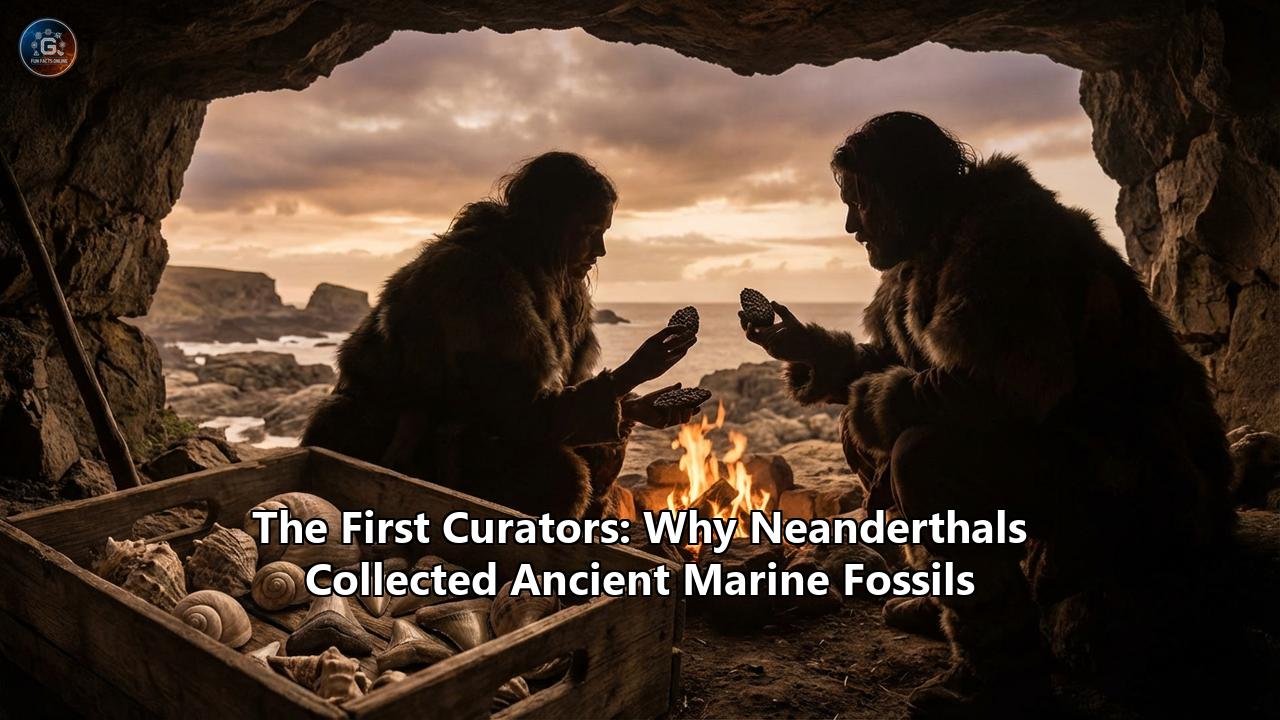
For over a century, the popular image of the Neanderthal has been one of grim survival. We pictured them huddled in cold caves, their lives defined by the brutal necessities of hunting mammoth and scraping hides. We imagined a species locked in the "now," capable of crafting spear points but incapable of appreciating a sunset, a melody, or a beautiful stone.
But the caves are finally speaking, and they are telling a different story.
In the flickering lamplight of recent archaeological excavations, a new portrait of our ancient cousins is emerging. It is a portrait not of brute survivalists, but of curious observers—sentient beings who traveled vast distances not just for food, but for beauty. We have found their paintings. We have found their jewelry. And now, thanks to groundbreaking discoveries in Spain and across Europe, we have found their collections.
It appears that Neanderthals were humanity’s first curators. Long before the first museum was built, before Homo sapiens began hoarding gold or gemstones, Neanderthals were walking the riverbeds and limestone ridges of Europe, bending down to pick up ancient marine fossils that had no practical use, simply because they found them intriguing.
This is the story of those fossils, the "museums" found in their caves, and what they reveal about the awakening of the human mind.
Part I: The Treasure of Prado Vargas
The most significant chapter in this story was written recently in the Prado Vargas Cave, a vast limestone cathedral tucked into the Cornejo valley of northern Spain. For years, archaeologists had been excavating Level 4, a layer of sediment dated to between 39,800 and 54,600 years ago. This was a world firmly in the grip of the Neanderthals; modern humans had not yet arrived in this part of the Iberian Peninsula.
As researchers sifted through the dirt, they found the usual debris of Paleolithic life: flint knives, the charred bones of red deer and wild goats, and the ash of hearths. But scattered among these utilitarian remnants were objects that didn't fit.
They found 15 marine fossils.
These were not fresh shells left over from a seafood dinner. They were ancient, stonified remains of creatures that had lived in the Cretaceous seas millions of years earlier. The collection was diverse and specific. It included:
- _Tylostoma_: Large, spiral-shaped predatory sea snails.
- _Pholadomya_ and _Granocardium_: Bivalves with distinct, ribbed textures.
- _Tetragramma_: A fossilized sea urchin, its spiny symmetry preserved in stone.
The Smoking Gun: Intentionality
In archaeology, context is everything. Could these fossils have washed into the cave naturally? The researchers, led by Marta Navazo Ruiz of the University of Burgos, consulted the geological maps. The walls of Prado Vargas are made of Coniacian limestone, but the fossils came from Santonian and Campanian formations.
This geological discrepancy was the "smoking gun." These fossils did not belong in that cave. To bring them there, a Neanderthal had to walk to a specific outcrop, recognize the fossil, pry it loose or pick it up, and carry it back to camp. The nearest source for some of these fossils was over 30 kilometers (18 miles) away.
Furthermore, microscopic analysis revealed a startling lack of wear. With one exception (a fossil used as a hammerstone), none of the items showed signs of being used as tools. They weren't scrapers; they weren't arrowheads. They were pristine. They had been collected, transported, and kept intact.
This was a collection in the truest sense of the word.
Part II: The Child Collector Hypothesis
Who were these first curators? The presence of a single milk tooth found in the same layer at Prado Vargas offers a poignant possibility.
Collecting is a deeply human trait, but it is specifically a childhood trait. Psychologists note that the urge to gather "useless" objects—smooth pebbles, shiny beetle wings, strange shells—often emerges in human children between the ages of three and six. It is a form of play, a way of categorizing the world, and a sign of cognitive development.
The researchers at Prado Vargas have suggested that these 15 fossils might represent the "treasure box" of a Neanderthal child. We can easily imagine a young Neanderthal accompanying their parents on a foraging trip miles from home. While the adults scanned the horizon for game or flint, the child looked down, captivated by the spiral of a Tylostoma snail turned to stone.
"Look," they might have gestured. "Stone snail."
And rather than discarding it as useless heavy weight, the adults allowed the child to bring it home. Or perhaps it was the adults themselves who were captivated, seeing in the fossilized sea urchin a reflection of the stars or a pleasing geometry that satisfied an aesthetic itch.
Part III: Beyond Spain—A Pattern of Curiosity
If Prado Vargas were the only site with such findings, we might dismiss it as an anomaly—a single eccentric clan. But once archaeologists started looking for "manuports" (objects carried by hand by hominids), they found them everywhere.
The Red Shell of Fumane
In the Grotta di Fumane in Italy, roughly 47,000 years ago, a Neanderthal picked up a fossilized shell of Aspa marginata. This was no casual pickup. The shell had been transported over 100 kilometers.
But the owner did more than just carry it. They modified it. Traces of pure hematite—a red pigment—were found smeared on the shell. It wasn't used as a tool; it was an object of display. Whether worn as a pendant or kept as a talisman, the red shell of Fumane proves that Neanderthals were capable of symbolic thought, attributing meaning and color to objects that had no survival function.
The "Curios" of Combe Grenal
In France, the site of Combe Grenal yielded even older secrets. In layers dating back to the Acheulean-Mousterian transition, excavators found brachiopod fossils (Rhynchonellidae). Like the Spanish discoveries, these were beautiful, symmetrical objects that had been singled out from the chaos of the natural world and brought into the domestic sphere.
The Contrast: Tools vs. Treasures
Skeptics might argue that we are projecting our own values onto these objects. Maybe they were just oddly shaped raw materials?
The site of Grotta dei Moscerini in Italy provides the counter-argument. Here, Neanderthals also collected shells—specifically the smooth clam Callista chione. But they used these shells as scrapers. We know this because they retouched the edges, sharpening them like flint knives.
This distinction is vital. Neanderthals knew that Callista shells were tools. But they treated the Tylostoma fossils of Prado Vargas and the Aspa of Fumane differently. They had a clear cognitive category for "utilitarian object" and a separate, perhaps more mysterious category for "aesthetic object." They knew the difference between a hammer and a keepsake.
Part IV: The Cognitive Revolution
Why does this matter? Why should we care about a few rocks in a cave?
Because "collecting" is a hallmark of abstract thinking. To collect a fossil requires a complex chain of mental events:
- Recognition: Seeing an object and distinguishing it from the background noise of gravel and dirt.
- Appreciation: Assigning value to the object based on its shape, texture, or color, rather than its function.
- Future Planning: Deciding to carry the object (which costs energy) for a future reward (enjoyment, social bonding) rather than immediate gratification.
For decades, we believed Neanderthals lacked this capacity for symbolism. We thought they were literalists, unable to think beyond the meat on the bone or the fire in the hearth. The collections at Prado Vargas and Fumane shatter this prejudice. They suggest that the Neanderthal mind was capable of "aesthetic remove"—the ability to step back and appreciate the form of nature for its own sake.
The Origins of Art?
These collections may represent the very seedlings of artistic tradition. Before you can sculpt a perfect sphere, you must first appreciate the spherical shape of a sea urchin fossil. Before you can paint a bison, you must first notice the animal shapes in the rocks and clouds. By collecting these "ready-made" art objects from nature, Neanderthals were exhibiting the sensibilities that would eventually lead to the cave paintings of Lascaux and Altamira (some of which, we now know, may have been started by Neanderthals).
Part V: The Legacy of the First Curators
When we look at the Tylostoma snail from Prado Vargas, we are looking at a bridge across time. It is a bridge that connects us to a vanished people, not through their death or their violence, but through their wonder.
We are a species of collectors. We fill our shelves with vinyl records, our pockets with sea glass, and our museums with bones. We do this to capture pieces of the world, to organize the chaos of existence, and to leave a mark of our identity.
It turns out, we didn't invent this.
46,000 years ago, in a flickering cave in Spain, a Neanderthal held a stone snail in a calloused hand and felt the same spark of intrigue that drives a modern child to pick up a seashell. They were not just surviving the Ice Age; they were admiring it. They were the first curators, and in their silent collections, we finally see the reflection of our own humanity.
Reference:
- https://www.cenieh.es/en/press/news/neanderthals-prado-vargas-were-first-fossil-collectors
- https://archaeologymag.com/2024/11/neanderthals-were-the-first-fossil-collectors/
- https://medium.com/teatime-history/when-neanderthals-collected-fossils-76ac6f92b97a
- https://www.zmescience.com/science/neanderthal-children-may-have-enjoyed-collecting-trinkets/
- https://www.techno-science.net/en/news/these-neanderthals-collected-cretaceous-fossils-N26088.html
- https://archaeology.org/news/2020/01/15/200116-neanderthal-shell-tools/
- https://www.sci.news/archaeology/neanderthals-first-collectors-fossils-13472.html
- https://www.donsmaps.com/neanderthalshell.html
- https://www.mdpi.com/2571-550X/7/4/49