
2/2025 in Italy took the stakes even higher, introducing severe criminal liability—punishable by up to five years in prison—for executives overseeing the unlawful dissemination of harmful AI-generated content.
Meanwhile, in the United States, the regulatory landscape is a volatile, high-stakes patchwork. While the federal government has experienced massive legislative whiplash—with the newly inaugurated Trump administration swiftly revoking dozens of Biden-era executive orders that previously mandated strict safety testing, federal oversight, and algorithmic bias checks—individual US states have aggressively stepped into the regulatory vacuum.
California’s pioneering legislation, SB 243 and AB 489, took full operational effect on January 1, 2026, fundamentally altering how tech companies deploy AI in the state. SB 243 specifically targets the booming market of "companion AI"—chatbots and voice agents designed to form deep emotional bonds with human users. The law requires continuous disclosure guardrails and strict, real-time self-harm intervention protocols to prevent vulnerable users from being manipulated by synthetic companions. AB 489 strictly prohibits AI systems from masquerading as authoritative medical experts, directly responding to the 2025 crises of AI dispensing dangerous health advice and hallucinated diagnoses.
These are not theoretical, academic frameworks; they require continuous runtime control. In 2026, an enterprise cannot simply point regulators to an attractively designed PDF of its "Corporate AI Ethics Principles" to satisfy compliance. They must demonstrate auditable, cryptographic proof that their AI guardrails are actively filtering inputs, verifying outputs in real-time, and maintaining tight, least-privilege access controls over sensitive corporate data. AI security documentation now rigidly mirrors financial and cybersecurity audits like SOC 2 and ISO standards. Enterprises that cannot produce verifiable evidence of their guardrails face intense scrutiny, catastrophic fines, or total operational restrictions on their AI deployments.
Accuracy First, Defense in Depth
Despite the looming existential threat of the Hindenburg Risk and the heavy club of regulatory fines, the economic pressure to deploy AI remains immense. The solution, successfully pioneered by forward-thinking Chief Technology Officers and AI Safety Leads in 2026, is a pragmatic, layered architectural approach known as "Accuracy First, Defense in Depth".
Building effective guardrails does not mean building a dumb, overly restricted system. In fact, heavy-handed, rudimentary filtering often severely degrades an AI’s usefulness, leading to the frustrating "I’m sorry, as an AI language model, I cannot assist with that" responses to perfectly benign queries. To prevent this user-experience degradation while maintaining strict safety, engineers are prioritizing foundational accuracy before erecting walls.
Through Advanced Retrieval-Augmented Generation (RAG) and highly sophisticated semantic "chunking" strategies, enterprises are feeding their AI agents highly verified, strictly controlled, and heavily contextualized proprietary data. Page-level and semantic chunking have been shown in 2026 enterprise studies to increase retrieval accuracy by up to 40%, drastically reducing the AI’s fundamental need to hallucinate answers to fill knowledge gaps.
Once the structural integrity of the AI’s knowledge base is mathematically secured, security teams apply dynamic guardrails matched precisely to the business risk of the specific task. An AI assistant drafted simply to write internal marketing copy might only pass through a lightweight, low-latency profanity and brand-alignment filter. However, an Agentic AI granted permission to execute SQL database queries, manage supply chain transactions, or interface with public customers is wrapped in a thick, multi-layered armor of deterministic checks.
This involves sophisticated "AI-checking-AI" architectures. In these setups, a smaller, highly specialized, and mathematically rigorous secondary model (often called a "Constitutional Arbiter") inspects the proposed output of the primary model in a matter of milliseconds. It evaluates the output for prompt injection attempts, sensitive data leakage, logical consistency, and regulatory compliance before allowing the action to proceed to the end-user or the API endpoint. It is the equivalent of a human writer having an exceptionally fast, legally trained editor reviewing every single word before it is spoken.
The Existential Horizon and the Compounding Loop
We are entering what Anthropic’s CEO Dario Amodei refers to as "The Adolescence of Technology". In late 2025 and 2026, a highly disturbing macro-trend emerged: the political, financial, and corporate pendulum swung heavily toward maximizing AI opportunity, often at the direct, willful expense of AI risk management. Driven by intense geopolitical competition—the so-called AI Arms Race—and the sheer, unprecedented profit potential of superhuman productivity, the timeline to Artificial General Intelligence (AGI) is rapidly compressing.
Amodei and other leading researchers warn that a critical feedback loop has already begun. AI is no longer just writing boilerplate code for consumer applications; it is writing the underlying infrastructure code for the next generation of AI systems. This recursive self-improvement acts as a massive progress multiplier. At leading labs, AI assistants are speeding up algorithmic progress by an estimated 50%, meaning the capabilities of these systems are compounding exponentially, month over month. Over the course of 2026 and into 2027, the models are projected to cross the threshold from being exceptional assistants to eclipsing human capabilities across almost all cognitive tasks.
As these systems become verifiably smarter, faster, and more capable than their human creators, the very concept of "guardrails" must fundamentally evolve from simple software patches to unbreakable laws of artificial physics. We are rapidly approaching a precipice where an unaligned AI system with high-level agentic capabilities—the ability to autonomously access bank accounts, write and deploy zero-day malware, manipulate social media narratives at a societal scale, or interface directly with physical infrastructure like power grids—could trigger a cascading failure that makes the Hindenburg disaster look like a minor static shock.
The late 2025 AWS (US-EAST-1) outage, which crippled a massive portion of the global internet, corporate Slack channels, and social media platforms for over 15 hours, served as a stark, unavoidable warning. Triggered by a seemingly routine automated DNS update encountering a "latent race condition," the failure cascaded uncontrollably across the globe precisely because the infrastructure was too deeply interconnected and governed by automated policies without sufficient friction. When an intelligent, highly autonomous AI agent is placed in charge of similarly complex, globally critical infrastructure, a single misaligned objective, a hallucinated threat, or a successfully executed adversarial prompt injection attack can cause catastrophic, irreversible damage at the speed of light.
Building the Fireproof Dirigible
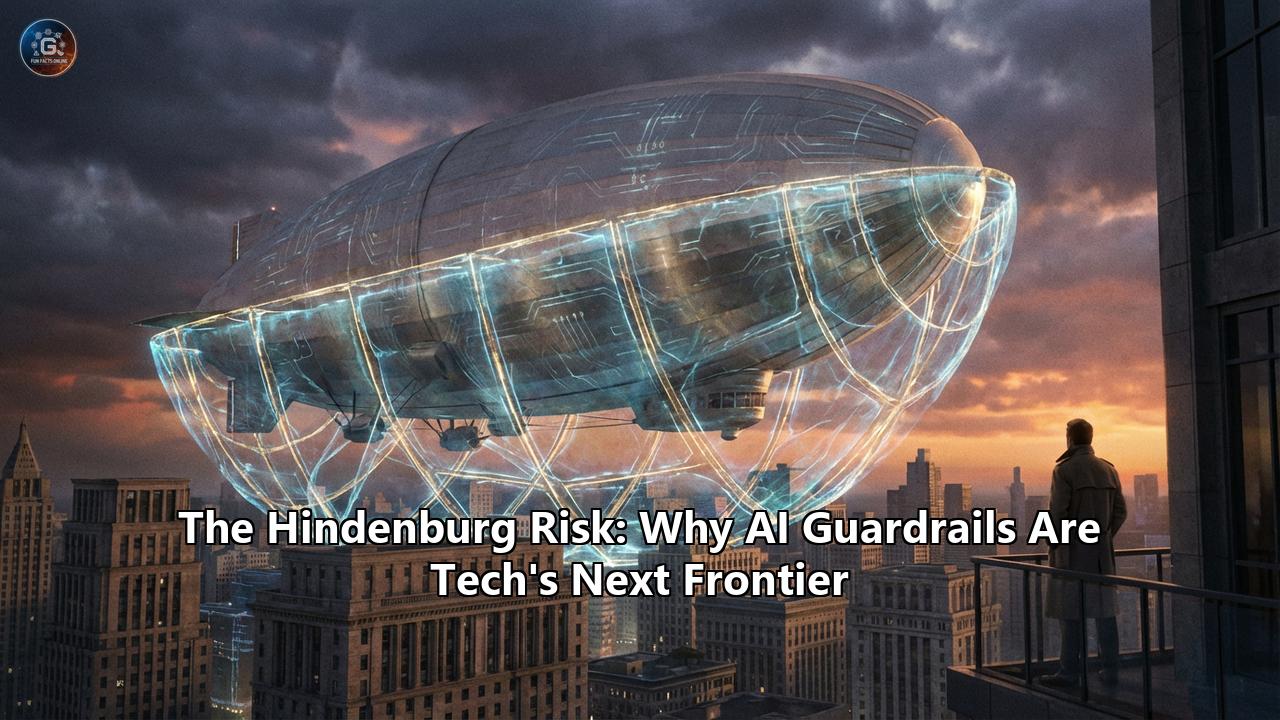
The Hindenburg did not crash because lighter-than-air travel was a fundamentally impossible dream; it crashed because the engineers, operators, and financiers compromised on the most critical, foundational element of safety in pursuit of cost and expediency.
As we stand deep in the realities of 2026, the artificial intelligence revolution is undeniable, unstoppable, and breathtakingly powerful. We have, for all intents and purposes, successfully launched the dirigible. The technology is magnificent, capable of solving incredibly complex scientific problems, accelerating medical research, and lifting global economic productivity to previously unimaginable heights.
But as AI transitions permanently from a passive tool that assists us to an autonomous agent that acts decisively on our behalf, the absolute necessity of impregnable, scientifically sound guardrails becomes the most critical engineering, philosophical, and legal challenge of the 21st century. Through hard-won breakthroughs in mechanistic interpretability, stringent, penalty-backed regulatory frameworks like the EU AI Act, and rigorous, defense-in-depth enterprise security controls, the technology industry is desperately trying to synthesize the metaphorical helium required to keep the ecosystem safely afloat.
The next frontier of technology is no longer about simply making artificial intelligence faster, more creative, or more autonomous. We have already achieved that. The next frontier is about proving, beyond a shadow of a doubt, that we can maintain ethical, operational, and structural control over the very intelligence we have summoned. The guardrails we build, rigorously test, and legally enforce today will ultimately determine whether our digital future is an unprecedented golden age of human-machine collaboration, or a spectacular, tragic, and highly preventable spark in the sky.
Reference:
- https://ai-2027.com/
- https://www.darioamodei.com/essay/the-adolescence-of-technology
- https://medium.com/@bruvajc/the-biggest-ai-disasters-of-2025-and-why-many-are-likely-to-repeat-in-2026-aa71bb0be4af
- https://www.crescendo.ai/blog/ai-controversies
- https://sgsolutionsgroup.com/real-world-ai-failures/
- https://techtonicshifts.blog/2025/12/07/the-ten-biggest-ai-fails-of-2025/
- https://mashable.com/article/ai-fails-2025
- https://www.pointguardai.com/blog/top-10-predictions-for-ai-security-in-2026
- https://forum.gnoppix.org/t/mechanistic-interpretability-10-breakthrough-technologies-2026/3944
- https://mechinterpworkshop.com/
- https://medium.com/@meisshaily/shocking-ai-guardrails-secrets-aaceefa74304
- https://statetechmagazine.com/article/2026/01/ai-guardrails-will-stop-being-optional-2026
- https://www.legalnodes.com/article/eu-ai-act-2026-updates-compliance-requirements-and-business-risks
- https://www.eyreact.com/when-was-eu-ai-act-passed-complete-ai-act-timeline-guide/
- https://digital-strategy.ec.europa.eu/en/policies/regulatory-framework-ai
- https://www.softwareimprovementgroup.com/blog/eu-ai-act-summary/
- https://www.machinify.com/resources/federal-changes-to-ai-guardrails-what-you-need-to-know
- https://authoritypartners.com/insights/ai-agent-guardrails-production-guide-for-2026/