
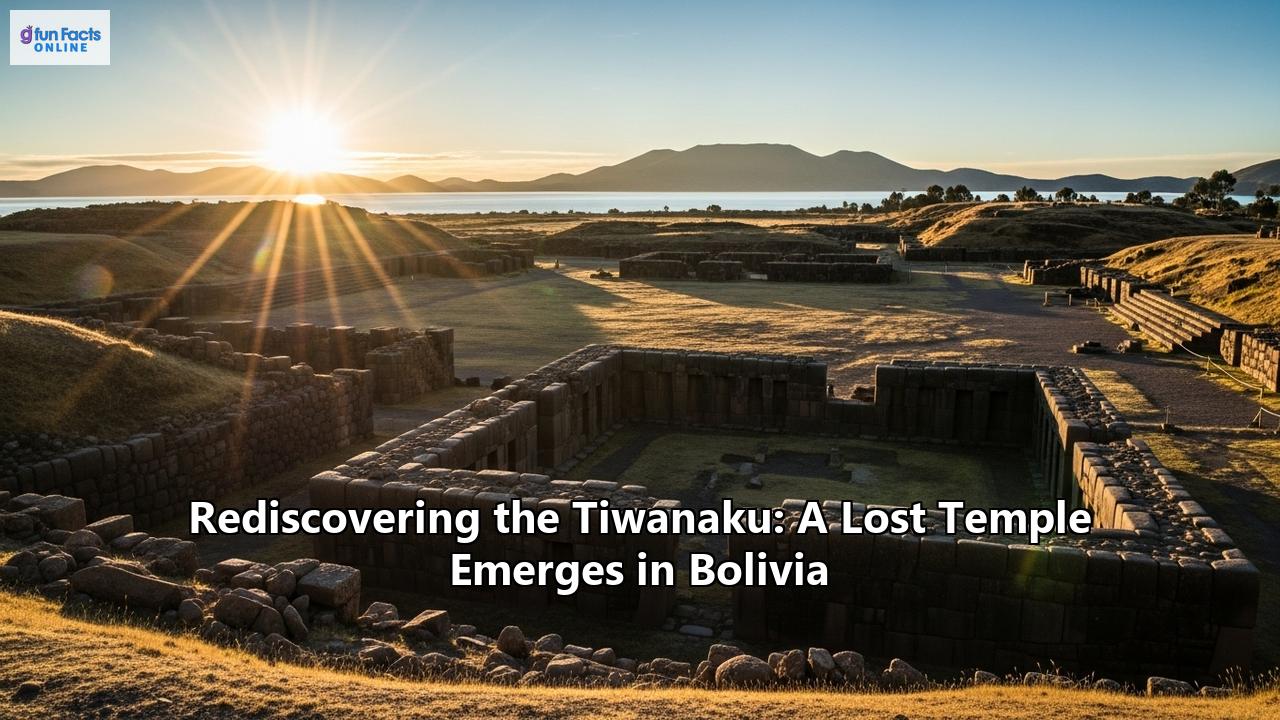
In the vast, windswept plains of the Bolivian Andes, where the air is thin and the past feels palpably present, the remnants of one of South America's most influential and enigmatic ancient civilizations, the Tiwanaku, have guarded their secrets for a millennium. Now, a stunning discovery is peeling back the layers of time, revealing a previously unknown temple complex that promises to reshape our understanding of this pre-Incan society. Archaeologists have unearthed the remains of a major ceremonial center, a testament to the Tiwanaku's power, spiritual depth, and expansive reach.
A New Chapter in Andean Archaeology: The Palaspata Temple
In a significant breakthrough, a team of archaeologists from Penn State University, in collaboration with Bolivian researchers, has identified a large temple complex in the highlands near the municipality of Caracollo. Located approximately 130 miles (about 215 kilometers) south of the renowned Tiwanaku UNESCO World Heritage site by Lake Titicaca, this newfound temple, named Palaspata, had remained hidden in plain sight on a hilltop known to local Indigenous communities but unexamined by scholars.
The discovery, published in the esteemed journal Antiquity in June 2025, is being hailed as a monumental step forward in unraveling the mysteries of the Tiwanaku civilization, which flourished between 500 and 1000 CE. Lead author Dr. José Capriles, an associate professor of anthropology at Penn State, emphasized the significance of the find, noting that while the Tiwanaku left behind impressive monuments like pyramids and terraced temples, much about their societal structure, influence, and eventual collapse around 1000 CE remains debated. This society was already in ruins by the time the Inca empire rose to prominence in the 15th century.
Unveiling the Unseen: Technology and Discovery
The faint outlines of Palaspata's architecture were not immediately obvious on the ground. Its discovery is a triumph of modern archaeological techniques. The research team employed a combination of drone-based photogrammetry and blended satellite imagery to meticulously map the subtle architectural features of the site. This high-tech approach allowed them to create a detailed 3D rendering of the structure and its topography, revealing what the naked eye might have missed.
The results were astonishing. The digital reconstructions unveiled a massive complex, roughly the size of a city block, measuring approximately 410 by 475 feet (125 by 145 meters). The temple's layout features 15 rectangular enclosures methodically arranged around a central, rectangular inner courtyard, a design that strongly echoes the architectural style of a Tiwanaku terraced platform temple. This large, modular building with its integrated sunken courtyard points to a significant investment of resources and labor by the Tiwanaku state.
A Crossroads of Faith, Trade, and Power
The location of the Palaspata temple, far from the Tiwanaku capital, was not accidental but highly strategic. At its zenith, the Tiwanaku civilization controlled a vast territory, and this temple was situated at a critical nexus connecting three distinct and vital ecosystems. To the north lay the fertile highlands surrounding Lake Titicaca, the heartland of the Tiwanaku. To the west stretched the arid Altiplano, ideal for herding llamas, a cornerstone of the Andean economy. To the east were the agriculturally rich valleys of Cochabamba.
This strategic placement suggests that Palaspata was far more than just a religious sanctuary. Researchers believe it served as a gateway node, a place where the power and influence of the Tiwanaku state were made tangible. It was a hub for trade, facilitating the movement of goods and connecting different culinary and cultural traditions. As Dr. Capriles explained, in the ancient Andes, "Most economic and political transactions had to be mediated through divinity, because that would be a common language that would facilitate various individuals cooperating.”
Rituals Written in Stone and Clay
The design and contents of the Palaspata temple offer profound insights into the spiritual life of the Tiwanaku. The layout appears to be aligned with the solar equinox, suggesting that the temple was used for ceremonies tied to astronomical events and the agricultural calendar. This astronomical precision underscores the advanced knowledge possessed by the Tiwanaku people.
Excavations at the surface of the site yielded numerous fragments of keru cups. These distinctive ceremonial vessels were used for drinking chicha, a traditional maize beer, during important feasts and celebrations. The presence of these cups strongly indicates that the temple was a vibrant center for communal gatherings and rituals.
The maize used to brew the chicha provides further evidence of the temple's role as a trade hub. Maize was not cultivated in the high-altitude location of Palaspata but was brought in from the lower, more agriculturally productive valleys of Cochabamba to the east. This underscores the temple's importance in facilitating long-distance exchange and bringing together people from different regions.
The Broader Tiwanaku World: Echoes from Under the Lake
The discovery of Palaspata adds a crucial piece to the puzzle of the Tiwanaku civilization, but it is not the only "lost" temple to emerge from the Bolivian landscape. For decades, legends have swirled around a submerged city in the depths of Lake Titicaca, the sacred birthplace of the Inca sun god, Viracocha.
In the year 2000, these legends were proven true. An international team of archaeologists discovered a massive temple structure submerged beneath the lake's surface, just off the coast of Copacabana. Estimated to be between 1,000 and 1,500 years old, the underwater temple predates the Inca and is believed to have been built by the Tiwanaku.
This submerged complex is vast, with the main temple measuring 656 feet by 164 feet (200 meters by 50 meters). Divers have also found a long road, agricultural terraces, and an 800-meter-long wall, all part of a once-thriving lakeside settlement. Over 10,000 artifacts, including gold pieces, ceramics, stone carvings, and even human and animal remains, have been recovered from the watery depths.
Since 2012, further underwater excavations led by the Free University of Brussels have uncovered 25 new submerged sites, cataloging over 20,000 objects and revealing shrines, ancient dwellings, and even a pre-Columbian port. These finds from Lake Titicaca demonstrate the deep spiritual significance of the lake to the Tiwanaku and later the Inca, who made offerings to it.
A Future for the Past
The discovery of the Palaspata temple and the ongoing exploration of the underwater ruins in Lake Titicaca highlight how much there is still to learn about the Tiwanaku. Less than 10 percent of their ruins are believed to have been excavated, leaving a vast field for future discoveries.
The Bolivian government, recognizing the immense cultural value of these sites, has expressed plans to protect and showcase this heritage. For the underwater discoveries in Lake Titicaca, there is an ambitious project to build an underwater museum, a venture that would allow visitors to witness the submerged relics firsthand while ensuring their preservation.
For Palaspata, the work has just begun. Further studies will aim to determine the temple's precise age and its exact relationship to other Tiwanaku ceremonial centers. The discovery is not just an academic achievement; it is a profound connection to a lost world. It reminds us that the history of the Andes is rich and complex, with powerful civilizations rising and falling long before the arrival of Europeans. The rediscovery of the Palaspata temple is more than just finding lost stones; it is the recovery of a forgotten narrative, a story of faith, power, and human ingenuity high in the mountains of Bolivia.
Reference:
- https://arkeonews.net/newly-discovered-tiwanaku-temple-in-bolivia-sheds-light-on-mysterious-ancient-civilization/
- https://archaeologymag.com/2025/06/lost-tiwanaku-temple-unearthed-in-bolivia/
- https://www.newsweek.com/archaeology-tiwanaku-civilization-temple-palaspata-disappearance-bolivia-2090442
- https://www.psu.edu/news/research/story/ancient-temple-ruins-discovered-andes-shed-light-lost-society
- https://www.popularmechanics.com/science/archaeology/a65191833/tiwanaku-andes-temple/
- https://www.sci.news/archaeology/palaspata-temple-14017.html
- https://indiandefencereview.com/hidden-tiwanaku-temple-bolivia/
- https://archaeology.org/news/2025/06/26/temple-built-by-enigmatic-andes-civilization-identified/
- https://www.independent.co.uk/news/science/archaeology/ancient-andes-temple-ruins-b2776933.html
- https://www.ancient-origins.net/news-ancient-places-americas/ancient-ruins-and-beneath-sacred-lake-titicaca-004012
- https://www.machupicchutrek.net/lake-titicaca-ruins/
- https://courier.unesco.org/en/articles/titicaca-sacred-lake-reveals-its-secrets
- https://architecturecoffeeandink.com/2022/07/10/17-the-mystery-of-lake-titicaca/