
The lunar surface is a graveyard of silence, a monochrome expanse where the footsteps of twelve men remain frozen in the regolith, undisturbed for decades. It is a world of magnificent desolation, as Buzz Aldrin famously described it. But it is also a world of violence. The Moon’s surface is a shooting gallery for micrometeoroids traveling at bullet-like speeds, a radiation trap bathed in the lethal ultraviolet glare of the Sun and the insidious piercing of galactic cosmic rays. Temperatures swing wildly, boiling water instantly in the sunlight and freezing nitrogen in the shadow. To live on the Moon—to truly inhabit it, not just visit—we cannot remain on the surface. We must go where the Moon itself has prepared a sanctuary for us. We must go down.
Beneath the grey dust and the cratered plains lies a secret world: a labyrinth of subterranean voids known as lava tubes. These are not the cramped, damp caves of Earth. These are basalt cathedrals, colossal tunnels forged in fire billions of years ago, some wide enough to house the Empire State Building or swallow the entirety of Central Park. In these deep, silent arteries of the Moon, the temperature is a steady, mild -20°C. The deadly radiation is blocked by thick roofs of rock. The micrometeoroids burn up or shatter harmlessly hundreds of meters above.
This is the story of humanity's future in the lunar underworld. It is a vision of Subterranean Space Cities, where the next great leap for our species will not be a footprint on the dust, but a light switched on in the dark.
I. The Geological Gift: Cathedrals of Basalt
To understand why the future of space colonization lies underground, we must first understand the violent past of our satellite. Billions of years ago, the Moon was a geologically active world. Rivers of low-viscosity basaltic lava, far hotter and more fluid than the lavas of Hawaii, flowed across the lunar maria. As these rivers flowed, the surface cooled and crusted over, forming a hard roof while the molten rock beneath continued to surge. When the eruption ceased and the lava drained away, it left behind hollow conduits—lava tubes.
On Earth, gravity pulls hard on these structures. A terrestrial lava tube is considered large if it is thirty meters wide. But on the Moon, where gravity is only one-sixth that of Earth, the physics of rock mechanics changes dramatically. The roof of a lunar lava tube can span kilometers without collapsing.
Data from the GRAIL (Gravity Recovery and Interior Laboratory) mission and the Lunar Reconnaissance Orbiter (LRO) have confirmed the existence of these massive voids. Gravitational anomalies suggest mass deficits—empty spaces—beneath the surface that align with sinuous rilles, the collapsed trenches of ancient lava flows. But the most striking evidence comes in the form of "skylights."
In the Marius Hills region, a volcanic province on the Oceanus Procellarum, a dark pit gapes open in the sunlight. It is roughly 65 meters in diameter and drops 80 meters straight down before opening up into a void. This is not a crater formed by an impact; it is a roof collapse, a natural doorway into the underworld. The Japanese orbiter Kaguya and NASA’s LRO have imaged this and other skylights, including one in Mare Tranquillitatis, the Sea of Tranquility. These are the entry points to a ready-made infrastructure that would cost trillions of dollars and centuries of time to build from scratch.
The sheer scale of these tubes is difficult to comprehend. Theoretical models suggest stable lunar tubes could be up to 5 kilometers wide. Inside, the ceiling could soar hundreds of meters overhead. In such a space, you would not feel like a cave dweller; you would feel like you were standing in a vast, dark valley. The volume of a single segment of the Marius Hills tube could contain the entire city center of Philadelphia. It is here, in this unlimited volume, that we will build.
II. The Surface Problem: Why We Cannot Stay Above
The romantic image of a lunar base is often a cluster of domed habitats on the surface, glowing warmly against the black sky, with Earth hanging like a blue marble overhead. This image, while inspiring, is an engineering nightmare.
The Radiation sieve: The Earth is protected by a thick atmosphere and a powerful magnetosphere that deflects solar wind and cosmic rays. The Moon has neither. On the surface, an astronaut is exposed to Solar Particle Events (SPEs)—sudden bursts of protons from solar flares that can cause acute radiation sickness and death within hours. Even on quiet days, the background Galactic Cosmic Rays (GCRs)—heavy, high-energy ions from exploding stars—gradually shred DNA, increasing cancer risk and causing cognitive decline. To protect a surface habitat, we would need to pile meters of regolith (lunar soil) on top of our domes, effectively burying them anyway. The Thermal Sawtooth: The lunar day lasts 14 Earth days, followed by 14 Earth days of night. At the equator, daytime temperatures hit a searing 120°C (250°F), hot enough to boil water. At night, they plunge to -130°C (-200°F). This thermal cycling wreaks havoc on materials. Metals expand and contract, seals degrade, and electronics fail. A surface base requires heavy, energy-hungry active thermal control systems to keep the humans inside alive. The Micrometeoroid Rain: The Earth burns up meteors in the mesosphere. On the Moon, a grain of sand traveling at 20 kilometers per second hits the surface with the force of a hand grenade. A surface habitat is constantly being sandblasted by these invisible bullets. A larger strike could depressurize a dome instantly. The Dust: Lunar regolith is not like beach sand. It is jagged, electrostatically charged shards of glass created by billions of years of impacts. It sticks to everything, clogs machinery, destroys seals, and shreds lungs if inhaled. On the surface, dust levitation caused by electrostatic charging at the terminators (sunrise/sunset lines) coats everything in a fine, abrasive powder.Inside a lava tube, all these problems vanish.
- Radiation: The hundreds of meters of basalt overhead provide shielding superior to Earth's atmosphere. Radiation levels inside a tube are negligible.
- Temperature: Down there, the sun never rises and never sets. The temperature remains a constant, stable -20°C (-4°F). While cold, this is easily managed. It is a stable thermal sink, meaning we only need to generate a little heat, not constantly fight massive fluctuations.
- Micrometeoroids: The roof takes the hits. The city below is safe.
- Dust: While the floor of the tube is dusty, it is "dead" dust, undisturbed by the solar wind’s electrostatic charging. Once paved or covered, it stays down.
III. Entering the Abyss: The Engineering of Access
The first challenge of the subterranean city is simply getting inside. The skylights are vertical shafts, dropping into the darkness. We cannot simply land a rocket inside the hole—the precision required is too high, and the exhaust plume would turn the tube into a shrapnel storm of kicked-up rocks.
Phase 1: The ScoutsBefore humans arrive, robots will claim the dark. The European Space Agency (ESA) has conceptualized the DAEDALUS mission—a sphere-shaped robot lowered on a tether. Equipped with LIDAR and stereoscopic cameras, it will hang in the void, mapping the interior in 3D. Other concepts involve "Cavehoppers," small robots that use the low gravity to hop around the debris pile on the tube floor, and "SphereX" drones that use cold-gas thrusters to fly through the vacuum.
These scouts will look for structural stability. They will check for "roof blocks"—massive slabs that might have fallen from the ceiling. They will map the floor, which is likely covered in a chaotic pile of rubble directly under the skylight (the talus slope) but may smooth out into a flat floor of solidified lava further in. Most importantly, they will hunt for ice. In the permanent darkness of these tubes, water ice from ancient comet impacts might be preserved, trapped in the cold.
Phase 2: The Sky-CraneOnce a site is selected, the "Access Tower" is built on the surface rim of the skylight. This structure will be the lifeline of the city. It will feature a massive solar array farm spreading out across the surface to catch the sunlight, and a nuclear fission reactor for the long lunar night.
A heavy-lift crane or elevator system will be installed over the pit. In the low gravity, cables can be thinner yet carry more weight. This elevator will lower the first construction rovers, the habitats, and the humans. It is the umbilical cord connecting the sunlit world of power and communications to the dark world of habitation.
Phase 3: Sealing the BreachWe do not need to pressurize the entire 50-kilometer tube immediately. That is a task for the 22nd century. The initial approach is the "Ship in a Bottle" concept. We will lower inflatable habitats—huge, Kevlar and Vectran balloons similar to the BEAM module currently on the ISS, but much larger—and inflate them inside the tube.
However, a more ambitious concept is "The Plug." Engineers could seal the skylight itself. By spanning the hole with a high-tensile membrane or a dome printed from surface regolith, we can turn the area directly under the skylight into a pressurized atrium. The "Project Loop" concept envisions a 3D-printed ring at the entrance, acting as an airlock and interface, while the city grows outward into the tunnel.
IV. Architecture of the Deep: Building the City
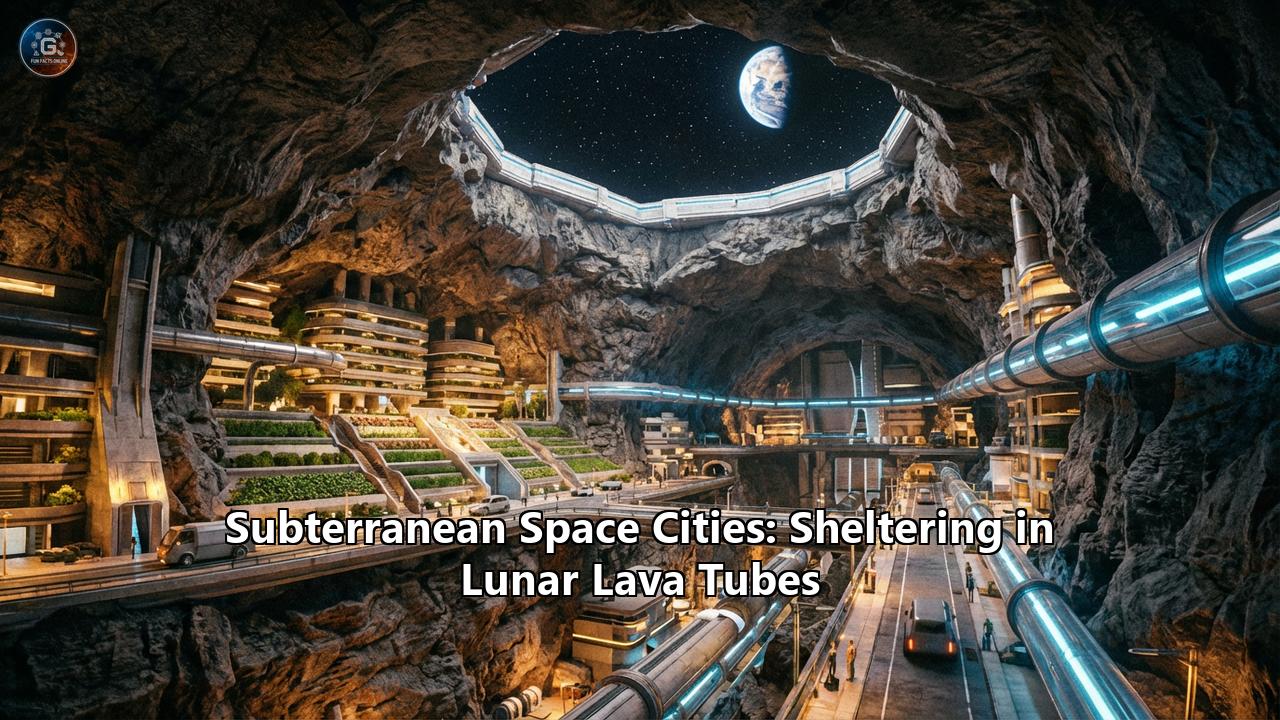
What does a city in a lava tube look like? It does not look like a sci-fi bunker with claustrophobic metal corridors. It looks like a park.
Because the tube protects against the vacuum and radiation, the structures inside don't need to be armored tanks. They can be light, airy, and architectural.
The Inflatable Districts:Imagine rows of translucent, glowing cylinders resting on the tube floor. These are the main habitats. Inside, the air pressure holds the shape. Because the external environment is a vacuum, the walls are under tension. High-strength fabrics allow for large open spaces.
The Regolith Shells:For radiation shielding on the surface, we need meters of dirt. Inside, we don't. But we might still use regolith concrete (lunarcrete) for flooring, roads, and internal radiation shielding for nuclear power sources. Swarms of autonomous 3D printers will chew up the loose rocks on the floor, mix them with a binding agent (perhaps sulfur or a polymer brought from Earth), and print the foundations of the city.
The Verticality:The ceiling might be 100 meters high. In one-sixth gravity, you can build tall, slender towers that would collapse on Earth. You can have suspension bridges spanning the width of the tube with gossamer-thin cables. Staircases can be steep and spiraling, as climbing them is effortless.
The Artificial Sky:The psychological weight of living underground is real. To counter this, the ceiling of the tube—the basalt roof—will be utilized. We can project a live feed of the Earth and the stars onto the ceiling, or simulate a blue sky with moving clouds using OLED panels or laser projection. This "circadian lighting" is crucial. It will brighten to a brilliant blue-white in the "morning" and soften to a warm amber in the "evening," maintaining the 24-hour cycle of human biology despite the 28-day lunar cycle outside.
V. Life Support: The Breath of the City
In a closed system, nothing is wasted. The city must be a biological machine.
The Air:Carbon dioxide exhaled by the colonists is scrubbed. In the early days, this is done chemically (using zeolites). As the city grows, it transitions to bioregeneration. Algae tanks and hydroponic farms absorb CO2 and release oxygen. The sheer volume of the lava tube offers a buffer; unlike a small capsule where air goes bad in hours, the massive volume of a sealed tube section (if we eventually seal a section) provides a reservoir of air that stabilizes the system.
The Water:Water is the gold of the Moon. We will mine it from the polar craters or from deep ice deposits within the tubes themselves. Once in the system, it loops endlessly. Urine, sweat, and humidity are recaptured, filtered, mineralized, and drunk again. The shower you take today is the coffee you drink tomorrow.
The Farm:You cannot ship steaks from Earth. The city will have vast hydroponic bays glowing with pink and purple LED lights (optimized for photosynthesis). They will grow high-calorie crops: sweet potatoes, soybeans, wheat, and leafy greens. Insect protein (crickets, mealworms) will likely be the first livestock—efficient, dense in protein, and low-waste. Later, tilapia fish farms and even poultry might be introduced. The farm is not just a food source; it is the "green lung" of the city and a psychological refuge—a place of smell and color in a world of grey rock.
VI. Powering the Depths
A city needs gigawatts.
Solar:On the surface above the tube, fields of solar panels track the sun. But the lunar night is two weeks long. Batteries are too heavy to store that much power.
Nuclear:Small Modular Reactors (SMRs), like the Kilopower units developed by NASA, will be lowered into the tube or buried near the entrance. Nuclear power is ideal for the Moon; it is dense, reliable, and produces heat (which is useful in the -20°C tube).
Power Beaming:A futuristic solution involves the "peaks of eternal light" at the lunar poles, where the sun never sets. Solar farms there could generate power and beam it via microwaves or lasers to relay satellites, which then beam it down to the rectennas (receiving antennas) at the skylight of our lava tube city. This creates a planetary power grid.
VII. The Human Experience: Society in the Void
What is it like to live there?
Movement:You weigh 16% of your Earth weight. You don't walk; you lope. In the large open spaces of the tube, human flight becomes possible. With a simple pair of fabric wings and a bit of practice, you could strap on wings and fly across the city powered only by your own muscles. Sports will be reinvented. 3D basketball, zero-g gymnastics, and vertical parkour will be the pastimes of lunar youth.
Psychology:Biophilic design is mandatory. We need nature. The architecture will incorporate fractal patterns, natural materials (bamboo grown on-site), and running water. The sound of a fountain is not just decoration; it is white noise to mask the hum of ventilation fans and a reminder of Earth.
Governance:Who owns the city? The Outer Space Treaty says no nation can claim sovereignty over the Moon. But it allows for the use of resources. The city will likely be an international zone, governed by a "Lunar Charter" similar to the Antarctic Treaty or the laws of the high seas. It might start as a scientific outpost, run by a commander, but as civilians arrive—miners, engineers, artists—it will evolve into a democracy or a corporate-state.
VIII. The Economy: Why We Stay
A city cannot survive on subsidies forever. It must pay its way.
- Mining: The regolith contains Helium-3 (a potential fusion fuel), titanium, and rare earth elements. The tubes provide the base of operations for surface strip-mining rovers.
- Manufacturing: The vacuum and low gravity are perfect for creating things impossible on Earth: ZBLAN fiber optics (which require zero gravity to avoid crystallization), perfectly spherical ball bearings, and biological organs printed without collapsing under their own weight.
- Data Havens: The cold, stable environment and lack of seismic activity (Moonquakes are rare and weak compared to Earth) make lava tubes perfect for long-term data storage servers.
- Tourism: For the wealthy, the Moon is the ultimate destination. The lava tube hotel offers safety that a surface lander cannot. The "Grand Hall" of the Marius Hills tube will be the greatest tourist attraction in the solar system.
IX. Conclusion: The Womb of a New Civilization
The first cities on Earth were built in river valleys. The first cities on the Moon will be built in stone rivers.
Subterranean space cities are not just a safety measure; they are an evolutionary necessity. They allow us to shed the spacesuit. Inside the tube, sealed and pressurized, we can walk in shirtsleeves. We can sit in a park and watch a tree grow. We can raise children without fear of solar flares.
The lava tubes of the Moon are nature's invitation. They are the empty houses waiting for the tenants to arrive. When we finally seal that skylight and fill the great basalt hall with air and light, we will have done more than build a base. We will have birthed a new world, safely tucked beneath the skin of the old one. We will be, finally, Solarians.
Reference:
- https://www.esa.int/Enabling_Support/Preparing_for_the_Future/Discovery_and_Preparation/En_route_to_exploring_lunar_caves
- https://www.hou.usra.edu/meetings/lpsc2021/pdf/1574.pdf
- https://www.youtube.com/watch?v=w4iEjht96pQ
- https://www.researchgate.net/publication/398261292_Project_Loop_A_Sustainable_Lunar_Settlement_Model_by_Sealing_and_Inhabiting_a_Lava_Tube
- https://www.nasa.gov/wp-content/uploads/2017/07/niac_2011_phasei_whittaker_lavatubesandcaves_tagged.pdf
- https://x-energy.com/why/nuclear-and-space/lunar-surface-power
- https://www.universetoday.com/articles/does-beaming-power-in-space-make-sense-at-the-moon
- https://www.researchgate.net/publication/338346765_A_Dimension_of_Biophilia_in_Urban_Design
- https://www.youtube.com/watch?v=uAmbZCtNC9U
- https://www.thespacereview.com/article/2703/1
- https://www.unoosa.org/documents/pdf/copuos/lsc/2017/symp-01.pdf
- https://en.wikipedia.org/wiki/Moon_Treaty
- https://www.unoosa.org/oosa/en/ourwork/spacelaw/treaties/introouterspacetreaty.html