
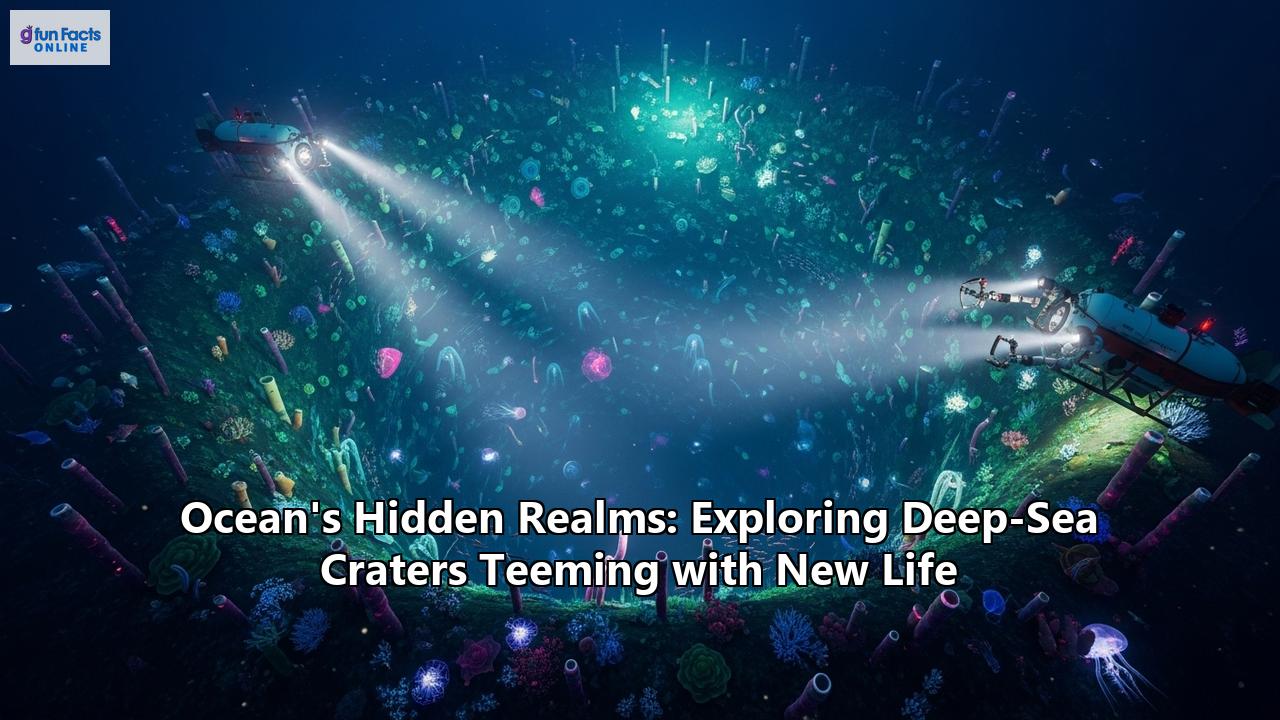
An expedition to the East Pacific Rise off the coast of Central America has revealed a previously unknown ecosystem. In the pitch-black, crushing depths of the ocean, a world of vibrant life thrives in the most unlikely of places: deep-sea craters and their associated hydrothermal vents. For decades, these oases of life, powered by chemical energy from the Earth's interior rather than sunlight, have fascinated scientists. But recent expeditions, armed with cutting-edge technology, have unveiled an even greater abundance and diversity of life than previously imagined, challenging our understanding of the limits of life on our own planet and offering tantalizing clues about the potential for life elsewhere in the universe.
A Glimpse into the Abyss: The Discovery of Deep-Sea Vents
The story of our exploration of these hidden realms began in 1977 near the Galápagos Islands. Scientists, predicting the existence of underwater hot springs, were nonetheless astonished by what they found at a depth of 2,500 meters (8,250 feet). Instead of a barren seafloor, they discovered bustling ecosystems teeming with bizarre, never-before-seen organisms. Towering structures, dubbed "chimneys," spewed superheated, mineral-rich water, creating a stark contrast with the near-freezing temperatures of the surrounding deep sea. This landmark discovery fundamentally altered our perception of where and how life could exist, proving that sunlight was not the only source of energy for life on Earth.
These hydrothermal vents form in volcanically active regions, such as mid-ocean ridges and subduction zones, where Earth's tectonic plates are either pulling apart or colliding. Seawater seeps through fissures in the ocean crust, where it is heated by underlying magma chambers to temperatures that can exceed 400°C (750°F). This intense heat triggers chemical reactions, stripping minerals and chemicals from the surrounding rocks. The now buoyant, superheated fluid erupts back into the ocean, creating the characteristic plumes of "black smokers" or "white smokers," depending on the mineral composition. It is this chemical-rich "soup" that fuels these unique deep-sea communities.
The Engine of Life: Chemosynthesis
In the absence of sunlight, life at hydrothermal vents relies on a process called chemosynthesis. At the base of this extraordinary food web are chemosynthetic bacteria. These microbes are the primary producers, analogous to plants on land. Instead of using sunlight for photosynthesis, they harness the chemical energy from compounds like hydrogen sulfide, which are abundant in the vent fluids, to produce organic matter. This process forms the foundation upon which the entire vent ecosystem is built. All other animals at the vents ultimately depend on these bacteria for their nutrition.
Recent discoveries have expanded our understanding of chemosynthesis, revealing that other chemicals, such as hydrogen, can also fuel these deep-sea communities. The discovery of vast hydrothermal systems releasing copious amounts of hydrogen opens up new avenues of research into the metabolic diversity of these extreme environments.
A World of Strange and Wonderful Creatures
The ecosystems that flourish around deep-sea craters and vents are populated by a host of organisms, many of which are found nowhere else on Earth. These extremophiles are uniquely adapted to survive in an environment of crushing pressure, extreme temperatures, and toxic chemicals.
Some of the most iconic inhabitants of hydrothermal vents are the giant tubeworms (Riftia pachyptila). These striking creatures, which can grow to be several feet tall, have no mouth or digestive tract. Instead, they have a bright red, feathery plume that acts as their gills, absorbing chemicals from the vent fluid. They host chemosynthetic bacteria within a specialized organ in their bodies. The bacteria produce food for the worm in a remarkable symbiotic relationship.
Alongside the giant tubeworms, a diverse array of other fascinating creatures can be found. The "Pompeii worm" (Alvinella pompejana) is one of the most heat-tolerant animals on the planet, living in tubes right on the sides of the hot smoker chimneys. They are covered in a fleece-like coating of bacteria that is thought to help protect them from the intense heat.
Other common residents include:
- Crabs and Shrimp: Various species of crabs and shrimp are often seen crawling over the vent structures, feeding on bacteria and other small organisms.
- Mollusks: Large clams and mussels cluster around the vents, also housing symbiotic bacteria that provide them with nourishment.
- Fish: Bizarre-looking vent fish, such as the eel-like zoarcid fish, are often found among the tubeworm colonies, feeding on parasites and other small invertebrates.
- Snails and other Gastropods: A variety of snails can be found grazing on the bacterial mats that cover the surfaces around the vents.
New Frontiers of Discovery: Recent Expeditions and Groundbreaking Finds
Recent years have seen a surge in deep-sea exploration, thanks to advancements in technology such as high-resolution sonar mapping and sophisticated remotely operated vehicles (ROVs). These technological leaps have allowed scientists to explore previously inaccessible areas and have led to a series of astonishing discoveries.
The Galapagos Vents: A Hotbed of New Species
In the very region where hydrothermal vents were first discovered, recent expeditions continue to unveil new wonders. In late 2023, scientists aboard the Schmidt Ocean Institute's research vessel Falkor (too) discovered two new hydrothermal vent fields in the Galapagos Marine Reserve: "Tortugas" and "Crab Path". The "Tortugas" field, named for its turtle-like mounds, consists of towering chimneys reaching up to 50 feet tall.
These expeditions revealed at least 15 species previously unknown to the region, including a "living fossil" mollusk known as a monoplacophoran. Perhaps most remarkably, they discovered a nursery for the eggs of Pacific white rays in a low-temperature hydrothermal vent area. This is only the second such nursery ever to be documented in the world. These discoveries were made possible by pioneering high-resolution mapping technologies that created detailed seafloor maps with a resolution of up to 3 centimeters, allowing scientists to pinpoint the vents and characterize their chemical emissions and resident animal life.
A Hidden World Beneath the Seafloor
In another groundbreaking discovery, an international team of scientists found an entirely new ecosystem thriving in volcanic caves beneath hydrothermal vents. For over four decades, research had focused on the life found on the surface of the vents. However, by using an ROV to overturn chunks of volcanic crust, researchers uncovered a network of subsurface cavities teeming with worms, snails, and chemosynthetic bacteria living in the 25°C (77°F) water.
This discovery suggests that the habitat of hydrothermal vents extends into a new, previously unknown dimension. It also provided crucial evidence for how vent animals, like tubeworms, might colonize new habitats. Scientists have long been puzzled by how the larvae of these stationary animals could travel between distant vent fields. The discovery of tubeworm larvae living in these subsurface fluid flows suggests that they may travel beneath the seafloor to establish new communities. This subterranean world represents a new frontier in our understanding of deep-sea ecosystems.
The Kunlun System: A Giant in the Pacific
In a discovery that dwarfs previously known hydrothermal fields, Chinese researchers have explored a massive system of deep-sea craters in the Pacific Ocean northeast of Papua New Guinea. Named the "Kunlun" system, it is composed of 20 large craters, with the largest spanning an incredible 1,800 meters (5,900 feet) wide and 130 meters (430 feet) deep. The entire field covers an area of about 11 square kilometers (4.3 square miles), making it hundreds of times larger than the famous "Lost City" hydrothermal field in the Atlantic.
What makes the Kunlun system particularly intriguing is its release of copious amounts of hydrogen, which is thought to fuel the diverse life found there. Researchers observed a thriving community of shrimp, squat lobsters, anemones, and tubeworms, which may rely on hydrogen-fueled chemosynthesis. The cooler temperatures of this system, below 90°C (194°F), and its unusual location in the interior of a tectonic plate, far from a mid-ocean ridge, challenge long-held assumptions about where these life-sustaining systems can form. The hydrogen-rich environment of the Kunlun system is also thought to be similar to the chemical conditions on early Earth, offering a unique natural laboratory for studying the origins of life.
Life in the Deepest Trenches
The exploration of the hadal zone, the deepest part of the ocean found in trenches, has also yielded extraordinary discoveries. In the Kuril-Kamchatka and Aleutian trenches of the northwest Pacific, an international team using the manned submersible Fendouzhe descended to depths of over 31,000 feet (9,500 meters). What they found was "unbelievable": dense communities of tubeworms, mollusks, and other creatures stretching for miles in the crushing darkness.
These are the deepest known ecosystems on Earth sustained by chemicals seeping from the seafloor. Analysis of the samples collected revealed thousands of previously unknown species of microorganisms, with over 89% of the prokaryotic species identified being new to science. The discovery that these extensive chemosynthetic communities are not just confined to hydrothermal vents but can also be found in the deepest ocean trenches significantly expands the known limits of where life can exist on our planet.
The Importance of Deep-Sea Crater Ecosystems
The ongoing exploration of deep-sea craters and their associated ecosystems is more than just a quest to find new and unusual creatures. These discoveries have profound implications for several fields of science.
Clues to the Origin of Life
Many scientists hypothesize that life on Earth may have originated in hydrothermal vents. The chemical-rich, energy-abundant environment, shielded from the harsh conditions of the early Earth's surface, could have provided the perfect crucible for the first life to emerge. The discovery of systems like Kunlun, with its hydrogen-rich fluids reminiscent of early Earth's chemistry, provides a powerful model for testing these hypotheses.
Understanding the Limits of Life
The study of extremophiles from deep-sea vents pushes the boundaries of our understanding of how life can adapt to extreme conditions. The unique metabolic pathways and adaptations of these organisms to high pressure, extreme temperatures, and toxic chemicals could have significant applications in biotechnology and medicine.
Potential for Extraterrestrial Life
The discovery of life thriving in the absence of sunlight in the deep ocean has significant implications for the search for extraterrestrial life. If life can exist in such extreme environments on Earth, it raises the possibility that similar ecosystems could exist in the subsurface oceans of icy moons like Jupiter's Europa or Saturn's Enceladus, which are thought to have hydrothermal activity on their ocean floors. The adaptability of organisms in Earth's deep-sea trenches gives hope to those searching for life on other worlds.
Threats to these Hidden Realms
Despite their remoteness, these unique and fragile ecosystems are not immune to human impacts. The primary threat facing deep-sea vents is the prospect of deep-sea mining. Inactive hydrothermal vents can contain rich deposits of valuable minerals like copper, zinc, gold, and silver. As terrestrial resources become scarcer, the pressure to exploit these deep-sea deposits is growing.
However, the potential environmental consequences are immense. Mining activities could destroy vent habitats, release toxic plumes, and have devastating impacts on the unique and often slow-growing species that live there. Many of the species found at these vents are endemic, meaning they are found nowhere else on Earth. The destruction of a single vent field could lead to the extinction of multiple species.
The scientific community is urging caution and advocating for more research to understand these ecosystems before any large-scale mining is permitted. The data collected during recent expeditions will be crucial for understanding the life cycle of hydrothermal vent ecosystems and their importance to the planet, helping to inform decisions about their protection. Ecuador has already called for a preventive pause on deep-sea mining, highlighting the growing international concern.
The Future of Deep-Sea Exploration
We are living in a golden age of deep-sea exploration. As technology continues to advance, we will be able to explore even more of our planet's hidden realms. The development of autonomous underwater vehicles (AUVs) and advanced in-situ sensors, like the InVADER payload being developed by NASA, will allow for long-term, continuous monitoring of these dynamic environments.
Each new expedition brings with it the potential for groundbreaking discoveries that will rewrite our textbooks and reshape our understanding of life itself. From the bizarre creatures that call these deep-sea craters home to the profound questions they help us answer about our own origins and our place in the cosmos, the exploration of the ocean's hidden realms is a journey of discovery that has only just begun. The secrets of the deep are waiting to be unveiled, and the wonders they hold are sure to captivate and inspire for generations to come.
Reference:
- https://schmidtocean.org/scientists-discover-new-ecosystem-underneath-hydrothermal-vents/
- https://www.whoi.edu/oceanus/feature/the-discovery-of-hydrothermal-vents/
- https://www.youtube.com/watch?v=JtV-FP212Uc
- https://www.livescience.com/planet-earth/rivers-oceans/chinese-submersible-explores-previously-unknown-giant-craters-at-the-bottom-of-the-pacific-and-theyre-teeming-with-life
- https://oceanexplorer.noaa.gov/wp-content/uploads/2022/10/hydrothermal-vents-fact-sheet.pdf
- https://www.cbsnews.com/news/underwater-discovery-deep-sea-trenches/
- https://oceanexplorer.noaa.gov/okeanos/explorations/ex1605/background/vents/welcome.html
- https://daily.jstor.org/volcanic-ecosystems-in-the-deep-ocean/
- https://news.ssbcrack.com/chinese-researchers-discover-giant-hydrothermal-system-in-pacific-shedding-light-on-origins-of-life/
- https://www.worldatlas.com/articles/the-deep-sea-ecosystem-life-in-the-dark-cold-waters.html
- https://www.naturetoday.com/intl/en/nature-reports/message/?msg=31144
- https://www.miamiherald.com/news/nation-world/world/article278076452.html
- https://www.darwinfoundation.org/en/news/all-news-stories/scientists-used-high-resolution-mapping-technologies-to-find-new-hydrothermal-vents-and-discover-at-least-15-unknown-species-in-the-galapagos-marine-reserve/
- https://www.nathab.com/blog/new-species-deep-sea-vents-galapagos
- https://www.popularmechanics.com/science/animals/a44784168/new-ecosystem-under-ocean-floor/
- https://www.smithsonianmag.com/smart-news/in-a-first-scientists-find-animals-thriving-beneath-the-ocean-floor-in-hidden-habitats-near-deep-sea-vents-180985316/
- https://www.sciencealert.com/stunning-discovery-deep-in-the-ocean-dwarfs-the-famous-lost-city
- https://www.livescience.com/animals/first-of-it-kind-footage-captures-bizarre-sea-creatures-flourishing-in-extreme-depths-of-the-ocean
- https://www.popularmechanics.com/science/environment/a65594783/hidden-world-new-life-forms/
- https://deep-sea-conservation.org/explore/deep-sea-life-and-habitats/
- https://www.hou.usra.edu/meetings/lpsc2021/pdf/2505.pdf