
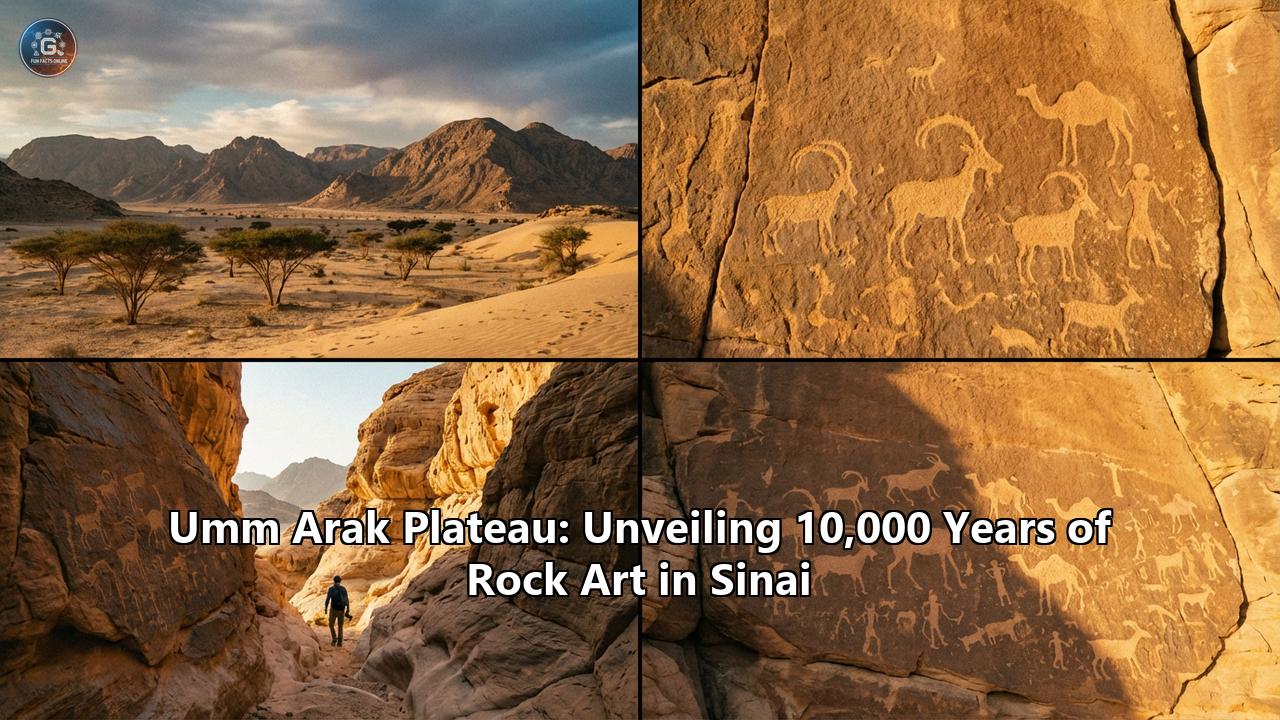
The wind howls across the fractured sandstone of the Tih Plateau, carrying with it the dust of millennia. Here, in the rugged heart of South Sinai, the landscape is a testament to the raw power of nature—a vast, arid expanse of ochre and burnt orange that seems, at first glance, to be timeless and unchanging. But hidden within the folds of these ancient mountains lies a secret, a silent chronicle of human history that has waited ten thousand years to be told.
This is the story of the Umm Arak Plateau, a newly discovered archaeological marvel that has shattered our understanding of human habitation in the Sinai Peninsula. It is a story of a "Green Sinai" teeming with life, of ancient miners seeking turquoise for the pharaohs, of Nabataean traders navigating the stars, and of the Bedouin custodians who have guarded these secrets for generations.
Recent announcements by the Egyptian Ministry of Tourism and Antiquities have unveiled this spectacular site to the world—a natural rock shelter extending over 100 meters, adorned with vivid rock art, inscriptions, and evidence of habitation spanning from the Neolithic era to the Islamic period.
Join us on a journey through deep time as we explore the "Mother of Arak Trees," unlocking the mysteries of the artists who painted their world in red ochre and gray ash, and discovering what their legacy tells us about our shared human heritage.
Part I: The Discovery – A Secret Revealed
The discovery of the Umm Arak site in early 2026 was not a sudden stumble upon a buried treasure, but the fruit of a meticulous collaboration between modern science and indigenous knowledge. The Sinai Peninsula is vast, its terrain unforgiving. To navigate it requires more than satellite imagery and GPS; it requires the ancestral memory of those who call it home.
The Role of Sheikh Rabie BarakatThe hero of this discovery is Sheikh Rabie Barakat, a local resident of the Serabit el-Khadim area. In the tradition of the Bedouin, the land is not just a physical space but a living archive. Every wadi, every peak, and every shaded overhang has a name and a story. Sheikh Rabie guided the mission from the Supreme Council of Antiquities (SCA) to this remote sandy area, approximately five kilometers northeast of the famous Temple of Hathor at Serabit el-Khadim.
For the archaeologists, led by the SCA, the site was a revelation. Tucked away on the eastern side of the Umm Arak Plateau was a natural sandstone shelter. It was massive—stretching over 100 meters in length, with a depth of two to three meters. The ceiling, varying in height from a crouching half-meter to a standing 1.5 meters, acted as a canvas protected from the harsh sun and eroding winds.
The "Mother of Arak"The name itself, Umm Arak, offers a poetic clue to the region's past. In Arabic, "Umm" means "Mother of," and "Arak" refers to the Salvadora persica, the toothbrush tree. Known for its fibrous branches used as natural toothbrushes (miswak) across the Islamic world, the Arak tree is a survivor. Its presence—or the memory of its presence—in the place name suggests a time when this arid plateau might have supported more vegetation, a subtle linguistic fossil hinting at a wetter, greener past.
When the researchers, including SCA Secretary-General Hisham El-Leithy, first illuminated the ceiling of the shelter, they were met with a breathtaking sight: a crowded, chaotic, and beautiful gallery of animals and symbols, painted in vibrant hues that had defied the passage of ten millennia.
Part II: The Green Sinai – 10,000 Years Ago
To understand the oldest art at Umm Arak, we must strip away the modern desert. We must travel back to the Holocene Wet Phase, roughly 10,000 to 5,500 BC.
Today, Sinai is a desert. But in the Neolithic period, the Earth’s orbital mechanics shifted the monsoon rains northward. The Sahara and the Sinai were not barriers of sand, but corridors of savannah. The wadis that are now dry riverbeds were flowing streams. The plateau was carpeted in grasses and dotted with acacia and, yes, Arak trees.
The Red Pigment PaintingsThe oldest layer of art at Umm Arak consists of paintings executed in red ochre. These are the voices of the Neolithic hunter-gatherers.
- The Subjects: They painted what they saw and what they needed. The ceiling is alive with depictions of ibex, gazelles, and perhaps even wild cattle and ostriches—fauna that thrived in the green savannah.
- The Style: These are not crude sketches. They show a keen observation of animal anatomy and movement. The use of red pigment, likely derived from iron-rich minerals ground and mixed with animal fat or plant gum, has chemically bonded with the sandstone, preserving the images against the elements.
These paintings are more than art; they are a form of sympathetic magic or prayer. By capturing the image of the prey, the hunter might have hoped to ensure the success of the hunt, or perhaps thank the spirit of the animal. In a world where survival depended on the migration of herds, this shelter was likely a sacred lookout—a place to watch the plains below for the movement of game.
The Mystery of the Grayscale ArtOne of the most exciting aspects of the Umm Arak discovery is the documentation of "grayscale" paintings. This is a rarity. While red ochre is common in prehistoric rock art globally, the use of gray/black pigments (likely charcoal or ash-based) represents a different artistic tradition or perhaps a different time period. These figures are currently under intense study. Do they represent a specific tribe? A shift in available materials? Or a different symbolic language entirely?
Part III: The Hunters of the Plateau
As the millennia passed and the climate began to dry, the lush savannah slowly retreated. The people of Sinai adapted. The art at Umm Arak evolved from the painted forms of the wet phase to the engraved petroglyphs of the drying world.
The Sunken Relief EngravingsThe archaeologists found incredibly detailed engravings carved into the rock face. One scene, in particular, stands out as a masterpiece of narrative art:
- The Scene: A hunter stands poised, a bow drawn, the tension of the string almost palpable in the stone.
- The Companions: He is not alone. Beside him are hunting dogs.
This single image tells us volumes about the domestication of dogs in the region and the sophistication of hunting tactics. The use of dogs suggests a partnership with nature, a move away from solitary stalking to coordinated group hunting. The fact that this was carved in sunken relief (where the image is carved into the rock rather than the background being cut away) shows a high level of technical skill and the use of harder stone tools, likely flint chisels found at the site.
Part IV: The Pharaohs’ Turquoise – The Middle Kingdom Connection
Five kilometers to the southwest of Umm Arak lies Serabit el-Khadim, one of the most significant sites in Pharaonic history. This was the "Terrace of Turquoise." For centuries, Egyptian pharaohs sent massive mining expeditions here to extract the blue-green stone that symbolized rebirth and the goddess Hathor.
The discovery at Umm Arak has yielded pottery shards dating to the Middle Kingdom (approx. 2055–1650 BC). This confirms that the shelter was not just a prehistoric relic but remained an active part of the landscape during the height of Egyptian civilization.
A Refuge for Miners?Life in the turquoise mines was brutal. The scorching heat, the dust, and the isolation were torment for the workers. The Umm Arak shelter, with its deep shade and elevated position catching the northern breeze, would have been a paradise compared to the stifling mines.
It is easy to imagine a group of Egyptian overseers or perhaps local Canaanite workers (the Retenu) resting here. They might have looked at the ancient red paintings on the ceiling—already thousands of years old by their time—and wondered about the ancestors who made them, just as we do today.
The Proto-Sinaitic Link?While the initial reports mention Nabataean and Arabic inscriptions, the proximity to Serabit el-Khadim raises the tantalizing possibility of finding Proto-Sinaitic scripts. Serabit el-Khadim is the birthplace of the alphabet—where Semitic workers adapted hieroglyphs to write their own language. As the SCA team continues to analyze the thousands of overlapping graffiti at Umm Arak, the world watches with bated breath for any signs of these early alphabetic experiments.
Part V: The Crossroads of Civilizations – Nabataeans and Romans
As the pharaohs faded, new powers rose. The Sinai became a bridge between the spice-rich lands of Arabia and the ports of the Mediterranean.
The Nabataean MerchantsThe Nabataeans, the architects of the rose-red city of Petra, were the masters of the desert. They controlled the incense routes, guiding caravans of frankincense and myrrh through the desolate wadis.
At Umm Arak, they left their mark. Inscriptions in the distinct, cursive Nabataean script have been found on the shelter walls. These are often graffiti—signatures, prayers for safety, or greetings left by travelers passing through. They depict camels, the ships of the desert, replacing the ibex of the Neolithic hunters.
- The Armed Riders: Engravings from this period show figures riding camels and horses, brandishing weapons. This reflects a more volatile Sinai, a place of tribal skirmishes and the need for protection along the trade routes.
Pottery from the 3rd Century AD (Roman period) was also uncovered. By this time, the Romans had annexed the Nabataean kingdom. The shelter likely served as a lookout post for Roman auxiliary troops or local scouts patrolling the frontier (the Limes Arabicus). The view from the plateau would have allowed them to monitor movements across the Tih Plateau, securing the empire's southern border.
Part VI: The Islamic Era and the Bedouin Legacy
The timeline of Umm Arak does not end with antiquity. The site contains Arabic inscriptions, geometric tribal markings ( wusum), and evidence of use right up to the medieval and modern periods.
The Open-Air MosqueFor the Bedouin tribes—the Sawalha, the Muzeina, the Jabaliya—this shelter was a practical resource. The thick layers of animal dung found in the excavations tell a story of pastoralism. During the bitter cold of the Sinai winter or the flash floods of spring, shepherds would drive their flocks of goats and sheep into the safety of the Umm Arak shelter.
They built low stone walls to partition the space, creating "living units" and hearths. In the center of these spaces, layers of ash confirm centuries of campfires. Here, stories were told, coffee was roasted, and the oral history of the tribe was passed down—a living tradition that Sheikh Rabie Barakat continues today.
The Geometric WusumThe walls are dotted with X-shapes, circles, and lines. These are wusum—tribal brands. Just as a rancher brands cattle, Bedouin tribes brand the rock to mark territory, water rights, or safe passage. These simple symbols transform the shelter from a geological feature into a political map of the Sinai tribes.
Part VII: An Open-Air Museum
Dr. Hisham El-Leithy, Secretary-General of the SCA, has aptly described Umm Arak as an "open-air natural museum."
What makes this site unique is not just the quality of the art, but the continuity. In many places in the world, rock art sites are single-period snapshots. Umm Arak is a timelapse video.
- Bottom Layer: Neolithic red paintings (Climate: Wet / Activity: Hunting).
- Middle Layer: Engraved scenes (Climate: Drying / Activity: Specialized Hunting).
- Upper Layers: Nabataean/Roman inscriptions (Climate: Arid / Activity: Trade & War).
- Surface: Bedouin Wusum & Arabic (Climate: Desert / Activity: Pastoralism).
The discovery is a goldmine for multiple disciplines:
- Climatologists can use the animal depictions to reconstruct the timeline of desertification in Sinai.
- Anthropologists can study the shift from hunter-gatherer societies to pastoral nomadism.
- Linguists have a new database of inscriptions to study the evolution of North Arabian scripts.
Conclusion: The Echoes of Umm Arak
The Umm Arak Plateau is more than just a collection of rocks and scratches. It is a monument to human resilience. For 10,000 years, people have looked at this sandstone canvas and felt the urge to say, "I was here."
From the artist who mixed red ochre to capture the spirit of an ibex, to the Nabataean trader praying for a safe journey to Petra, to the modern Bedouin seeking shelter from the rain—all are united by this single space.
As the Egyptian mission continues its work, documenting and conserving these fragile images, the Umm Arak Plateau stands as a reminder that the desert is never truly empty. It is full of ghosts, full of stories, and full of the enduring spirit of humanity.
For those wishing to visit: The site is currently under active archaeological study and conservation. Access is restricted to protect the fragile pigments. However, artifacts and detailed photographic exhibits are expected to be displayed in the future at the Sharm El-Sheikh Museum, bringing the wonders of the High Plateau to the world.Reference:
- https://greekreporter.com/2026/02/13/ten-thousand-years-history-new-site-sinai-egypt/
- https://www.sciencealert.com/10000-year-old-symbols-and-art-found-in-egyptian-rock-formation
- https://www.egypttoday.com/Article/4/145046/Discovery-of-a-New-Archaeological-Site-in-South-Sinai-Unveils
- https://archaeologymag.com/2026/02/10000-years-of-rock-art-in-southern-sinai/
- https://tvbrics.com/en/news/egypt-discovers-major-prehistoric-rock-art-site-in-south-sinai/
- https://en.wikipedia.org/wiki/Salvadora_persica
- https://www.sciencenews.org/article/ancient-rock-art-arabian-desert-wet
- https://archaeologymag.com/2024/06/the-lost-city-of-tuam-in-uae/
- https://www.techexplorist.com/12000-year-old-rock-art-arabia-reveals-traces-lost-civilization/101227/
- https://thejamiat.co.za/2025/12/the-meaning-of-umm-and-importance-of-mothers-in-islam/
- https://archaeologymag.com/2025/07/moses-may-be-named-in-egyptian-mine-inscriptions/