
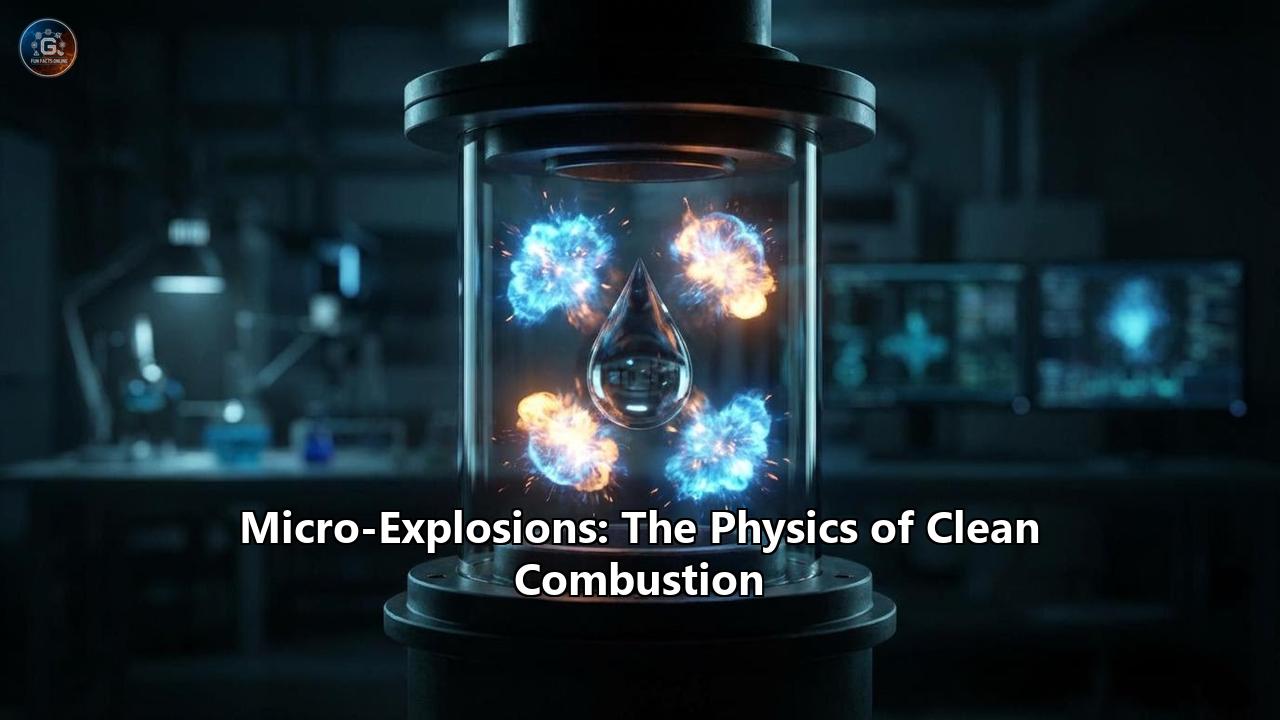
Inside the dark, high-pressure confines of a combustion chamber, a violent, invisible mechanical ballet takes place thousands of times per minute. When a jet of liquid fuel is injected into the searing heat of compressed air, it does not ignite instantaneously. Instead, it is sheared apart into millions of microscopic droplets. These droplets must vaporize and mix with surrounding oxygen before chemical ignition can occur. For over a century, the efficiency and cleanliness of this process have been constrained by a stubborn paradox of physics: the outer layer of a fuel droplet burns first, consuming the available oxygen and leaving the droplet's core to bake in the heat, forming black soot. Meanwhile, the extreme temperatures generated at the outer edge of the flame tear atmospheric nitrogen apart, forging toxic nitrogen oxides (NOx).
Engineers call this the "NOx-Soot Trade-off"—a frustrating balancing act where lowering combustion temperatures reduces NOx but increases soot, and raising temperatures burns off soot but spikes NOx. But a fascinating quirk of fluid dynamics and thermodynamics is currently revolutionizing how we approach clean energy. It is a phenomenon that solves both problems simultaneously by shattering the fuel droplet from the inside out before it even has the chance to burn poorly.
Physicists call it the micro-explosion.
By engineering specialized, multi-component fuels—most notably Water-in-Diesel Emulsions (WiDE)—scientists have learned how to smuggle microscopic droplets of water inside droplets of fuel. When subjected to the inferno of the engine, the trapped water undergoes explosive boiling, tearing the fuel apart in a microscopic detonation. This "secondary atomization" drastically alters the geometry and chemistry of the flame. Recent global analyses in early 2026 have demonstrated that this simple but profoundly complex physical trick can slash harmful diesel emissions by well over 60% without requiring a single modification to the engine itself.
To understand how a tiny drop of water can tame the world's most polluting engines, we must dive deep into the fluid dynamics, thermodynamics, and phase-change physics of the micro-explosion.
The Bottleneck of Primary Atomization
To appreciate the elegance of a micro-explosion, we must first understand how conventional combustion fails. In a standard diesel or jet engine, liquid fuel is forced through a tiny nozzle under immense pressure—sometimes exceeding 30,000 psi. This process, known as primary atomization, breaks the solid stream of fuel into a fine spray of droplets, typically ranging from 20 to 50 micrometers in diameter.
However, primary atomization has a physical limit. Even at 50 micrometers, a fuel droplet is massive on a molecular scale. As the droplet enters the 600°C+ environment of the cylinder, heat transfers to the droplet's surface via convection and radiation. The surface of the droplet begins to evaporate, creating a cloud of fuel vapor that mixes with the surrounding air. When this vapor-air mixture reaches its auto-ignition temperature, it catches fire.
This creates a "diffusion flame" that envelops the droplet. The flame acts as a barrier. Oxygen from the surrounding air is consumed at the flame front and cannot easily penetrate deeper into the fuel vapor cloud. Consequently, the liquid fuel trapped in the center of the droplet experiences intense heat but is starved of oxygen. Instead of burning cleanly, the core undergoes pyrolysis—a thermal decomposition that transforms the hydrocarbon chains into solid carbonaceous particles. These particles are ejected from the exhaust as particulate matter, or soot.
Simultaneously, the localized flame front burns incredibly hot, often exceeding 1,500°C. At these extreme temperatures, the normally inert nitrogen gas (N2) in the air breaks apart and reacts with oxygen, forming nitrogen oxides (NOx) via the Zeldovich mechanism. NOx is a primary catalyst for smog, acid rain, and severe respiratory diseases.
Engine manufacturers have spent billions developing ultra-high-pressure fuel pumps, complex swirl geometries, and restrictive exhaust after-treatment systems (like particulate filters and catalytic converters) to mitigate these twin evils. Yet, the physical bottleneck remains the droplet itself. It is simply too large to burn perfectly.
The Trojan Horse: Emulsion Fuel Chemistry
If primary atomization using mechanical pressure has reached its limits, the solution lies in secondary atomization—breaking the droplet apart again after it has been injected into the combustion chamber. This is achieved through the use of emulsified fuels.
An emulsion is a mixture of two or more liquids that are normally immiscible (unblendable). In the case of Water-in-Diesel Emulsion (WiDE), water is fundamentally incompatible with the hydrocarbon chains of diesel. To force them together, chemists use specialized surfactant molecules. A surfactant is amphiphilic; it has a hydrophilic (water-loving) head and a lipophilic (oil-loving) tail.
When mixed under high shear, the water breaks into nano-sized sub-droplets. The lipophilic tails of the surfactant embed themselves in the surrounding diesel, while the hydrophilic heads attach to the water, creating a protective chemical cage. The result is a continuous "parent" phase of diesel fuel containing hundreds of dispersed "child" phases of water. To the naked eye, the fuel looks milky and homogeneous, and thanks to modern surfactant chemistry, it can remain stable for up to 60 days without separating.
This emulsified droplet acts as a thermodynamic Trojan Horse. It enters the combustion chamber looking and acting like a standard droplet of fuel, but it harbors a highly volatile payload designed to self-destruct.
The Anatomy of a Micro-Explosion
The moment the emulsified droplet leaves the fuel injector, a brilliant sequence of high-speed physics is set in motion. The entire lifecycle of a micro-explosion takes place in mere microseconds.
1. The Heat-Up and Boiling Point Mismatch
As the droplet enters the hot ambient air of the cylinder, the outer diesel shell rapidly absorbs thermal energy. The fundamental trigger for the micro-explosion is the vast disparity in boiling points between the continuous phase and the dispersed phase. Standard diesel fuel is a complex mixture of heavy hydrocarbons that boils across a broad spectrum, typically between 150°C and 380°C. Water, of course, boils at 100°C at atmospheric pressure.
2. The Metastable Superheated State
As the parent droplet heats up, the internal water sub-droplets reach 100°C long before the outer diesel shell begins to fully vaporize. However, the water cannot easily turn into steam. It is trapped inside the diesel phase, held under immense pressure by both the ambient pressure of the combustion cylinder and the surface tension of the diesel shell. Because of this containment, the water is pushed past its normal boiling point while remaining a liquid. It enters a metastable thermodynamic state known as a superheated liquid.
3. Nucleation and Bubble Growth
The superheated water is physically desperate to change state. It only requires a tiny energetic perturbation—a scratch, an impurity, or a localized hot spot at the oil-water interface—to trigger nucleation. A microscopic vapor bubble forms inside the water sub-droplet. As heat continues to pour into the droplet from the surrounding fire, this bubble grows exponentially.
4. The Explosive Phase Change
When water transitions from a liquid to a gas, its volume expands by approximately 1,600 times. When this happens to multiple water sub-droplets simultaneously inside a tiny, confined shell of oil, the internal pressure spikes violently.
5. Secondary Atomization (The Rupture)
The structural integrity of the continuous diesel phase fails catastrophically. The parent droplet is ripped apart from the inside out. This explosive boiling tears the 50-micrometer parent droplet into thousands of secondary "child droplets" that are often between 1 and 10 micrometers in size.
This rupture is not always a complete obliteration. Fluid dynamicists categorize the intensity of this secondary atomization into two distinct visual phenomena:
- Puffing: If the explosive boiling occurs near the surface of the droplet, the vapor simply erupts outward, shooting a jet of steam and oil into the air—much like a miniature geyser. The parent droplet remains largely intact but becomes deformed. This is considered a localized or weak micro-explosion.
- Intense Micro-Explosion: If the nucleation occurs deeper within the core, or if multiple bubbles coalesce and expand simultaneously, the entire droplet violently bursts in all directions, leaving nothing behind but a cloud of fine aerosolized mist.
Recent cutting-edge research published in early 2025 utilized ultra-high-speed digital image processing and gas chromatography to reveal that a distinct "mist" is actively generated during these explosions. As the violent expansion of the micro-explosion occurs, the sudden drop in localized pressure and temperature causes rapid condensation of the fuel vapor, generating a dense mist of ultra-fine hydrocarbons that mix perfectly with the incoming air.
The Physics of Clean Emissions
Why does blowing up a fuel droplet with water result in an engine that runs cleaner? The answer lies in the beautiful convergence of geometry and thermodynamics.
The Geometry of Fire (Solving the Soot Problem)
By shattering one large parent droplet into thousands of microscopic child droplets, the micro-explosion exponentially increases the total surface area of the fuel. In combustion, surface area is everything. A higher surface-to-volume ratio means that oxygen can wrap around and penetrate the fuel matrix almost instantaneously.
Because the mixing of air and fuel is so incredibly thorough, the "diffusion flame" model breaks down. The fuel does not have time to sit in an oxygen-starved core and bake into soot. The combustion process is complete and highly efficient. Studies reviewed by researchers at the Federal University of Technology Owerri and Shenyang Agricultural University in 2026 concluded that engines running on micro-explosive WiDE fuels saw particulate matter (soot) plummet by up to 68% compared to standard diesel.
The Thermodynamic Quench (Solving the NOx Problem)
If perfect mixing was the only mechanism at play, the engine might actually produce more NOx, because the flame would burn faster and hotter. But this is where the water delivers its second thermodynamic masterstroke.
Water has an incredibly high specific heat capacity and latent heat of vaporization. It takes a massive amount of thermal energy to heat water, and even more energy to force it to change from a liquid to a gas. As the dispersed water droplets undergo explosive boiling, they act as a distributed network of microscopic heat sinks. They absorb the ambient heat of the combustion chamber, actively "quenching" the localized flame front.
By lowering the peak adiabatic flame temperature, the water prevents the environment from reaching the critical thermal threshold required to break atmospheric nitrogen bonds. The result is astonishing: thermal NOx formation is suppressed right at its source. Recent field data from 2026 confirms that nitrogen oxide emissions drop by as much as 67% when utilizing micro-explosion technology.
Beyond Diesel: The Future of Micro-Explosive Fuels
While the immediate application of micro-explosion physics is aimed at cleaning up the millions of legacy diesel engines used in global shipping, agriculture, and heavy machinery, the concept of secondary atomization is rapidly expanding into futuristic energy domains.
Tri-Fuel Emulsions and Biofuels
To further improve environmental sustainability, researchers are exploring "tri-fuel" micro-emulsions. These fuels blend conventional diesel with high-viscosity biofuels and highly volatile alcohols (such as n-butanol or ethanol). Biodiesel alone is notoriously difficult to atomize due to its thickness. However, by introducing alcohol—which has a very low boiling point—the micro-explosion is triggered much faster and with greater violence. The alcohol acts as the chemical detonator, shattering the thick biodiesel into an ultra-fine, highly combustible mist.
Aerospace and Green Propellants
The principles of the micro-explosion have reached the aerospace sector. In recent experiments with Ammonium Dinitramide (ADN)-based liquid rocket propellants, researchers utilized directed microwave energy to artificially induce puffing and micro-explosions. Microwaves specifically target polar molecules (like water or specific active agents in the propellant). By pulsing microwaves into the combustion chamber, scientists can force explosive boiling exactly when and where they want it, reducing propellant evaporation time by over 56% and significantly cutting ignition delay. This allows for the design of incredibly precise, highly responsive, and greener rocket thrusters.
Carbon-Free Metal Fuel Combustion
Perhaps the most exotic application of micro-explosion physics is in the realm of solid metal fuels. Iron powder is being heavily researched as a 100% carbon-free fuel; when burned, iron produces immense heat and leaves behind iron oxide (rust), which can be captured and recycled back into pure iron using renewable energy.
However, solid particles burn differently than liquid droplets. Recent high-speed micro-shadowgraphy of burning iron particles suspended in ammonia/air mixtures revealed that iron, too, undergoes micro-explosions. At extreme temperatures, trace amounts of internal carbon oxidize, generating trapped gas inside the molten iron droplet. As the liquid iron oxide outer layer hardens, the internal gas pressure mounts until the molten metal droplet violently explodes into glowing child fragments. Understanding and controlling these metal micro-explosions is a critical step toward realizing commercial, closed-loop metal-powder power plants.
Overcoming the Engineering Hurdles
If the physics of the micro-explosion are so advantageous, why aren't all engines currently running on emulsions? The transition from laboratory physics to widespread commercial infrastructure involves navigating several engineering bottlenecks.
First is emulsion stability. Over time, water and oil naturally want to separate (phase separation) due to their differing densities and polarities. If an emulsion separates inside a fuel tank, the engine will draw pure water into the injectors, causing catastrophic stalling and corrosion. Advances in nanomaterials and cutting-edge surfactants are solving this, extending the shelf-life of WiDE fuels from days to months. Furthermore, modern systems are being developed to create the emulsion dynamically on-board the vehicle, mixing the water and diesel in a highly pressurized chamber just microseconds before injection, negating the need for long-term storage entirely.
Second is the energy density penalty. Because water does not contain chemical energy, substituting 10% to 15% of a fuel's volume with water means less actual fuel is injected per stroke. Traditionally, this would result in a loss of engine power. However, the micro-explosion dramatically improves the Brake Thermal Efficiency (BTE) of the engine—meaning the fuel that is present burns so much more completely that it offsets the volumetric loss of energy. Engines running on WiDE often maintain their baseline power output while simultaneously extending the mechanical lifespan of the engine due to cooler operating temperatures.
Third is dynamic monitoring. Because the intensity of a micro-explosion is highly sensitive to the water-to-fuel ratio, operating an engine efficiently requires real-time data. Engineers are now outfitting fuel supply systems with advanced water content sensors and optical diagnostic tools to monitor the exact stoichiometry of the emulsion, ensuring the optimal micro-explosive yield for whatever load the engine is currently bearing.
The Elegance of the Microscopic Detonation
The internal combustion engine is arguably the most consequential invention of the industrial age, but its legacy is deeply intertwined with the degradation of the Earth's atmosphere. For decades, the solution to engine pollution has been to attach expensive, heavy, and complex filters to the exhaust pipe—treating the symptoms of poor combustion rather than the disease.
The micro-explosion offers an elegant, physics-based cure. By leveraging the fundamental thermodynamic differences between two unblendable liquids, we can turn the fuel droplet into a self-atomizing mechanism. The rapid phase change of water to steam acts as a microscopic bomb, tearing apart the physical barriers that prevent clean combustion, while simultaneously cooling the fires that forge toxic gases.
As we push toward a decentralized, multi-fuel future—spanning from water-laced diesel in cargo ships to microwave-pulsed propellants in orbit—the physics of secondary atomization will play a pivotal role. The micro-explosion proves that sometimes, to clean up the macro environment, we must master the violent, fleeting, and beautiful mechanics of the microscopic world.
Reference:
- https://pubs.aip.org/aip/pof/article/37/8/082134/3360098/Microexplosion-in-burning-emulsified-fuel-droplets
- https://www.sciencedaily.com/releases/2026/03/260313002630.htm
- https://pmc.ncbi.nlm.nih.gov/articles/PMC3916022/
- https://squ.elsevierpure.com/en/publications/water-in-diesel-emulsion-and-its-micro-explosion-phenomenon-revie/
- https://pubs.aip.org/aip/pof/article/26/10/103302/103904/Physics-of-puffing-and-microexplosion-of-emulsion
- https://www.mdpi.com/1996-1073/15/20/7670
- https://pubs.aip.org/aip/pof/article/35/11/117122/2921810/Experimental-study-on-microwave-induced-puffing
- https://arxiv.org/abs/2504.14140
- https://techtos.net/sbornik/2013/07.DIESEL-WATER%20EMULSION,%20AN%20ALTERNATIVE%20FUEL%20TO%20REDUCE%20DIESEL%20ENGINE%20EMISSIONS.%20A%20REVIEW.pdf
- https://ideas.repec.org/a/eee/rensus/v111y2019icp490-506.html
- https://www.researchgate.net/publication/381070653_Formation_of_bubbles_and_microexplosions_in_burning_boron_agglomerates
- https://www.combustion-engines.eu/Improving-the-performance-of-diesel-engines-fueled-with-water-fuel-emulsion,169139,0,2.html