
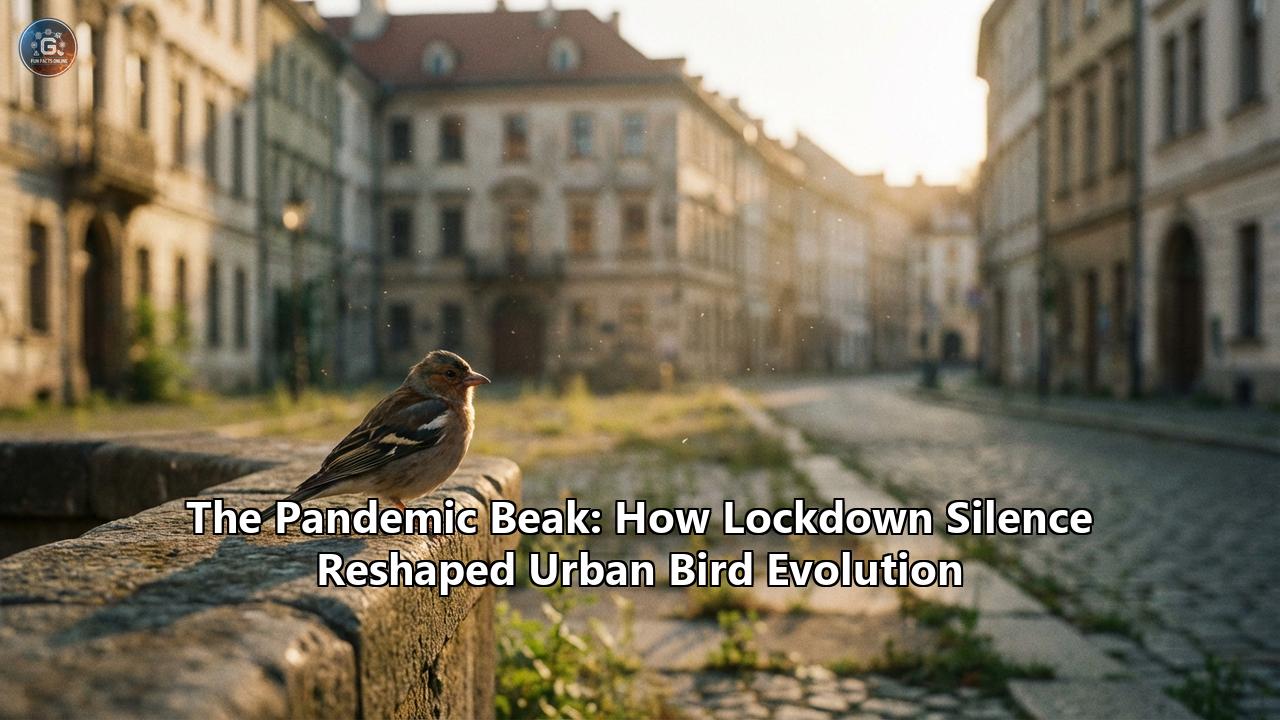
The Spring of 2020 was unlike any other in human history. As cities across the globe ground to a halt under the weight of the COVID-19 pandemic, a strange and unsettling silence descended upon the world’s busiest metropolises. The roar of traffic on the Golden Gate Bridge faded to a whisper; the incessant hum of London’s M25 motorway vanished; the chaotic din of Mumbai’s streets quieted. For humans, it was a time of isolation and anxiety. But for the urban wildlife that shares our concrete canyons, it was an unprecedented liberation.
This period, now known to scientists as the "Anthropause," provided a once-in-a-lifetime natural experiment. For a few brief months, the heavy blanket of human disturbance was lifted, revealing the hidden lives of city creatures. Among the most dramatic revelations came from the avian world. We discovered that our feathered neighbors are not just passive residents of our cities; they are highly responsive evolutionary acrobats.
In the silence of the lockdown, birds didn't just sing differently—they physically changed. From the songs of sparrows in San Francisco to the very shape of finch beaks in Los Angeles, the pandemic silence reshaped urban bird evolution in real-time. This is the story of The Pandemic Beak.
Part I: The Great Silence
The Physics of the AnthropauseTo understand the magnitude of what happened to birds in 2020, we must first understand the "urban roar." Before the pandemic, the average noise level in major cities hovered between 60 and 70 decibels—roughly the volume of a vacuum cleaner running constantly. In hotspots near highways or construction, it could spike much higher.
This acoustic smog is not just an annoyance; it is a biological barrier. For birds, sound is survival. It is how they claim territory, warn of predators, and, most importantly, attract mates. Low-frequency noise—the deep rumble of tires on pavement and heavy machinery—is particularly damaging because it occupies the same acoustic space as many bird songs. It masks the lower notes of their calls, forcing them to adapt or be drowned out.
Then came March 2020. In the San Francisco Bay Area, traffic volumes on the Golden Gate Bridge collapsed to levels not seen since 1954. Sound pressure levels dropped by nearly 50%. The acoustic smog evaporated, and for the first time in nearly a century, the airwaves were clear.
Part II: The Voice of the City
The San Francisco Sparrow ExperimentElizabeth Derryberry, a behavioral ecologist, had been studying the White-crowned Sparrows of San Francisco for decades. These birds are the rock stars of urban adaptation. Long before the pandemic, Derryberry’s team had documented how city sparrows had evolved a "shouting" style to cope with the urban roar.
The Lombard EffectIn the noisy "Before Times," urban sparrows suffered from the Lombard Effect—a reflex where vocalizers involuntarily raise their volume and pitch to compete with background noise. Imagine trying to talk to a friend in a crowded nightclub; you shout, your voice gets higher, and you lose all nuance.
- Pre-Pandemic Song: Loud, high-pitched, and simple. They had to scream to be heard, sacrificing the complexity and "bandwidth" of their trills.
- The Cost: While they could be heard, these "shouted" songs were lower quality. In the bird world, a lower-bandwidth song is less "sexy." It requires less vocal skill, making the singer appear less fit to potential mates.
When the silence fell, Derryberry and her team rushed (safely) into the field to record. What they found was a shock. almost overnight, the sparrows had stopped shouting.
- Volume Drop: The birds were singing 30% softer than before.
- Transmission Boost: Despite singing softer, their songs traveled twice as far because the acoustic masking of traffic was gone.
- The "Sexy" Factor: Most remarkably, the birds dropped the high-pitched "scream" and returned to lower frequencies with wider bandwidths. They began singing intricate, complex trills that hadn't been heard in the city since the 1970s.
In the absence of traffic, the male sparrows could finally show off their true vocal range. They became, acoustically speaking, better singers. This wasn't a genetic mutation that took generations; it was phenotypic plasticity—the ability of an organism to change its behavior in response to its environment. The sparrows had the capacity for these complex songs all along; the city had just been suppressing them.
Part III: The Pandemic Beak
Rapid Morphological Change in Los AngelesWhile the sparrows of San Francisco were changing their tune, the Dark-eyed Juncos of Los Angeles were changing their faces.
This is the most startling discovery of the Anthropause, one that gives this phenomenon its name: The Pandemic Beak.
At the University of California, Los Angeles (UCLA), a population of Dark-eyed Juncos had lived on campus for roughly 20 years. These small, grey-and-white birds had become urban specialists.
- The Urban Beak: Before 2020, the UCLA juncos had evolved beaks that were distinctly different from their wild cousins in the nearby mountains. Their beaks were shorter, wider, and stubbier. Why? Because they were eating human trash. A stubby beak is excellent for dealing with dropped bagel crumbs, sandwich crusts, and the general detritus of 45,000 students.
When the campus closed in March 2020, the food source vanished. The dumpsters were empty. The students were gone. The "crumb economy" collapsed.
The juncos were faced with a choice: starve, or adapt. They had to switch back to their natural diet—seeds, insects, and vegetation that required foraging in the landscaping rather than scavenging on the pavement.
The EvolutionA study published in the Proceedings of the National Academy of Sciences (PNAS) revealed the impossible. In the span of just one to two breeding seasons during the lockdown, the beak shape of the junco population shifted.
- The Change: The new generation of birds hatched during the pandemic had beaks that were longer and more slender—almost identical to the "wild" phenotype found in the mountains.
- The Mechanism: This wasn't just behavior; it was morphology. The pressure was so intense that birds with the "trash beak" (stubby) likely failed to thrive or reproduce efficiently without human food. Those with the genetic variance for a more natural, versatile beak survived and passed those genes on. Alternatively, it may have been a sorting event where "wild-type" birds from the periphery moved in and outcompeted the urban specialists.
The story has a twist. When students returned to campus in late 2021 and 2022, the trash returned. Remarkably, the beak shape of the junco population snapped back to the stubby "urban" form within another generation. This "yo-yo evolution" demonstrates the incredible speed at which urban wildlife can adapt to the pressures we create. It challenges the old Victorian notion that evolution is a slow, glacial process. In the Anthropocene, evolution happens on a deadline.
Part IV: The Global Chorus
Worldwide Ripple EffectsThe phenomenon wasn't limited to California. The silence of the Anthropause rippled across the planet, affecting avian biology in diverse ways.
1. The British Great Tits and the "Culture" of SongIn the United Kingdom, researchers at Wytham Woods have studied Great Tits (Parus major) for over 70 years. During the lockdown, they observed shifts in "cultural evolution." Bird song is often learned; young birds mimic the adults.
- The Dialect Shift: With the noise gone, young birds could hear the subtle details of their elders' songs more clearly. This potentially altered the "dialect" of the generation, correcting errors that had crept in due to noise masking.
- Habitat Reclaim: In cities like London and Glasgow, birds were seen foraging in open parks and even on roads that were previously death zones. Without the constant threat of "roadkill," populations in some areas spiked, and birds explored new territories.
In India, the lockdown was strict and sudden. In bustling cities like Mumbai and Delhi, the smog cleared, and the noise dropped.
- Visibility vs. Reality: Citizens reported seeing exotic birds—Hornbills, Peacocks, and Flame-throated Bulbuls—from their balconies. While some of this was simply humans having the time to look, scientists confirmed that species richness (the number of different species detected) did increase in urban centers. Birds from the fringes moved into the quiet city hearts.
- The Flamingo Flush: In the wetlands of Navi Mumbai, tens of thousands of flamingos gathered, turning the water pink. While they visit annually, their numbers and their proximity to the city were unprecedented, emboldened by the lack of human disturbance.
Why does this matter? A study on Zebra Finches gives us a clue. Research has shown that traffic noise causes chronic stress in birds, elevating corticosterone levels.
- The Color of Stress: This stress doesn't just make them jittery; it affects their appearance. Male finches exposed to traffic noise developed duller beaks. In the bird world, a bright red/orange beak is a signal of immune health and genetic quality. Noise pollution was literally making urban birds less attractive, independent of their song. The silence of the pandemic likely gave urban birds a "glow up," allowing them to recover their physical vibrancy.
Part V: The Invisible Cost of Noise
What We Learned About PollutionThe pandemic taught us that noise is not just a nuisance; it is a pollutant as potent as chemical waste. The "acoustic horizon"—the distance at which a bird can hear a rival or a potential mate—is slashed by 90% in a noisy city.
When we quieted our engines, the birds expanded their acoustic horizons instantly.
- Predator Detection: Birds could hear predators approaching from further away, reducing their "landscape of fear."
- Territorial Defense: Males could defend territories with less energy (singing softer) while reaching more rivals (transmitting further).
- Cognitive Load: Without the constant need to filter out traffic noise, birds likely had more "brain space" for foraging and mating behaviors.
The "Pandemic Beak" and the "Pandemic Song" proved that urban birds are living in a state of constant, high-stakes compromise. They are surviving despite us, contorting their voices and their bodies to fit into the slivers of space we leave them.
Part VI: The Future of Urban Ecology
Can We Keep the Quiet?We cannot stay in lockdown forever. The cars have returned, the students are back at UCLA, and the roar of the city has resumed. The sparrows of San Francisco are likely shouting again, and the juncos are evolving back to their trash-eating beaks.
However, the data from this period provides a blueprint for a better city. We now have empirical proof that noise reduction is a viable conservation strategy.
- Quieter Pavement: Engineering road surfaces to reduce tire noise can lower decibel levels significantly.
- Electric Vehicles: The shift to EVs removes the low-frequency engine rumble that interferes most with bird communication.
- Green Buffers: Planting dense vegetation barriers absorbs sound and provides habitat, creating "acoustic refuges" within the city.
The Pandemic Beak was a warning and a lesson. It showed us that nature is resilient, rapid, and responsive. It is waiting for us to make room. If we can simply lower the volume, even by a fraction, we can allow the wild voices of our cities to sing their true songs once again.
Conclusion
The spring of 2020 was a tragedy for humanity, but for a brief moment, it offered a glimpse of a parallel world. A world where the San Francisco mist carried the intricate trills of sparrows rather than the roar of engines. A world where the beaks of finches shaped themselves to the rhythms of nature rather than the rhythms of our waste.
We now know that urban evolution is not a closed book. It is happening now, on our windowsills and in our parks. The birds adjusted to our silence in a heartbeat; the question remains: can we adjust our noise to let them live?
Reference:
- https://www.audubon.org/magazine/bird-song-became-softer-during-pandemic-thanks-less-noise-pollution
- https://www.livemint.com/mint-lounge/ideas/are-birds-flying-back-to-our-concrete-jungles-in-lockdown-111641398918779.html
- https://www.youtube.com/watch?v=8CL2BCA1ND0
- https://www.youtube.com/watch?v=hHvNuznpUi8
- https://www.theguardian.com/environment/2020/apr/14/endangered-new-zealand-bird-sent-to-safety-offshore-despite-covid-19-lockdown
- https://pmc.ncbi.nlm.nih.gov/articles/PMC9746919/
- https://www.thehindu.com/sci-tech/energy-and-environment/covid-19-lockdown-not-all-news-of-urban-wildlife-spotting-is-factual/article31228052.ece
- https://sciencemediacentre.es/en/absence-human-activity-during-pandemic-lockdowns-altered-beaks-bird-species
- https://www.oxfordmail.co.uk/news/24995788.oxford-study-reveals-bird-songs-evolve-time/
- https://www.theguardian.com/science/2025/mar/07/birds-song-repertoires-age-migration-study