
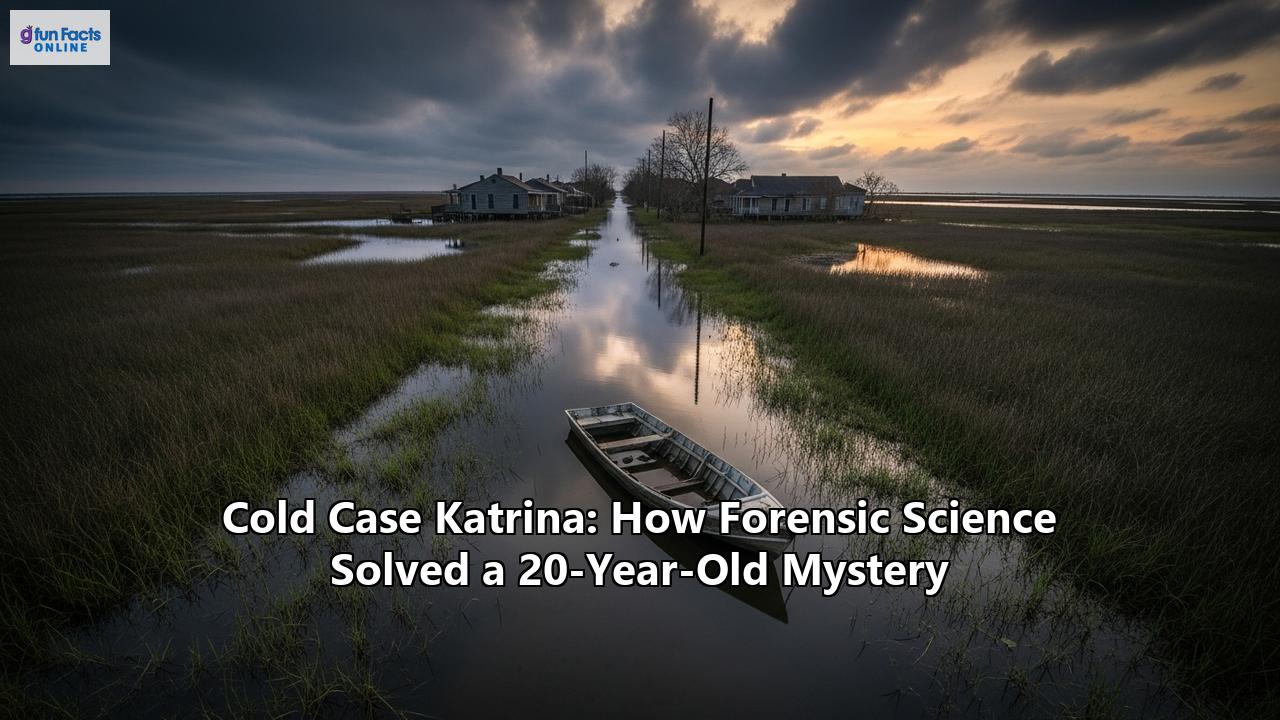
In the immediate aftermath of Hurricane Katrina's devastating blow to the U.S. Gulf Coast in August 2005, a monumental and heart-wrenching task began. Amidst the submerged streets and shattered homes, first responders and recovery teams faced the grim reality of widespread loss of life. In the ensuing chaos, while many victims were identified, hundreds were not. They became the silent, unnamed casualties of the storm, their identities washed away by the floodwaters, leaving behind a legacy of unanswered questions and unresolved grief for families clinging to fading hope. For nearly two decades, these cold cases remained a painful testament to the storm's enduring impact.
The passage of time, however, brought with it an evolution in forensic science, a revolution in technological capabilities that the initial responders in 2005 could only dream of. This is the story of how cutting-edge science, coupled with unwavering dedication from investigators and the poignant persistence of journalists, pierced the veil of two of these 20-year-old mysteries, finally bringing names to the unknown and a measure of peace to the families who never stopped searching. The identifications of Dorothy Virginia Driggers Taquino and Tonetta Jackson, two women lost to the storm in different states and under different circumstances, stand as powerful examples of how science can resurrect a cold case, offering closure long after all hope seemed lost.
The Deluge and the Dead: A Crisis of Identification
When Hurricane Katrina made landfall on August 29, 2005, it brought with it a storm surge that overwhelmed levees and floodwalls, plunging New Orleans and the surrounding coastal regions of Louisiana and Mississippi into a murky, toxic soup. The scale of the disaster was unprecedented, not just in terms of property destruction, but in the tragic number of fatalities. In Louisiana alone, the death toll would climb to over 1,400.
In the days and weeks that followed, a massive operation was launched to recover the deceased. The Federal Disaster Mortuary Operational Response Team (DMORT), a specialized unit composed of forensic pathologists, odontologists, anthropologists, and other experts, was deployed to assist overwhelmed local coroner's offices. They established a temporary morgue in St. Gabriel, Louisiana, a small town about 70 miles west of New Orleans, to begin the painstaking process of identifying the victims.
The challenges were immense. Many of the bodies recovered were badly decomposed due to the prolonged immersion in contaminated floodwaters and the sweltering Louisiana heat. This made visual identification impossible and often degraded traditional forensic identifiers like fingerprints. The storm had also scattered personal belongings and destroyed records. Dental offices were flooded, washing away the very records that could have provided a swift match. Families who would normally provide antemortem information were themselves displaced, scattered across the country in a diaspora of survivors, making it incredibly difficult to obtain medical histories or DNA reference samples.
DMORT teams worked tirelessly under extreme conditions, processing hundreds of remains. Each victim was assigned a case number and went through a series of stations for decontamination, photography, X-rays, and examination. Despite their heroic efforts, a significant number of victims could not be identified. By February 2006, six months after the storm, fewer than 100 people remained unidentified, a number that would slowly be whittled down over the years. Eventually, 84 unidentified or unclaimed victims from the New Orleans area were laid to rest in specially marked crypts at the Hurricane Katrina Memorial on Canal Street. For years, 30 of those crypts held individuals known only to God, their stories silenced by the storm.
A Glimmer of Hope: The Case of Dorothy Taquino
For nearly twenty years, one of those anonymous souls was an 81-year-old woman named Dorothy Virginia Driggers Taquino. Known to her family as "Aunt Dot," she was a widow who lived alone in a small house on Community Street in Arabi, a suburb in St. Bernard Parish just outside of New Orleans. In the frantic hours before Katrina's landfall, her niece, Jean Driggers, made the gut-wrenching decision to evacuate with her own mother. It was late, and the storm was bearing down. The agonizing choice to leave Aunt Dot behind would haunt her for years. "I was torn," Driggers recounted in a later interview. "It really did hurt me, but I just didn't know what to do at the time."
After the storm, Dorothy's home was found inundated with water. On September 12, 2005, her remains were discovered inside. Her body was transported to the temporary morgue in St. Gabriel for processing. Jean Driggers did what so many others did: she called the family assistance hotline for months and submitted a DNA sample, hoping for a match that would confirm what she already feared. But in the chaos of the aftermath, a positive identification was never made. Investigators reportedly told the family that the DNA sample wasn't sufficient to confirm a match, a common problem with the DNA technology of the time, especially when dealing with degraded remains and distant relatives. Dorothy Taquino, a woman who had lived a full life, was officially lost, her remains eventually interred in one of the anonymous crypts at the Katrina Memorial.
The case went cold, another forgotten file in the mountain of post-Katrina paperwork. The breakthrough, when it finally came nearly two decades later, was not from a new DNA technology, but from old-fashioned investigative journalism. In the summer of 2025, with the 20th anniversary of the storm approaching, Devin Bartolotta, an anchor and investigative reporter for WWL Louisiana, began a project called "Bringing Dorothy Home." The goal was to shed light on the 30 unidentified individuals still resting in the memorial. The news station filed public records requests and received over 800 autopsy reports from the initial DMORT operation.
While sifting through the limited information and cross-referencing with the National Missing and Unidentified Persons System (NamUs), one case stood out. It was a woman found in Arabi, outside of Orleans Parish, who was wearing a distinctive piece of jewelry: a necklace engraved with "Joseph Kohn High School."
This single clue was the key. WWL Louisiana contacted Ray Theriot, the chief investigator for the St. Bernard Parish Coroner's Office, the jurisdiction where the body was found. Spurred by the inquiry, Theriot reopened the cold case. He dove into a painstaking investigation, a testament to the power of traditional detective work. He pulled utility bills, driver's license files, and property records, confirming that a woman matching the victim's general description, Dorothy Taquino, had lived at the Arabi address.
The final, definitive link was unearthed from the archives of the Orleans Parish school system. Theriot found Dorothy Taquino's 1942 high school diploma from Joseph Kohn High School, a perfect match to the inscription on the necklace she wore even in death. "We've got the right person. There's no doubt," Theriot stated, the satisfaction of solving a 20-year-old mystery evident in his voice.
For Jean Driggers, the news brought a wave of emotions. The knock on her door from Investigator Theriot, two decades after she had lost hope, was a shock. She had always remembered the necklace her aunt never took off. "If you love something, you have to let it go; if it's meant to be, it'll come back," she had told herself over the years. "Well, Friday morning, it came knocking at my door...so it was meant to be."
The investigation even uncovered another poignant detail: Dorothy had purchased a burial plot and headstone for herself at St. Bernard Memorial Gardens back in 1988. For decades, the marker stood engraved with her name, missing only a date of death. Thanks to the renewed investigation, "Aunt Dot" could finally be moved from her anonymous crypt to the resting place she had chosen for herself, bringing the number of unidentified victims at the memorial down to 29 and providing her family with a profound sense of closure.
A Different Storm, A Different Science: The Identification of Tonetta Jackson
While Dorothy Taquino's case was solved through the meticulous piecing together of historical records, another 20-year-old Katrina mystery was being unraveled miles away in Mississippi through the power of cutting-edge genetic science. The story of Tonetta Jackson is a dramatic and tragic tale that captured the nation's attention in the storm's immediate aftermath, only to fade into a long and painful silence.
On the day the storm hit, 46-year-old Tonetta and her husband, Hardy Jackson, were in their home in Biloxi, Mississippi. As the floodwaters rose with terrifying speed, they took refuge in their attic. But the force of the water was too much. In a now-famous and heartbreaking interview with a WKRG reporter just after the storm, a dazed and grieving Hardy Jackson recounted the horrific moment. "The house just split in half," he said, his voice thick with shock. "We got up in the roof, all the way to the roof, and water just came in and opened it up." He told of how he and his wife were swept into the raging flood. "I tried, I hold her hand as tight as I could," he recalled, "and she told me, 'You can't hold me. Take care of the kids and the grandkids.'" Hardy managed to grab onto a tree and survived; Tonetta was swept away, her body seemingly lost to the storm.
About a week later, a search and rescue team found the remains of a Black woman between the slabs of two destroyed homes in nearby St. Martin. Investigators could determine her approximate age and height, but with no identifying documents and in the widespread chaos, they couldn't determine who she was. The case went cold. The unidentified woman was buried in Machpelah Cemetery in Pascagoula, her grave marked with a headstone that read "Jane (Love)" and noted she was a victim of the hurricane. Hardy Jackson, who became an emblem of the storm's personal toll for many who saw his interview, passed away in 2013 without ever knowing what happened to his wife.
The key to unlocking this mystery lay dormant for years, buried with Jane Love. The renewed effort was spearheaded by Lieutenant Darren Versiga of the Pascagoula Police Department, a dedicated cold case investigator. Versiga had been working since 2011 to identify the unknown victims of Katrina in his region. The technology that would ultimately solve the case, forensic genetic genealogy, wasn't even a tool available to law enforcement in 2005.
In 2023, the Mississippi Bureau of Investigation and the State Medical Examiner's Office made the decision to exhume the remains of "Jane Love," hoping that new technology could finally reveal her identity. They sent skeletal evidence to Othram Inc., a private laboratory in Texas specializing in forensic genealogy. Othram's scientists faced a significant challenge: extracting a viable DNA profile from remains that had been buried for nearly two decades after suffering significant environmental damage.
Othram utilized a technique called Forensic-Grade Genome Sequencing®. This advanced method is designed specifically for degraded and low-quantity DNA, the very type of evidence that had previously been a dead end in many cold cases. Unlike traditional DNA testing that looks at a small number of markers (like the STRs used in 2005), Othram's process sequences hundreds of thousands of genetic markers. This creates a much more detailed genetic profile, which can then be uploaded to public genealogy databases.
Investigators use these databases to find distant relatives of the unidentified person. By building out family trees from these distant cousins, they can triangulate and eventually identify the individual. In the case of Jane Love, Othram's team successfully built a comprehensive DNA profile. This profile led investigators to potential relatives, who were then contacted by law enforcement. A DNA sample from a close family member confirmed the match: Jane Love was Tonetta Waltman Jackson.
The identification, which came in May 2024, was the 27th such case solved in Mississippi using Othram's technology, an effort significantly supported by funding from Mississippi native and philanthropist Carla Davis. For Tonetta's family, especially her daughter, Tonie Waltman, the news was the final, painful chapter in a 20-year saga. "All the hopes and prayers and stuff, it all paid off though," she said, finally able to bring her mother's ashes home. The identification healed a wound that had remained open for two decades, a wound poignantly captured by Hardy Jackson's on-camera grief. Lieutenant Versiga, reflecting on the case, noted the irony that had he seen Hardy's famous interview sooner, he might have put the pieces together. "I just missed it, and I'm the expert," he admitted. "But, we have her now. We've got her name back to her, and that's the principle of all this."
The Science of Identification: Then and Now
The successful resolution of the Taquino and Jackson cases highlights a dramatic leap in forensic capabilities over two decades. In 2005, forensic science was robust, but it had its limits, which were stretched thin by the scale of the Katrina disaster.
Forensics in 2005:- DNA Analysis: The standard was Short Tandem Repeat (STR) analysis. While effective, it required a relatively good quality and quantity of DNA. Degraded samples, common in the conditions of the Katrina aftermath, often failed to yield a full profile.
- Dental Records: Odontology was a primary method for identification, but as seen in Katrina, it is entirely dependent on the availability of antemortem dental records, which were often destroyed or inaccessible.
- Fingerprints: Another primary method, but one that is often useless when remains are decomposed or have been submerged in water for extended periods.
- Forensic Genetic Genealogy (FGG): This is arguably the most significant advancement for solving cold cases. By leveraging public DNA databases, FGG can identify individuals even without a direct DNA match from a suspect or family member in a criminal database. Companies like Othram have pioneered its use for unidentified human remains. This was the technology that was indispensable in identifying Tonetta Jackson.
- Next-Generation Sequencing (NGS): This is the underlying technology that makes FGG possible for degraded samples. NGS, or Massively Parallel Sequencing (MPS), allows scientists to analyze millions of DNA fragments simultaneously, making it possible to piece together a profile from even the most challenging and fragmented DNA.
- Isotope Analysis: Though not a primary feature in these specific cases, stable isotope analysis of remains can now provide clues about a person's geographic origins and travel history by examining the chemical signatures in their bones and teeth, offering another potential avenue for investigation.
The evolution from the limited STR technology of 2005 to the powerful combination of NGS and FGG today represents a paradigm shift in disaster victim identification (DVI). It offers a new horizon of hope for identifying the remaining victims of Katrina and other mass casualty events.
The Unseen Wound: The Psychological Toll of the Missing
For every cold case that is solved, there is a story of a family that has lived in a state of agonizing uncertainty. The psychological term for this is "ambiguous loss," a unique and torturous form of grief experienced by those who have a loved one disappear without a trace. Unlike a confirmed death, which allows the grieving process to begin, ambiguous loss leaves families in a state of suspended animation, caught between hope and despair.
This prolonged stress can lead to a host of psychological issues, including depression, anxiety, and post-traumatic stress disorder. It disrupts family structures and social relationships, as there is no ritual, like a funeral, to mark the loss and allow the community to offer support. Families of the missing often feel isolated in their grief.
The act of identification, even two decades later, is therefore more than just a procedural matter of closing a case file. It is a profoundly therapeutic event. It validates the family's long-held grief, transforms the ambiguous loss into a tangible one, and allows for the final, necessary rituals of mourning. It provides a measure of closure, a focal point for remembrance, and the simple, human dignity of a name. For Jean Driggers, it meant finally being able to place flowers on the grave her aunt had chosen. For Tonie Waltman, it meant finally holding her mother's ashes and fulfilling the promise her father made in the midst of the storm.
Conclusion: The Enduring Pursuit of a Name
The stories of Dorothy Taquino and Tonetta Jackson, separated by geography but united by tragedy and eventual discovery, are powerful parables of the modern forensic age. They demonstrate that even when a case has been cold for twenty years, a resolution is still possible. Dorothy's case reminds us of the enduring value of traditional investigation, of the determined work of journalists and investigators who refuse to let the forgotten stay forgotten. Tonetta's case, on the other hand, showcases the breathtaking power of modern science to find answers locked away in the very building blocks of life.
As of 2025, there are still 29 unidentified victims of Hurricane Katrina resting in the memorial in New Orleans, and likely others in Mississippi and elsewhere. Each one represents a family still living with the pain of ambiguous loss. But the successful identification of Dorothy and Tonetta offers them a renewed, if distant, hope. It affirms a fundamental principle: that every life is valuable, and every person deserves a name. The tireless work of investigators like Ray Theriot and Darren Versiga, the dedication of journalists like those at WWL Louisiana, and the innovation of scientists at labs like Othram ensure that the pursuit of those names, no matter how long it takes, will continue. The waters of Katrina may have washed away lives and homes, but they could not entirely erase the identities of its victims, which, one by one, are finally being brought back to the surface.
Reference:
- https://files.asprtracie.hhs.gov/documents/dmort-in-action-the-role-of-dmort-in-natural-disasters-pandemics-and-beyond.pdf
- https://www.ojp.gov/ncjrs/virtual-library/abstracts/life-disaster-morgue
- https://www.theguardian.com/us-news/2025/aug/29/hurricane-katrina-woman-identified
- https://www.youtube.com/watch?v=k35TQvLhSss
- https://www.wwltv.com/article/news/local/katrina/exclusive-wwl-louisiana-investigation-leads-officials-to-identify-unknown-katrina-victim/289-16c1df3d-7b1c-4164-9164-c896ae69ecae
- https://simplyforensic.com/forensic-dna-analysis-unveiled-cutting-edge-advances-you-need-to-knowforensic-dna-analysis-has-revolutionized-the-field-of-forensic-science-offering-unparalleled-precision-in-solving-crimes-identif/
- https://eprints.leedsbeckett.ac.uk/id/eprint/6747/1/TheMediaAsAnInvestigativeResourceAM-BENNETT.pdf
- https://en.wikipedia.org/wiki/Investigative_genetic_genealogy
- https://www.tandfonline.com/doi/full/10.1080/07481187.2025.2513993?src=
- https://www.attolife.co.uk/blog/2024/6/the-evolution-of-forensic-dna-testing/
- https://pmc.ncbi.nlm.nih.gov/articles/PMC4580997/
- https://genomelink.io/blog/cases-solved-using-forensic-genetic-genealogy-how-dna-profiles-crack-cold-cases
- https://pmc.ncbi.nlm.nih.gov/articles/PMC8457771/
- https://www.fmreview.org/dangerous-journeys/liddell-archer-batch-stockwell/
- https://pmc.ncbi.nlm.nih.gov/articles/PMC8555241/
- https://www.frontiersin.org/journals/psychiatry/articles/10.3389/fpsyt.2022.866269/full