
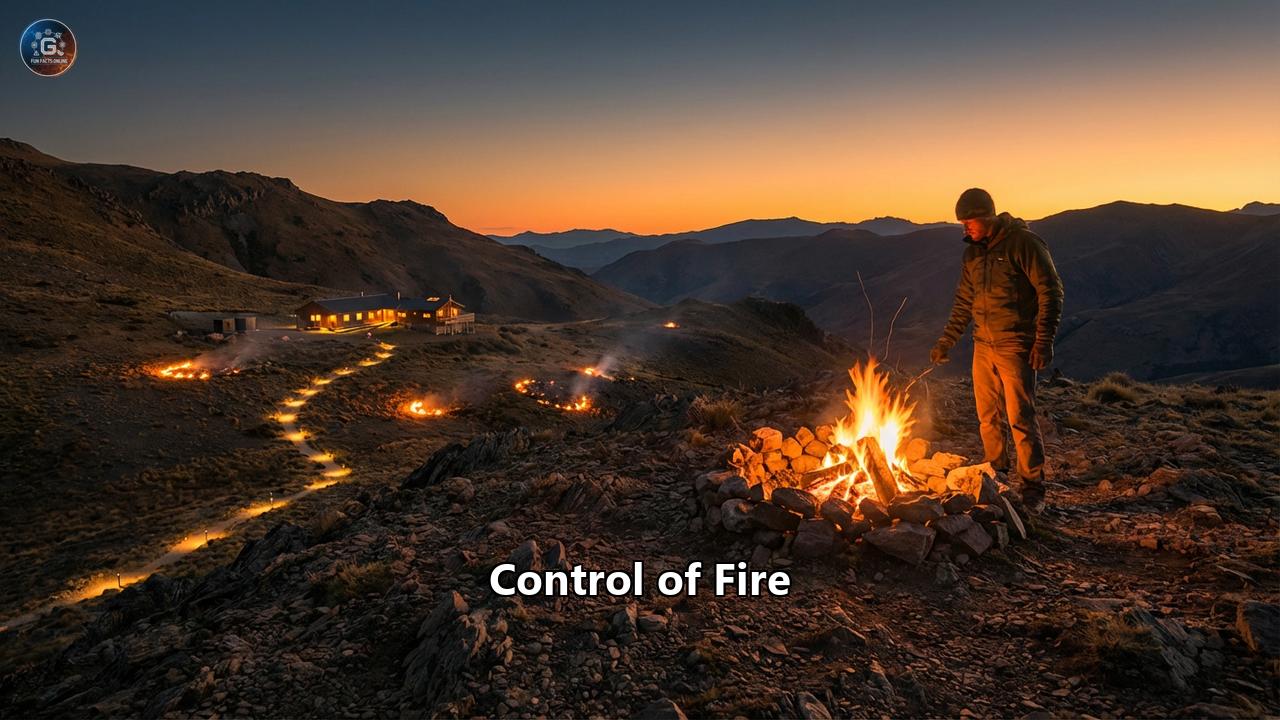
The conquest of fire stands as the single most pivotal achievement in human history. It was not merely a discovery of a tool, but the forging of an alliance with a chemical reaction that would reshape our biology, our societies, and the very face of the Earth. From the flickering hearths of the Paleolithic caves to the roaring combustion chambers of modern rockets, the story of humanity is the story of our control over the flame.
I. The Dawn of the Flame: An Evolutionary Spark
Long before we wrote history, we lived it in the dark. The early hominids were creatures of the daylight, vulnerable to the predators that prowled the night. The "control of fire" was not a singular event but a slow, perilous evolution from opportunistic foraging to mastery.
From Foraging to Making
The relationship likely began with Homo erectus around 1.5 to 2 million years ago. Early humans were "fire foragers," collecting smoldering embers from lightning strikes or volcanic vents. They fed these precious sparks, carrying them in horn or shell containers, acting as guardians of a flame they could not yet create.
The leap to making fire—pyrotechnology—changed everything. Archaeological sites like Barnham in Suffolk, England (400,000 years ago) and Wonderwerk Cave in South Africa provide some of the earliest definitive evidence of deliberate fire use. Whether by striking iron pyrite against flint to create sparks or using the friction of a fire drill, humans unlocked the ability to summon heat and light on command.
The Cooking Hypothesis
Primatologist Richard Wrangham proposed the "Cooking Hypothesis," suggesting that fire did more than warm us—it built us. Raw meat and tough tubers require massive energy to digest. By cooking food, early humans broke down complex proteins and starches effectively "pre-digesting" them. This unlocked a caloric surplus that allowed the human gut to shrink and the human brain to grow expontentially. We are, biologically, the children of the cooking fire.
The Social Hearth
Fire also created the "night." Before fire, darkness meant sleep or silence. With a campfire, the day was extended. The hearth became the social nucleus—a place for storytelling, conflict resolution, and the transmission of culture. It is believed that the complex nuances of human language evolved in the safety of the firelight, where the day’s lessons were turned into the evening’s legends.
II. The Physics and Chemistry of Combustion
To control fire, we had to misunderstand it for millennia, viewing it as a mystical spirit or a fundamental element. Today, we know it as a chemical process: rapid exothermic oxidation.
The Fire Tetrahedron
For centuries, we relied on the "Fire Triangle" (Heat, Fuel, Oxygen). Modern science added a fourth dimension, creating the Fire Tetrahedron.
- Fuel: The reducing agent (wood, gas, coal).
- Oxygen: The oxidizing agent (usually from air).
- Heat: The energy required to raise the fuel to its ignition temperature.
- Chemical Chain Reaction: The self-sustaining transfer of energy that keeps the fire burning.
Remove any one of these, and the fire dies. This principle underpins all modern firefighting, from the kitchen extinguisher to industrial suppression systems.
Anatomy of a Flame
A flame is not matter; it is a region of gas undergoing a reaction.
- The Blue Base: In a candle or gas burner, the blue base indicates premixed combustion, where fuel and oxygen mix efficiently before burning. This is the hottest part, where complete combustion occurs.
- The Yellow Body: This is a diffusion flame. The yellow glow comes from soot particles (unburnt carbon) glowing due to intense heat (incandescence). It represents incomplete combustion.
Thermodynamics
Fire spreads through three mechanisms, each requiring different control strategies:
- Conduction: Heat traveling through solids (e.g., a metal beam carrying fire through a wall).
- Convection: The upward movement of hot gases and smoke, which can ignite ceilings or upper floors (the "chimney effect").
- Radiation: The transfer of heat via electromagnetic waves. This is why you feel heat from a bonfire without touching it, and how a fire can "jump" across a street to ignite a neighboring building.
III. Fire in the Human Imagination
Before we had the periodic table, we had myth. Across every continent, the acquisition of fire is remembered not as an invention, but as a theft or a divine gift.
The Theft of Fire
Humans intuitively understood that fire belonged to the gods.
- Greece: Prometheus stole fire from Mount Olympus, hiding it in a fennel stalk to give to humanity, suffering eternal torture for his generosity.
- Polynesia: The demigod Maui sought the secret of fire from the goddess Mahuika. She gave him her fingernails, which were made of flame, one by one until he learned the secret of friction.
- Native America: Many tribes, such as the Maidu and Karuk, tell of Coyote, the trickster who organized a relay race with other animals to steal fire from the selfish Fire Beings or Thunder Gods, passing the ember from animal to animal to bring warmth to the freezing people.
- Aboriginal Australia: Dreamtime stories tell of Crow stealing fire from seven secret women or two sky brothers, creating the bushfire that allowed humans to cook.
Sacred and Eternal Flames
- Zoroastrianism: In ancient Persia, fire was the physical representation of Asha (truth/order). The Atash Behram (Fire of Victory) is the highest grade of fire, gathered from 16 different sources (including lightning and cremation fires) and purified through complex rituals. It is never allowed to die.
- The Aztec New Fire Ceremony: Every 52 years, the Aztecs believed the sun might die. They extinguished every fire in the empire. High priests would wait for the Pleiades to reach the zenith, then kindle a New Fire on the chest of a sacrificial victim. Runners would then carry torches from this single flame to relight every hearth in the land, symbolizing the rebirth of the cosmos.
- Beltane: The Celtic fire festival marked the beginning of summer. Cattle were driven between two bonfires to purify them and protect them from disease before they were led to summer pastures.
IV. Building Civilization: The Pyrotechnological Ages
Civilization is essentially a history of hotter and hotter ovens. The ability to contain and elevate heat—pyrotechnology—dictated the materials we could master.
The First Engineers: Pottery
The first synthetic material created by humans was ceramic. By heating clay to 900°C (1,650°F), early artisans performed a chemical transformation, turning soft earth into stone-hard vessels. This allowed for food storage, brewing, and the transport of water, fundamental for settled societies.
The Metal Ages
- Copper & Bronze: Copper melts at a relatively modest 1,085°C. Early pottery kilns could reach this temperature. By adding tin (melting point 232°C), ancients created Bronze, an alloy harder than stone. This era gave us the first swords, armor, and durable tools.
- The Iron Age: Iron was abundant but locked away by its high melting point (1,538°C). Ancient kilns couldn't melt it. Instead, they used bloomery furnaces to heat iron ore with charcoal. The burning charcoal produced carbon monoxide, which stripped oxygen from the ore, leaving behind a spongy mass of solid iron (bloom) that had to be hammered to remove impurities. This required immense labor and fuel, driving the development of charcoal production.
The Transparent Revolution: Glass
Whether discovered by Phoenician sailors cooking on sandy beaches (as Pliny suggested) or by Mesopotamian potters, glassmaking is the supreme art of fire control. It requires maintaining temperatures of 1,500°C to melt silica sand. The Romans revolutionized this with the blowpipe, turning a luxury item into a commodity that eventually gave us lenses, windows, and test tubes—the tools of modern science.
Agriculture: Slash-and-Burn
Fire was the first farm tool. Swidden or slash-and-burn agriculture allowed humans to convert forests into fields. The burning biomass released a pulse of nitrogen and potash into the soil, acting as a fertilizer. While often criticized today for deforestation, in the Neolithic era, this was the engine of human expansion, allowing populations to migrate and thrive in dense woodlands.
V. Powering the Modern World
In the 18th century, humanity learned to convert heat into motion. We stopped just using fire to change matter and started using it to move matter.
The Steam Engine (External Combustion)
The Industrial Revolution was fueled by coal. The steam engine is an external combustion engine—the fire burns outside the cylinder to heat water. This allowed us to drain mines, drive locomotives, and power looms. It broke the reliance on muscle and wind, but it was heavy and inefficient.
The Internal Combustion Engine (ICE)
The 19th century saw the fire move inside the machine. Inventors like Nicolaus Otto and Rudolf Diesel realized that if you mixed fuel and air inside a cylinder and ignited it, the expanding gases could push a piston directly.
- The Controlled Explosion: Your car engine is essentially a cannon that fires thousands of times a minute. It relies on the precise timing of the "fire triangle" occurring in milliseconds. This technology shrank the power plant, making automobiles and airplanes possible.
Rocketry: The Ultimate Fire
Rocketry is combustion taken to its limit. To escape gravity, we burn fuel (hydrogen, kerosene) with oxidizers (liquid oxygen) to create a directed explosion of immense velocity. The Saturn V rocket was essentially a skyscraper-sized torch, controlling a reaction energetic enough to level a city, yet precise enough to carry humans to the moon.
VI. Mastering the Beast: Modern Fire Safety & Management
As our cities grew higher and our industries hotter, the threat of fire evolved. We responded with the discipline of Fire Protection Engineering.
Active vs. Passive Protection
- Passive Protection: This is built into the architecture. Firewalls, fire-rated doors, and intumescent paints (which swell to form an insulating char) are designed to contain a fire within a single room or floor ("compartmentation").
- Active Protection: These are systems that act. Sprinklers, smoke detectors, and halon gas suppression systems (used in data centers to kill fire without damaging electronics) break the chain reaction of the fire tetrahedron.
Wildfire Management in the Anthropocene
We are currently facing a crisis of "Megafires." A century of aggressive fire suppression left forests loaded with excess fuel (dead wood), and climate change has dried this fuel out.
- New Paradigm: Modern management is shifting from "suppression" to "mitigation." We use prescribed burns—deliberate, controlled fires—to mimic the natural cycle and reduce fuel loads.
- Tech: We now fight fire with data. Satellites using infrared sensors detect heat signatures from orbit. AI algorithms predict fire spread based on wind and terrain. Drones drop "dragon eggs" (incendiary spheres) to start backburns that starve an approaching wildfire of fuel.
VII. Conclusion
The history of humanity is written in ash and forged in flame. We are the only species that does not flee from fire, but runs toward it. We captured it in the clay kiln to build our cities, trapped it in the piston to drive our cars, and focused it in the rocket nozzle to touch the stars.
Yet, as wildfires rage and carbon emissions rise, we are reminded that fire is never truly "tamed"—only negotiated with. The control of fire remains our oldest responsibility and our most dangerous power. We are still, after a million years, gathering around the hearth, trying to keep the darkness at bay while being careful not to burn the house down.
Reference:
- https://www.reddit.com/r/AskHistorians/comments/13vdgb/why_does_the_bronze_age_comes_before_the_iron_age/
- https://www.youtube.com/watch?v=rC_62NPM1iU
- https://en.wikipedia.org/wiki/Kiln
- https://en.wikipedia.org/wiki/Slash-and-burn_agriculture
- https://www.researchgate.net/publication/350655650_Slash-and-Burn_Experiments_to_Reconstruct_Late_Neolithic_Shifting_Cultivation
- https://www.encyclopedia.com/environment/encyclopedias-almanacs-transcripts-and-maps/slash-and-burn-agriculture
- https://www.khanacademy.org/humanities/world-history/world-history-beginnings/birth-agriculture-neolithic-revolution/a/where-did-agriculture-come-from
- https://ourhumanpast.com/the-neolithic-revolution-transition-from-hunting-gathering-to-agriculture/
- https://en.wikipedia.org/wiki/Internal_combustion_engine