
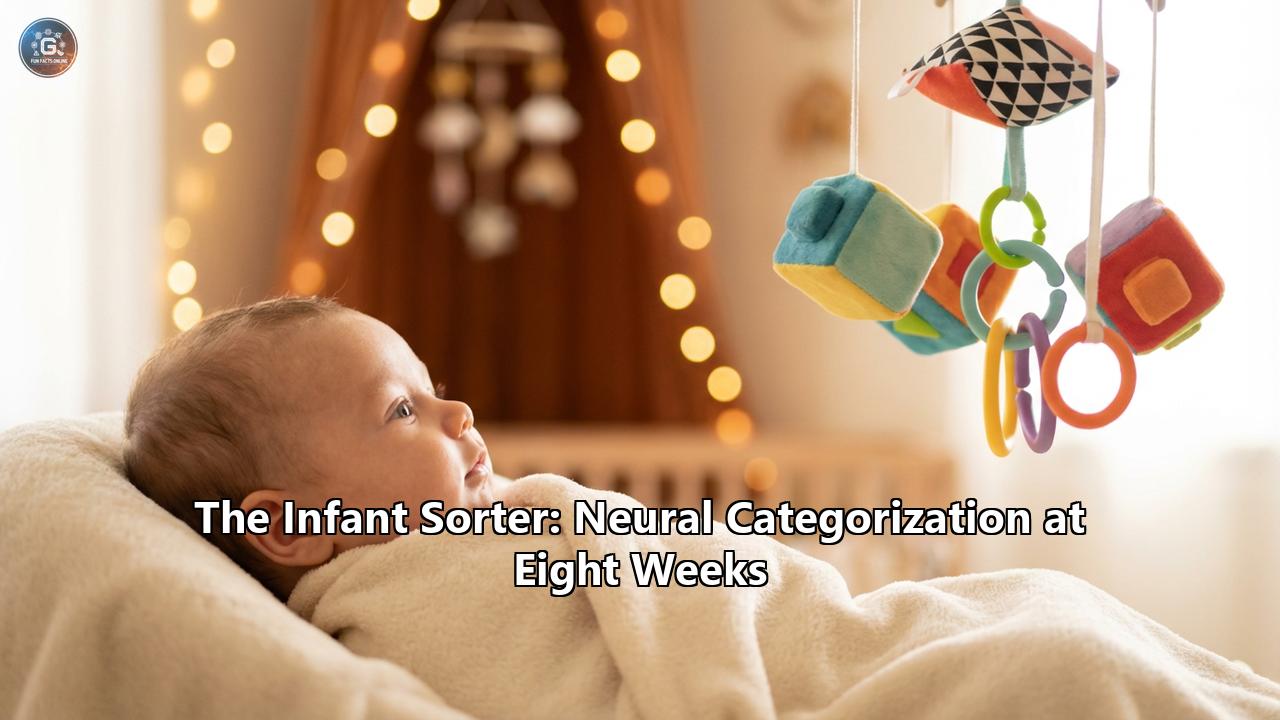
In the quiet hum of the laboratory, a two-month-old infant named Eli lies nestled in a specialized beanbag. He is wearing noise-canceling headphones, and his eyes—wide, curious, and darker than they will be in a year—track images flashing on a screen above him. A rubber duck. A shopping cart. A tree. A cat. To the casual observer, Eli is simply looking. He cannot speak; he cannot crawl; his hands still curl in the primitive palmar grasp. He appears to be a passive observer of a chaotic world.
But inside his skull, a silent symphony of sophisticated neural engineering is taking place. Eli is not just seeing; he is sorting.
For decades, developmental science operated under the assumption that the infant world was, as William James famously put it in 1890, a "blooming, buzzing confusion." The prevailing theory held that young infants perceived the world as a sensory soup—a wash of colors, edges, and light intensities—and that the ability to organize these sensations into distinct categories (like "animal" vs. "object") was a higher-order cognitive skill acquired slowly through months of tactile interaction and language learning.
That assumption has just been shattered.
Groundbreaking research published this week in Nature Neuroscience by a collaborative team from Trinity College Dublin, Stanford University, and Queen's University Belfast has revealed that the "Infant Sorter"—the brain’s innate filing system—is online and fully operational as early as eight weeks of age. This discovery, which represents the largest longitudinal fMRI study of awake infants ever conducted, fundamentally rewrites the timeline of human cognitive development. It suggests that the architecture for making sense of the world is not built brick-by-brick over years, but is largely ready for inspection mere weeks after birth.
The Breakdown of the "Blank Slate"
To understand the magnitude of this discovery, one must appreciate the scientific dogma it displaces. For much of the 20th century, the "tabula rasa" or blank slate theory influenced how we viewed infant cognition. While we knew babies had reflexes, their visual cortex—the part of the brain responsible for processing sight—was thought to be too immature to handle complex categorization.
Categorization is the bedrock of intelligence. It is the mental shortcut that allows us to see a Golden Retriever, a Chihuahua, and a Great Dane, and instantly file them all under "Dog." Without categorization, every single object we encounter would be a unique, terrifyingly novel experience. We would be paralyzed by the sheer volume of processing required to navigate a room.
The new study, led by Dr. Cliona O’Doherty and supervised by Professor Rhodri Cusack, utilized functional Magnetic Resonance Imaging (fMRI) to peer into the living, waking brains of 130 two-month-old infants. The sheer logistical triumph of this method cannot be overstated. fMRI requires the subject to remain perfectly still—a notorious difficulty for adults, let alone wiggling eight-week-olds. The team achieved this by swaddling the infants comfortably and timing the scans to coincide with their periods of calm alertness, creating a "window" into the infant mind that had previously been opaque.
The Experiment: Decoding the Baby Brain
The infants were shown images from 12 distinct categories, ranging from animate objects like faces and limbs to inanimate objects like toys and household items. As Eli and his peers watched the screen, the MRI scanner mapped the blood flow in their brains, highlighting which neurons were firing in response to which images.
If the "blooming, buzzing confusion" theory were true, the brain activity would have been messy and indistinct. The visual cortex would have reacted to the brightness of the yellow duck or the sharp edges of the shopping cart, but it wouldn't have recognized them as fundamentally different types of things.
Instead, the scanners revealed something extraordinary.
When the infants looked at a face, a specific region of the visual cortex lit up. When they looked at a scene (like a corridor), a different region activated. Most stunningly, the patterns of neural activity were distinct enough that researchers could train Artificial Intelligence (AI) models to read the brain scans and predict what the baby was looking at. The AI could look at the neural map of an eight-week-old and say, "This baby is looking at a toy," or "This baby is looking at an animal."
The patterns were not random. They followed a topographical organization surprisingly similar to that of an adult brain. The brain wasn't just recording light; it was sorting the data into "files." The "Infant Sorter" was already at work, partitioning the world into understandable units.
The Neural Mechanics of the "Sorter"
What exactly is happening in the eight-week-old brain to allow for this categorization? The study points to the ventral visual stream, often called the "What Pathway." This is a highway of neurons that travels from the back of the head (occipital lobe) toward the sides (temporal lobe).
In adults, this pathway is highly specialized. We have the Fusiform Face Area (FFA) for faces, the Parahippocampal Place Area (PPA) for landscapes, and the Visual Word Form Area (VWFA) for reading. The new data suggests that the seeds of this specialization are not planted by years of schooling or learning the names of things. They are, to a large extent, hardwired.
"The visual cortex at eight weeks is not a blank canvas," explains Dr. Anna Truzzi, a co-author of the study. "It is more like a coloring book. The outlines are already there—the brain has a designated spot for 'faces' and a designated spot for 'tools'—and experience simply colors them in."
This neural pre-scaffolding explains how human infants learn so rapidly. If a baby had to learn the concept of "face" from scratch, it might take years. But if the brain arrives with a "Face Slot" ready to receive data, the infant can begin social bonding and emotional reading almost immediately. The "Infant Sorter" acts as a cognitive bootstrap, giving the baby a massive head start in the race to understand reality.
The Role of Artificial Intelligence in the Discovery
A fascinating layer of this research is the symbiosis between biological intelligence and artificial intelligence. The human eye alone could never decipher the subtle shifts in blood flow captured by the fMRI. It required deep learning algorithms—similar to those used in ChatGPT or image recognition software—to decode the neural signatures.
The researchers used a "representational similarity analysis." They compared the patterns of the infant brains to the patterns of deep neural networks (DNNs) trained to recognize images. They found a high degree of congruence. The way a state-of-the-art AI breaks down an image of a cat into features (fur texture, ear shape, eye position) and categorizes it essentially mirrors the strategy used by the two-month-old brain.
This validation is two-fold. It confirms the sophistication of the infant brain, but it also suggests that our best AI models are beginning to approximate the biological reality of how vision works. We are building machines that see like babies, and using those machines to understand how babies see.
Developmental Implications: The "Smart" Infant
The implications of the "Infant Sorter" extend far beyond neuroscience; they touch on philosophy, education, and parenting.
1. The End of "Passive" InfancyWe often treat the first three months of life (the "fourth trimester") as a period of mere survival—eat, sleep, poop. This research suggests that this is a period of intense intellectual activity. The infant is not just metabolizing milk; they are metabolizing visual data, sorting their environment into safe/unsafe, living/non-living, social/asocial. Parents who feel their two-month-old is "studying" them are likely correct. The baby is updating their "Human Face" category in real-time.
2. Language AcquisitionLinguists have long puzzled over the "symbol grounding problem." How do babies learn that the sound "dog" refers to the furry animal, and not the grass it stands on or the collar it wears? The "Infant Sorter" provides the answer. If the brain has already visually categorized the dog as a distinct entity separate from the background before the child understands language, the word "dog" has a clear slot to land in. Visual categorization is the silent precursor to language.
3. Neurodiversity and Early DetectionOne of the most promising applications of this research is in the early detection of neurodevelopmental conditions. If the "Infant Sorter" is a standard feature of typical development, deviations from this pattern could be early biomarkers for conditions like Autism Spectrum Disorder (ASD). ASD is often characterized by differences in social processing (faces). If an eight-week-old’s brain does not show the expected activation in the "face" category region, it could allow for intervention years before behavioral symptoms typically appear.
The Philosophical Angle: Kant Was Right
In the 18th century, the philosopher Immanuel Kant argued that the human mind does not passively reflect the world like a mirror. Instead, he proposed that we impose "categories of understanding" onto the world. We are born with the glasses through which we see reality.
The "Infant Sorter" is essentially the biological proof of Kant’s philosophy. We do not learn that objects have boundaries, or that living things are different from inert matter, solely through trial and error. We come equipped with the neural hardware to make those distinctions. The human brain is pre-configured for the human experience.
Looking Forward: The 10,000-Hour Head Start
This research, coming as it does in early 2026, sets the stage for a new era of "Cognitive Fetology" and early infant science. The next steps for the research team involve tracking these same infants as they grow. How does the "Infant Sorter" evolve when the child starts to crawl? How does it change when they learn to speak?
For now, the image of the eight-week-old "sorter" stands as a testament to the complexity of human life. Before they can hold a spoon, before they can sit up, and long before they can say "Mama," our children are already scientists. They are observing the chaotic data of the universe and, with the quiet hum of a developing cortex, putting everything in its right place.
Practical Takeaways for Parents and Caregivers
- Visual Diet Matters: Since the "sorter" is active at 8 weeks, providing a visually rich environment is beneficial. This doesn't mean high-tech screens, but rather high-contrast books, varied faces, and exposure to nature. The brain is hungry for data to sort.
- The Power of Faces: The face-processing region is one of the earliest to come online. Face-to-face interaction is not just emotional; it is a cognitive workout for the infant brain’s most sophisticated hardware.
- Trust the Baby: When an infant stares intently at a ceiling fan or a shadow, they aren't "zoning out." They are processing. Interrupting them is akin to walking into a room where a scientist is running a simulation. Let them sort.
The "Infant Sorter" reveals that the lights are on, and someone is definitely home, much earlier than we ever dared to imagine.
Reference:
- https://scienceblog.com/babies-sort-the-world-at-two-months-old/
- https://www.businesseye.co.uk/news/i-see-a-rubber-duck-queens-leads-new-research-into-the-brain-power-of-babies/
- https://pmc.ncbi.nlm.nih.gov/articles/PMC8872728/
- https://www.sciencedaily.com/releases/2026/02/260204114144.htm
- https://www.iflscience.com/baby-brains-sort-objects-into-visual-categories-from-just-2-months-old-before-they-even-see-in-color-82417
- https://1063thefox.com/highlighted/new-research-shows-babies-are-ahead-of-where-we-think-they-are/
- https://pubmed.ncbi.nlm.nih.gov/37261784/
- https://www.natureasia.com/en/info/press-releases/detail/9226