
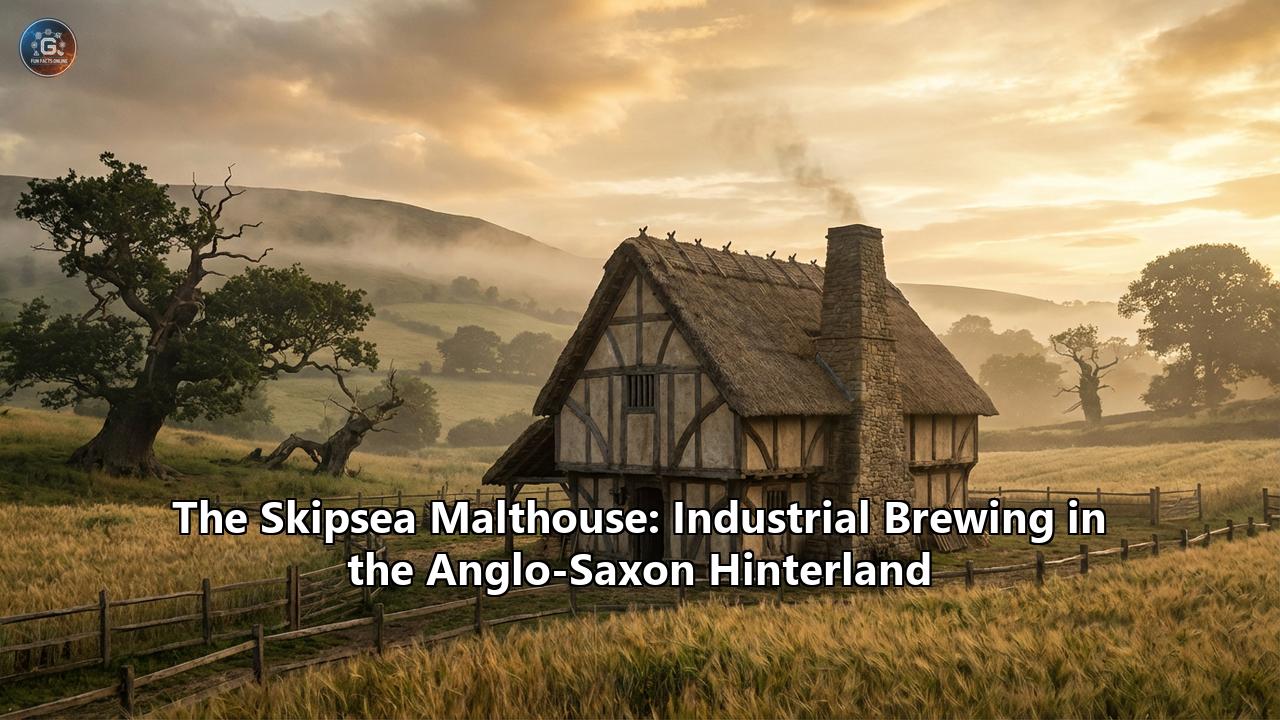
The wind off the North Sea cuts across the Holderness plain with a sharpness that hasn’t changed in a thousand years. Today, it whistles through the hawthorn hedges and over the eroding clay cliffs of East Yorkshire, but in the 8th century AD, it carried the heavy, sweet scent of roasting grain. Here, in what modern eyes might dismiss as a quiet agricultural backwater, the engine of Anglo-Saxon social life was thrumming: a massive, industrial-scale malthouse, churning out the raw material for the ale that fueled the feasts of kings and thanes.
For decades, the story of Skipsea was dominated by the imposing earthwork of its "Norman" castle. But a groundbreaking excavation at a site known as Sparrow Croft, just a stone's throw from the castle motte, has shattered that narrative. Researchers from the University of York have unearthed a complex that predates the Normans by centuries—a "lordly centre" of the Kingdom of Northumbria featuring a timber tower, a great feasting hall, and, most crucially, a sophisticated facility dedicated to the production of malt.
This is the story of the Skipsea Malthouse, a discovery that forces us to rewrite the history of the "Dark Ages" in Northern England, revealing a society of immense organizational power, technological sophistication, and a serious dedication to the art of brewing.
Part I: The Ghost in the Barley Field
The discovery at Sparrow Croft did not happen overnight. It began with a reassessment of the landscape itself. For years, the massive earthen mound of Skipsea Castle was assumed to be a classic Norman motte, built by Drogo de la Beuvrière in the years following the Conquest of 1066. It was the textbook example of Norman domination—a foreign fortress imposing its will on the flat English landscape.
But in the mid-2010s, a team led by Dr. Jim Leary drilled a borehole into the center of the mound and recovered organic material for radiocarbon dating. The results were a bombshell: the mound wasn't Norman. It was Iron Age, built around 400 BC. The Normans hadn't built it; they had simply squatted on it.
This revelation unlocked a new way of seeing the landscape. If the mound was an ancient feature, what else in the surrounding fields had been misidentified or overlooked? The focus shifted to "Sparrow Croft," a seemingly nondescript field about 200 meters from the castle. Geophysical surveys—using magnetometers to detect tiny anomalies in the soil's magnetic field caused by ancient fires and disturbed earth—lit up with intriguing patterns. There were rectangles, circles, and linear features that suggested a dense settlement.
When the trowels finally broke ground in the mid-2020s, the archaeologists didn't find the peasant huts or animal pens they might have expected. They found high-status architecture. They found a square sunken feature lined with timber and mortar—the cellar of a massive wooden tower. They found the post-holes of a long timber hall, a venue for political assembly and feasting. And nestled among these symbols of power was a structure that was purely industrial: the malthouse.
Part II: Anatomy of the Skipsea Malthouse
To understand the significance of the Skipsea Malthouse, one must first understand that in the Anglo-Saxon world, brewing was not merely a hobby; it was a caloric necessity and a social lubricant. Water could be dangerous; milk was for cheese; wine was an expensive import for the church. Ale was the staple drink for everyone from the slave to the king.
Most brewing was domestic—a "cottage industry" in the literal sense, performed by women (brewsters) in the home for their immediate family. The Skipsea find is different. This was not a kitchen operation. This was a factory.
The structure excavated at Sparrow Croft, dating to between AD 750 and 850, reveals a level of specialization that implies a centralized economy. The building was timber-framed, with walls of wattle and daub—woven wooden lattice smeared with a mixture of mud, straw, and dung to create a weatherproof seal. But the heart of the building was the kiln.
The Kiln and the Corn Dryer
The archaeologists uncovered a large, T-shaped or keyhole-shaped oven, heavily scorched by years of intense heat. This was the grain dryer. In the malting process, barley must be soaked to trick the grain into germinating (releasing the enzymes needed to convert starch into sugar), and then rapidly dried to stop the sprout from consuming those sugars.
The Skipsea kiln was a masterpiece of thermal engineering. It likely featured a "stokehole" where the fire was fed, connected by a flue to a drying chamber. The heat would have been channeled under a suspended floor—perhaps made of horsehair cloth laid over timber slats, or a perforated clay surface—allowing hot air to rise through the grain without burning it.
The presence of charred grain residues—"carbonized germinated grain"—is the smoking gun. In a standard grain dryer used for food storage, you find clean grain. In a malthouse, you find grain that has sprouted. The tiny, fragile rootlets of the barley, preserved by charring, tell us exactly what this building was for.
The Steeping Tanks
Adjacent to the kiln, the excavation revealed areas of compacted clay flooring and potential evidence of lead-lined or timber-lined pits. These would have been the steeping tanks. To make malt, you need water—lots of it. The grain must be submerged for two to three days until it swells and its moisture content hits roughly 45%.
The location of Skipsea is crucial here. Today, the castle sits on a dry mound, but in the 8th century, this area was a wetland archipelago. The castle mound was an island in the middle of "Skipsea Mere," a vast freshwater lake that teemed with eels and waterfowl. The malthouse was situated perfectly to access the fresh water needed for steeping, likely drawn from the mere or diverted via channels to the industrial site.
The Germination Floor
Between the wet tanks and the hot kiln lay the "couching" or germination floor. This would have been a long, smooth area where the soaked grain was spread out to breathe. It required constant attention. Maltsters would have used wooden rakes to turn the grain every few hours, preventing the buildup of heat and mold, and ensuring even germination. The scale of the building found at Sparrow Croft suggests a floor capable of processing hundreds of bushels of barley at a time—enough to brew thousands of gallons of ale.
Part III: The Science of the Anglo-Saxon Brew
What did the ale from the Skipsea Malthouse taste like? To answer that, we have to reconstruct the chemistry of 8th-century brewing, which was markedly different from modern beer making.
The most glaring difference was the absence of hops. Hops, which provide the bitterness and preservative qualities in modern beer, were not widely used in England until the 15th century. The brew made at Skipsea was "ale," not "beer" (in the medieval distinction of the words).
Without hops, the sweetness of the malt had to be balanced with "gruit"—a mixture of herbs and spices. Archaeobotanical samples from similar sites in East Yorkshire suggest a palette of local botanicals:
- Bog Myrtle (Sweet Gale): A shrub growing in the wetland margins of the mere, providing a resinous, spicy bitterness.
- Yarrow: A common field herb that adds a medicinal, astringent quality.
- Ground Ivy: Used for clarifying the ale and adding a bitter tang.
- Meadowsweet: Found in damp meadows, adding almond-like aromas and antiseptic properties.
The malthouse produced the "pale malt" (dried at lower temperatures) or "brown malt" (dried at higher temperatures with wood smoke). The fuel used in the Skipsea kiln—likely local hardwoods like oak or hazel, or perhaps peat from the mere's edge—would have imparted a distinct smokiness to the grain.
The resulting drink was likely thick, opaque, and low in carbonation, but rich in nutrients. It was "liquid bread." For the elite feasting in the nearby hall, this ale might be sweetened with honey or fortified with imported spices, but the base product came right from that clay-floored oven in Sparrow Croft.
Part IV: The "Lordly Centre" – A Complex of Power
The malthouse effectively proves that Sparrow Croft was not a peasant village. Peasants don't build industrial factories; lords do. The malthouse was part of a larger machine of social control and display.
The Timber Tower
Perhaps the most visually arresting find at the site is the "sunken tower." Archaeologists found the cellar of a square tower, a feature that is exceptionally rare for the Anglo-Saxon period. In the 8th century, stone was largely reserved for the church; secular buildings were timber.
This tower likely stood two or three stories high. Its purpose was multifold. Militarily, it was a watchtower, offering a view over the flat Holderness coastline to spot Viking longships or rival Northumbrian raiding parties. Religiously, it might have served as a "turriform church" or a bell tower, calling the faithful to prayer. But socially, it was a statement. In a flat landscape, a tower says: I am watching you. I am above you.
The Great Hall
North of the malthouse lay the Great Hall. This was the social universe of the Anglo-Saxon elite. It was a long, rectangular timber building, likely with a thatched roof and a central hearth.
We can imagine the scene inside: the Lord of Skipsea (perhaps a high-ranking thane or an ealdorman of the Northumbrian court) sitting on the "high seat." The air is thick with woodsmoke and the smell of roasted meat. The ale, brewed just meters away, flows freely into horn and glass vessels.
The hall was where the "gift economy" functioned. The lord gave ale, food, and rings (gold/silver armbands) to his retainers; in exchange, they gave him their loyalty and their swords. The malthouse, therefore, was not just a kitchen annex—it was the fuel depot for the political machine. Without the ale to bind the warrior band together, the lord's power would evaporate.
Part V: The Geopolitical Storm – Northumbria in the 8th Century
The dates of the malthouse (AD 750-850) place it squarely in one of the most dynamic and dangerous periods of English history.
In AD 750, the Kingdom of Northumbria was a center of European learning and art. This was the age of Alcuin of York (who went on to tutor Charlemagne) and the Venerable Bede. The wealth of the kingdom is evident in the "stycas" (small copper coins) found in excavations across the region. The sheer size of the Skipsea complex reflects this golden age—a time when local lords had the resources to build massive infrastructure projects.
But the horizon was darkening. In AD 793, the Vikings sacked Lindisfarne, just up the coast. By the mid-9th century, the "Great Heathen Army" would land in East Anglia and march north, capturing York in AD 866.
The Skipsea Malthouse operated in the shadow of this encroaching doom. The fortification of the site—the ditch systems and the tower—suggests a landscape that was becoming increasingly militarized. The ale brewed here might have been drunk by warriors preparing to face the Danes, or perhaps by the Danes themselves after they seized the Lordship of Holderness.
The excavation suggests the site continued to be important right up to the Conquest. The fact that the malthouse was rebuilt and repaired suggests it was a critical asset that successive waves of rulers—Northumbrian, Viking, and Saxon—wanted to control.
Part VI: The Landscape of the Meres
To fully appreciate the Skipsea site, we must mentally delete the modern drainage ditches and flat beet fields. In the 8th century, Holderness was a water-world.
The name "Skipsea" itself is a clue. It comes from the Old English/Old Norse Skip (ship) and Sae (lake or sea). It literally means "Ship Lake." The mere was navigable. Flat-bottomed boats and dugouts would have moved goods between the lordly centre and the scattered farmsteads on the "mainland."
The malthouse required grain (barley) to be brought in from the surrounding arable lands. In a landscape of marshes, water transport was far more efficient than ox-cart. We can visualize barges laden with golden barley poling through the reeds of Skipsea Mere, docking at the Sparrow Croft complex to unload their cargo into the waiting granaries.
This aquatic connection also linked Skipsea to the wider world. The mere drained into the North Sea, making this site a potential port of trade. Pottery shards found in the region—Ipswich Ware and later Torksey Ware—show that goods were moving up and down the east coast. The Lord of Skipsea wasn't just a local farmer; he was a merchant prince, plugged into a trade network that stretched to the Rhineland.
Part VII: Comparison with Sedgeford – The "Industrial Revolution"
Until the Skipsea discovery, the best parallel for this kind of site was Sedgeford in Norfolk. There, archaeologists have spent decades uncovering a massive malting complex with multiple kilns and steeping tanks.
The similarities between Skipsea and Sedgeford are striking. Both are located in the "hinterland" (away from the major urban centers like York or Norwich), yet both show industrial capacity. This challenges the old view of the Anglo-Saxon economy as primitive and subsistence-based.
What we are seeing is an "agricultural industrial revolution" of the Mid-Saxon period (roughly AD 650-850). Elites were reorganizing the countryside to maximize production. They weren't just demanding tribute; they were investing in infrastructure. They built mills to grind flour and malthouses to process grain, centralizing the production of high-value goods (flour and malt) to control the peasantry. If you have to bring your grain to the Lord's malthouse to make it usable for brewing, the Lord controls your beer supply—and thus, he controls you.
Part VIII: The Norman Eclipse
The story of the Anglo-Saxon malthouse ends with the arrival of the Normans. When William the Conqueror’s men arrived in Holderness, they found a landscape already rich in history and infrastructure.
The Lordship of Holderness was given to Drogo de la Beuvrière, a Flemish mercenary who had married William’s niece. Drogo was a ruthless man (he eventually killed his wife and fled the country), and he wanted a castle that reflected his dominance.
He looked at the ancient Iron Age mound, which likely still had the timber tower or hall of the Anglo-Saxon lord standing near it, and he seized it. The Normans reshaped the landscape, digging the massive moat that still exists today and raising the motte higher.
The Sparrow Croft site—the hall, the tower, and the malthouse—was abandoned or subsumed. The center of gravity shifted a few hundred meters to the castle proper. The timber buildings rotted away, the wattle walls of the malthouse collapsed, and the clay floors were buried under the drifting soil of the Holderness plain.
For 900 years, the Anglo-Saxon industrial complex slept.
Conclusion: A Toast to the Past
The excavation of the Skipsea Malthouse is more than just a finding of old burnt seeds and post-holes. It is a window into the vibrancy of the Anglo-Saxon world. It reminds us that the people of the 8th century were engineers, chemists, and industrialists. They understood the biology of grain, the physics of heat, and the sociology of alcohol.
Standing in the field at Sparrow Croft today, with the wind biting at your face, it is hard to imagine the heat of the great kiln or the roar of laughter from the timber hall. But thanks to the work of the University of York archaeologists, the ghosts of Skipsea have been given a voice. And if you listen closely, you can almost hear the clinking of horns and the toast: Wes hál—Be whole, be healthy.
The Skipsea Malthouse stands as a testament to the enduring human desire to gather, to feast, and to build, even in the face of the gathering storm. It is one of the most significant archaeological discoveries of the decade, a true jewel in the crown of East Yorkshire's heritage.
Reference:
- https://www.theguardian.com/science/2016/oct/03/skipsea-castle-yorkshire-built-on-iron-age-mound
- https://www.english-heritage.org.uk/visit/places/skipsea-castle/history/
- https://grokipedia.com/page/skipsea_castle
- https://crispmalt.com/news/sedgeford-archaelogical-dig/
- https://www.york.ac.uk/news-and-events/news/2026/research/lordly-centre-revealed-skipsea-castle/
- https://www.thearchaeologist.org/blog/anglo-saxon-lordly-centre-revealed-by-excavations-near-skipsea-castle
- https://www.york.ac.uk/news-and-events/news/2024/research/archaeologists-excavate-medieval-timber-hall/
- https://regia.org/research/life/brewing.htm
- https://www.sharp.org.uk/single-post/sedgeford-s-anglo-saxon-malthouse
- https://arkeonews.net/the-sedgeford-anglo-saxon-malting-complex-may-be-the-largest-ever-discovered-in-the-uk/
- https://the-past.com/feature/brewing-up-history-unearthing-evidence-for-middle-saxon-malting-at-sedgeford/
- https://en.wikipedia.org/wiki/Skipsea_Castle
- https://www.sharp.org.uk/early-medieval-malting-trench