
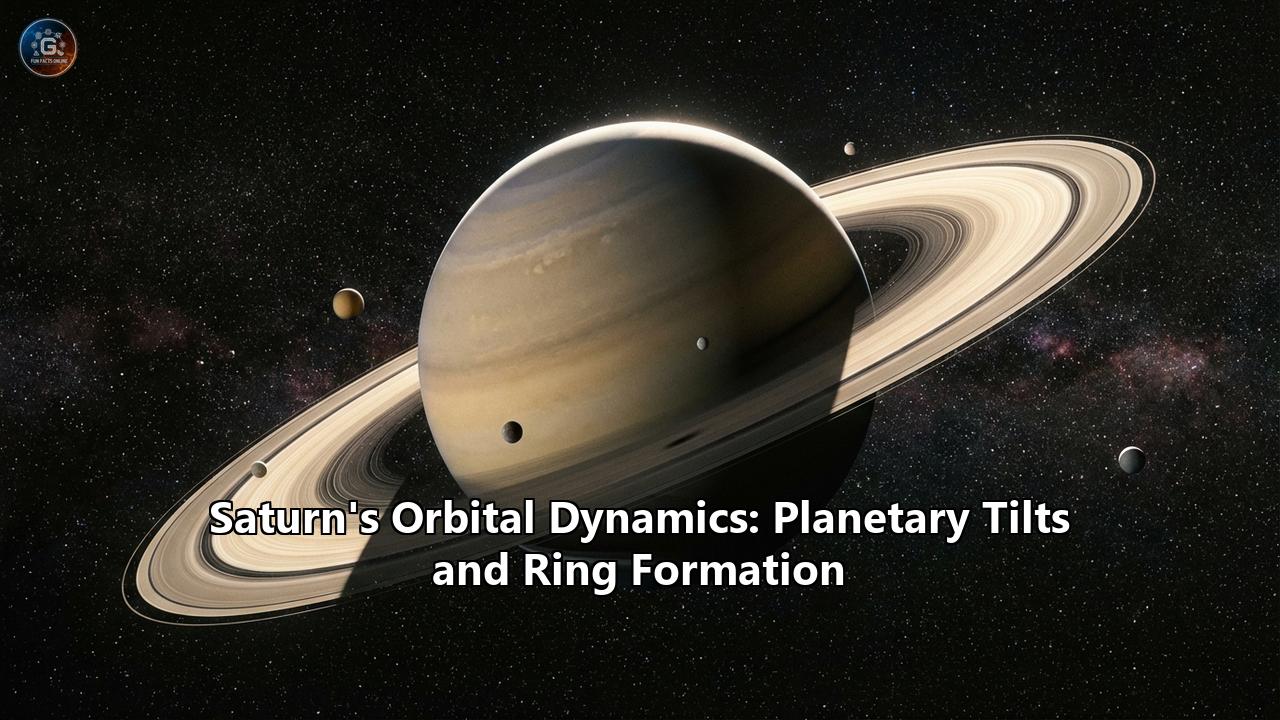
When we gaze through a telescope at the night sky, few sights are as universally breathtaking as the golden, banded sphere of Saturn suspended within its shimmering, icy halo. For centuries, this spectacular ring system has been the defining feature of our solar system’s second-largest planet, earning it the moniker "Lord of the Rings." Yet, beneath this serene and majestic astronomical portrait lies a history characterized by intense gravitational warfare, catastrophic destruction, and complex orbital dynamics. Saturn is not just a passive gas giant floating in the outer solar system; it is a dynamic, evolving world whose iconic rings and unusual planetary tilt are the scars of an ancient, violent cosmic event.
To truly understand Saturn, we must peel back the layers of its modern appearance and delve into the delicate interplay of gravity, orbital resonances, and the tragic fate of a lost moon named Chrysalis. The story of Saturn’s orbital dynamics and ring formation is a grand celestial detective story—one that forces us to abandon the idea of a static, unchanging solar system and embrace a cosmos where even the most massive planets are subject to chaotic, transformative forces.
The Enigma of the Slanted Giant
A planet's axis of rotation is rarely perfectly perpendicular to its orbital plane. Earth, for example, boasts an axial tilt—or obliquity—of 23.5 degrees, a quirk of celestial mechanics that blesses our world with the changing seasons. Saturn similarly spins at a pronounced angle, boasting an axial tilt of 26.7 degrees. For a rocky, terrestrial planet like Earth or Mars, a tilted axis is easily explained by the violent conditions of the early solar system. During the chaotic protoplanetary disk phase, massive planetesimals routinely smashed into one another, and a colossal impact from a Mars-sized object was more than enough to knock a rocky world off its vertical axis.
However, applying this violent impact model to a gas giant like Saturn presents a monumental physics problem. Gas giants are incredibly massive—Saturn is 95 times more massive than Earth—and they possess enormous angular momentum. To permanently tilt a planet composed almost entirely of hydrogen and helium, an impactor would have to be unfathomably massive. Even then, the fluid dynamics of a gas giant would likely absorb the blow without permanently altering the planet's rotation to such a steep degree. "The tilt is too large to be a result of known formation processes in a protoplanetary disk or from later, large collisions," notes Jack Wisdom, a professor of planetary science at the Massachusetts Institute of Technology (MIT).
If a giant impact did not knock Saturn over, what did? For decades, astronomers theorized that the answer lay not in a sudden collision, but in a slow, invisible gravitational tether to the outermost ice giant of our solar system: Neptune.
Planets wobble as they spin, much like a child's spinning top that begins to slow down. This wobbling motion is known as axial precession. In the early 2000s, astrophysicists recognized that the rate at which Saturn’s axis precesses was remarkably close to the orbital precession rate of Neptune. This alignment suggested that the two planets were locked in a "spin-orbit resonance." Essentially, the gravitational influence of Neptune, acting over billions of years, had reached across the vast darkness of the outer solar system to grab hold of Saturn, gradually pulling its axis into a steep 26.7-degree tilt.
For a time, this theory satisfied the astronomical community. It was an elegant mathematical explanation for a physical anomaly. But the universe is rarely so simple, and the arrival of NASA’s Cassini spacecraft would soon unravel this neat hypothesis, revealing a far more intricate and dynamic reality.
The Cassini Revelation and Titan’s Escape
When the Cassini-Huygens mission arrived at Saturn in 2004, it commenced a 13-year masterclass in planetary science. Cassini mapped the planet's cloud tops, plunged through the icy plumes of Enceladus, dropped a probe onto the methane-soaked surface of Titan, and stared deeply into the complex structure of the rings. But some of the mission's most vital data came during its "Grand Finale" in 2017. Running low on fuel, Cassini was instructed to execute a series of daring, suicidal dives between Saturn's upper atmosphere and its innermost rings.
During these final orbits, Cassini precisely measured Saturn's gravitational field, allowing scientists to map the distribution of mass deep within the planet's interior. By understanding the planet's moment of inertia—how its mass is distributed from its dense core to its wispy outer atmosphere—researchers could definitively calculate the precise mechanics of its spin and precession.
When Jack Wisdom and his colleagues at MIT fed Cassini's highly accurate gravitational data into their complex orbital models, the results were shocking. The math did not add up. The data revealed that while Saturn’s precession is extremely close to being in resonance with Neptune, it is actually just outside of it. Saturn was not currently locked in a gravitational dance with Neptune; it had escaped.
But how does a planet the size of Saturn simply break free from a multi-billion-year gravitational lock? The answer lay in the behavior of Saturn's extensive retinue of moons.
Saturn hosts a staggering collection of natural satellites—over 140 recognized moons ranging from tiny moonlets embedded in the rings to colossal worlds larger than the planet Mercury. The undisputed king of this satellite system is Titan. Titan is a behemoth, possessing a thick nitrogen atmosphere and hydrocarbon lakes, and its gravitational presence dominates the Saturnian system.
Cassini's astrometric measurements revealed a startling fact about Titan: it is migrating away from Saturn at a rapid clip of about 11 centimeters (4.3 inches) per year. While this may sound minuscule, on a cosmic scale and over millions of years, it represents a massive shift in orbital energy. As Titan slowly spiraled outward, its gravitational influence on Saturn and the other moons shifted dramatically. This rapid migration provided scientists with the "lever" needed to explain Saturn's tilt. As Titan moved outward, it helped push Saturn into resonance with Neptune. But Titan alone could not explain how Saturn eventually broke out of that resonance to reach its current state. To balance the equations, the MIT team realized that a massive piece of the puzzle was missing. Saturn must have once had another moon.
Enter Chrysalis: The Sacrificial Moon
To solve the dual mysteries of Saturn's current axial tilt and its narrow escape from Neptune's gravitational grip, Jack Wisdom and his team proposed a meticulously tested hypothesis in 2022: the Saturnian system was once home to an additional, massive moon. They named this lost world Chrysalis.
Calculations suggest that Chrysalis was roughly the size of Iapetus, Saturn's third-largest moon, which measures about 1,500 kilometers (roughly 900 miles) in diameter—about half the size of Earth's moon. For billions of years, Chrysalis was a stable, harmonious member of Saturn's lunar family. Together with Titan, Iapetus, and the rest of the icy satellites, Chrysalis orchestrated a collective gravitational pull that kept Saturn's wobble perfectly synchronized with Neptune.
However, the solar system is a clockwork mechanism where the gears are constantly shifting. As Titan continued its relentless outward migration, the gravitational harmony of the Saturnian system began to fracture. Between 100 and 200 million years ago—a time when dinosaurs like the Stegosaurus and Allosaurus roamed the Earth during the Jurassic period—the expanding orbit of Titan pushed Chrysalis into a "chaotic orbital zone".
Suddenly, the once-stable moon found itself subjected to extreme gravitational perturbations. It began to experience a series of dangerous, close encounters with both Titan and Iapetus. These near-misses warped Chrysalis's orbit, turning it from a neat, circular path into a highly eccentric, elliptical plunge that brought it dangerously close to Saturn itself.
Around 160 million years ago, the fatal moment arrived. Chrysalis swung too close to Saturn, breaching an invisible boundary known as the Roche limit.
The Roche limit is the critical distance at which the tidal forces exerted by a massive primary body (like Saturn) exceed the internal gravitational forces holding a smaller secondary body (like a moon) together. As Chrysalis crossed this threshold, the gravitational pull on the side of the moon facing Saturn was vastly stronger than the pull on its far side. The solid ice and rock of the moon began to stretch, groan, and fracture. In a cosmic blink of an eye, the immense tidal forces ripped Chrysalis to shreds.
The researchers conclude that approximately 99 percent of the shattered moon's mass was swallowed completely by Saturn's gaseous atmosphere. But it is the remaining 1 percent that changed the solar system forever. This fragmented debris, consisting mostly of pure water ice, remained suspended in orbit. Over millions of years, these fragments collided with one another, grinding down from the size of mountains to boulders, pebbles, and microscopic dust, eventually spreading out to form the dazzling, expansive ring system we see today.
The loss of Chrysalis was the precise event that allowed Saturn to snap out of its resonance with Neptune. "You're losing this whole moon, and then you can have one less handle to jerk Saturn around," explained Burkhard Militzer, a UC Berkeley professor and co-author of the study. By shedding this massive gravitational anchor, Saturn was left with its steep 26.7-degree tilt, a permanent monument to the moon it destroyed.
A New Origin Story for the Rings
The Chrysalis hypothesis is widely celebrated because it acts as a grand unifying theory, solving not just the mystery of Saturn's tilt, but also one of the most hotly debated topics in planetary science: the age of Saturn's rings.
Since Galileo Galilei first observed Saturn in 1610 (mistaking its rings for "ears" or twin moons) and Christiaan Huygens correctly identified them as a disk in 1655, astronomers have wondered how old the rings are. For a long time, the prevailing wisdom was that the rings were primordial—that they formed 4.5 billion years ago alongside Saturn itself, coalescing from the leftover material in the solar nebula.
However, if the rings were 4.5 billion years old, they should look very different. Space is dusty. Interplanetary micrometeoroids, carbon-rich dust, and the soot of ancient comets constantly drift through the solar system. If Saturn's rings had been exposed to this cosmic pollution for billions of years, they would have grown dark, dull, and soot-colored. Instead, the rings of Saturn are incredibly bright, highly reflective, and composed of 98 to 99 percent pure water ice. This pristine composition strongly suggests they haven't been accumulating dust for very long.
Once again, Cassini's Grand Finale provided the smoking gun. By flying between the planet and the rings, Cassini directly measured the gravitational pull of the ring system, allowing scientists to calculate its mass with unprecedented accuracy. The rings turned out to be surprisingly light—equivalent to about 40 percent of the mass of the moon Mimas, or roughly two-thirds the mass of Earth's Antarctic ice sheet.
In astrophysics, mass and age are deeply intertwined when it comes to ring systems. A massive ring system can absorb micrometeorite impacts and remain bright for a longer period, while a low-mass ring system will darken much faster. Combining the low mass of the rings with the known rate of "dust pollution" in the Saturnian system, researchers arrived at a stunning conclusion: Saturn's rings are practically infants. They are between 10 million and 100 million years old.
This timeframe aligns perfectly with the violent destruction of Chrysalis 160 million years ago. Just as an insect’s chrysalis lies dormant before bursting forth to reveal a spectacular butterfly, this lost moon orbited quietly for billions of years before its dramatic destruction birthed the most beautiful feature in the night sky.
The Anatomy of a Celestial Masterpiece
The debris of Chrysalis now forms an expansive, complex structure that stretches across hundreds of thousands of kilometers of space, yet is impossibly thin—in many places, the rings are only about 10 meters (30 feet) to 100 meters thick. If you were to scale Saturn down to the size of a basketball, its rings would be thinner than a human hair.
The ring system is broadly divided into several main sections, labeled alphabetically in the order of their discovery. The most prominent are the A, B, and C rings.
- The B Ring: This is the brightest, widest, and most massive of the rings. It contains the bulk of the ring system's material and is so dense that it blocks almost all sunlight from passing through it.
- The A Ring: Separated from the B ring by a massive, dark gap, the A ring is slightly fainter but features incredible dynamic structures, including propeller-shaped disturbances caused by unseen, house-sized moonlets embedded within the ice.
- The C Ring: Closer to the planet lies the C ring, which is much fainter and more transparent, composed of darker, perhaps older material.
One of the most defining features of the ring system is the Cassini Division, a massive, 4,800-kilometer-wide (3,000-mile) gap between the A and B rings. While it looks empty from Earth, it is actually filled with faint, dusty material. The Cassini Division is not a random void; it is a stunning visual representation of orbital dynamics in action.
The gap is maintained by a 2:1 orbital resonance with the moon Mimas (often called the "Death Star" moon due to its massive Herschel crater). Any ice particle orbiting within the Cassini Division takes exactly half the time to orbit Saturn as Mimas does. This means that every time the particle completes two orbits, it receives a gravitational "tug" from Mimas at the exact same location. Much like pushing a child on a swing at the precise moment to make them go higher, these repeated gravitational kicks alter the particle's orbit, forcing it out of the division and leaving a sweeping, empty lane in the rings.
Beyond resonances, the rings are sculpted by "shepherd moons." Tiny satellites like Prometheus and Pandora orbit tightly along the edges of the narrow F ring. Their combined gravitational influences act like cosmic sheepdogs, herding the icy ring particles and preventing them from spreading out into space, creating intricate, braided patterns in the ice.
Furthermore, the rings are not a dead, static environment. Data from Cassini indicates that the rings possess their own distinct, localized atmosphere. As ultraviolet light from the Sun bombards the water ice in the rings, it breaks the molecular bonds, releasing molecular oxygen ($O_2$) and hydrogen ($H_2$). This creates a delicate, transient atmosphere that clings to the rings, a testament to the continuous chemical evolution happening in the vacuum of space.
The Fleeting Beauty: Ring Rain and The End of the Rings
The realization that Saturn's rings are young forces us to confront an equally profound truth: they are temporary. We are incredibly fortunate to exist in a narrow window of cosmic time—a mere blink of the universe's eye—where Saturn possesses its magnificent halo.
The rings are currently in a state of rapid decay. The same forces of gravity and magnetism that dictate the planet's dynamics are slowly tearing the rings apart. This phenomenon, known as "ring rain," was first theorized from Voyager data and vividly confirmed by Cassini and the Keck Observatory in Hawaii.
Saturn is bombarded by ultraviolet radiation from the sun, and the ice particles in the rings are constantly colliding with tiny meteoroids. These interactions strip electrons from the water ice, turning the once-neutral particles into electrically charged ions. Once charged, these microscopic pieces of Chrysalis are caught in Saturn’s powerful magnetic field.
The magnetic field lines intersect the ring plane and curve downward toward the planet's upper atmosphere. The charged ice grains are pulled along these invisible magnetic tracks, spiraling out of the rings and plunging into Saturn’s atmosphere at blistering speeds. As they hit the upper atmosphere, they vaporize, reacting with Saturn's ionosphere and creating glowing bands of infrared light that astronomers can detect from Earth.
The sheer volume of material raining down on Saturn is staggering. Scientists estimate that a staggering 10,000 kilograms (roughly 22,000 pounds) of ring material falls into the planet every second. That is enough water ice to fill an Olympic-sized swimming pool in just half an hour.
Coupled with the ring material falling into Saturn's equator, this relentless drain means the rings are living on borrowed time. Current estimates suggest that the main body of the rings could vanish entirely in as little as 100 million to 300 million years. When the rings finally dissipate, Saturn will be left as a bare, slightly tilted gas giant, its grandest feature erased by the same gravitational and magnetic forces that govern its existence.
Conclusion: A Masterclass in Planetary Evolution
The story of Saturn, its tilt, and its rings is a profound reminder that the cosmos is not a museum of static exhibits. It is an active, violent, and deeply interconnected engine.
For billions of years, a forgotten moon named Chrysalis stood as a silent sentinel, anchoring a massive gas giant in an invisible tug-of-war with Neptune. But the relentless outward march of Titan rewrote the gravitational rulebook of the Saturnian system. The resulting chaotic resonance and the catastrophic tidal disruption of Chrysalis completely reinvented the planet. It freed Saturn to spin at its steep 26.7-degree angle, and it scattered millions of tons of fresh, bright water ice into orbit, painting the magnificent rings we marvel at today.
As we point our telescopes toward the Lord of the Rings, we are not just looking at a pretty planet. We are looking at the glittering, shattered remains of a lost world. We are watching the ongoing consequences of orbital dynamics, mean-motion resonances, and tidal forces playing out in real-time. And as the rings slowly rain down into Saturn's atmosphere, we are reminded of the fleeting, ephemeral beauty of the universe. In the grand timeline of the cosmos, Saturn’s rings are a brief, spectacular fireworks display—and we just so happen to have a front-row seat.
Reference:
- https://news.mit.edu/2022/saturn-rings-tilt-missing-moon-0915
- https://www.universityofcalifornia.edu/news/how-saturn-got-its-rings
- https://sciencesprings.wordpress.com/tag/chrysalis-the-missing-moon-of-saturn/
- https://sciencemediacentre.es/en/reactions-study-suggesting-saturns-rings-and-tilt-may-be-product-missing-moon
- https://earthsky.org/space/saturns-lost-moon-chrysalis-became-its-rings/
- https://en.wikipedia.org/wiki/Rings_of_Saturn
- https://pmc.ncbi.nlm.nih.gov/articles/PMC11297086/
- https://english.elpais.com/science-tech/2022-09-17/how-saturn-got-its-rings.html
- https://caps.gsfc.nasa.gov/simpson/kingswood/rings/