
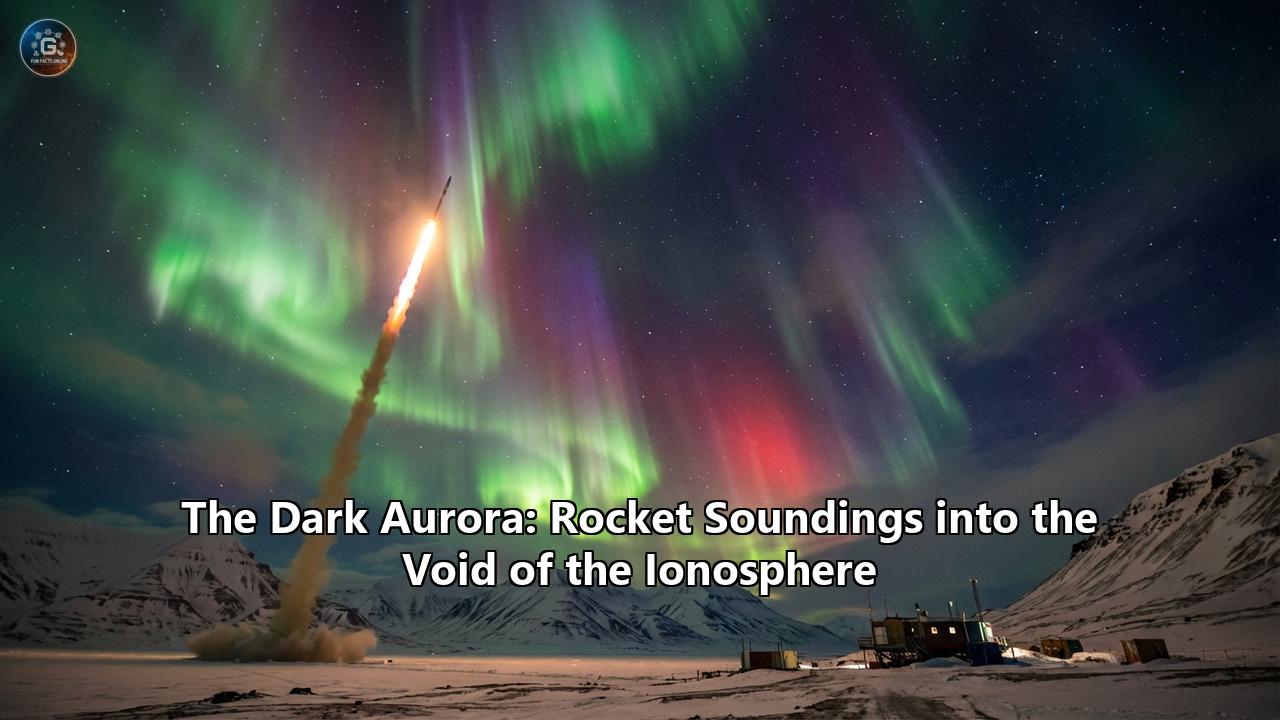
The Northern Lights are the crown jewels of the night sky, a celestial ballet of neon greens, violets, and crimsons that have captivated humanity for millennia. We understand them as the visible breath of the sun, a bombardment of charged particles funneled by Earth's magnetic field into our upper atmosphere. But amidst these curtains of light, there lies a deeper, darker mystery—one that looks not like a presence, but an absence.
They are called the "Dark Auroras."
To the casual observer, they appear as strange, ominous gaps in the shimmering ribbons of light—perfectly black holes, swirls, or vortexes that seem to eat the aurora from the inside out. For decades, they were dismissed as optical illusions or simple gaps in the plasma clouds. We now know they are neither. The Dark Aurora is a distinct, violent, and highly structured electrical phenomenon, a "negative" image of the aurora that represents one of the most powerful and least understood energy exchange processes between our planet and space.
To understand this void, scientists cannot rely solely on satellites that fly too high or ground radars that look from too far below. They must launch sounding rockets—agile, sub-orbital darts packed with sensors—directly into the heart of the darkness.
Part I: The Architecture of Nothingness
The Visual ParadoxImagine standing on the frozen tundra of the Poker Flat Research Range in Alaska. The sky is alive. A "diffuse aurora"—a broad, glow-in-the-dark background of faint green—covers the zenith. Suddenly, thin, jet-black ribbons begin to snake through the green mist. They curl into spirals, widen into gaping holes, or drift like smoke rings made of vacuum. These are not merely spaces where the light isn't; they are active structures where the light is being actively suppressed.
These are the black auroras. They are the anti-matter to the aurora’s matter. While visible auroras are caused by electrons spiraling down from space and crashing into oxygen and nitrogen atoms (exciting them to release photons), black auroras are regions where electrons are being sucked up and out of the atmosphere.
The Global CircuitTo grasp the dark aurora, one must understand the Earth as a giant electrical component. The planet's magnetosphere and ionosphere form a massive circuit, powered by the solar wind. Like any circuit, there must be a complete loop.
- The Downward Leg (Visible Aurora): In the bright arcs we love, currents flow downward. Electrons precipitate into the atmosphere, creating light.
- The Upward Leg (Dark Aurora): Nature demands balance. For every cascade of electrons coming down, there must be a return current going up. The dark aurora is the visual signature of this return current. It is the exhaust pipe of the ionospheric engine.
In these dark regions, the electric fields reverse. Instead of a "potential drop" that accelerates particles downward, there is a divergent electric field that evacuates the ionosphere. It strips the upper atmosphere of its charge carriers, creating a "plasma cavity"—a literal void in the electrified air—where density drops continuously, and light is extinguished.
Part II: The Ignorosphere and the Rocket Gap
Why do we need rockets to study this? Why not just use satellites?
The black aurora forms in the ionosphere, specifically in the E-region and F-region (roughly 100 to 300 kilometers up). This altitude is the "Ignorosphere"—too high for weather balloons (which pop around 30-40 km) and too low for satellites (which would drag and burn up below 400 km).
This region is the turbulent shoreline between Earth's atmosphere and the vacuum of space. It is where the neutral atmosphere (the air we breathe) wrestles with the plasma (the charged gas of space). It is a zone of chaotic winds, immense electrical currents, and chemical heating.
The Sounding Rocket SolutionEnter the sounding rocket. These are not the lumbering giants that carry rovers to Mars. Vehicles like the NASA Black Brant or Terrier-Improved Malemute are the special forces of rocketry. They are relatively small, solid-fueled, and designed for a suicide mission.
They launch rapidly, screaming up to 200, 300, or 600 miles altitude, tracing a parabolic arc through the aurora before falling back to Earth. They give scientists 10 to 15 minutes of "apogee"—time in space—to taste, smell, and measure the plasma directly.
For the dark aurora, the mission profile is harrowing. You are not aiming for the bright, easy-to-see lights. You are trying to hit a moving, invisible target—a black patch in a faint green sky—with a rocket traveling at Mach 5.
Part III: The Hunt for the Anti-Aurora (The Missions)
In recent years, the pursuit of the dark aurora has shifted from curiosity to a high-priority scientific imperative. Several missions stand out in this bold endeavor.
1. The Cluster PreludeBefore rockets took center stage, the European Space Agency's Cluster mission provided the "smoking gun." In 2001, the four Cluster satellites flew in formation through a black aurora high above Earth (at 20,000 km). They detected a massive evacuation of electrons. But Cluster was too high to see the complex turbulence happening "on the ground" in the ionosphere. It saw the chimney, but not the fire.
2. The MICA Mission (Magnetosphere-Ionosphere Coupling in the Alfvén Resonator)Launched from Alaska, MICA was a detective looking for the "fingerprint" of the dark aurora's cousin—the discrete arc. While not solely focused on the dark, it proved that Alfvén waves (ripples in the magnetic field lines) act like guitar strings, communicating energy between the magnetosphere and the ionosphere. This established the "language" that the dark aurora speaks.
3. The BaDASS Mission (Black and Diffuse Aurora Science Surveyor)The most audacious mission concept in recent years is NASA’s BaDASS. The acronym is as aggressive as the science. The goal: to fly a rocket specifically through a "black aurora" event.
- The Challenge: Black auroras are elusive. They often appear late at night, in the "recovery phase" of a substorm, when the sky is a messy, pulsating glow.
- The Payload: The rocket carries a suite of instruments including Langmuir probes (to measure electron density and temperature), energetic particle detectors (to count the electrons fleeing the atmosphere), and vector electric field instruments (to map the invisible walls of the void).
- The Science: BaDASS aims to solve a discrepancy. Theory suggests the black aurora should be stable, yet ground cameras show them swirling and fragmenting. What causes this turbulence? Is it the Kelvin-Helmholtz instability—the same fluid dynamics that create wave-like clouds in the sky—occurring in a plasma vacuum?
While BaDASS hunts the dark, GIRAFF hunts the flicker. Launched into "pulsating aurora" (often the background canvas for black aurora), this mission studies how high-energy electrons from the radiation belts are dumped into the atmosphere. The "fast features" it studies are the rapid heartbeats of the ionosphere, providing the context needed to understand why the heart sometimes stops beating (the black aurora).
Part IV: Into the Void – The Physics of "Negative" Light
When a sounding rocket like BaDASS pierces a black aurora, the data it returns paints a chaotic picture of the "anti-aurora."
The Ionospheric HoleAs the rocket enters the dark region, the onboard Langmuir probe usually screams a warning: Density Drop. The plasma density can plummet by a factor of 10 or more. The rocket has entered a hole in the ionosphere.
The Reverse WaterfallParticle detectors on the rocket see something strange. In a normal aurora, they would be detecting a rain of electrons falling down. In the dark aurora, they detect a fountain of thermal electrons moving up. These are "cold" electrons, dragged out of the ionosphere by a strong upward electric field.
The Potential HumpIn normal aurora, there is a "potential well" (a U-shape in voltage) that accelerates particles down. In the dark aurora, the rocket flies through a "potential hump" (an inverted U). This hump acts as a barrier to incoming solar electrons (blocking the light) and a vacuum cleaner for Earthly electrons (creating the return current).
The Anti-Black AuroraRecent research, bolstered by citizen science and rocket data, has revealed an even stranger phenomenon: the "Anti-Black Aurora." These are tiny, intense beads of light that sometimes form inside the black currents. They are a paradox within a paradox—a spark of light inside the shadow. Sounding rockets suggest these may be caused by extreme turbulence at the edges of the black streams, where the shear forces between "upward" and "downward" currents rip the plasma apart, creating short-circuits of intense energy.
Part V: Why It Matters (The Impact of the Void)
Why spend millions launching rockets into the dark?
1. The Satellite Drag MysteryThe ionosphere is the medium through which low-Earth orbit satellites fly. When the aurora heats the atmosphere, it expands, increasing drag on satellites (a phenomenon that famously doomed dozens of Starlink satellites in 2022). The dark aurora represents a region of cooling and density depletion. To model the orbit of a satellite accurately, you cannot just model the heating; you must model the holes. Flying through a black aurora is like a boat suddenly losing the water beneath it.
2. GPS ScintillationThe edges of the dark aurora are jagged and sharp. When a GPS signal from a satellite passes through these sharp density gradients, the signal is bent and scattered (scintillation). This can cause GPS receivers on the ground to lose lock or report errors of meters to kilometers. In an era of autonomous cars and precision drone warfare, a "black aurora" can be a massive disruptor.
3. Planetary AtmospheresThe dark aurora is a universal phenomenon. It likely occurs on Jupiter and Saturn, or any planet with a magnetic field and an atmosphere. By studying it on Earth, we are learning about the fundamental electrodynamics of the universe. We are learning how planets "breathe" electricity.
Part VI: The Future of Sounding the Void
The era of the sounding rocket is far from over; it is entering its golden age.
The Multi-Point AttackFuture missions are moving away from single rockets. We are now seeing "swarms"—one main rocket releasing several "daughter" payloads (like the Auroral Jets or Kinetic-Scale Energy and Momentum Transport eXperiment missions). These can measure the black aurora at multiple points simultaneously, creating a 3D map of the void.
Chemical TracersSome rockets release trails of trimethyl aluminum or barium. These colorful clouds (glowing blue, green, or red) drift with the neutral winds and ion drifts. By watching how these clouds deform near a black aurora, scientists can "see" the invisible winds and electric fields twisting around the void.
Citizen Science CollaborationThe Aurorasaurus project and other citizen science initiatives are now vital. Photographers on the ground, equipped with high-ISO cameras, can spot black auroras and alert range controllers in real-time, helping to guide the rockets to their targets.
Conclusion: The Call of the Dark
The Dark Aurora serves as a humbling reminder that in space physics, what you don't see is often as important as what you do. It is a phenomenon of subtraction, a cosmic silence amidst the noise of the geomagnetic storm.
The sounding rockets that pierce these voids are our needles, stitching together the fabric of our understanding. They launch into the freezing Alaskan night, trailing fire, to touch the cold, dark emptiness where the Earth exhales its electric soul. In that darkness, we find the balance of our world—the return current that completes the circuit, the shadow that defines the light. The black aurora is not just a hole in the sky; it is a window into the hidden machinery of our planet.
Reference:
- https://www.rmg.co.uk/stories/space-astronomy/what-causes-northern-lights-aurora-borealis-explained
- https://science.nasa.gov/sun/auroras/
- https://science.nasa.gov/science-research/heliophysics/nasa-rockets-flickering-vanishing-auroras/
- https://en.wikipedia.org/wiki/Aurora
- https://www.space.com/the-universe/earth/earths-elusive-ignorosphere-could-shed-new-light-on-auroras
- https://pwg.gsfc.nasa.gov/istp/news/0112/clusterprobes.html
- https://www.iflscience.com/black-aurora-a-mysterious-phenomenon-caused-by-cosmic-and-earthly-forces-colliding-77115
- https://www.google.com/search?q=time+in+Milan,+IT
- https://www.sciencedaily.com/releases/2026/01/260112214310.htm
- https://www.astronomy.com/science/scientists-launch-nasa-rocket-into-aurora/