
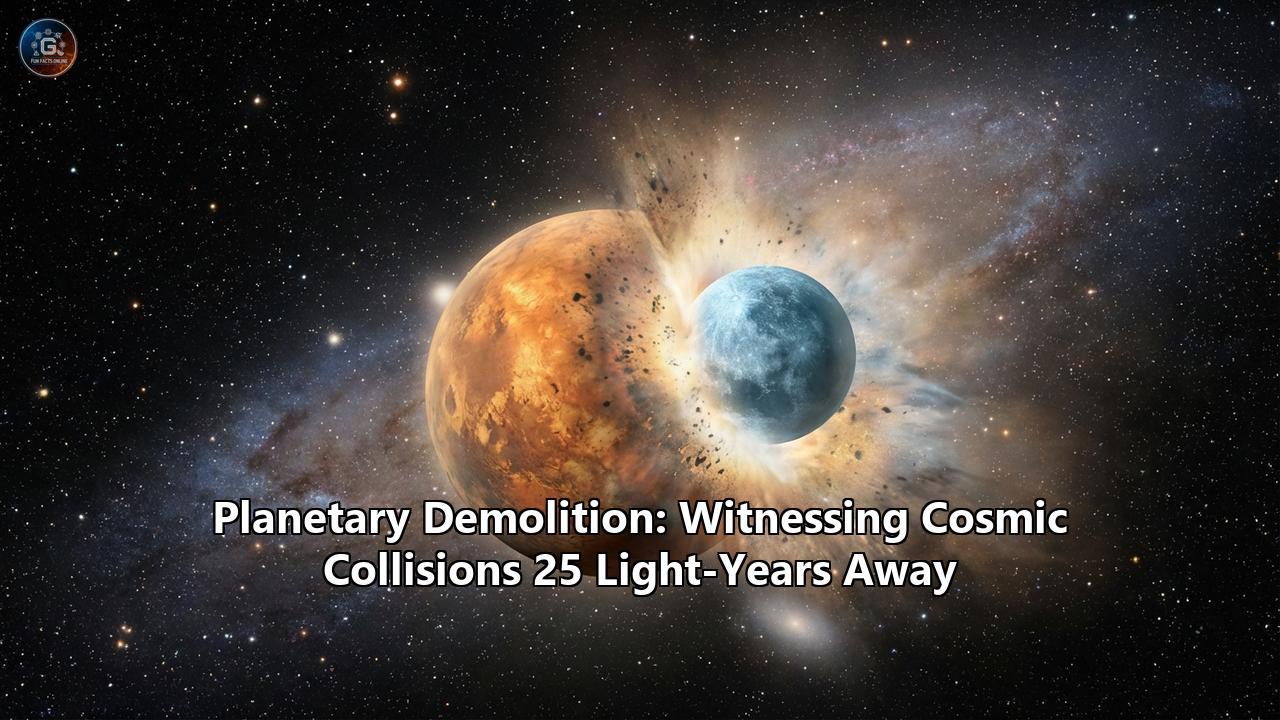
It is a scene of unimaginable violence, yet from our vantage point on Earth, it appears as nothing more than a faint flicker in the deep infrared dark. Twenty-five light-years away, in the constellation Piscis Austrinus, a catastrophe has occurred. Two massive celestial bodies—asteroids or perhaps icy planetesimals the size of dwarf planets—have slammed into one another at speeds exceeding 22,000 miles per hour. The resulting explosion has pulverized them instantly, creating an expanding cloud of fine dust that glows like a ghostly ember against the cold backdrop of space.
For astronomers, this isn't a tragedy; it is a revelation.
This week, scientists using the Hubble Space Telescope and the James Webb Space Telescope (JWST) announced the confirmation of a second massive collision event in the Fomalhaut star system. Dubbed "Fomalhaut cs2," this new debris cloud joins the ghostly remnant of a previous collision observed two decades ago, offering us a front-row seat to a "planetary demolition derby." We are not just watching rocks smash together; we are watching a live playback of the chaotic processes that shaped our own Solar System 4.5 billion years ago.
In this deep-dive special report, we explore the "Eye of Sauron" star, the mystery of the vanishing planet, and what these violent smash-ups tell us about the birth and death of worlds.
Part I: The Eye of Sauron
A Star with a Ring of Fire
To understand the magnitude of what we are witnessing, we must first understand the stage upon which this drama is unfolding. Fomalhaut is one of the brightest stars in our night sky, a blue-white Class A star roughly 440 million years old. Compared to our middle-aged Sun (4.6 billion years old), Fomalhaut is a teenager—energetic, luminous, and surrounded by the messy leftovers of its birth.
For decades, Fomalhaut has fascinated astronomers because of its debris disk. First discovered by the IRAS satellite in the 1980s and resolved in stunning detail by Hubble in 2004, this vast ring of cold dust spans some 14 billion miles, dwarfing our own Solar System. The ring is sharp-edged and slightly offset from the star, giving the system the eerie appearance of a giant eye staring back at us across the cosmos—earning it the nickname "The Eye of Sauron."
This ring is not just decoration. It is a Kuiper Belt on steroids. While our Solar System’s Kuiper Belt (home to Pluto and Arrokoth) contains icy remnants of planet formation, Fomalhaut’s belt is younger, denser, and far more volatile. It is a chaotic swarming ground for billions of comets and asteroids, all jostling for position under the gravitational influence of the star and its unseen planets.
It is here, in this dusty ring of fire, that the demolition is taking place.
Part II: The Ghost Planet
The Rise and Fall of Fomalhaut b
To appreciate the discovery of the new collision ("cs2"), we must revisit one of the most famous controversies in modern astronomy: the case of Fomalhaut b.
In 2008, astronomers using the Hubble Space Telescope announced a historic breakthrough. They had spotted a tiny point of visible light moving along the inner edge of Fomalhaut’s dust ring. It was hailed as the first exoplanet ever directly imaged in visible light. They named it Fomalhaut b.
But almost immediately, things didn't add up.
- Too Bright, Too Cold: The object was incredibly bright in visible light but invisible in the infrared. A real planet with the mass of Jupiter should glow with heat from its formation, but Fomalhaut b was cold.
- The Orbit: As years passed, the "planet" didn't follow a stable elliptical orbit like a normal world. It appeared to be on an escape trajectory, drifting out of the system.
- The Vanishing Act: By 2014, the object had begun to fade. By 2020, it had disappeared completely.
Planets don't just vanish. The scientific consensus shifted dramatically. Fomalhaut b was never a planet. It was a dust cloud.
We had been tricked. We hadn't taken a picture of a solid world; we had snapped a photo of the aftermath of a titanic collision. Two icy asteroids, likely 125 miles (200 km) wide, had smashed together shortly before Hubble looked that way in 2004. The "planet" was the resulting cloud of fine dust, expanding and dispersing into space until it became too thin to see.
Fomalhaut b was reclassified from "planet" to "collision sequence 1" (cs1). It was a ghost—a temporary scar on the system. And now, history has repeated itself.
Part III: The New Collision (cs2)
Lightning Strikes Twice
If seeing one massive collision in a human lifetime is lucky, seeing two is statistically startling.
According to the new findings published in Science this week, astronomers monitoring the Fomalhaut system noticed a new point of light appearing in the debris ring—distinct from the location of the now-vanished Fomalhaut b.
"We were looking for the ghost of the first object, but we found a new phantom," said Dr. Paul Kalas, a lead researcher on the project.
This new object, designated Fomalhaut cs2, behaves almost exactly like its predecessor. It is a concentrated cloud of light that was not present in earlier archival images. Over the last few years of observation, it has shown signs of expansion.
The Forensics of a Crash
How do we know it's a collision and not a planet? The evidence lies in the light.
- The Scattering Effect: The object is bright in visible light because it consists of extremely fine dust particles. These particles act like a giant reflector for the central star's light.
- Lack of Heat: Like Fomalhaut b, cs2 is faint in the thermal infrared (viewed by JWST). A massive planet would be glowing with internal heat. A dust cloud, however, has a vast surface area to reflect light but very little mass to generate heat.
- Transient Nature: Planets are permanent fixtures. Clouds are transient. The fact that cs2 "turned on" recently suggests a singular event occurred—a hypervelocity impact.
The estimated energy of this collision is staggering. Imagine two asteroids, each the size of a small moon, colliding head-on. The energy released would vaporize rock instantly, creating a cloud of microscopic silica and ice grains that expands at thousands of miles per hour. This cloud is what our telescopes are picking up.
Part IV: A Window into the "Late Heavy Bombardment"
Why This Matters for Earth
Why should we care about rocks smashing together 25 light-years away? Because Fomalhaut is a time machine.
Our Solar System is currently in a state of relative peace. The planets are in stable orbits, and major collisions are rare (the extinction of the dinosaurs 66 million years ago being a notable exception). But it wasn't always this quiet.
Approximately 4 billion years ago, our system underwent a period known as the Late Heavy Bombardment (LHB). During this era, the migration of the giant planets (Jupiter and Saturn) disrupted the orbits of asteroids and comets, sending them raining down into the inner solar system. Earth, the Moon, Mars, and Venus were pummeled.
This violence was creative as well as destructive.
- Water Delivery: Many theories suggest that Earth's oceans were filled by icy comets and hydrated asteroids impacting the surface during this time.
- The Moon: Our own Moon is the result of a massive collision between Earth and a Mars-sized protoplanet named Theia earlier in our history.
By watching Fomalhaut, we are seeing a similar "bombardment" phase happening in real-time. The Fomalhaut system is currently organizing itself. Its gravity is shifting, its belts are being stirred up, and bodies are colliding.
"We are witnessing the construction of a planetary system," says Dr. Meredith MacGregor, an astrophysicist specializing in debris disks. "Every time we see a flash like cs2, we are seeing the building blocks of planets being ground down or built up. It’s a messy, violent, and necessary part of making a world."
Part V: The Technology Behind the Discovery
Hubble and JWST: The Dynamic Duo
This discovery would have been impossible without the synergy between our two greatest space observatories.
The Hubble Space Telescope (Visible Light):Hubble remains the king of resolution in visible light. Its coronagraph (a device that blocks the blinding glare of the central star) allowed astronomers to see the faint reflected light of the dust ring. Hubble provided the baseline—the "before" pictures that proved cs2 wasn't always there.
The James Webb Space Telescope (Infrared):JWST brought a new dimension to the study. Its MIRI (Mid-Infrared Instrument) looks at heat. By observing Fomalhaut in the infrared, JWST confirmed that there were no massive, hot gas giants at the location of the collision. It helped rule out the "planet" theory. Furthermore, JWST has resolved the structure of the inner dust belts with unprecedented clarity, showing us the "gap" between the star and the ring where terrestrial planets might be hiding.
The combination of Hubble's timeline (spanning 30 years) and JWST's sensitivity has transformed exoplanetary science from taking snapshots to watching movies. We can now track changes in these systems on human timescales.
Part VI: The "Planetesimal" Problem
Where Are the Planets?
Despite the incredible debris ring and the evidence of collisions, one mystery remains: Where are the actual planets?
A ring this sharp and well-defined usually requires a "shepherd planet"—a massive world whose gravity keeps the dust in line, much like how shepherd moons keep Saturn's rings in place. For years, Fomalhaut b was thought to be that shepherd. Now that we know "b" was just a dust cloud, the shepherd is missing.
However, the presence of these collisions (cs1 and cs2) hints at a bustling unseen population. You cannot have collisions without things to collide. The Fomalhaut ring is likely teeming with:
- Planetesimals: Objects 10–100km in size.
- Dwarf Planets: Pluto-sized bodies.
- Super-Earths: The elusive shepherd planet may be a "Super-Earth" or "Mini-Neptune" that has so far evaded direct detection because it is cooler and smaller than the gas giants we usually photograph.
The collisions act as tracer fire. Just as smoke reveals the invisible wind, the dust from these crashes reveals the invisible gravitational currents of the system. The sheer frequency of these crashes—two massive ones observed in just 20 years—suggests the system is far more dynamic and crowded than we previously thought.
Part VII: Beyond Fomalhaut
The Era of "Time-Domain" Astronomy
The discovery of cs2 marks the beginning of a new era: Time-Domain Exoplanetary Science.
In the past, we thought of star systems as static paintings. We took a photo, and it stayed that way. Now, we realize they are dynamic videos. Things change. Clouds expand. Rings warp. Flares erupt.
Fomalhaut is not alone.
- Beta Pictoris: Another young system (63 light-years away) where JWST recently detected a "cat's tail" of dust, likely from another massive asteroid collision.
- Vega: The star in the movie Contact also has a debris disk that shows signs of clumpiness, potentially indicating recent impacts.
As we stare longer and harder at these nearby stars, we will likely see more "flashes" of destruction. We are realizing that the galaxy is a lively place.
Conclusion: The Beauty of Destruction
It is humbling to stand under the night sky, look toward the Southern Fish, and know that 25 light-years away, worlds are dying so that others might live.
The "Planetary Demolition" in Fomalhaut is not just a spectacle; it is a laboratory. It challenges our models of how fast planets form and how long the chaotic bombardment phase lasts. It reminds us that our own peaceful blue marble was forged in a similar fire—a survivor of a billion cosmic car crashes that eventually settled into the stable home we know today.
As Hubble continues its watch and JWST peers deeper into the dust, we can expect more surprises from the Eye of Sauron. The demolition isn't over. In fact, we've only just started watching.
Glossary of Terms
- Debris Disk: A ring of dust and debris orbiting a star, created by collisions between planetesimals.
- Planetesimal: Solid objects (rock/ice) that exist in protoplanetary disks and debris disks; the building blocks of planets.
- Coronagraph: A telescopic attachment that blocks out the direct light of a star so that nearby objects can be seen.
- LHB (Late Heavy Bombardment): A hypothesized event in the early Solar System where asteroids collided with the inner planets.
- Exoplanet: A planet orbiting a star outside our Solar System.
Reference:
- https://www.popsci.com/science/cosmic-collision-hubble/
- https://esahubble.org/news/heic2512/?lang
- https://news.northwestern.edu/stories/2025/12/cosmic-crash-caught-on-camera
- https://www.astronomy.com/science/jwst-finds-new-planet-forming-rings-around-fomalhaut/
- https://scitechdaily.com/what-looked-like-a-planet-was-actually-a-cosmic-crash/
- https://en.wikipedia.org/wiki/Fomalhaut_b
- https://scitechdaily.com/new-study-revives-doubted-exoplanet-fomalhaut-b/
- https://en.wikipedia.org/wiki/Fomalhaut
- https://scitechdaily.com/hubble-observes-aftermath-of-massive-collision-blueprint-for-how-planets-destroy-each-other/
- https://www.ksat.com/tech/2025/12/18/hubble-space-telescope-spies-dusty-debris-from-two-cosmic-collisions/
- https://tollbit.greenwichtime.com/news/article/hubble-space-telescope-spies-dusty-debris-from-21250607.php
- https://www.sciencenews.org/article/hubble-telescope-exoplanet-mystery
- https://www.discovermagazine.com/violent-space-rock-smashups-caused-a-dusty-wreck-in-a-nearby-planetary-system-48427
- https://www.wftv.com/unavailable-location/?outputType=amp
- https://medium.com/starts-with-a-bang/fomalhauts-great-dust-cloud-isn-t-real-28928010423e
- https://en.wikipedia.org/wiki/Beta_Pictoris
- https://www.sci.news/astronomy/webb-giant-collision-beta-pictoris-system-13011.html
- https://earthsky.org/space/beta-pictoris-asteroid-collision-asteroids-exoplanets-webb-spitzer/