
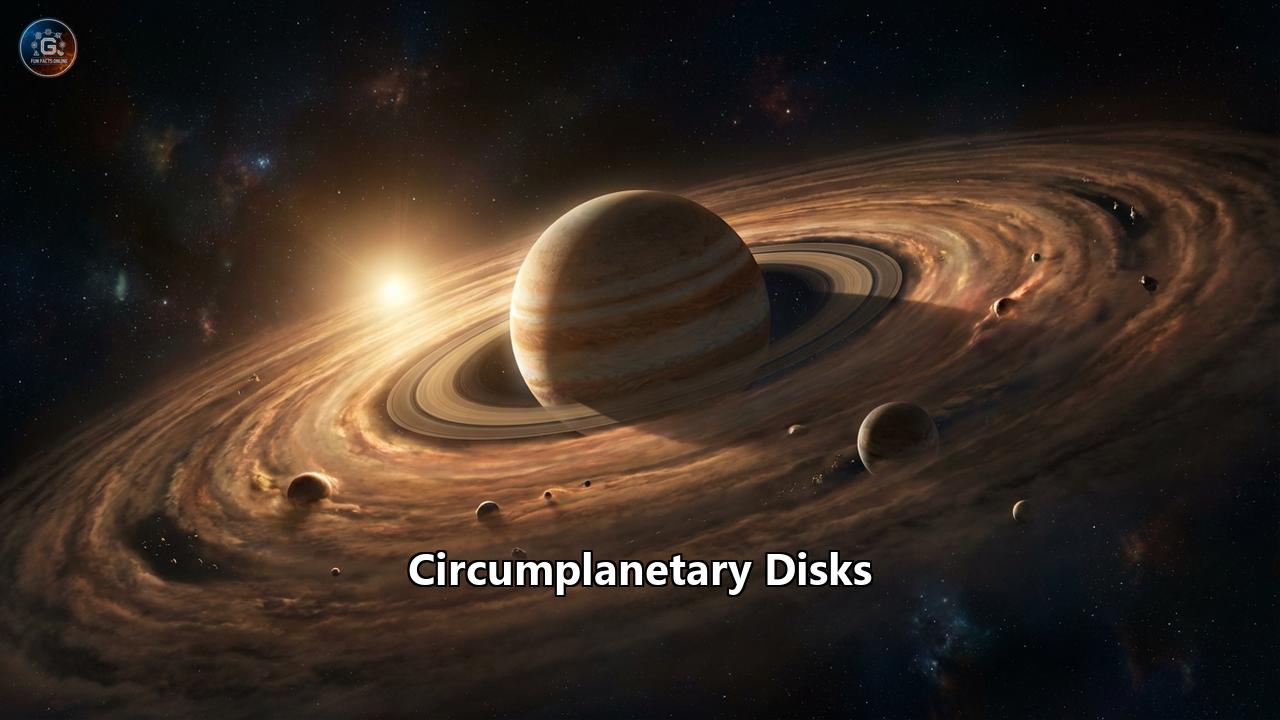
The darkness of the early cosmos was not merely a void, but a canvas of swirling potential. Around newborn stars, vast wheels of gas and dust—protoplanetary disks—spin in silence, the raw material of worlds waiting to be born. For decades, astronomers stared at these stellar disks, tracing the rings and gaps that hinted at invisible giants growing within. But in recent years, our gaze has zoomed in further, past the star, past the great spiral arms of the stellar nebula, to witness a phenomenon that is both a mechanism of creation and a miniature mirror of the solar system itself: the Circumplanetary Disk (CPD).
These are the "disks within disks," the hidden nurseries where giant planets feed and where moons are forged. They are the gatekeepers of planetary growth and the architects of satellite systems like the Galilean moons of Jupiter. To understand them is to understand the final, chaotic, and beautiful chapters of planet formation.
I. The Cosmic Russian Doll: Contextualizing the CPD
To appreciate the circumplanetary disk, one must first understand its environment. A star is born from the collapse of a molecular cloud, and conservation of angular momentum flattens the remaining material into a Protoplanetary Disk (PPD). This structure spans hundreds of Astronomical Units (AU), a vast, dusty frisbee orbiting the protostar.
Within this PPD, density fluctuations occur. A "seed"—perhaps a rocky core or a gravitational instability—begins to pull material in. As this protoplanet grows, its gravity becomes the dominant force in its immediate vicinity. It begins to clear a lane in the stellar disk, carving a dark annular gap that separates the inner star-disk from the outer reservoirs of gas.
However, this gap is not empty. Gas streams across the gap, bridging the divide between the stellar disk and the planet. When this material approaches the planet, it carries too much angular momentum to fall directly onto the surface. Instead, it spirals inward, forming a smaller, secondary accretion disk around the planet itself.
This is the Circumplanetary Disk. It is a cosmic Russian doll: a disk orbiting a planet, which is orbiting a star, which is orbiting the galaxy.
II. The Physics of the Hill Sphere
The domain of the circumplanetary disk is defined by the Hill Sphere (or Hill Radius). This is the region of space where the planet's gravity dominates over the star's tides. For a planet like Jupiter, the Hill sphere extends roughly 50 million kilometers.
Theoretical models and hydrodynamic simulations suggest that a circumplanetary disk typically fills the inner 30% to 50% of the planet's Hill sphere. Beyond this boundary, the chaotic tug-of-war between the star and planet shreds any organized structure.
The Vertical Feeding Frenzy
One of the most fascinating discoveries from 3D simulations is how these disks are fed. In the flat 2D models of the past, astronomers assumed gas spiraled in from the edges of the gap. Modern 3D hydrodynamics reveals a more violent and dynamic picture: Meridional Circulation.
Gas from the upper layers of the stellar disk, which is less depleted, rains down vertically onto the poles of the growing planet. It crashes into the circumplanetary disk, creating shock fronts and generating immense heat. This material then spreads outward along the midplane before spiraling back inward to accrete onto the planet. This "fountain" effect cycles material, processing the dust and gas that will eventually become moons.
III. Anatomy of a Moon Factory
A circumplanetary disk is not a uniform sheet of gas. It is a complex, stratified machine with distinct zones, temperatures, and chemical compositions.
1. The Inner Sanctum (Accretion Zone):Close to the planet, the disk is hot—potentially thousands of Kelvin. Viscous friction, caused by the gas spiraling onto the planet at high speeds, generates intense luminosity. This region is often too hot for ices to exist; any dust here is silicates or metals. This is the bottleneck through which the planet gains the bulk of its mass.
2. The Dead Zone:Further out, the density remains high, but the turbulence drops. In some models, this region forms a "dead zone" where gas accumulates. This quiet, dense environment is the perfect incubator for moon formation. Without violent turbulence to shatter them, dust grains can stick together, growing from pebbles to boulders to "satellitesimals."
3. The Ice Line:Just as the solar system has a "snow line" (beyond which water freezes), the circumplanetary disk has its own ice line. The position of this line is critical.
- Inside the line: Moons formed here will be rocky and dense (like Io and Europa).
- Outside the line: Moons formed here will be rich in water ice and volatiles (like Ganymede and Callisto).
The gradation of density in Jupiter’s Galilean moons—rocky on the inside, icy on the outside—is a direct fossil record of the temperature gradient in Jupiter’s ancient circumplanetary disk.
IV. PDS 70 c: The Holy Grail of Detection
For decades, CPDs were theoretical. We knew they must exist because Jupiter and Saturn have moons, and those moons orbit in the same plane as the planet's equator, implying they formed from a disk. But seeing one? That required technology that didn't exist until the 21st century.
The glare of a parent star is billions of times brighter than a planet, and the planet is thousands of times brighter than its disk. Spotting a CPD is like trying to see a moth flitting around a firefly, which is itself buzzing around a spotlight.
The Breakthrough:The system PDS 70, a young star located about 370 light-years away in the constellation Centaurus, changed everything. It hosts two giant protoplanets, PDS 70 b and PDS 70 c, carving a massive cavity in the stellar disk.
In 2019, and confirmed more robustly in 2021, astronomers using ALMA (Atacama Large Millimeter/submillimeter Array) made a startling detection. While planet b appeared relatively clean, planet c was surrounded by a discrete cloud of millimeter-sized dust grains.
This was not a glitch. It was a ring of material roughly the width of the Earth-Sun distance (1 AU), orbiting the planet PDS 70 c. The mass of the dust alone was estimated to be about 0.03 Earth masses—enough to form three moons the size of our own Luna.
Why is PDS 70 c special?- Separation: It orbits far from its star (about 34 AU), making it easier to resolve.
- The "Kinematic Detection": In 2024 and 2025, advanced analyses of gas velocities (using Carbon Monoxide lines) showed "kinks" in the Doppler shift data. The gas wasn't just orbiting the star; it was swirling around the planet.
- H-Alpha Variability: Observations from Hubble and ground-based adaptive optics showed the planet glowing brightly in Hydrogen-alpha light. This specific wavelength is emitted when hydrogen gas crashes onto a planet's surface at supersonic speeds—the "smoking gun" of active accretion from a disk.
V. The Galileo Connection: Reconstructing Our History
To study CPDs is to study our own origins. The Galilean moons of Jupiter—Io, Europa, Ganymede, and Callisto—are a miniature solar system. Their formation is the primary test case for any CPD theory.
The Resonant Chain Mystery:Io, Europa, and Ganymede are locked in a 1:2:4 orbital resonance. For every four orbits Io makes, Europa makes two, and Ganymede makes one. Theories suggest that as these moons grew within the thick gas of the Jovian CPD, the drag from the gas caused them to migrate inward. They drifted toward Jupiter until they locked into these gravitational sweet spots, which prevented them from falling all the way in.
The "Canup & Ward" Model:A leading theory by researchers Robin Canup and William Ward suggests that the CPD was "gas-starved." If the disk were too thick, the moons would have spiraled into Jupiter and been destroyed. They propose that Jupiter had generations of moons. The current Galilean satellites might be the last generation that formed just as the gas was dissipating, saving them from a fiery death in Jupiter's atmosphere.
VI. Observational Challenges and Future Tech
Detecting these disks pushes the absolute limits of modern astronomy. We rely on three main signatures:
- Infrared Excess: A planet with a disk appears brighter in mid-infrared wavelengths (detected by JWST) than a naked planet, because the dusty disk absorbs light and re-radiates it as heat.
- Kinematic Signatures: Using ALMA to see the velocity of gas deviate from the Keplerian flow of the star.
- Accretion tracers (H-alpha): Measuring the shock of gas falling from the disk onto the planet.
The James Webb Space Telescope is currently revolutionizing this field. Its MIRI (Mid-Infrared Instrument) can pierce through the dust of the parent star's disk to spot the thermal glow of the circumplanetary disk. Early data suggests it can detect chemical signatures—water vapor, methane, and ammonia—within these disks, offering clues about the potential habitability of future exomoons.
The ELT (Extremely Large Telescope):Set to see first light later this decade, the ELT’s 39-meter mirror will provide the angular resolution needed to image these disks directly in optical and near-infrared light, potentially resolving the gap between the planet and its disk.
VII. The Exomoon Frontier
If Circumplanetary Disks are common, then exomoons must be ubiquitous. While we have thousands of confirmed exoplanets, confirmed exomoons remain elusive (with candidates like Kepler-1625b i still sparking fierce debate).
The study of CPDs is the indirect path to finding them. By measuring the mass and extent of these disks, we can calculate the "Moon Budget"—the maximum mass of satellites a planet can spawn. Current estimates suggests that super-Jupiters could host moons as large as Mars or even Earth. If such a moon formed in the habitable zone of its star, and possessed an atmosphere... it opens a new paradigm for life in the universe.
VIII. Conclusion: The Architects of Systems
Circumplanetary disks are transient, fleeting structures, lasting perhaps only a few million years. Yet, in that cosmic blink of an eye, they determine the spin of the planet, the final mass of the gas giant, and the architecture of its moon system. They are the engines of diversity in planetary systems.
When we look at the PDS 70 system, we are not just seeing a smudge of light. We are time-traveling. We are watching a version of a young Jupiter, 4.5 billion years ago, spinning up its forge to create an Europa or a Ganymede. We are witnessing the universal recipe for world-building, playing out across the dark expanse of the galaxy.
Reference:
- https://en.wikipedia.org/wiki/Circumstellar_disc
- https://www.almaobservatory.org/en/science-blog/alma-makes-first-ever-detection-of-gas-in-a-circumplanetary-disk/
- https://telescope.live/blog/alma-detects-circumplanetary-disk-allowing-thorough-analysis-planetary-systems
- https://en.wikipedia.org/wiki/Circumplanetary_disk
- https://www.astronomy.com/science/astronomers-re-create-the-formation-of-jupiters-galilean-moons-using-new-theory/
- https://grokipedia.com/page/Circumplanetary_disk
- https://academic.oup.com/mnras/article/464/3/3158/2497156
- https://www.quora.com/What-is-the-difference-between-a-protostellar-and-proto-planetary-disk
- https://www.researchgate.net/publication/398513523_The_Two-Dimensional_Structure_of_Circumplanetary_Disks_and_their_Radiative_Signatures
- https://arxiv.org/html/2403.05662v1
- https://www.space.com/first-moon-forming-exoplanet-disc-found
- https://aasnova.org/2022/08/10/a-circumplanetary-disk-candidate-spotted-with-alma/
- https://www.almaobservatory.org/en/press-releases/alma-pinpoints-the-radio-signature-of-planetary-growth/
- https://www.researchgate.net/publication/367432127_Early_stages_of_Galilean_moon_formation_in_a_water-depleted_environment
- https://en.wikipedia.org/wiki/Galilean_moons
- https://www.universetoday.com/articles/webb-finds-hints-of-a-third-planet-at-pds-70
- https://www.revoscience.com/en/astronomers-unveil-new-clues-in-planet-formation-using-alma-telescope/