
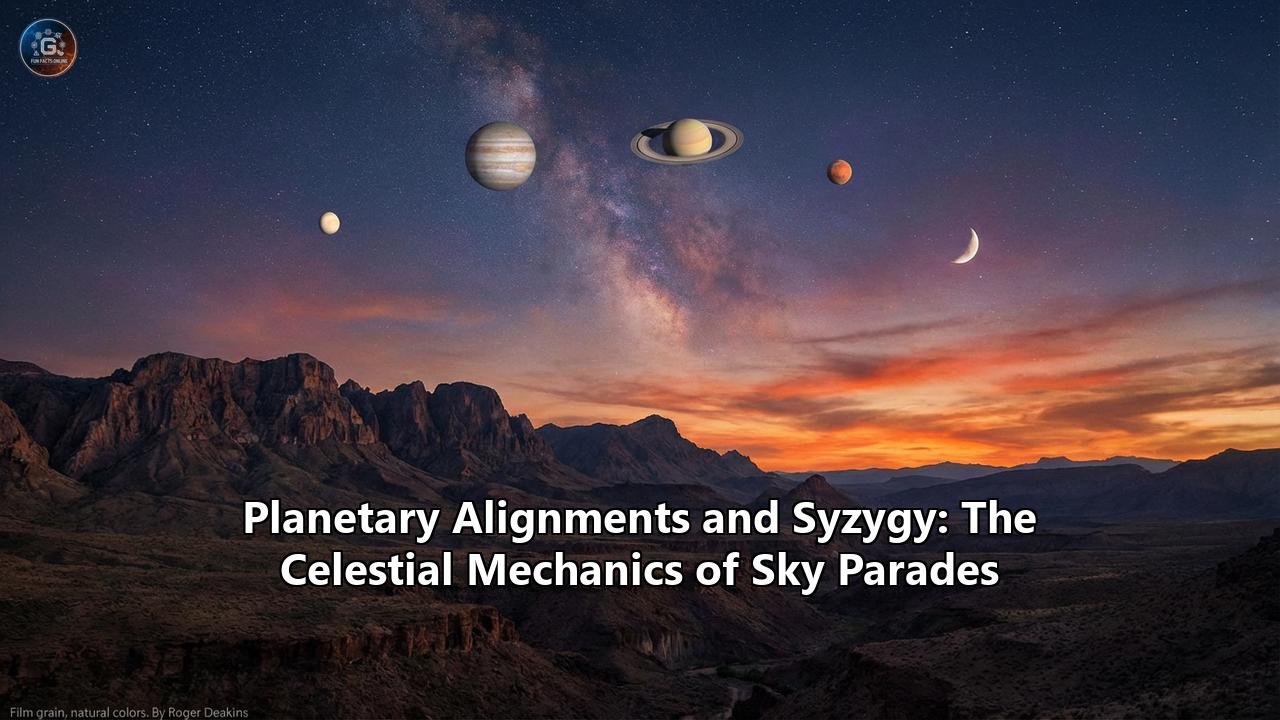
For as long as humanity has tilted its gaze upward, the night sky has served as our oldest canvas, a profound tapestry of myths, mathematics, and profound mystery. Among the steady, twinkling pinpricks of light, ancient astronomers noticed anomalies—restless points of brilliance that refused to remain fixed. The Greeks called them planētai, the "wandering stars." Today, we know them as the planets of our solar system. Most of the time, these worlds trace their lonely, disparate paths across the heavens, separated by hundreds of millions of miles of freezing vacuum. But every so often, the celestial clockwork brings them into a staggering, synchronized dance.
These events are known colloquially as "sky parades" or "planetary alignments." To the astronomer, they are expressions of orbital mechanics; to the casual observer, they are breathtaking spectacles of cosmic harmony. Yet, to truly appreciate the majesty of these planetary gatherings, one must dive beneath the visual splendor and understand the intricate, unseen forces that govern them—the fascinating science of syzygy and the laws of celestial mechanics.
The Architecture of a Sky Parade: Ecliptics and Illusions
When we speak of a "planetary alignment," it is crucial to clarify what is actually happening in the dark expanse of space. Pop culture and science fiction often depict planetary alignments as a perfectly straight line drawn through the center of the Sun and extending outward, threading through Mercury, Venus, Earth, Mars, and beyond, like celestial pearls on a cosmic string.
In reality, such a perfect three-dimensional alignment is a physical impossibility. Our solar system is not entirely flat. While the planets orbit the Sun in roughly the same plane—a relic of the spinning, protoplanetary disk of gas and dust from which our solar system was forged 4.6 billion years ago—their orbits are subject to slight inclinations. For instance, Mercury’s orbit is tilted by about 7 degrees relative to Earth's, and the other planets possess their own minor orbital tilts.
Because of these varying inclinations, the planets never form a geometrically flawless, straight line in three-dimensional space. Instead, a planetary alignment is a phenomenon of perspective. From our vantage point on Earth, the solar system is viewed edge-on. The planets all appear to travel along a shared, invisible highway in the sky known as the ecliptic—the apparent path of the Sun across the celestial sphere. When the differing orbital speeds of the planets cause them to gather in the same general quadrant of the solar system, we perceive them as bunching together along the ecliptic. We call this visual congregation a conjunction, or when multiple planets are involved, a grand alignment or "planet parade".
This illusion of proximity is staggering. Two planets might appear a mere hair's breadth apart in the twilight sky, yet one could be hundreds of millions of miles further away than the other. The celestial mechanics required to bring them into the same visual corridor are dictated by their orbital periods. Mercury completes a frenetic dash around the Sun in just 88 days, while sluggish Neptune requires a staggering 165 Earth years to finish a single orbit. Calculating when these vastly different cycles will harmonize to place the planets in the same slice of the sky is a masterpiece of mathematical astronomy.
Syzygy: When the Cosmos is Yoked Together
To understand the deepest mechanics of these alignments, one must become acquainted with one of the most beautiful and esoteric words in the English language: Syzygy (pronounced SIZ-eh-jee). Derived from the ancient Greek word syzygos, meaning "yoked together," a syzygy refers to the rough straight-line configuration of three or more celestial bodies in a gravitational system.
While planetary alignments are broad visual gatherings, syzygy is a more precise mechanical event. The most common and dramatic examples of syzygy involve the Earth, the Moon, and the Sun. When these three bodies align, the results are deeply tangible. If the Moon passes directly between the Earth and the Sun (at the orbital node where their planes intersect), we experience a solar eclipse. If the Earth passes directly between the Sun and the Moon, casting its shadow upon the lunar surface, a lunar eclipse occurs.
But syzygy is not limited to eclipses. When Venus or Mercury pass directly across the face of the Sun from our perspective—a phenomenon known as a transit—that, too, is a syzygy. Historically, the Transit of Venus provided 18th and 19th-century astronomers with the crucial parallax measurements needed to calculate the exact distance from the Earth to the Sun, establishing the fundamental baseline for all cosmic distances.
When the planets engage in a grand alignment, they are partaking in a loose, overarching syzygy. The mechanics behind this are so precise that astronomers can run the clockwork of the solar system forward and backward in time, predicting planetary parades thousands of years into the future or tracing them back to the dawn of antiquity.
The Gravity of the Situation: Debunking Doomsday
Throughout human history, the sudden gathering of wandering stars was often viewed with profound superstition. In ancient Babylonian astrology, the planets were considered powerful deities, and their congregation in a single zodiacal house was thought to herald the rise and fall of empires, the birth of kings, or the coming of great calamities. Even in the modern era, planetary alignments have been subjected to pseudoscientific panic. During the "Jupiter Effect" hysteria of 1982, and the Mayan Calendar frenzy of 2012, doom-sayers predicted that the combined gravitational pull of the aligned planets would warp the Earth, triggering mega-earthquakes, apocalyptic tsunamis, and the tearing of the planet's crust.
The reality of celestial mechanics quickly dismantles these fears. To understand why planetary alignments pose absolutely no physical threat to Earth, one must look to Isaac Newton's laws of universal gravitation and the specific nature of tidal forces.
It is true that celestial bodies exert a gravitational pull on one another. The Moon's gravity pulls on the Earth, causing our oceans to bulge toward it, creating the daily rhythm of the tides. The Sun, despite being 93 million miles away, also has a massive gravitational influence, contributing to about a third of Earth's tidal effects. When the Sun, Earth, and Moon are in syzygy (during a full moon or new moon), their gravitational forces combine to create "spring tides," which are slightly higher and lower than usual.
However, the power of a tidal force does not just rely on mass; it relies heavily on distance. While the force of gravity weakens with the square of the distance (the inverse-square law), tidal forces weaken with the cube of the distance (1/r³). Because the planets are millions or billions of miles away, their tidal influence on Earth is infinitesimally small.
Consider Jupiter, the behemoth of our solar system, packing more than 300 times the mass of Earth. Even at its closest approach, roughly 365 million miles away, Jupiter's tidal force on Earth's oceans is about a million times weaker than that of our Moon. Venus, which comes much closer to Earth than Jupiter, exerts a tidal force that is still tens of thousands of times weaker than the Moon's.
If you were to align all the planets in the solar system on one side of the Earth at their absolute closest possible distances—a mathematical impossibility, but an amusing thought experiment—their combined gravitational effect on our tides would be a fraction of a millimeter. The shift in gravitational pull caused by a planetary alignment is so minute that it is vastly overpowered by the gravitational pull of a passing commercial airplane, or even the Moon moving slightly closer in its elliptical orbit. Simply put, when the planets align, the ocean does not roar back in response; the Earth barely feels a whisper.
The true impact of a planetary alignment is not gravitational, but psychological, scientific, and cultural.
Historical Syzygies and the Great Slingshot
While they do not trigger earthquakes, planetary alignments have undeniably altered the course of human history and our exploration of the cosmos.
One of the most famous historical alignments is suspected to be the reality behind the Star of Bethlehem. Many modern astronomers and historians believe that the "star" that guided the Magi in biblical lore was not a supernova or a comet, but rather a rare triple conjunction of Jupiter and Saturn in the constellation Pisces around 7 BC. To ancient sky-watchers, the merging of the "King Planet" (Jupiter) with the planet of destiny (Saturn) in the constellation representing the Jewish people would have been interpreted as an explosive astrological omen.
Centuries later, the brilliant 17th-century astronomer Johannes Kepler used his meticulous observations of planetary conjunctions to formulate his laws of planetary motion, proving once and for all that the planets moved in elliptical orbits rather than perfect circles.
But perhaps the most magnificent utilization of a planetary alignment occurred in the late 20th century. In the 1960s, aerospace engineer Gary Flandro discovered that in the late 1970s, Jupiter, Saturn, Uranus, and Neptune would align in a sweeping arc. This specific alignment, occurring only once every 176 years, presented an unprecedented opportunity. NASA realized they could use the gravity of each planet to "slingshot" a spacecraft to the next, drastically reducing the travel time to the outer solar system. This alignment gave birth to the Voyager program. The resulting "Grand Tour" allowed Voyager 1 and Voyager 2 to provide humanity with our very first close-up images of the gas and ice giants, fundamentally revolutionizing our understanding of the outer solar system. Without that specific planetary alignment, our maps of the outer solar system would have remained blank for decades.
A Golden Era of Sky Parades: The 2020s and Beyond
We are currently living through a remarkably active era for planetary parades. The cosmic clockwork is churning out spectacular visual gatherings that are drawing eyes upward across the globe.
In late February 2026, an incredibly rare seven-planet alignment will grace the evening skies. On dates around February 28, stargazers will be treated to the sight of Mars, Jupiter, Uranus, Venus, Neptune, Mercury, and Saturn all strung out along the ecliptic simultaneously. For the northern hemisphere, this majestic parade unfolds shortly after sunset. While brilliant Venus, Jupiter, Mars, and Saturn will easily pierce the twilight as bright beacons to the naked eye, catching the elusive inner planet Mercury will require a clear western horizon, and spotting the distant ice giants Uranus and Neptune will require binoculars or a telescope. Alignments of this magnitude—featuring seven planets simultaneously—are exceptionally rare, and once this February 2026 parade disperses, another seven-planet gathering will not occur until 2040.
Following closely behind, October 2028 will offer another spectacular near-replication of this great alignment, featuring a morning sky studded with a beautiful color-contrasted gathering of Mars, Venus, Jupiter, and Mercury.
But for amateur astronomers and astrophotographers, the true crown jewel of the 21st century lies waiting in the autumn of 2040. On September 8, 2040, the "Naked Eye Quintet"—Mercury, Venus, Mars, Jupiter, and Saturn—will gather together in a breathtakingly tight cluster. All five planets will be crammed into a patch of sky just 9.3 degrees wide (roughly the width of your fist held at arm's length). To add to the sheer cinematic beauty of the event, a delicate crescent Moon will perfectly slide between Venus and Saturn, acting as an anchor for this glittering celestial necklace.
Looking even further ahead, the children of today will witness a staggering Great Conjunction on March 15, 2080. Six planets will rule the morning sky, highlighted by Jupiter and Saturn passing so close to one another they will be separated by only 6 arcminutes—barely distinguishable as two separate points of light to the unaided eye.
How to Witness the Music of the Spheres
Experiencing a sky parade requires no deep scientific background, only patience, a clear sky, and a sense of wonder. However, a few practical tips can elevate the experience from a casual glance to a profound astronomical observation.
1. Understand the Ecliptic: To find a planet parade, you do not need to scan the entire sky wildly. Look to the path the Sun took during the day. The ecliptic traces an arc from east to west. Because all the major planets lie on this flat plane, they will always appear along this imaginary curved line. 2. Timing is Everything: Inner planets like Mercury and Venus never stray far from the Sun from our perspective. Therefore, planet parades are almost exclusively visible in the twilight hours—either right after sunset in the west or just before sunrise in the east. Mercury, in particular, is notoriously difficult to spot, often playing hide-and-seek in the Sun's glare. 3. Equipment: While the majesty of a grand alignment is best appreciated with the naked eye, taking in the sweeping arc of worlds, a simple pair of 10x50 binoculars can enhance the view immensely. Binoculars will resolve the moons of Jupiter into tiny pinpricks, turn the yellowish blur of Saturn into a tiny oval, and reveal the ghostly blue-green hues of Uranus and Neptune. Modern stargazing apps, acting as augmented reality guides, can help perfectly pinpoint which point of light corresponds to which gas giant or rocky world. 4. The Mindful Gaze: Beyond the optics, observing a planetary alignment offers immense psychological benefits. In an era dominated by screens, artificial light, and instant gratification, the slow, silent majesty of a sky parade forces us to slow down. Dr. Christopher Barnes, an expert in the benefits of stargazing, notes that engaging with the night sky fosters a deep sense of mindfulness, restoring perspective and allowing us to detach from the relentless pace of modern terrestrial life.The Enduring Symphony
We exist on a small, rocky sphere, hurtling around an average yellow dwarf star at 67,000 miles per hour. Most days, we are entirely consumed by the gravity of our immediate lives—our emails, our commutes, our terrestrial concerns.
But when the planets align, the universe demands our attention. These sky parades serve as a massive, visual reminder of the sheer scale and clockwork precision of the cosmos. They are monuments of celestial mechanics, dictated by orbital speeds, gravitational tethers, and the cold, beautiful math of syzygy. They will not cause the oceans to rise, nor will they dictate the fall of empires, but they achieve something arguably more important: they yoke us together in a shared moment of wonder.
Whether you are staring at the tight cluster of the Naked Eye Quintet in 2040, or stepping outside this week to witness the sprawling seven-planet arc of 2026, you are participating in a tradition as old as humanity itself. You are watching the wandering stars meet in the dark, dancing to the silent, gravitational music of the spheres.
Reference:
- https://starwalk.space/en/news/what-is-planet-parade
- https://www.quora.com/What-is-a-brief-explanation-of-syzygy
- https://jharkhand.pscnotes.com/dmpq/explain-the-celestial-mechanics-behind-lunar-and-solar-eclipses-clarifying-the-why-and-how-with-specific-orbital-and-alignment-facts/
- https://www.oreateai.com/blog/the-next-great-planetary-alignment-what-to-expect-in-the-2040s/aa5fc4d5142964db70cd3fe0b1406335
- https://online.ucpress.edu/abt/article/86/1/47/199004/Syzygy-and-the-Language-of-Science
- https://brainly.com/question/57035734
- https://www.space.com/stargazing/when-is-next-planetary-parade-how-rare-are-they
- https://www.youtube.com/watch?v=ADmcc7UAEUk
- https://www.researchgate.net/publication/318880584_Just_how_much_do_the_planets_affect_the_tides
- https://www.reddit.com/r/askscience/comments/qnj2k/do_the_planets_aligning_actually_do_anything/
- https://www.reddit.com/r/askscience/comments/7t466h/do_any_planets_in_the_solar_system_create_tidal/
- https://www.irishstar.com/news/us-news/planets-align-same-time-sky-34637840
- https://www.independent.co.uk/space/planetary-parade-2025-alignment-how-where-to-look-b2706346.html