
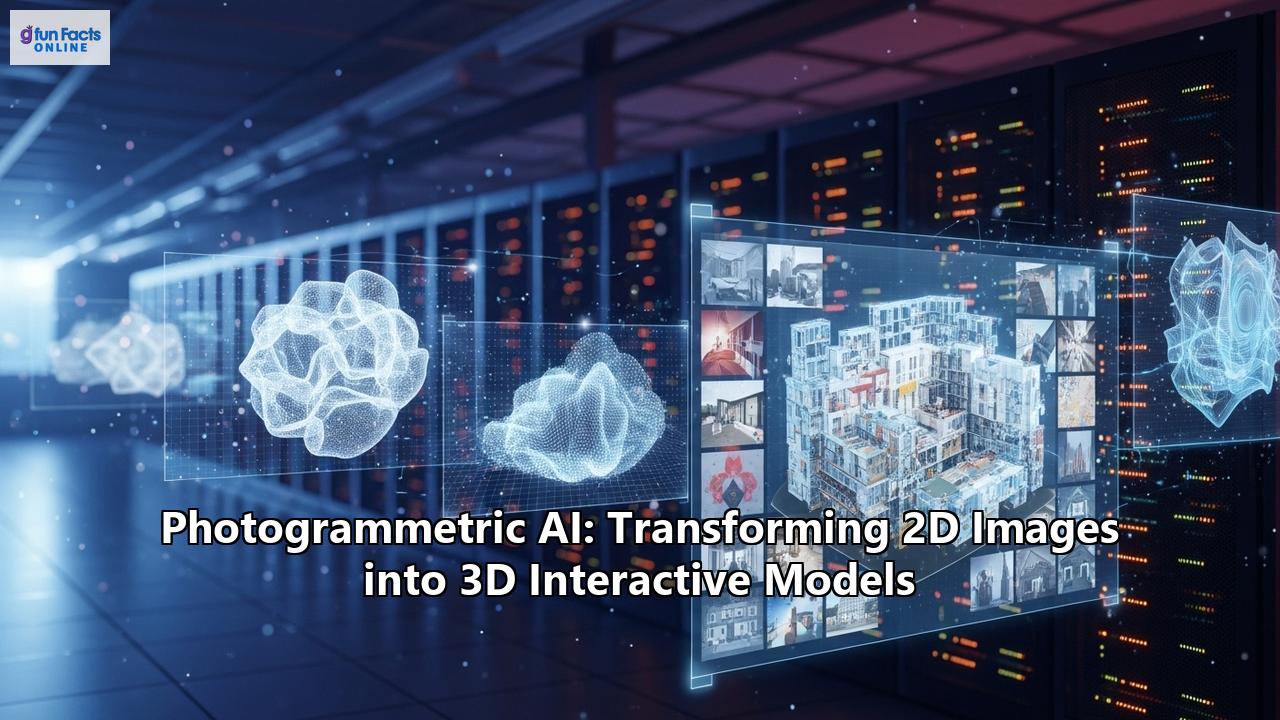
The Dawn of a New Dimension: How Photogrammetric AI is Breathing Life into 2D Images
The digital world is in the midst of a profound transformation, moving beyond the flat, two-dimensional interfaces that have defined our screens for decades. We are stepping into an era of immersive, interactive, and incredibly realistic three-dimensional experiences. At the heart of this revolution lies a powerful and increasingly accessible technology: Photogrammetric AI. This groundbreaking fusion of photogrammetry—the science of making measurements from photographs—and artificial intelligence is democratizing the creation of 3D models, turning simple 2D images into rich, navigable digital worlds. From preserving the intricate details of our most precious historical landmarks to crafting the hyper-realistic environments of next-generation video games, photogrammetric AI is not just changing how we see the digital world, but how we interact with it, understand it, and create within it.
This article will embark on a comprehensive journey into the world of photogrammetric AI. We will explore its fundamental principles, dissect the intricate technical workflows supercharged by artificial intelligence, and showcase its transformative applications across a multitude of industries. We will also delve into the challenges and limitations of this technology, and cast our gaze toward a future where emerging techniques like Neural Radiance Fields (NeRFs) and Gaussian Splatting promise to redefine the boundaries of what is possible.
From Puzzles to Pixels: Understanding the Core of Photogrammetry
At its core, photogrammetry is akin to solving a complex jigsaw puzzle, where the pieces are a collection of overlapping photographs. By capturing numerous images of an object or a scene from various angles, specialized software can identify common points and features across these images. This process of triangulation allows the software to calculate the precise three-dimensional coordinates of these points in space, effectively reconstructing the geometry of the subject. The more images you provide, and the greater the overlap between them, the more detailed and accurate the resulting 3D model will be.
Traditionally, this process was painstaking and labor-intensive, requiring significant manual intervention to identify and match features between images. However, the advent of artificial intelligence, particularly deep learning, has catapulted photogrammetry into a new era of automation and accuracy.
The AI Engine: Supercharging the Photogrammetry Workflow
The integration of AI has revolutionized nearly every step of the photogrammetry pipeline, making it faster, more efficient, and capable of handling increasingly complex scenarios. This has made the technology more accessible to a wider range of users, from individual creators to large enterprises. Let's break down the key stages of a modern, AI-powered photogrammetry workflow:
1. Image Acquisition: The Foundation of a Great Model
The first and arguably most crucial step is capturing high-quality images. The quality of the final 3D model is directly dependent on the quality of the input data. This involves taking a series of sharp, well-lit photographs of the subject from multiple viewpoints, ensuring significant overlap between each shot. While any camera can be used, including smartphones, the use of drones has become increasingly popular for capturing large-scale environments and structures.
AI is beginning to play a role even at this early stage. Some advanced systems can provide real-time feedback during the capture process, indicating whether sufficient coverage has been achieved or if certain areas require more photographs.
2. Feature Matching and Keypoint Detection: The Power of Deep Learning
This is where AI truly begins to shine. In the past, identifying corresponding points across dozens or even hundreds of images was a manual and time-consuming task. Today, deep learning algorithms, particularly Convolutional Neural Networks (CNNs), have automated this process with remarkable speed and accuracy.
These neural networks are trained on vast datasets of images to recognize and describe key features, such as corners, edges, and textures. Advanced models like SuperPoint can perform both keypoint detection and description in a single network, while others like D2-Net and R2D2 further refine this integration. By learning from a massive number of examples, these AI models can robustly identify matching features even in the presence of challenging conditions like varying lighting, perspective changes, and partial occlusions.
3. Structure from Motion (SfM): Reconstructing the 3D Scene
Once the keypoints are matched, the next step is Structure from Motion (SfM). This is a fundamental technique in computer vision that simultaneously estimates the 3D structure of the scene and the camera poses (position and orientation) for each image. The result of this process is a sparse point cloud—a collection of 3D points representing the basic geometry of the subject—and the calculated camera positions.
Deep learning is also making significant inroads into SfM. Models like DeepSFM and VGG-SfM from Meta AI are designed to enhance the traditional SfM pipeline. These deep learning approaches can improve the accuracy and robustness of camera pose estimation and initial 3D reconstruction, especially in scenarios where traditional methods might struggle, such as in low-texture areas.
4. Multi-View Stereo (MVS): Densifying the Point Cloud
The sparse point cloud from SfM provides a skeletal outline of the object. To create a more detailed model, we need to densify this point cloud. This is the role of Multi-View Stereo (MVS) algorithms. MVS takes the camera poses from SfM and the original images to calculate a dense point cloud, adding significantly more detail to the 3D reconstruction.
Here too, AI is proving to be a game-changer. Learning-based MVS methods, often utilizing CNNs, have demonstrated superior performance compared to traditional approaches, particularly in handling complex scenes and texture-less regions. These AI-powered techniques can more effectively infer depth information from the images, resulting in a more complete and accurate dense point cloud.
5. Mesh Generation and Texturing: From Points to a Solid Model
The dense point cloud is a collection of individual points in space. To create a solid, continuous surface, this point cloud needs to be converted into a mesh, which is typically a collection of interconnected triangles (polygons). Techniques like Poisson surface reconstruction are commonly used for this purpose.
AI is increasingly being used to refine and enhance the meshing process. For example, AI algorithms can help to reduce noise and remove outliers from the point cloud before meshing, leading to a cleaner final model. Some advanced techniques, like Point2Mesh, use neural networks to deform an initial mesh to fit the input point cloud, leveraging a "self-prior" to encourage geometric self-similarity across the surface.
Once the mesh is created, the final step is texturing. This involves projecting the original images back onto the 3D model to create a realistic, photorealistic appearance. AI can assist in this stage by automatically balancing colors and exposure across different images and intelligently blending textures to create a seamless final result.
A World of Applications: Photogrammetric AI in Action
The ability to quickly and accurately create detailed 3D models from photographs has unlocked a vast array of applications across numerous industries. Here are some of the most compelling examples:
Architecture, Engineering, and Construction (AEC)
The AEC sector has been an early and enthusiastic adopter of photogrammetric AI. The technology is used for:
- Site Surveying and Monitoring: Drones equipped with cameras can rapidly survey large construction sites, generating accurate 3D models and topographic maps. This allows for efficient progress monitoring, comparing as-built conditions to the original design plans, and identifying potential issues early on.
- Creating As-Built Models: Photogrammetry can be used to create highly detailed and accurate 3D models of existing buildings and infrastructure. These as-built models are invaluable for renovation, retrofitting, and facility management.
- Digital Twins: The 3D models created through photogrammetry form the basis of digital twins—virtual replicas of physical assets. These digital twins can be used for simulations, predictive maintenance, and optimizing the entire lifecycle of a building or infrastructure project.
- Façade Inspection: High-resolution images captured by drones can be used to create detailed 3D models of building facades, allowing for close inspection of potential defects like cracks or corrosion without the need for scaffolding or manual inspection.
One compelling example of photogrammetry in architecture involved a project to revitalize urban spaces. Architects used high-resolution images from a calibrated digital camera to capture over 250 photos of building facades at different times of the day. Despite challenges like traffic and pedestrians, they were able to process these images using close-range photogrammetry integrated with geographical information systems to conduct a detailed evaluation of the facades, informing their renovation plans.
Cultural Heritage and Historical Preservation
Photogrammetric AI is a powerful tool for preserving our shared cultural heritage for future generations. Its applications in this field include:
- Digital Archiving of Artifacts and Sites: Fragile historical artifacts and entire archaeological sites can be digitally preserved as highly detailed 3D models. This allows researchers and the public to study and interact with these objects without risking damage to the originals.
- Virtual Restoration: AI-powered techniques can be used to digitally reconstruct damaged or incomplete artifacts and historical sites. By analyzing fragments and existing data, AI can help to fill in the missing pieces, providing a glimpse of how these objects and places once appeared.
- Virtual Tourism and Education: The 3D models created through photogrammetry can be used to create immersive virtual reality (VR) and augmented reality (AR) experiences. This allows people from all over the world to virtually visit and explore historical sites, making cultural heritage more accessible than ever before.
A team used photogrammetry to preserve the Wing's Noodle Factory, a historical landmark in Montreal's Chinatown. By capturing the building's exterior with photogrammetry, they created a photorealistic and to-scale 3D model. This digital snapshot serves as an eternal record of the building, which can be used for educational purposes and even in VR experiences, allowing students to virtually "visit" the site.
Entertainment: Gaming and Visual Effects
The entertainment industry has embraced photogrammetric AI to create stunningly realistic and immersive virtual worlds.
- Creating Realistic Game Assets: Game developers use photogrammetry to capture real-world objects, textures, and even human faces and transform them into highly detailed 3D assets for their games. This approach is often faster and more cost-effective than creating these assets from scratch.
- Building Immersive Game Environments: Entire real-world locations can be captured and recreated as vast, explorable environments in video games, offering players an unprecedented level of realism.
- Visual Effects (VFX) for Film and Television: Photogrammetry is used to create digital sets, props, and characters for movies and TV shows, seamlessly blending real-world footage with computer-generated imagery.
Many of the biggest game development companies, such as Epic Games, have heavily invested in photogrammetry. They use software like RealityCapture to transform photographs of real-world objects and environments into the stunningly realistic assets that populate their games, a process that significantly cuts down on development time compared to traditional 3D modeling.
Manufacturing and Industrial Inspection
In the manufacturing sector, photogrammetric AI is being used to improve quality control and inspection processes.
- Defect Detection: High-resolution 3D models of manufactured parts can be automatically inspected by AI algorithms to identify defects, such as cracks, dents, or other imperfections, with a high degree of accuracy. This can lead to a significant reduction in defect rates and improved product quality.
- As-Built vs. As-Designed Comparison: The 3D model of a manufactured part can be compared to its original CAD design to ensure that it has been produced to the correct specifications.
- Reverse Engineering: Photogrammetry can be used to create a 3D model of an existing part, which can then be used for reverse engineering or to create a digital inventory of spare parts.
In one case study, a manufacturer implemented an AI-powered visual inspection system to detect wrinkles in car seat upholstery. The system achieved 99% accuracy and reduced the inspection time from one minute per seat to just 2.2 seconds. This resulted in a 30% reduction in defect rates and a 30-fold reduction in costs compared to manual inspection.
The Hurdles on the Path to Perfection: Challenges and Limitations
Despite its transformative potential, photogrammetric AI is not without its challenges and limitations.
- Data Quality is Paramount: As mentioned earlier, the quality of the final 3D model is heavily dependent on the quality of the input images. Poorly lit, blurry, or non-overlapping images will result in inaccurate or incomplete models.
- Reflective and Transparent Surfaces: Photogrammetry struggles with highly reflective or transparent surfaces, such as glass, mirrors, and polished metal. These surfaces can confuse the feature-matching algorithms, leading to errors in the reconstruction.
- Featureless and Homogeneous Surfaces: Similarly, objects with smooth, uniform surfaces that lack distinct visual features can be difficult for photogrammetry software to process.
- Moving Objects: Capturing objects that are in motion is a significant challenge, as the scene changes between each photograph.
- Computational Cost: Processing the large datasets of images required for high-quality photogrammetry can be computationally expensive, often requiring powerful hardware.
- Need for Skilled Professionals: While AI automates many tasks, skilled professionals are still needed to plan and execute the data capture, oversee the processing, and interpret the results.
The Next Frontier: NeRFs, Gaussian Splatting, and the Future of 3D Modeling
The field of photogrammetric AI is constantly evolving, with new techniques emerging that promise to overcome current limitations and unlock even greater possibilities. Two of the most exciting developments are Neural Radiance Fields (NeRFs) and Gaussian Splatting.
Neural Radiance Fields (NeRFs): Painting with Light
NeRFs represent a paradigm shift in how we think about 3D scene representation. Instead of creating a mesh, a NeRF uses a neural network to learn a continuous volumetric representation of a scene. It takes a set of images and their corresponding camera poses as input and trains a small neural network to predict the color and density of light at any point in 3D space. The result is an incredibly realistic, view-dependent rendering of the scene that can handle complex phenomena like reflections and transparency with ease.
Gaussian Splatting: Real-Time Radiance Fields
While NeRFs produce stunning results, they can be slow to train and render. Gaussian Splatting is a more recent technique that offers a similar level of realism but with significantly faster rendering times. Instead of a neural network, Gaussian Splatting represents a scene as a collection of 3D "splats," each with its own position, shape, color, and opacity. This representation is more explicit and can be rendered in real-time, making it ideal for interactive applications.
Both NeRFs and Gaussian Splatting are still relatively new technologies, and they have their own set of challenges, particularly when it comes to editing and exporting to traditional 3D formats. However, they represent the cutting edge of 3D reconstruction and are likely to have a profound impact on the future of photogrammetry and 3D modeling.
The Economic Impact: A New Calculus for Creation
The automation and efficiency gains brought about by photogrammetric AI are having a significant economic impact. By reducing the time and cost of 3D model creation, this technology is enabling new business models and making 3D content creation accessible to a much broader audience. Companies that adopt these workflows are seeing a significant return on investment (ROI) through:
- Reduced Labor Costs: Automating tasks that were previously done manually significantly reduces the number of person-hours required for 3D modeling.
- Increased Productivity: Faster processing times and more efficient workflows allow teams to complete more projects in less time.
- Improved Quality and Accuracy: AI-powered systems can often achieve a higher level of accuracy and consistency than manual methods, reducing the need for costly rework.
- New Revenue Streams: The ability to easily create high-quality 3D content is opening up new opportunities in areas like e-commerce, virtual reality, and personalized products.
One survey found that companies using AI report an average ROI of $3.50 for every $1 spent, a testament to the transformative power of this technology.
Conclusion: A Future Sculpted in Three Dimensions
Photogrammetric AI is more than just a technological curiosity; it is a fundamental shift in how we capture, create, and interact with the digital world. By transforming the humble 2D photograph into a rich, interactive 3D model, this technology is breaking down the barriers between the physical and the digital, creating a more immersive, intuitive, and ultimately, more human-centric digital experience.
The journey of photogrammetric AI is still in its early stages. The challenges are real, but the pace of innovation is relentless. As algorithms become more sophisticated, as new techniques like NeRFs and Gaussian Splatting mature, and as the technology becomes even more accessible, we can expect to see an explosion of creativity and innovation in the years to come. The future is not just something we will view on a flat screen; it is something we will step into, explore, and help to create, one photograph at a time. The age of the 3D interactive model is upon us, and it promises to be nothing short of revolutionary.
Reference:
- https://www.promptloop.com/docs/understanding-roi
- https://www.pix-pro.com/blog/photogrammetry-limits
- https://track3d.ai/unlocking-the-potential-of-photogrammetry-application-in-construction-progress-monitoring/
- https://knowledgement.co.uk/blog/f/revolutionizing-photogrammetry-the-impact-of-ai?blogcategory=Agile
- https://www.researchgate.net/publication/383241592_Artificial_intelligence_techniques_in_photogrammetry_application_A_review
- https://pubs.aip.org/aip/acp/article/3105/1/050057/3308891/Artificial-intelligence-techniques-in
- https://metrology.news/shaping-the-future-ais-future-role-in-3d-scanning/
- https://www.datumate.com/blog/top-strategies-for-leveraging-photogrammetry-in-heavy-civil-construction-a-practical-guide/
- https://www.researchgate.net/publication/371848444_IMAGE_RETRIEVAL_FOR_3D_MODELLING_OF_ARCHITECTURE_USING_AI_AND_PHOTOGRAMMETRY
- https://www.researchgate.net/publication/330771797_IMAGE_RECORDING_CHALLENGES_FOR_PHOTOGRAMMETRIC_CONSTRUCTION_SITE_MONITORING
- https://www.artec3d.com/learning-center/photogrammetry-for-games
- https://30dayscoding.com/blog/game-development-with-photogrammetry-and-3d-scanning
- https://www.xraispotlight.com/blog/tools-and-resources-to-learn-and-master-nerfs-and-gaussian-splatting/
- https://foyr.com/learn/how-architects-are-using-photogrammetry-in-home-designing
- https://www.geoweeknews.com/blogs/nerfs-gaussian-splats-3d-model-rendering-photogrammetry-ai-ml
- https://www.synima.com/the-differences-between-photogrammetry-nerf-and-gaussian-splatting/
- https://www.youtube.com/watch?v=MzZGEhAvQTA
- https://knowledgeone.ca/case-study-using-photogrammetry-to-immortalize-a-historical-landmark/
- https://praxie.com/ai-quality-inspections-in-manufacturing/
- https://aglowiditsolutions.com/blog/ai-in-construction-project-monitoring/
- https://www.gridpaperstudio.com/post/exploring-the-use-cases-of-photogrammetry-from-heritage-preservation-to-gaming
- https://pf-aviation.com/blog/the-future-of-3d-modeling--drones--photogrammetry---matterport
- https://www.youtube.com/watch?v=21K4Nqc_sb8
- https://yenra.com/ai20/historical-restoration-and-analysis/
- https://thatonegamedev.com/3d-game-design/photogrammetry-for-game-development/
- https://arxiv.org/html/2505.16951v1
- https://dac.digital/benefits-of-ai-for-quality-control-in-manufacturing/
- https://www.assemblymag.com/articles/98449-beyond-the-human-eye-ai-improves-inspection-in-manufacturing
- https://ckoziol.com/blog/2024/radiance_methods/
- https://medium.com/@singularitynetambassadors/the-ai-revolution-3d-modeling-and-motion-capture-37da84a55d53
- https://www.europarl.europa.eu/RegData/etudes/BRIE/2019/637967/EPRS_BRI(2019)637967_EN.pdf637967_EN.pdf)
- https://www.superside.com/blog/roi-ai-creative-workflows