
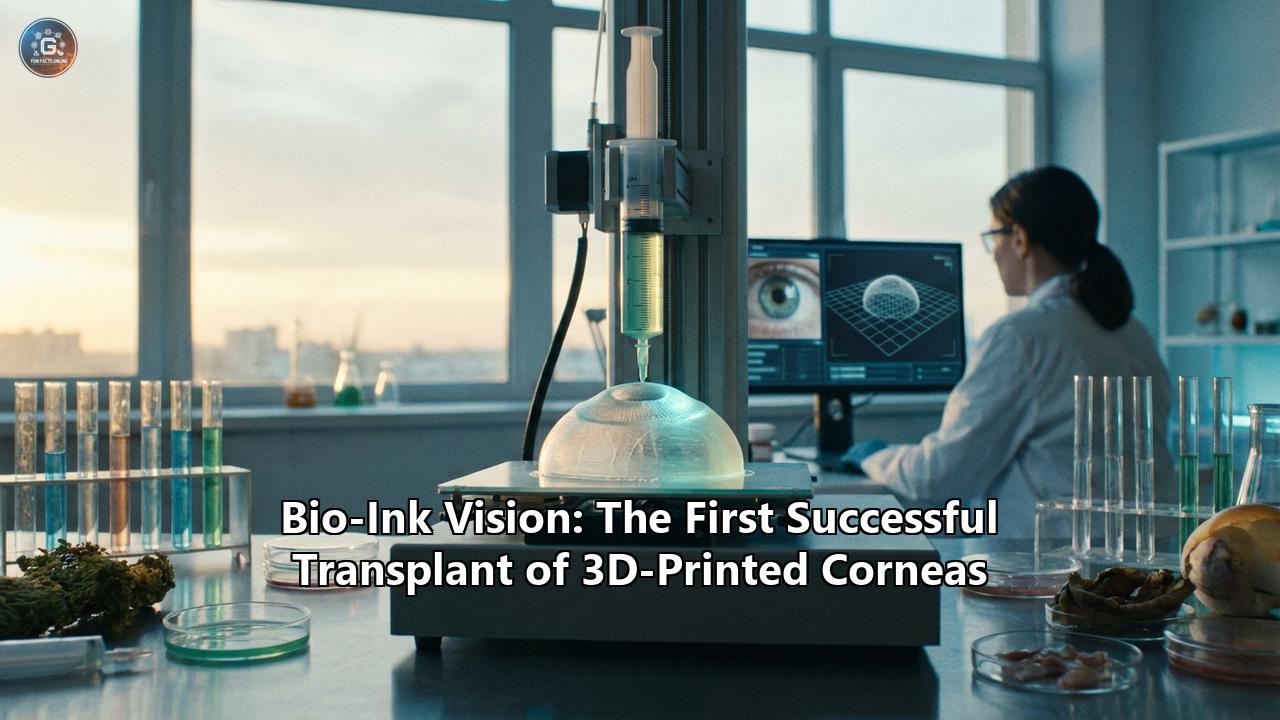
The sterile air of the operating theater at the Rambam Health Care Campus in Haifa, Israel, hummed with a tension that was different from the usual surgical routine. It was late October 2025. Professor Michael Mimouni stood over a patient who had lived in the gray fog of legal blindness for years. The procedure about to take place was not merely a transplant; it was a fabrication of the future. The object being carefully unfurled into the patient’s eye wasn't a slice of tissue taken directly from a deceased donor. It was a masterpiece of bio-engineering—a cornea that had been printed, layer by microscopic layer, in a laboratory.
When the bandages were removed days later, and the patient saw the world again, humanity crossed a threshold. We had entered the era of Bio-Ink Vision.
This moment was the culmination of decades of research, a convergence of biology, engineering, and sheer human will. It marked the first successful transplant of a fully 3D-bioprinted, cell-based corneal implant into a human being. But to truly understand the magnitude of this breakthrough, we must embark on a journey through the anatomy of sight, the desperation of the global blindness crisis, and the liquid miracles known as bio-inks that are rewriting the rules of medicine.
Part I: The Window to the World
The Architecture of Clarity
To appreciate the difficulty of 3D printing a cornea, one must first appreciate the biological marvel that is the natural cornea. It is often described simply as the "clear front window" of the eye, but this description betrays its complexity. The cornea is a structural paradox: it must be tough enough to protect the delicate inner eye from dust, germs, and injury, yet it must be perfectly transparent to allow light to pass through undistorted.
If you were to look at a cross-section of the cornea under a microscope, you would see a structure of immense precision. It is not a single piece of "glass," but a composite of five (arguably six) distinct layers, each with a specific function.
- The Epithelium: The outermost layer, a fast-healing barrier that absorbs oxygen and nutrients from tears.
- Bowman’s Layer: A tough sheet of tissue composed of collagen fibers.
- The Stroma: The masterpiece. Making up 90% of the cornea's thickness, the stroma consists of water and collagen fibers. But unlike the collagen in your skin (which is opaque), the collagen in the stroma is arranged in a lattice pattern so precise—uniformly spaced and parallel—that it allows light to travel through without scattering. This is the "invisible" layer.
- Descemet’s Membrane: A thin but strong sheet of tissue that serves as a protective barrier against infection and injuries.
- The Endothelium: The innermost layer, just one cell thick. These cells are the pumps. They constantly pump excess fluid out of the stroma. If they fail, the cornea swells, becomes cloudy (edema), and vision is lost.
Replicating this structure in a lab is one of the hardest challenges in tissue engineering. If your 3D printer lays down the collagen fibers just a fraction of a degree off-alignment, the cornea becomes white and opaque. If the bio-ink is too soft, the eye collapses. If it is too hard, the patient feels like they have a stone in their eye.
The Silent Crisis
For millions, this complex window has shattered. Corneal blindness is the third leading cause of blindness globally, following cataracts and glaucoma. The World Health Organization estimates that over 10 million people are waiting for a corneal transplant.
The tragedy of corneal blindness is that it is curable. A transplant can restore sight. However, the cure relies on a resource that is tragically finite: the death of a donor.
For every 70 people who need a cornea, there is only one donor available. In developed nations like the United States, eye banking systems are efficient, and the wait might be only a few weeks. But in the developing world—in vast swathes of India, Africa, and Southeast Asia—the wait is effectively forever. Children born with corneal defects or farmers who suffer minor eye injuries that scar over are condemned to a lifetime of darkness simply because there isn't enough human tissue to go around.
This scarcity created a desperate need for a synthetic alternative. For decades, scientists tried plastics (keratoprosthesis), but these were prone to infection and extrusion. The body rejected them because they were foreign. The dream was always to create a biological cornea—one made of human cells that the body would recognize, accept, and heal.
Part II: The Rise of the Bio-Printers
Defining the Magic: What is Bio-Ink?
The hero of our story is not the 3D printer itself—which is essentially a high-precision robotic arm—but the "cartridge" loaded inside it. In standard 3D printing, you melt plastic to build a shape. In bioprinting, you cannot melt the material because the material is alive.
This material is called bio-ink.
A bio-ink is a delicate slurry containing two main components:
- The Scaffold (The House): A hydrogel usually made from alginate (seaweed extract), collagen, or decellularized tissue matrix. This provides the structure, the "walls" and "floors" that hold the shape of the cornea.
- The Living Cells (The Residents): Suspended within this gel are living human cells—stem cells, stromal cells, or endothelial cells.
The engineering challenge is a "Goldilocks" problem. The bio-ink must be liquid enough to flow through a printer nozzle thinner than a human hair, but solid enough to instantly hold its shape once it hits the printing bed. If it's too thick, the shear stress of being pushed through the nozzle kills the cells (exploding them like water balloons). If it's too thin, the printed cornea melts into a puddle.
The Early Pioneers
The road to the 2025 breakthrough was paved by several key milestones.
- 2018: The Newcastle Proof of Concept:
Researchers at Newcastle University in the UK, led by Professor Che Connon, made headlines when they successfully 3D printed the first human corneal stroma. They used a bio-ink made of alginate and collagen mixed with human corneal stromal cells. It was a massive scientific leap. They proved you could keep cells alive during the printing process and that the structure would hold. However, these were not transplanted into humans; they were "proof of concept" models kept alive in petri dishes.
- 2022: The Indian Leap (LVPEI, IIT Hyderabad, CCMB):
In August 2022, a team in Hyderabad, India, took the next massive step. Scientists from the L V Prasad Eye Institute (LVPEI), IIT Hyderabad, and the Centre for Cellular and Molecular Biology (CCMB) developed a bio-ink made from decellularized human corneal tissue. They took donor corneas that were essentially "rejects" (not good enough for transplant), stripped away the cells to leave just the natural matrix, and turned that into a printable ink.
They successfully printed a cornea and transplanted it into a rabbit. The rabbit's eye healed, the cornea remained clear, and there was no rejection. This was the first proof that a 3D-printed cornea could survive inside a living body. It was a "Made in India" triumph that set the stage for human trials.
- Pandorum Technologies:
Another Indian biotech firm, Pandorum Technologies, began working on "liquid corneas"—a hydrogel that could be injected into the eye to heal wounds, eventually moving toward solid printed implants.
These stepping stones were vital. They taught scientists how to amplify cells—taking a small biopsy from one donor and growing enough cells in a lab to print dozens of corneas.
Part III: The Breakthrough – October 2025
The Rambam Miracle
By late 2025, the technology had matured. Precise Bio, a regenerative medicine company with roots in North Carolina and Israel, had developed a proprietary platform dubbed "4D-Bio-Fabrication."
Their implant, code-named PB-001, was different. It wasn't just a chunk of collagen. It was a printed graft containing functional human cells that had been cultured in a lab.
The patient at Rambam Health Care Campus had suffered from corneal disease that left them legally blind. The stromal layers of their eye were damaged, opaque, and scarred. In a traditional scenario, this patient would have waited for a human donor.
Instead, Professor Michael Mimouni and his team prepared the PB-001 implant. The surgery was a variation of a procedure known as endothelial keratoplasty or anterior lamellar keratoplasty, but with a futuristic twist. The damaged tissue was removed, and the bio-printed disc was inserted.
Unlike a piece of plastic, the bio-printed cornea was designed to integrate. The cells inside the printed lattice began to talk to the patient’s own eye biology. They signaled the surrounding tissue to heal, to connect, and to feed the new graft.
When the results were announced, the medical community was stunned. The patient regained sight. The implant didn't reject. The optical clarity was comparable to a human donor graft.
The Mathematics of Hope: 1 into 300
The most revolutionary aspect of the Precise Bio and Rambam success wasn't just that it worked for one person. It was the math behind the manufacturing.
In traditional transplants, one donor cornea = one recipient. It is a 1:1 ratio.
With 3D bioprinting, scientists can take a single donor cornea, extract the cells, and cultivate them in a bioreactor. These cells multiply. They can then be mixed with the bio-ink to print multiple new corneas.
Precise Bio and the researchers involved estimated that one single donor cornea could now create enough bio-ink to print 300 implants.
This is the game-changer. It effectively ends the shortage. If one donor can save 300 eyes, the waiting lists in India, Africa, and South America could theoretically be wiped out in a decade. We move from an economy of scarcity to an economy of abundance.
Part IV: How It Works – The Fabrication Process
To understand the "magic," let's break down the actual process of creating a 3D-printed cornea today.
Step 1: The Blueprint (Scanning)
It starts with data. The patient’s eye is scanned using Optical Coherence Tomography (OCT) and corneal topography. This creates a digital 3D map of the eye’s curvature, thickness, and any irregularities. Unlike donor corneas, which come in a "standard" shape that the surgeon must force to fit, a 3D-printed cornea is customizable. It can be printed to the exact curvature of the patient’s eyeball, potentially correcting refractive errors (like astigmatism) during the transplant itself.
Step 2: The Ink Formulation
This is the "secret sauce." The bio-ink is prepared in a sterile cleanroom.
- The Matrix: A solution of collagen (often recombinant human collagen or decellularized tissue) and alginate is prepared.
- The Cells: Human corneal stromal cells (keratocytes) are thawed from a cryobank. These cells are the workers that will maintain the cornea's clarity after the hydrogel dissolves or integrates.
- Mixing: The cells are gently folded into the matrix. The temperature must be strictly controlled; too warm, and the collagen sets too early; too cold, and the cells go into shock.
Step 3: The Bioprinting
The printer looks like a high-tech box with a syringe-like nozzle moving on three axes (X, Y, Z).
- Extrusion: The nozzle moves in a concentric circle pattern, mimicking the natural collagen alignment of the stroma. It lays down the bio-ink in layers, each only microns thick.
- Cross-linking: As the ink is deposited, it is often too liquid to hold its shape. A UV light or a chemical mist is used to "cross-link" the gel—instantly hardening it just enough to maintain structure without killing the cells.
- Time: The printing of a single cornea takes less than 10 to 20 minutes.
Step 4: Incubation
The printed cornea isn't ready for surgery immediately. It is placed in a bioreactor—a nutrient-rich bath that mimics the conditions inside the human eye. Here, the cornea "matures." The cells inside proliferate and begin to reorganize the collagen scaffold, making it clearer and stronger. This can take a few weeks.
Step 5: Transplantation
The final product is shipped to the hospital. It looks like a contact lens but feels like firm jelly. The surgeon makes an incision in the patient's eye, slips the printed cornea in, and sutures it (or uses a bio-adhesive) in place.
Part V: The Future Landscape
Beyond Transplants: The "Super Cornea"
The success of the first transplant opens the door to science fiction becoming reality. If we can print corneas, we can improve them.
- built-in Vision Correction: Currently, if you get a corneal transplant, you often still need glasses or contact lenses afterwards because the shape isn't perfect. In the future, the 3D printer could calculate your precise prescription and print the cornea with the exact refractive power needed. You would wake up from surgery with 20/20 vision, effectively combining a transplant with LASIK.
- Smart Corneas: Researchers are experimenting with embedding microscopic electronics or sensors into the prints. Imagine a cornea that monitors your glucose levels (for diabetics) or intraocular pressure (for glaucoma patients) and sends the data to your phone.
- End of Rejection: The ultimate goal is autologous bioprinting. This means taking a small skin biopsy from the patient, turning those skin cells into stem cells (iPSCs), differentiating them into corneal cells, and printing a cornea made of the patient’s own DNA. The risk of rejection would drop to zero. No more immunosuppressant eye drops.
The Challengers and The Race
While Precise Bio and the Israeli team claimed the "first human transplant" milestone for a fully printed cell-based cornea, the field is crowded with brilliance.
- India: The LVPEI/IIT team is rapidly moving toward human trials for their decellularized matrix corneas. Their approach is particularly promising for cost-effective solutions in the developing world because it relies on "upcycling" waste donor tissue.
- South Korea: Researchers at Pohang University of Science and Technology (POSTECH) have developed bio-inks that mimic the shear stress of the eye during printing to align collagen fibers perfectly.
- USA: University researchers are looking at "in-situ" bioprinting—where a robotic arm prints the cornea directly onto the patient's eye in the operating room, skipping the incubation phase.
Part VI: The Ethical and Economic Horizon
With great power comes great complexity. The transition from "donor tissue" to "manufactured tissue" raises new questions.
1. The Cost of Sight:Currently, a donor cornea is relatively cheap to procure (it is a donation), though the testing and banking fees add up ($2,000 - $4,000 USD). A 3D-bioprinted cornea involves patent fees, high-tech bioreactors, and proprietary bio-inks. Will this technology be a luxury for the rich, while the poor wait for scarce donors?
However, economists argue that mass production will eventually crash the price. Once the R&D is paid for, the raw materials (collagen, alginate, cultured cells) are cheap. If a factory can print 1,000 corneas a day, the cost could drop below that of harvesting and testing human donor tissue.
2. Regulatory Hurdles:The FDA and other global regulatory bodies are in uncharted waters. Is a printed cornea a "drug" (because of the cells), a "device" (because of the scaffold), or a "biologic"? The classification changes the testing requirements. The Phase 1 trial at Rambam is just the beginning. It will take years of Phase 2 and 3 trials to prove long-term safety (e.g., ensuring the stem cells don't mutate or grow uncontrollably).
3. The End of Eye Banking?Eye banks have been the guardians of sight for a century. As 3D printing rises, their role will shift. They may become "Cell Banks," storing vials of master cell lines rather than refrigerators full of whole eyes.
Part VII: A New Vision for Humanity
The first successful transplant of a 3D-printed cornea in late 2025 was more than a medical success; it was a humanitarian victory.
Consider the story of a farmer in rural India, blinded by a fungal infection, unable to work, his family plunged into poverty. In the old world, he waits five years for a donor, by which time his livelihood is gone. In the new world of Bio-Ink Vision, he visits a local clinic. The clinic downloads a standard corneal file, prints a sterile graft in 15 minutes, and a surgeon restores his sight the same day.
The technology that seemed like fantasy—printers creating living human parts—is now a clinical reality. The rabbit trials in Hyderabad proved it was safe. The surgeons in Haifa proved it works in humans. Now, the engineers must prove it can be scaled.
We are standing at the dawn of the Regenerative Age. The cornea was the first victory because it is simple, bloodless, and transparent. But the lessons learned here—how to print collagen, how to keep cells alive, how to vascularize tissue—will be applied to the next frontiers: printed skin for burn victims, printed cartilage for arthritis, and eventually, printed hearts and livers.
But for now, the victory belongs to the eye. For the millions living in darkness, the hum of the 3D bioprinter is the most beautiful sound in the world. It is the sound of light returning.
Summary of Key Milestones in Bio-Ink Vision
| Era | Milestone | Significance |
| :--- | :--- | :--- |
| 2018 | Newcastle University (UK) prints first human cornea model. | Proof that bio-ink can hold shape and keep cells alive. |
| 2022 | LVPEI / IIT Hyderabad (India) transplant printed cornea into a Rabbit. | First successful animal trial; proved biocompatibility in a living eye. |
| 2024 | Pandorum & Others refine bio-ink stability. | Advancements in "liquid cornea" fillers and hydrogels. |
| Oct 2025 | Rambam Eye Institute / Precise Bio (Israel) performs first Human Transplant. | The "Moon Landing" of ophthalmology. Restored sight to a blind patient. |
| 2026+ | Global Clinical Trials. | The race to scale production and gain FDA/global approval. |
The first patient to receive this gift in Israel looked through a window that was made, not born. And in doing so, they showed us all a future where blindness is not a life sentence, but merely a broken part waiting to be printed anew.
Reference:
- https://www.foxnews.com/tech/3d-printed-cornea-restores-sight-world-first
- https://timesofindia.indiatimes.com/life-style/health-fitness/health-news/how-worlds-first-3d-printed-cornea-restored-a-70-yr-olds-vision/articleshow/125875541.cms
- https://www.good.is/3d-printed-eye
- https://www.rambamhcc.com/post/global-first-at-rambam-a-3d-printed-cornea-restores-sight
- https://www.goodnewsnetwork.org/first-human-cornea-transplant-using-3d-printed-lab-grown-tissue-restores-sight-in-a-game-changer-for-millions-who-are-blind/
- https://3dprint.com/322382/worlds-first-3d-bioprinted-corneal-implant-successfully-implanted-in-phase-1-patient/
- https://www.fiercebiotech.com/medtech/precise-bio-completes-first-human-cornea-transplant-using-3d-printed-lab-grown-tissue
- https://newatlas.com/medical/3d-printed-cornea-restores-sight-first-time/
- https://3dprinting.com/news/rabbit-gets-printed-cornea/
- https://pmc.ncbi.nlm.nih.gov/articles/PMC10504850/
- https://blog.geeetech.com/special-offers/3d-printing-is-evolving-in-the-field-of-medicine-3d-printed-bio-ink-human-cornea/
- https://www.pcmag.com/news/bio-ink-used-to-3d-print-human-cornea-in-10-minutes
- https://www.cellink.com/customer-spotlight/on-the-horizon-using-3d-printed-corneas-to-cure-corneal-blindness/
- https://www.aao.org/education/headline/scientists-unveil-first-3d-printed-human-corneas
- https://3dprintingindustry.com/news/scientists-say-indias-first-3d-printed-cornea-can-be-used-in-humans-after-successful-animal-trial-213745/
- https://3dflyingbear.com/blogs/3d-printer/successful-animal-trials-indias-first-3d-printed-cornea-can-be-used-for-humans
- https://www.ncl.ac.uk/press/articles/archive/2018/05/first3dprintingofcorneas/