
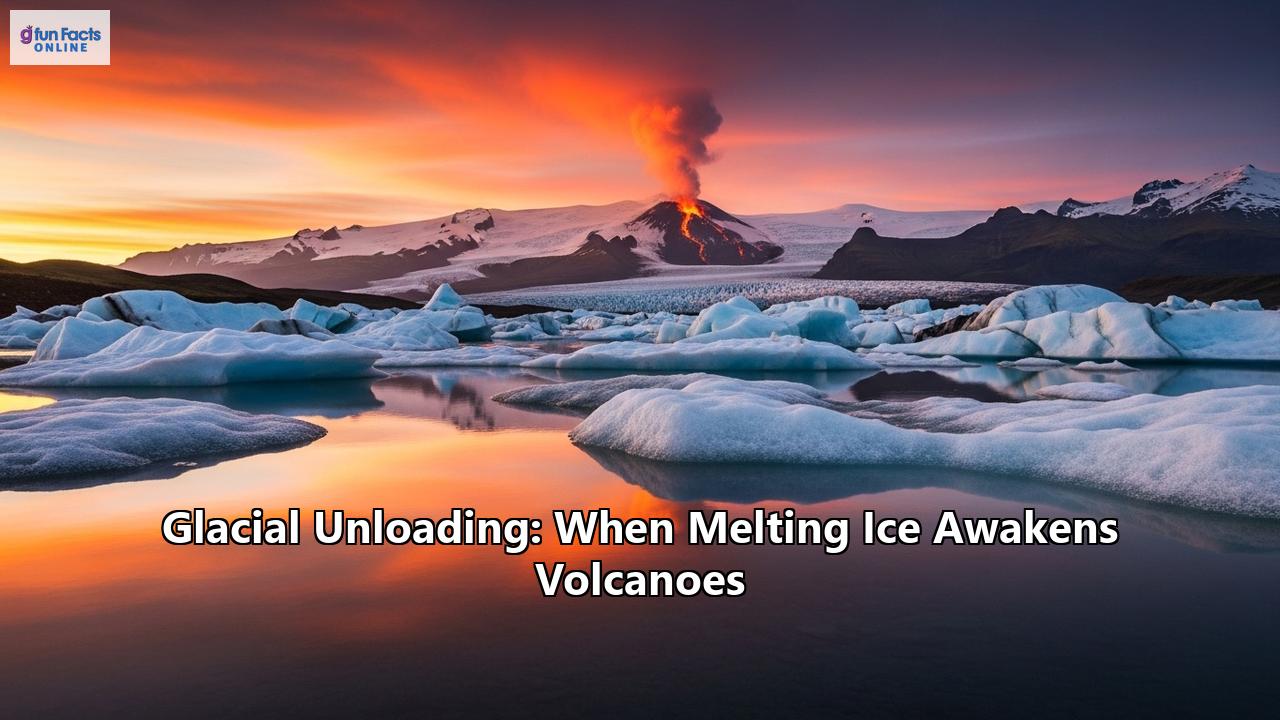
Earth's Fiery R'n'R: When Melting Ice Unleashes Volcanic Fury
Beneath the serene, frozen landscapes of our planet's iciest regions, a powerful and deeply interconnected drama is unfolding. The colossal weight of glaciers and ice sheets, which have for millennia pressed down upon the Earth's crust, is diminishing. As global temperatures rise and ice melts at an accelerating rate, this incredible "unloading" is not just causing the ground to rebound, but it may also be stirring the slumbering giants beneath: volcanoes. This phenomenon, known as glacial unloading, is revealing a dramatic and sometimes violent relationship between ice and fire, where the retreat of glaciers can trigger more frequent and explosive volcanic eruptions, potentially creating a feedback loop with profound implications for our planet's future.
The concept is both simple and powerful. Imagine the Earth's crust as a flexible surface with a massive weight sitting on it. For thousands of years during ice ages, glaciers, sometimes kilometers thick, have suppressed the molten rock, or magma, in the mantle below. This immense pressure acts like a cork in a champagne bottle, keeping the volatile gases dissolved within the magma and making it harder for the magma to find pathways to the surface.
Now, as that weight is lifted, the pressure on the underlying crust and mantle decreases. This decompression has two major effects. First, it lowers the melting point of the rock in the mantle, allowing more magma to be generated—a process called decompression melting. Second, the reduction in overlying pressure changes the stresses within the crust, effectively opening up fractures and conduits, making it easier for the accumulated magma to ascend. The result is a surge in volcanic activity, a planetary sigh of relief that can manifest as spectacular and hazardous eruptions.
This is not merely a theoretical concept. Scientists have found compelling evidence etched into the geological records of the past. In places like Iceland, the end of the last Ice Age, roughly 12,000 years ago, was followed by a dramatic spike in volcanic activity, with eruption rates estimated to be 30 to 50 times higher than they are today. More recent studies are now revealing similar patterns in other glacier-covered regions, from the towering peaks of the Andes to the vast, mysterious continent of Antarctica, raising urgent questions about the consequences of our current warming climate.
A Heavy Lid: The Science of Glacial Suppression
To truly grasp how melting ice awakens volcanoes, we must journey deep beneath the frozen surface to the realms of rock and fire, exploring the intricate dance of pressure, chemistry, and geology. The process is governed by a set of powerful physical principles, primarily glacial isostatic adjustment, decompression melting, and changes in crustal stress and magma chemistry.
The Great Rebound: Isostatic Adjustment
At the heart of the phenomenon is glacial isostatic adjustment (GIA), the process by which the Earth's lithosphere (its rigid outer layer) responds to the loading and unloading of ice sheets. Think of the lithosphere as a raft floating on the more fluid, viscous asthenosphere—the upper layer of the mantle. When a massive ice sheet forms, its immense weight—a cubic meter of ice weighs nearly a ton—depresses the lithosphere, pushing it down into the asthenosphere. The land directly beneath the ice sinks, while the displaced mantle material causes the land at the edges of the ice sheet to bulge upwards, creating what is known as a forebulge.
When the climate warms and the ice melts, this process reverses. Freed from its heavy burden, the depressed land begins to rebound, rising slowly over thousands of years as the mantle material flows back in. This "post-glacial rebound" is not a minor adjustment; in areas like Scandinavia and North America, land has risen by several hundred meters since the end of the last glacial period. This grand, slow-motion uplift fundamentally alters the pressure conditions deep within the Earth's crust and upper mantle, setting the stage for volcanic revival.
Unleashing the Mantle: Decompression Melting
One of the most direct consequences of this unloading is decompression melting. The Earth's mantle is incredibly hot, but for the most part, it remains solid because of the immense pressure exerted by the overlying rock. This pressure effectively increases the melting point of the mantle rock (peridotite). If that pressure is reduced, the melting point drops.
As the crust rebounds upwards due to melting glaciers, the pressure on the underlying mantle decreases. Even though the mantle rock itself may not heat up, the reduction in pressure can be enough for it to cross its melting threshold and begin to liquefy. This generates new, and often significant, quantities of magma that were previously suppressed by the weight of the ice. Studies have shown that this process is the most important mechanism for magma production on Earth, responsible for creating the oceanic crust at mid-ocean ridges. In the context of glacial unloading, it provides a powerful engine for increased volcanic activity. Evidence from Iceland, for instance, shows that the period of rapid deglaciation saw not just more frequent eruptions, but also changes in the lava's chemical signature consistent with higher degrees of partial melting in the mantle.
Cracking the Cap: Changing Crustal Stresses and Magma Ascent
While decompression melting explains the creation of more magma, changes in the crustal stress field explain how that magma more easily reaches the surface. The weight of a thick ice sheet creates a state of high compression in the crust beneath it. This compressive stress makes it difficult for magma to force its way upwards. Magma ascends by creating or exploiting fractures (dikes and sills), and under high pressure, these pathways are effectively clamped shut. This can cause magma to stall and pool in large reservoirs deep within the crust.
When the ice melts, this compressive stress is released. The crust relaxes and, in some cases, can even go into a state of extension, making it far easier for dikes to propagate upwards. The removal of the ice load essentially unclamps the system, opening a path for the stored magma to escape.
A fascinating study of Chile's Mocho-Choshuenco volcano revealed a three-phase response to deglaciation that illustrates this process perfectly.
- Phase 1 (Evacuation): Immediately following deglaciation (13–8.2 thousand years ago), there was a burst of large, explosive eruptions of highly evolved, silica-rich magma. This is interpreted as the rapid emptying of large magma reservoirs that had been building up and differentiating under the suppressive weight of the ice.
- Phase 2 (Relaxation): This was followed by a period of lower eruption rates of less-differentiated, more mafic magma (7.3–2.9 thousand years ago). This suggests that the old, stored magma had been cleared out, and new magma from the mantle was now ascending more directly without long storage times.
- Phase 3 (Recovery): Finally, in the most recent period (since 2.4 thousand years ago), eruptive fluxes increased again with more intermediate magma compositions, indicating that the plumbing system was beginning to re-establish new storage reservoirs and return to a more "normal" state.
A More Explosive Brew: The Chemistry of Unloaded Magma
Glacial unloading doesn't just increase the frequency of eruptions; it can also change their character, making them potentially more explosive. This is because the pressure of the overlying ice influences the chemistry and physical properties of the stored magma.
Under the immense pressure of a glacier, magma can hold large amounts of dissolved gases, particularly water and carbon dioxide, in solution—much like a sealed bottle of soda. This pressure also favors the formation of dense minerals. During long periods of glacial suppression, magma can sit in crustal reservoirs for thousands of years, slowly cooling and crystallizing. This process, known as fractional crystallization, preferentially removes certain elements, causing the remaining liquid magma to become enriched in silica.
High-silica magmas (like rhyolite) are much more viscous than low-silica magmas (like basalt). They have a thick, sticky consistency that traps gas bubbles. When the glacial ice melts and the pressure is released, two things happen:
- The dissolved gases violently come out of solution, forming a huge volume of bubbles that dramatically increases the pressure inside the magma chamber.
- The stored, high-silica, viscous magma is primed for an explosive eruption.
The sudden release of pressure is akin to vigorously shaking a bottle of champagne and then popping the cork. The result is not a gentle effusive lava flow, but a violent, explosive eruption that can produce massive ash clouds and pyroclastic flows. The evidence from the Chilean Andes, where rapid deglaciation triggered explosive eruptions from deep, silica-rich reservoirs, strongly supports this dangerous consequence of glacial unloading.
Echoes of the Past: A Scientific Detective Story
The idea that the Earth's massive ice sheets could influence the fiery volcanoes beneath them is not new. The theory's roots stretch back to the 1970s, born from observations in the geological playground of Iceland. However, it is only in recent decades, with the advent of advanced analytical techniques and sophisticated modeling, that scientists have been able to piece together the full story, transforming a compelling hypothesis into a robust scientific theory with global implications.
The early clues emerged from Iceland, an island uniquely positioned on both a mid-ocean ridge and a volcanic hotspot, making it one of the most geologically active places on Earth. Scientists studying the layers of volcanic rock (tephra) and lava flows noticed a striking pattern: a dramatic increase in volcanic activity coincided with the end of the last Ice Age, around 12,000 to 10,000 years ago. The rate of eruptions appeared to be up to 100 times higher than during the glacial period or in more recent times. This suggested a powerful, yet mysterious, link between the retreat of the massive Icelandic ice sheet and the island's volcanic pulse.
The scientific community began to connect the dots. Researchers like Gudmundsson (1986) proposed that the rapid uplift of the crust following ice removal—isostatic rebound—would favor the formation of volcanic ridges and shield volcanoes. But it was a seminal paper by Jull and McKenzie in 1996 that provided a powerful theoretical framework. They modeled the effects of removing an ice sheet and showed that it would significantly increase the rate of melt production in the mantle beneath, predicting a massive surge in volcanic eruptions directly linked to the speed of deglaciation. Their model for Iceland suggested that rapid deglaciation could have produced an astonishing 3,100 cubic kilometers of magma.
Building on this, a 2002 study by Maclennan and colleagues provided crucial geochemical evidence. By analyzing the composition of lavas erupted before, during, and after deglaciation, they found distinct chemical changes. The early post-glacial lavas were depleted in certain "incompatible" trace elements, a signature consistent with a higher degree of partial melting in the mantle—exactly what Jull and McKenzie's decompression model had predicted. This research demonstrated that not only were there more eruptions, but the very process of magma generation in the mantle had been altered by the removal of the ice.
For years, Iceland was the primary case study, leaving some to wonder if this was a phenomenon unique to its specific tectonic setting. However, research presented in July 2025 at the Goldschmidt Conference, led by scientists from the University of Wisconsin-Madison, blew the case wide open. By studying six volcanoes in the Chilean Andes, including the dormant Mocho-Choshuenco, they established the first clear link in a continental volcanic system. Using advanced argon dating and crystal analysis, they reconstructed the volcanic history in relation to the Patagonian Ice Sheet. Their findings were a stunning confirmation of the theory:
- During the peak of the last ice age (26,000-18,000 years ago), the thick ice suppressed eruptions, allowing a large reservoir of silica-rich magma to form 10-15 km underground.
- As the ice sheet melted rapidly, the sudden unloading caused the crust to relax and gases in the magma to expand, triggering explosive eruptions that formed the modern volcano.
This landmark study showed that the "Iceland effect" was not an anomaly. As lead researcher Pablo Moreno-Yaeger stated, the findings suggest the phenomenon could occur in other continental regions like "North America, New Zealand and Russia," and most critically, in Antarctica, which warrants "closer scientific attention." This has shifted the understanding of glacial unloading from a fascinating historical process to an urgent contemporary concern.
Global Hotspots: Case Studies from Fire and Ice
The link between retreating ice and volcanic fury is not a uniform global phenomenon. It manifests differently depending on the region's specific geology, ice history, and magma characteristics. From the hyperactive rift zones of Iceland to the remote, ice-bound volcanoes of Antarctica, each location tells a unique chapter of this epic geological story.
Iceland: The Classic Laboratory
Iceland remains the world's premier natural laboratory for studying glacio-volcanic interactions. Situated atop the Mid-Atlantic Ridge, its volcanic systems are highly sensitive to changes in pressure. Following the end of the last major glaciation around 11,000 years ago, Iceland experienced a volcanic surge, with magma production rates soaring to levels 30 to 50 times higher than modern rates. One study estimated that around 2,400 eruptions have occurred in the last 11,000 years, with 70% of the mafic lava volume erupting in the first half of that period (between 11,000 and 5,000 years ago), pointing to a clear post-glacial peak.
Key volcanoes at the heart of this research include:
- Grímsvötn: Iceland's most frequently erupting volcano, located beneath the massive Vatnajökull ice cap. Its activity is intimately linked with the melting of the glacier above it. Eruptions often trigger massive glacial outburst floods known as jökulhlaups, where heat from the magma melts enormous quantities of ice, which then bursts out from under the glacier. Intriguingly, this process can also work in reverse: a jökulhlaup can rapidly reduce the pressure on the volcano's magma chamber, triggering an eruption, as was the case in 1934 and 2004.
- Katla: Another powerful subglacial volcano, buried under the Mýrdalsjökull ice cap. Katla has a history of large, explosive eruptions (VEI 4-5), often accompanied by devastating jökulhlaups. While its last major eruption was in 1918, its long period of dormancy has raised concerns, especially as the glacier above it thins. The potential for a large, explosive eruption triggered or exacerbated by glacial unloading makes Katla one of Iceland's most hazardous volcanoes.
- Eyjafjallajökull: The 2010 eruption of this ice-capped volcano famously shut down European air traffic. The explosive nature of the eruption was intensified by the interaction of magma and meltwater, a hallmark of glacio-volcanism. Studies of volcanoes like Eyjafjallajökull and Katla are revealing how eruptive styles have evolved with changing ice thickness over millennia.
The Andes: A Continental Awakening
For decades, the Icelandic model was the focus. However, recent groundbreaking research in the Chilean Andes has proven that this is a global phenomenon extending to continental arcs. Here, the retreat of the vast Patagonian Ice Sheet has left a clear volcanic imprint.
The key case study is Mocho-Choshuenco, a large stratovolcano that was covered by up to a kilometer of ice until about 18,000 years ago. Detailed analysis of its eruptive history revealed a three-phase response to deglaciation:
- A violent evacuation: A period of large, explosive eruptions of stored, silica-rich magma immediately after the ice disappeared.
- A quiet relaxation: A subsequent phase of smaller, less-differentiated magma eruptions.
- A gradual recovery: A return to more intermediate compositions as the magmatic system re-established itself.
This pattern is not unique to Mocho-Choshuenco. Similar, though less detailed, post-glacial histories have been identified at other major Andean volcanoes like Puyehue-Cordón Caulle, Calbuco, and Villarrica, suggesting this is a common response for previously glaciated arc volcanoes. Studies at Puyehue-Cordón Caulle, for example, show that its last three major cone-building episodes began during periods of deglaciation, linking the unloading of ice to easier magma ascent. This research from the Andes is critical because it demonstrates that the mechanism is not limited to mid-ocean ridges like Iceland but is also potent in the thick crust of continental settings.
Antarctica: The Sleeping Giant
Perhaps the most alarming implications of glacial unloading lie in Antarctica. The continent hosts one of the largest volcanic provinces on Earth, with at least 138 volcanoes identified beneath the vast West Antarctic Ice Sheet (WAIS), many within the active West Antarctic Rift System. This region is already losing ice at an alarming rate, raising the specter of a widespread volcanic reawakening with devastating consequences.
Evidence of past activity is locked within the ice itself. Ice cores drilled from the WAIS have revealed layers of tephra (volcanic ash), providing direct physical evidence of subglacial eruptions that were powerful enough to breach the ice sheet. One study found evidence of two such eruptions near Mount Thiel and Mount Resnik, dating back about 22,000 and 45,000 years ago, respectively. Another discovered an ash layer from a powerful subglacial eruption 2,000 years ago that spread across an area larger than Wales.
The key concerns in Antarctica are:
- The West Antarctic Rift System: This active volcanic region lies beneath an ice sheet that is particularly vulnerable to collapse. The sheer number of volcanoes here creates the potential for multiple simultaneous or sequential eruptions as the ice thins.
- Mount Erebus: Antarctica's most active volcano, located on Ross Island. Studies have shown a link between its recent eruption rates and the retreat of local glaciers following the last glacial maximum, suggesting it is sensitive to even localized ice loss.
- A Dangerous Feedback Loop: Unlike in other regions, a subglacial eruption in Antarctica wouldn't just be a hazard in itself. The heat from an eruption would melt the base of the ice sheet, lubricating its flow and accelerating its slide towards the sea. This would, in turn, further unload the crust, potentially triggering yet more volcanic activity—a powerful positive feedback with the potential to destabilize large sections of the ice sheet.
Alaska: The Northern Frontier
In the Northern Hemisphere, Alaska provides another crucial setting for observing these interactions. The retreat of the Cordilleran Ice Sheet at the end of the last ice age also appears to have triggered a volcanic response. Research focused on the Mount Edgecumbe Volcanic Field in Southeast Alaska has directly linked a sudden burst of volcanic activity between 14,600 and 13,100 years ago to the rapid regional deglaciation and associated isostatic rebound. This provides strong supporting evidence that regional deglaciation can rapidly awaken dormant volcanic systems.
A Vicious Cycle: The Positive Feedback Loop
One of the most alarming prospects raised by the study of glacial unloading is the potential for a positive feedback loop, where the consequences of an eruption serve to amplify the initial trigger. In glaciated regions, this cycle can become a self-perpetuating engine of melting and volcanism, with each process feeding the other.
The cycle works like this:
- Initial Melting: Driven by global climate change, glaciers and ice sheets begin to thin and retreat.
- Volcanic Trigger: This glacial unloading reduces pressure on the Earth's crust and mantle, leading to increased magma production and easier pathways for ascent, ultimately triggering a volcanic eruption.
- Accelerated Melting: The eruption then drastically accelerates ice melting through two primary mechanisms:
Direct Heat Transfer: In a subglacial eruption, the immense heat from the lava and volcanic gases melts the base of the ice sheet directly. This creates vast quantities of meltwater, which can lubricate the glacier's base, causing it to slide faster towards the sea and thin out even more rapidly. This process is the primary cause of the destructive jökulhlaups seen in Iceland.
Albedo Effect: Explosive eruptions, even those thousands of miles away, can blanket vast areas of ice with dark volcanic ash (tephra). Ice and snow are naturally white and highly reflective, a property known as high albedo. This reflectivity helps keep them cool by bouncing solar radiation back into space. When dark ash covers the surface, it dramatically lowers the albedo. The ice surface absorbs more solar energy, heats up, and melts much faster.
- Further Unloading: This accelerated melting, driven by the eruption itself, further reduces the weight on the crust, enhancing the initial glacial unloading.
- More Eruptions: This increased unloading can then trigger subsequent eruptions from the same or neighboring volcanoes, starting the cycle anew.
Evidence for this feedback loop is mounting. In Antarctica, scientists are deeply concerned that subglacial eruptions in the vulnerable West Antarctic Rift System could initiate this exact cycle, leading to a runaway collapse of the ice sheet. The heat from eruptions would weaken the ice from below, while the increased meltwater would speed up its flow, leading to further unloading and potentially more volcanism.
This feedback loop complicates our understanding of both climate change and volcanic hazards. It suggests that the relationship is not a simple one-way street where climate change affects volcanoes. Instead, it is a two-way interaction where volcanoes, once awakened, can in turn influence the rate of climate change impacts, creating a cycle that could be difficult to stop once it begins.
An Unsettled Future: What Lies Ahead?
As the Earth's cryosphere continues to shrink in response to climate change, the phenomenon of glacial unloading is moving from the realm of historical geology to a pressing contemporary hazard. The scientific consensus is clear: the removal of ice is a potent trigger for volcanic activity. This raises critical questions about the future stability of volcanic regions currently covered by ice and the potential cascading consequences for our planet.
The primary regions of concern are those with active volcanism and significant ice cover, including:
- Antarctica: The West Antarctic Ice Sheet, with its more than 100 subglacial volcanoes, represents the greatest potential threat. The combination of a vulnerable ice sheet and an active rift system creates the conditions for a dangerous feedback loop of melting and eruptions that could significantly accelerate sea-level rise. The process is slow, unfolding over centuries, but scientists warn that the effects of the melting we've already locked in could influence volcanic behavior for thousands of years.
- Iceland: As its glaciers continue to retreat, Iceland is expected to experience an increase in the frequency and possibly the explosivity of its eruptions. While the island is sparsely populated, the 2010 eruption of Eyjafjallajökull demonstrated that Icelandic ash clouds can cause massive disruption to global air travel and commerce.
- The Andes and North America: Volcanoes in Patagonia, Alaska, and other glaciated continental regions like New Zealand and Russia are now under renewed scrutiny. Many of these volcanoes are located near populated areas, posing direct risks from explosive eruptions, pyroclastic flows, and lahars (volcanic mudflows).
The implications extend beyond the immediate volcanic hazards. A surge in global volcanic activity could also have significant climatic effects. While individual large eruptions can have a short-term cooling effect by injecting sunlight-reflecting sulfate aerosols into the stratosphere (as seen after the 1991 Mount Pinatubo eruption), a sustained period of increased volcanism would release vast quantities of greenhouse gases like carbon dioxide. This could create another feedback loop, where volcanism triggered by warming contributes to even more warming over the long term.
Fortunately, the timescales involved provide a window for action. While the geological response to unloading can be rapid, the underlying changes in magma systems build up over centuries. This gives society time to improve monitoring and early warning systems for these increasingly volatile regions. Scientists are calling for expanded monitoring of glacier-covered volcanoes, using tools like GPS to track ground deformation, seismic sensors to listen for magma movement, and satellite radar to measure changes in ice thickness.
The awakening of Earth's ice-bound volcanoes is a stark reminder of the planet's deeply interconnected systems. The melting of ice at the poles and on mountain peaks is not an isolated event; it is pulling a geological trigger that has been set for millennia. As we look to the future, understanding this fiery consequence of a warming world is more critical than ever, urging us to listen to the rumbles of a planet undergoing a profound and powerful transformation.
Reference:
- https://pubmed.ncbi.nlm.nih.gov/39619014/
- https://cleantechnica.com/2025/01/13/melting-glaciers-in-antarctica-may-encourage-more-volcanic-activity/
- https://www.jpost.com/science/science-around-the-world/article-838323
- https://www.smithsonianmag.com/smart-news/melting-glaciers-will-likely-lead-to-more-volcanic-eruptions-study-suggests-now-all-eyes-are-on-antarctica-180986945/
- https://www.livescience.com/planet-earth/volcanos/melting-glaciers-could-trigger-volcanic-eruptions-around-the-globe-study-finds
- https://www.downtoearth.org.in/climate-change/glacier-retreat-could-lead-to-volcanic-eruptions-worldwide-including-in-antarctica-study
- https://www.independent.co.uk/climate-change/news/glaciers-melting-volcano-eruption-explosive-b2784618.html
- https://www.gbnews.com/science/science-breakthrough-violent-volcanic-eruptions-melting-glaciers
- https://www.preventionweb.net/news/melting-antarctic-ice-sheets-may-be-causing-larger-volcanic-eruptions
- https://www.realclearscience.com/quick_and_clear_science/2017/09/14/the_first_solid_evidence_of_eruptions_under_antarctic_ice.html
- https://inthesetimes.com/article/the-global-volcanic-feedback-loop
- https://www.spacedaily.com/reports/Study_links_rapid_ice_sheet_melting_with_distant_volcanic_eruptions_999.html
- https://conf.goldschmidt.info/goldschmidt/2025/meetingapp.cgi/Paper/30438
- https://globalclimaterisks.org/sea-level-rise/antarctic-ice-loss-may-accelerate-volcanic-activity/
- https://www.google.com/search?q=time+in+Pacific/Auckland
- https://www.sciencedaily.com/releases/2008/01/080120160720.htm
- https://pubs.geoscienceworld.org/gsa/geology/article/44/4/251/132013/The-magmatic-and-eruptive-response-of-arc
- https://www.frontiersin.org/journals/earth-science/articles/10.3389/feart.2023.1082342/full
- https://universemagazine.com/en/melting-ice-in-antarctica-may-cause-increased-volcanic-activity/
- https://www.researchgate.net/publication/319683213_The_first_physical_evidence_of_subglacial_volcanism_under_the_West_Antarctic_Ice_Sheet
- https://scienceblog.com/melting-glaciers-could-awaken-hundreds-of-dormant-volcanoes/
- https://gtr.ukri.org/project/D450C72A-A630-46FA-80F2-4DE603CF47AB
- https://lup.lub.lu.se/luur/download?func=downloadFile&recordOId=2154389&fileOId=2154399
- https://www.iflscience.com/melting-ice-sheets-likely-to-trigger-antarctic-volcanic-eruptions-77606
- https://pubs.geoscienceworld.org/gsa/gsabulletin/article-abstract/120/5-6/599/2277/Eruptive-history-geochronology-and-magmatic
- https://aps.chinare.org.cn/EN/10.13679/j.advps.2018.3.00165
- https://www.bohrium.com/paper-details/deformation-at-the-open-vent-erebus-volcano-antarctica-from-more-than-20-years-of-gnss-observations/817364102060965891-167
- https://www.frontiersin.org/journals/earth-science/articles/10.3389/feart.2025.1569128/epub
- https://eos.org/research-spotlights/antarctic-ice-melt-may-fuel-eruptions-of-hidden-volcanoes
- https://www.cambridge.org/core/journals/journal-of-glaciology/article/understanding-jokulhlaups-from-tale-to-theory/21FD9F138CE4F1F74856701D1BE0F51A
- https://www.forbes.com/sites/robinandrews/2017/12/30/this-is-the-science-behind-jokulhlaups-a-curiously-wet-volcanic-hazard/
- https://www.earth.com/news/volcanic-eruptions-ice-sheets/
- https://news.climate.columbia.edu/2017/10/24/ice-sheets-may-melt-rapidly-in-response-to-distant-volcanoes/