
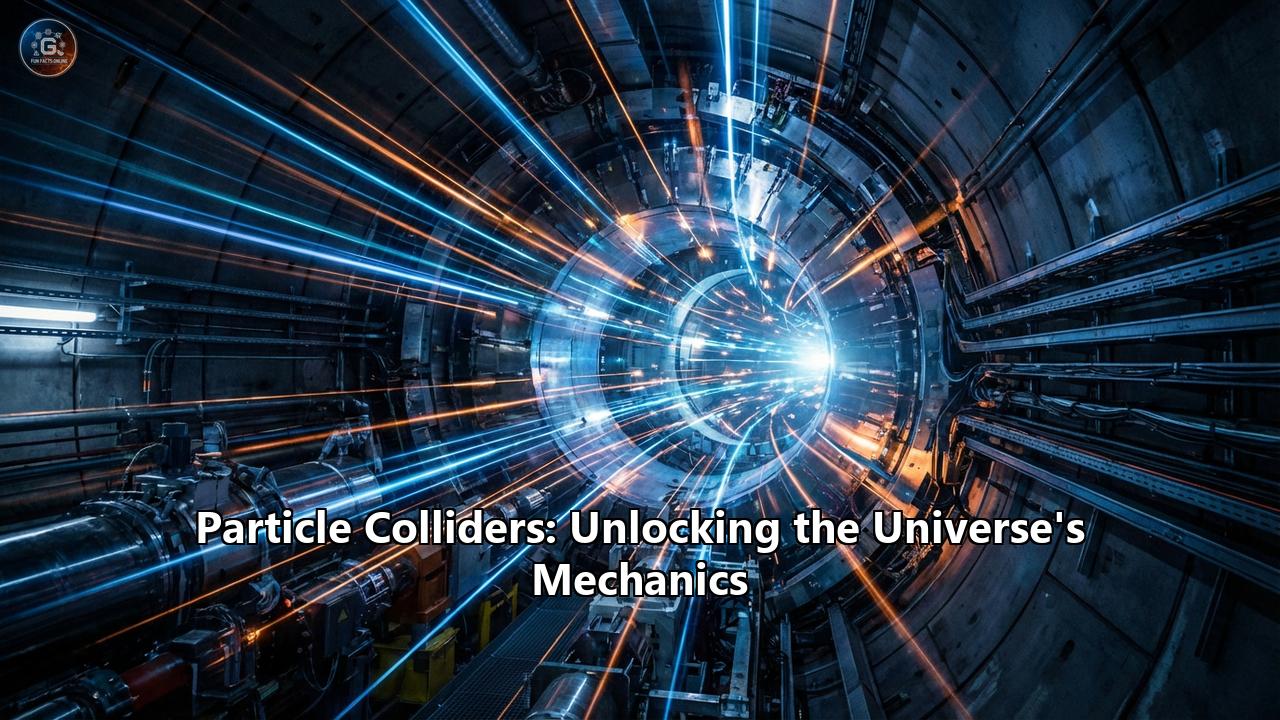
To understand the universe in its most profound, overarching totality, humanity has paradoxically been forced to look at the smallest possible components of existence. We look up at the night sky and see billions of galaxies, each containing billions of stars, but the mechanics that govern the cosmic ballet of those celestial bodies are dictated by invisible, infinitesimally small building blocks. To decode the grand tapestry of the cosmos, we must unravel the threads. This is the domain of the particle collider: the most complex, ambitious, and massive scientific instrument ever conceived by human minds.
Far beneath the serene landscapes of the Swiss-French border, wrapped in an ultra-high vacuum and chilled to temperatures colder than deep space, lies a machine that routinely recreates the conditions of the universe as they were just fractions of a nanosecond after the Big Bang. Particle colliders are not merely accelerators; they are time machines, giant microscopes, and discovery engines that probe the very fabric of reality. But how do these subterranean behemoths work? What secrets have they already whispered to us from the subatomic void? And as we stand in 2026, looking toward a future of even more colossal machines, what ultimate truths are we on the verge of uncovering?
The Philosophy of the Smash: Why We Collide Particles
At its core, the concept of a particle collider is delightfully simple, almost childlike: to understand how a complex object works, you smash it against something else really hard and look at the pieces that fly out.
However, in the quantum realm, this process transcends simple dismantling. Because of Albert Einstein’s famous equation, E=mc², we know that mass and energy are two sides of the same coin. Energy can be converted into mass, and mass into energy. When a modern collider accelerates two subatomic particles—like protons—to 99.999999% of the speed of light and smashes them together, they do not just break apart into smaller static pieces. Instead, the sheer, unimaginable kinetic energy of the collision is temporarily converted into a concentrated burst of pure energy. From this microscopic inferno, entirely new particles spontaneously condense into existence, born from the energy of the crash.
These heavier, exotic particles typically have lifespans measured in fractions of a trillionth of a second before they decay back into stable, everyday matter. They cannot be found in nature today because the modern universe is too cold and expanded to sustain them. To study them, we must artificially recreate the primordial heat of the Big Bang. Thus, particle colliders are not just breaking things; they are manifesting the forgotten ghosts of the early universe.
The Anatomy of a Behemoth: How the Large Hadron Collider Works
To understand the mechanics of the universe, we must first understand the mechanics of the machine that unlocks it. The Large Hadron Collider (LHC) at CERN (the European Organization for Nuclear Research) is the undisputed king of modern physics. A ring roughly 27 kilometers (17 miles) in circumference, buried 100 meters underground, the LHC is a triumph of engineering that pushes the limits of human capability.
The journey of a proton in the LHC begins rather humbly: with a bottle of standard hydrogen gas. Hydrogen atoms consist of one proton and one electron. By stripping away the electrons, scientists are left with a plasma of naked protons. These protons are injected into a sequence of increasingly larger accelerator rings—the Linac 4, the Proton Synchrotron Booster, the Proton Synchrotron, and the Super Proton Synchrotron—each stage kicking the particles to higher and higher energies before finally injecting them into the main LHC ring.
Inside the LHC, the protons travel in two counter-rotating beams, housed in separate ultra-high vacuum pipes. This vacuum is more perfect than the void of interplanetary space, ensuring the protons do not accidentally collide with stray air molecules.
To steer these beams around the circular track, the LHC utilizes over 1,200 superconducting dipole magnets. These are not your average refrigerator magnets. Wrapped in coils of niobium-titanium, they conduct electricity without any resistance. However, to achieve superconductivity, the magnets must be chilled to 1.9 Kelvin (-271.3°C), a temperature colder than the ambient temperature of outer space. This is achieved using a monumental circulatory system of liquid helium. When energized, these magnets generate a magnetic field of 8.3 Tesla—over 100,000 times stronger than the magnetic field of the Earth.
As the protons race around the ring 11,245 times per second, they are continually accelerated by Radio Frequency (RF) cavities. These metallic chambers generate oscillating electrical fields that give the protons a precisely timed "kick" every time they pass through, pushing them ever closer to the absolute speed limit of the universe.
Finally, the two beams are steered into a collision course at four distinct crossing points around the ring. Here, the beams are squeezed down to the width of a human hair, forcing the protons to cross paths. Even then, because protons are so infinitesimally small, most pass right through the empty space of the opposing beam. But out of billions of protons, a few dozen will strike each other head-on, creating the spectacular microscopic explosions the physicists are waiting for.
The Cathedrals of Science: The Detectors
If the accelerator ring is the gun, the detectors are the ultra-high-speed, 3D cameras that record the aftermath of the collision. Positioned at the four collision points around the LHC ring are four gargantuan detectors, each the size of a multi-story building and weighing thousands of tons.
1. ATLAS (A Toroidal LHC ApparatuS)ATLAS is the largest volume detector ever constructed for a particle collider, stretching 46 meters long and 25 meters high. It is a general-purpose detector designed to cast the widest possible net, searching for everything from the Higgs boson to dark matter. Its most distinctive feature is its massive toroidal (doughnut-shaped) magnet system, which bends the paths of charged particles zooming outward from the collision. By analyzing how a particle’s path curves in the magnetic field, physicists can calculate its momentum and electrical charge.
2. CMS (Compact Muon Solenoid)CMS is the sister experiment to ATLAS. It is also a general-purpose detector, but it takes a radically different engineering approach. While ATLAS is vast, CMS is incredibly dense. It weighs a staggering 14,000 tons (more than the Eiffel Tower) and relies on a single, massive superconducting solenoid magnet. Because ATLAS and CMS use different technologies and software, they act as independent verifiers for one another. If ATLAS spots a new particle, the physics community waits to see if CMS sees the exact same anomaly before confirming a discovery.
3. ALICE (A Large Ion Collider Experiment)While ATLAS and CMS primarily smash protons, ALICE is optimized for something heavier. For one month each year, the LHC switches from colliding protons to colliding heavy lead ions. These collisions are incredibly violent, creating temperatures over 100,000 times hotter than the center of the sun. At these temperatures, protons and neutrons literally melt into a primordial soup called the quark-gluon plasma. This state of matter hasn't existed naturally since the first microsecond of the Big Bang. Recent breakthrough studies published in late 2025 by the LHC collaborations provided unprecedented, tantalizing looks into this primordial soup, detecting subtle "dips" in particle production that help physicists map the fluid dynamics of the early universe.
4. LHCb (Large Hadron Collider beauty)LHCb specializes in solving one of the greatest existential mysteries in science: the asymmetry of antimatter. The Big Bang should have created equal amounts of matter and antimatter, which would have instantly annihilated each other, leaving a universe filled with nothing but light. Yet, we exist. There is a fundamental imbalance in the universe that favors matter. LHCb investigates this by studying particles containing the "beauty" (or bottom) quark, looking for minute differences in how matter and antimatter behave.
These detectors are marvels of computational engineering. Millions of collisions occur every second, generating so much raw data that it would fill tens of thousands of hard drives per minute. The detectors rely on automated hardware "triggers" that make split-second decisions to discard 99.99% of the collisions, saving only the most interesting and potentially groundbreaking events for further study on a global grid of supercomputers.
The Periodic Table of the Cosmos: The Standard Model
To appreciate what colliders have achieved, we must understand the framework they have helped construct: The Standard Model of Particle Physics. If the periodic table of elements explains chemistry, the Standard Model explains the fundamental makeup of reality itself.
The Standard Model posits that everything in the universe is made of twelve fundamental fermions (the building blocks of matter) and four fundamental gauge bosons (the carriers of the forces of nature).
The Fermions (Matter Particles):- Quarks: Coming in six "flavors" (Up, Down, Charm, Strange, Top, Bottom). Up and Down quarks combine to form protons and neutrons, which make up the nucleus of every atom in your body.
- Leptons: Also coming in six types. The most famous is the electron. The others include the heavier muon and tau particles, and three ghostly, nearly massless particles called neutrinos, which pass through our bodies by the trillions every second without us ever noticing.
Particles do not interact by magic; they communicate through forces, and these forces are carried by messenger particles.
- The Photon: Carries the electromagnetic force (light, magnetism, electricity).
- The Gluon: Carries the strong nuclear force, which acts like subatomic glue, binding quarks together inside protons and neutrons.
- The W and Z Bosons: Carry the weak nuclear force, responsible for radioactive decay and the nuclear fusion that powers the sun.
For decades, the Standard Model was an incredibly successful theory, predicting the outcomes of experiments with astonishing precision. However, throughout the late 20th century, the model had a glaring, massive hole. The mathematics of the Standard Model worked beautifully, but only if all the fundamental particles had exactly zero mass.
Clearly, particles do have mass, otherwise, atoms could never form, and the universe would just be a chaotic soup of particles zooming around at the speed of light. Physicists theorized that a pervasive, invisible field must stretch across the entire universe, acting like a cosmic molasses. As particles move through this field, they experience "drag." That drag is what we perceive as mass. But to prove this field existed, physicists needed to find its associated particle: the Higgs boson.
The Crown Jewel and the Golden Era: The Discovery of the Higgs
Finding the Higgs boson was the primary reason the Large Hadron Collider was built. Because the Higgs is incredibly heavy and highly unstable, it required unprecedented collision energies to manifest. On July 4, 2012, in an announcement that shook the scientific world and made front-page news globally, the ATLAS and CMS collaborations announced they had captured the elusive particle.
The discovery of the Higgs boson completed the Standard Model. It was a triumph of the human intellect, proving a mechanism that was theorized almost fifty years prior using nothing but chalk, blackboards, and mathematical intuition. But the discovery of the Higgs was not the end of particle physics; it was the opening of a new door. The Higgs is uniquely different from all other particles—it has no "spin"—and studying its properties has become a major focus of modern collider physics.
Run 3 and the 2025 Triumphs: Reaching Peak Performance
Following the discovery of the Higgs, the LHC has undergone several upgrades to push its limits even further. Following Long Shutdown 2, the LHC sparked back to life for "Run 3" with a record-breaking collision energy of 13.6 Tera-electron Volts (TeV).
During this era (running until early 2026), the accelerator complex has performed magnificently. By the end of 2025, the LHC broke new records for integrated luminosity, delivering unparalleled amounts of data to the ATLAS and CMS detectors.
This sheer volume of data has yielded breathtaking results. The LHC has now discovered more than 80 new hadrons. Hadrons are composite particles made of quarks. While protons and neutrons are made of three quarks (baryons), and mesons are made of a quark and an antiquark, the immense data produced during Run 3 has allowed physicists to definitively prove the existence of exotic matter: tetraquarks (four quarks) and pentaquarks (five quarks). In late 2025, the CMS collaboration even reported the first quantum property measurements of an "all-charm" tetraquark family, an exotic state of matter that forces physicists to rethink the fundamental rules of the strong nuclear force.
The phenomenal success of this era was globally recognized when the experimental collaborations—ATLAS, CMS, ALICE, and LHCb—were awarded the prestigious 2025 Breakthrough Prize in Fundamental Physics. This award, recognizing thousands of researchers, celebrated the LHC's unprecedented precision testing of the Standard Model, the elucidation of the Higgs mechanism, and the stringent limits placed on hypothetical new physics.
The 2026 Crossroads: Enter the High-Luminosity LHC (HL-LHC)
As we stand in 2026, the LHC has entered another critical, transformative phase. The machine is preparing for "Long Shutdown 3" (LS3), an extensive multi-year engineering intervention that will fundamentally upgrade the collider into a new machine: the High-Luminosity Large Hadron Collider (HL-LHC).
While previous upgrades focused on increasing the energy of the collisions, the HL-LHC focuses on luminosity. In particle physics, luminosity is a measure of how tightly packed the particles are within the beam, and consequently, how many collisions happen per second. The goal of the HL-LHC project is to increase the luminosity by a factor of 10.
To understand why this is necessary, consider looking for a needle in a haystack. If the needle is incredibly rare—such as a dark matter particle or a rare decay of a Higgs boson—you need a bigger haystack to have any statistical hope of finding it. The HL-LHC will produce roughly 15 million Higgs bosons per year, compared to the roughly three million produced in 2017. This colossal dataset will allow physicists to study the universe with a precision never before thought possible.
Achieving this requires tearing out roughly 1.2 kilometers of the LHC ring and replacing it with cutting-edge technology. In early 2026, CERN reached a monumental milestone: the start of full-scale cryogenic tests for the HL-LHC equipment. A massive 95-meter-long test stand, holding the newly designed inner triplet beam-focusing magnets, was successfully cooled to the requisite 1.9 Kelvin. These state-of-the-art superconducting magnets, made from a novel niobium-tin compound, are capable of generating significantly stronger magnetic fields, required to squeeze the proton beams to an unfathomably narrow crossing point.
Concurrently, physicists and engineers are conducting high-intensity beam tests in the LHC prior to the long shutdown. These tests are vital to ensure that the delicate infrastructure of the accelerator can withstand the extreme energies required by the HL-LHC. With stored beam energies pushing toward an unprecedented target of 700 Megajoules—enough kinetic energy to melt several tons of solid copper instantly—controlling these beams requires a masterclass in precision engineering.
The HL-LHC is scheduled to begin its initial physics runs in mid-2030, promising to dominate the landscape of high-energy physics for the following decade.
The Unsolved Mysteries: Why We Must Keep Digging
Despite the beauty and predictive power of the Standard Model, it is famously incomplete. In fact, it only describes about 5% of the universe. The rest is a dark, enigmatic void that continues to baffle the greatest minds on Earth. This is why the pursuit of higher luminosities and energies is an existential necessity for modern physics. The mysteries we currently face include:
1. Dark MatterAstrophysical observations of rotating galaxies show that there is not enough visible matter (stars, gas, planets) to generate the gravity needed to hold them together. They should tear themselves apart. There must be an invisible, massive substance holding the cosmos together. We call it "Dark Matter," and it makes up about 27% of the universe. Yet, it does not interact with light or electromagnetism, making it entirely invisible. Colliders like the LHC are searching for dark matter candidates by looking for "missing energy" in collisions—situations where particles crash, and something invisible flies away, carrying energy with it.
2. Dark EnergyMaking up the remaining 68% of the universe is an even more mysterious force known as Dark Energy. While gravity pulls matter together, dark energy is actively pushing the universe apart, causing the expansion of the cosmos to accelerate. The nature of dark energy is completely unknown, and while colliders are not the primary tool to study it, understanding the fundamental vacuum of space through the Higgs field may eventually provide clues.
3. The Matter-Antimatter AsymmetryAs mentioned with the LHCb experiment, the survival of the universe is a mathematical anomaly. For every particle of matter created in the Big Bang, a particle of antimatter should have been created. They should have annihilated perfectly. But a tiny fraction—about one in a billion—of matter particles survived. Why did nature favor matter over antimatter? This broken symmetry is the only reason stars, planets, and human beings exist, and it remains one of the most profound mysteries in science.
4. The Weakness of GravityThe Standard Model includes electromagnetism and the strong and weak nuclear forces, but it completely ignores gravity. Gravity is astonishingly weak compared to the other forces. A tiny fridge magnet can overpower the gravitational pull of the entire Earth to pick up a paperclip. Why is gravity so weak? Some theories suggest that gravity might be leaking into hidden, extra spatial dimensions. If so, a powerful enough particle collider could theoretically produce microscopic, harmless black holes or gravitons that disappear into these extra dimensions, leaving a traceable signature.
The Horizon of Human Ingenuity: The Future Circular Collider (FCC)
Because the mysteries of dark matter, gravity, and the early universe remain stubbornly elusive, physicists are already planning the machine that will eventually succeed the LHC. Designing and building a particle collider takes decades, so the physics community must think generations ahead.
Enter the Future Circular Collider (FCC), the proposed mega-machine that represents the ultimate frontier of Earth-bound particle physics. Following a comprehensive multi-year feasibility study that concluded in March 2025, the European Strategy Group officially recommended the FCC as CERN's preferred next flagship project in early 2026.
If approved and built, the FCC will make the LHC look like a preliminary prototype. It will be housed in a newly excavated, staggering 90.7-kilometer (56-mile) circular tunnel that will run beneath the Lake Geneva basin, looping beneath the French Alps and the Swiss countryside.
The FCC is conceived as a brilliant, two-stage integrated program designed to maximize scientific output and financial efficiency:
Stage 1: The FCC-ee (Electron-Positron Collider)Expected to begin construction in the 2030s and start operations in the late 2040s, the first machine installed in the massive tunnel will be an electron-positron collider. Unlike protons, which are messy bags of quarks and gluons, electrons and their antimatter counterparts (positrons) are fundamental, point-like particles. When they collide, the reaction is exceptionally "clean." The FCC-ee will act as an ultimate "Higgs Factory," churning out millions of Higgs bosons in a surgically precise environment. This will allow physicists to measure the properties of the Higgs, the W and Z bosons, and the top quark with an accuracy that the LHC could never achieve. Any slight deviation from the Standard Model in these hyper-precise measurements could definitively point the way to Dark Matter or new physics. The estimated construction cost for this phase is roughly 15 billion Swiss Francs, an investment spanning over a decade of human collaboration.
Stage 2: The FCC-hh (Hadron-Hadron Collider)After the FCC-ee finishes its 15-year operational run, the machine will be dismantled, and a true beast will be installed in the same 90.7-kilometer tunnel: the FCC-hh. Slated for the 2070s, this proton-proton collider will utilize next-generation superconducting magnets to achieve collision energies of 100 TeV—nearly eight times more powerful than the current LHC. If there are new, ultra-heavy particles out there—supersymmetric partners, dark matter candidates, or things we haven't even theorized yet—the sheer brute force of the FCC-hh will shatter the energy barrier hiding them from us. This machine will keep the fire of fundamental physics burning well into the end of the 21st century.
Colliders and the Real World: The Spinoff Technologies
A common question levied at these multi-billion-dollar endeavors is: Why spend so much time and money looking for invisible particles when we have so many problems on Earth?
The answer lies in the nature of foundational research. When you push the boundaries of human technology to build a machine like a particle collider, you are forced to invent technologies that do not yet exist. These technologies inevitably bleed into the public sphere, revolutionizing everyday life and the global economy. The return on investment for particle physics is historically staggering.
1. The World Wide WebThe most famous spinoff of particle physics is the internet as we navigate it today. In 1989, a British scientist at CERN named Tim Berners-Lee needed a way for thousands of physicists around the world to easily share complex data. He invented the World Wide Web, creating the first web browser and server. CERN subsequently released the software into the public domain for free. It is no exaggeration to say that modern global commerce, communication, and culture are the direct results of particle physics infrastructure.
2. Medical Imaging and Cancer TreatmentThe detector technology developed to track subatomic particles has revolutionized modern medicine. Positron Emission Tomography (PET) scanners, a crucial tool for detecting cancer and monitoring brain activity, rely on the exact same principles of antimatter detection used in colliders. Furthermore, the superconducting wire developed to build collider magnets paved the way for the widespread commercialization of Magnetic Resonance Imaging (MRI) machines.
Today, smaller versions of particle accelerators are used in hospitals worldwide for radiation therapy. An advanced technique called Hadron Therapy uses beams of protons or heavy ions (accelerated by miniature synchrotrons) to precisely target and destroy deep-seated tumors while sparing the surrounding healthy tissue. This technology was born directly from the beam dynamics pioneered at CERN and Fermilab.
3. Material Science and Quantum HorizonsThe vacuum technology, cryogenics, and massive data processing networks developed for colliders constantly push the frontiers of industrial manufacturing. Furthermore, the behavior of quantum particles studied in these collisions informs the emerging field of quantum computing and solid-state physics. For instance, recent discoveries in the behavior of fractional excitons and quantum states in nanomaterials draw upon the same quantum mechanical foundations validated in the high-energy realm.
A Monument to Curiosity
Particle colliders are more than just physics experiments; they are the modern equivalent of the great pyramids or the towering cathedrals of antiquity. They are monuments to human curiosity, built not by a single nation, but by a collaborative consortium of thousands of scientists, engineers, and technicians from over 100 countries working together in peaceful pursuit of knowledge. In an often divided world, places like CERN stand as a testament to what humanity can achieve when united by a common goal.
As we dive deeper into the 21st century, the LHC continues to refine our understanding of the universe, unearthing exotic tetraquarks, mapping the primordial soup of the Big Bang, and preparing for the High-Luminosity revolution. Meanwhile, the blueprints for the Future Circular Collider are already being drawn, promising a century of continuous, awe-inspiring exploration.
We are a species that evolved on a tiny rock orbiting an average star, yet we have built machines capable of recreating the dawn of time. We have weighed the invisible, mapped the quantum void, and found the mechanism that gives substance to our existence. The story of particle colliders is the story of our relentless drive to understand not just what the universe is, but why we are here to observe it at all. As the massive magnets cool, as the protons accelerate, and as the detectors watch in silent vigil, the universe slowly yields its mechanics, one magnificent collision at a time.
Reference:
- https://en.wikipedia.org/wiki/Large_Hadron_Collider
- https://eps.org/cern-releases-report-on-the-feasibility-of-a-possible-future-circular-collider/
- https://alice-collaboration.web.cern.ch/2025_Breakthrough_Prize
- https://www.livescience.com/physics-mathematics/particle-physics/physicists-recreated-the-first-millisecond-after-the-big-bang-and-found-it-was-surprisingly-soupy
- https://www.lhc-closer.es/taking_a_closer_look_at_lhc/1.home
- https://physicsworld.com/a/cerns-large-hadron-collider-gears-up-for-run-3/
- https://home.cern/news/news/accelerators/lhc-delivers-record-number-particle-collisions-2025
- https://acceleratingnews.eu/news/issue-53/high-luminosity-lhc-hl-lhc/nearer-future-high-intensity-beam-test-preparation-cerns
- https://www.gradcracker.com/hub/759/cern/additional-content/501/the-high-luminosity-lhc
- https://home.cern/news/press-release/accelerators/hilumi-lhc-full-scale-tests-start
- https://en.wikipedia.org/wiki/High_Luminosity_Large_Hadron_Collider
- https://home.cern/science/accelerators/future-circular-collider
- https://www.researchprofessionalnews.com/rr-news-europe-infrastructure-2025-12-cern-advised-to-go-ahead-with-future-circular-collider/
- https://cerncourier.com/european-strategy-group-recommends-fcc-ee/
- https://acceleratingnews.eu/news/issue-53/future-circular-collider-fcc/future-accelerators-look-future-circular-collider-fcc
- https://www.brown.edu/news/2025-01-08/new-quantum-particles