
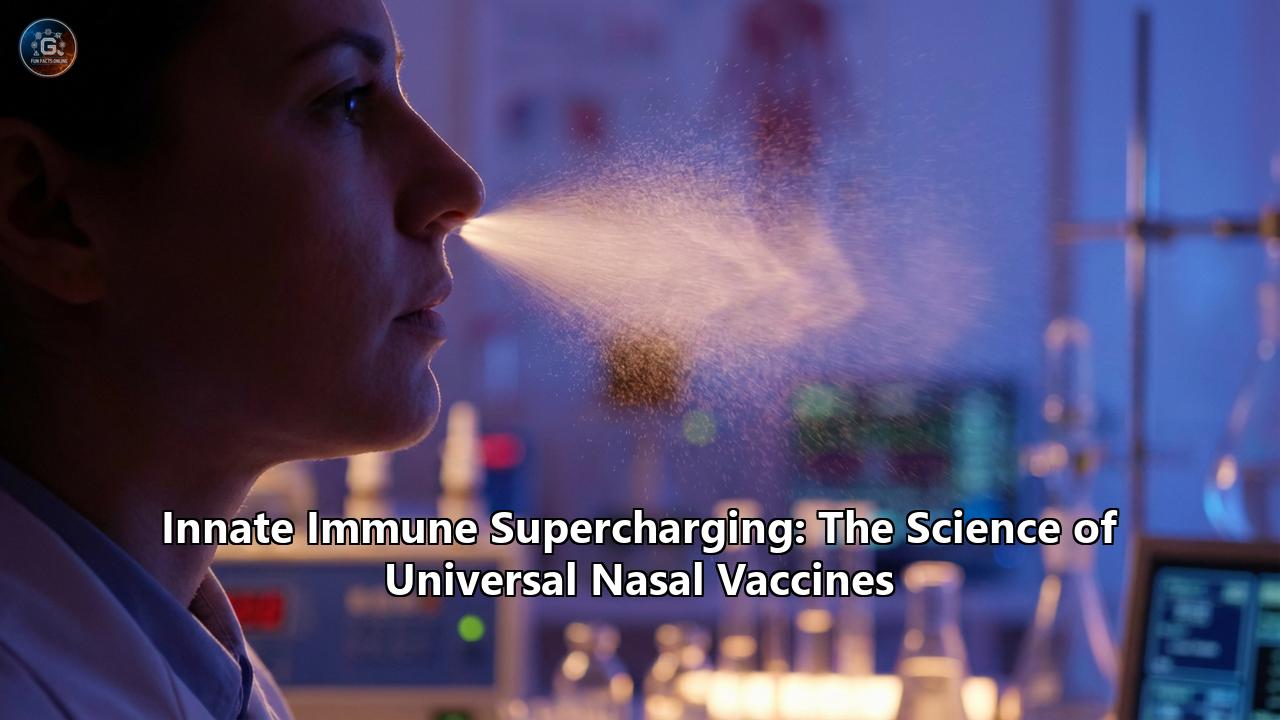
Imagine waking up on a crisp autumn morning, walking into your local pharmacy, and receiving a quick, painless spray in each nostril. With that simple action, your lungs and respiratory tract are instantly fortified—not just against the specific strain of influenza circulating that year, and not just against the latest variant of SARS-CoV-2, but against virtually any respiratory virus, bacterial pneumonia, and even the seasonal allergens that trigger asthma.
For decades, this scenario was dismissed as a scientific pipe dream. Vaccinology has historically been a game of precise molecular matchmaking. You inject a specific piece of a virus (an antigen) into the arm, wait for the adaptive immune system to generate highly specific antibodies, and hope the virus doesn't mutate before those antibodies are needed. But the rules of immunology are being fundamentally rewritten.
We are entering the era of innate immune supercharging and universal nasal vaccines. By targeting the mucosal linings of our respiratory tract and hacking the evolutionary memory of our oldest immune cells, scientists are developing broad-spectrum shields that stop pathogens right at the point of entry.
Recent breakthroughs from top-tier institutions in 2025 and 2026 have taken this from theoretical biology to stunning preclinical reality. Researchers have successfully created nasal sprays that reduce viral loads by up to 700 times, protecting against coronaviruses, deadly hospital-acquired bacteria, and even dust mites for months at a time.
To understand how a single sniff of a vaccine could render us virtually bulletproof against respiratory disease, we must dive into the fascinating biology of the mucosa, the revelation of "trained immunity," and the cutting-edge science of epigenetic cellular reprogramming.
The Front Door Fortress: Why We Must Look to the Mucosa
To understand the sheer revolutionary power of nasal vaccines, we first have to understand the limitations of the traditional "jab in the arm."
Intramuscular vaccines—like the standard flu shot or the mRNA COVID-19 vaccines—are undeniably miracles of modern medicine. They excel at preventing severe disease, hospitalization, and death. However, they work by triggering systemic immunity. When you receive an injection in the deltoid muscle, your body produces robust levels of Immunoglobulin G (IgG) antibodies and memory T cells that circulate in your bloodstream.
The problem? The bloodstream is the body's interior. When a respiratory virus like influenza, respiratory syncytial virus (RSV), or SARS-CoV-2 enters your body, it doesn't start in the blood. It lands on the mucosal surfaces of your nose, throat, and lungs. By the time a pathogen replicates enough in your respiratory tract to trigger the systemic immune alarms and draw IgG antibodies from the blood into the lungs, you are already infected, you are likely experiencing symptoms, and crucially, you are already contagious.
The mucosa is the front door of the human body. It has its own localized, specialized security force. The star players of this mucosal defense are secretory Immunoglobulin A (IgA) antibodies and Tissue-Resident Memory T cells (TRMs).
- Secretory IgA acts like a microscopic net lining the mucus of your respiratory tract. It can bind to and neutralize viruses in the airway before they even touch your cells.
- Tissue-Resident Memory T cells (TRMs) are elite cellular assassins that do not circulate in the blood. Instead, they take up permanent residence in the mucosal tissues of the nose and lungs. When they sense an invader, they trigger an immediate, explosive localized response within hours, rather than the days it takes for systemic T cells to arrive from the lymph nodes.
Nasal vaccines are designed to activate this localized mucosal immunity, effectively placing the guards outside the castle walls rather than waiting for the invaders to breach the courtyard. But until recently, mucosal vaccines faced severe limitations. They were notoriously difficult to adjuvant (boost to create a strong response), and like systemic vaccines, they still relied on matching the exact strain of the virus.
That is, until scientists realized they could train the lungs' first responders to fight anything.
Shattering the Dogma: The Rise of Trained Immunity
For over a century, immunology textbooks divided the immune system into two rigid branches: Innate and Adaptive.
The adaptive immune system (B cells and T cells) was the "smart" but slow branch. It learned the exact shape of a pathogen, created custom-tailored weapons, and remembered that pathogen for decades. Regular vaccines exclusively target this system.
The innate immune system (macrophages, neutrophils, dendritic cells, and natural killer cells) was viewed as the "dumb" but fast branch. These cells act as cellular paramedics and garbage collectors, rushing to the site of an infection within minutes to swallow invaders whole and trigger inflammation. The dogma stated that innate immune cells had no memory; they would react to an infection exactly the same way every time, regardless of past encounters.
We now know this is categorically false.
The first cracks in the dogma appeared with the Bacillus Calmette-Guérin (BCG) vaccine, a tuberculosis vaccine administered to roughly 100 million newborns annually. For decades, epidemiologists noticed something bizarre: babies who received the BCG vaccine had dramatically lower infant mortality rates across the board, not just from tuberculosis, but from respiratory syncytial viruses, bacterial pneumonias, and viral sepsis. The BCG vaccine was somehow conferring "non-targeted protection".
Modern molecular biology finally revealed the mechanism: Trained Immunity.
When innate immune cells, such as macrophages, are exposed to certain stimuli (like the live-attenuated bacteria in the BCG vaccine), they undergo profound epigenetic and metabolic reprogramming. The DNA inside these cells is spooled around proteins called histones. During trained immunity, chemical tags are added to these histones, forcing the chromatin (the packaged DNA) to unspool and remain "open" at specific gene locations.
Because these genes—which control inflammation, viral sensing, and pathogen-eating capabilities—are left physically accessible, the macrophage remains in a state of hyper-vigilance. If a completely unrelated pathogen invades the lungs months later, these "trained" macrophages respond with explosive speed and overwhelming force. They have been supercharged.
The 2026 Breakthrough: The Universal Nasal Spray
In February 2026, researchers at Stanford Medicine, led by Dr. Bali Pulendran, achieved a monumental milestone in vaccine science, publishing their results in the prestigious journal Science. They successfully engineered a "universal" nasal spray vaccine that doesn't target a specific pathogen, but instead artificially induces this state of trained immunity in the lungs, creating an impenetrable barrier against a staggering array of biological threats.
The Stanford team realized that traditional vaccines fail to capture the holistic "danger signals" that a real infection generates. Rather than using a piece of a specific virus, they created a formulation—dubbed GLA-3M-052-LS+OVA—that perfectly mimics the communication signals immune cells use when under severe attack.
This formula combines two crucial elements:
- Synthetic Adjuvants: Molecules designed to perfectly stimulate the innate sensors (like Toll-like receptors) in the respiratory mucosa, tricking the lungs into thinking a massive invasion is underway.
- A Harmless Training Antigen: They used Ovalbumin (OVA), a benign protein derived from chicken eggs.
Why include a harmless egg protein? Because innate supercharging usually fades after a few days or weeks. The Stanford team discovered an elegant way to make it last for months. The OVA protein acts as a safe training target that summons the "smart" adaptive immune cells—specifically, Tissue-Resident Memory T cells—into the lungs.
Once these T cells settle into the lung tissue, they act as permanent drill sergeants for the innate immune cells. The Stanford researchers uncovered that these localized T cells continuously emit a chemical signal called RANKL. This continuous RANKL signaling keeps the lungs' alveolar macrophages (the resident clean-up cells) in a permanent state of epigenetic readiness.
Epigenomic profiling using techniques like ATAC-seq confirmed the breakthrough. The DNA inside the lung macrophages of the vaccinated subjects was physically altered, maintaining an "open" chromatin structure that allowed them to express higher levels of antigen-presentation molecules and exhibit vastly superior pathogen-eating (phagocytic) abilities.
Stunning Efficacy Across the Pathogen Spectrum
The results of the Stanford trials in animal models were nothing short of breathtaking. Mice were given the vaccine via droplets in the nose. When exposed to lethal doses of various pathogens, the unvaccinated mice suffered severe lung inflammation, catastrophic weight loss, and high mortality.
The mice pre-treated with the universal nasal spray, however, were transformed into immunological fortresses. They were protected against:
- Multiple Coronaviruses: Including severe ancestral strains of SARS-CoV-2 and highly mutated variants.
- Deadly Hospital Bacteria: The spray conferred near-total protection against Staphylococcus aureus and Acinetobacter baumannii, two notorious superbugs that cause fatal pneumonias in hospitals.
- Allergens: Astonishingly, the supercharged innate immune system even prevented allergic asthma reactions triggered by common house dust mites.
Viral loads in the supercharged subjects were slashed by up to 700 times, and this broad-spectrum protection lasted for months. As Dr. Pulendran noted, the implications for human health are world-changing. "Imagine getting a nasal spray in the fall months that protects you from all respiratory viruses including COVID-19, influenza, respiratory syncytial virus and the common cold, as well as bacterial pneumonia and early spring allergens," he stated. "That would transform medical practice".
The "Prime and Spike" Paradigm: Yale's Mucosal Masterpiece
While Stanford researchers have been focused on using adjuvants to universally supercharge innate macrophages, another paradigm-shifting approach has emerged from the Yale School of Medicine, pioneered by the legendary immunologist Dr. Akiko Iwasaki.
Dr. Iwasaki’s laboratory focuses intensely on mucosal immunity and the natural site of viral entry. Her team has solved one of the greatest riddles of the pandemic era: How do we leverage the massive success of systemic mRNA vaccines (like the Pfizer/BioNTech and Moderna shots) and translate that into localized, transmission-blocking mucosal immunity?
The answer is a strategy Iwasaki's team originally dubbed "Prime and Spike," and subsequently expanded into "Prime and HA" for influenza.
The mechanism is brilliant in its simplicity:
- The Prime (Systemic): A patient receives a standard intramuscular mRNA vaccine (or achieves systemic immunity through a prior infection). This builds a massive, systemic reservoir of memory B and T cells circulating in the blood. But remember, these cells don't naturally patrol the nasal passages.
- The Pull (Mucosal Boost): Weeks or months later, the patient receives an unadjuvanted, simple protein spray directly into the nose. For COVID-19, this is the Spike protein. For the flu, it is the Hemagglutinin (HA) protein.
Because the body has already been "primed" systemically, it recognizes the protein instantly. But because the protein is introduced in the nose, the immune system thinks the respiratory tract is under attack. It immediately "pulls" the systemic memory cells out of the blood and permanently relocates them into the mucosal tissues of the nose, throat, and lungs, converting them into localized Tissue-Resident Memory cells and triggering a massive secretion of mucosal IgA.
In late 2024 and 2025, Iwasaki’s team proved that this "Prime and HA" approach works spectacularly against influenza A. Furthermore, they demonstrated that an intranasal booster using completely unadjuvanted protein is enough to induce this protective mucosal immunity. It establishes a frontline barrier that drastically reduces viral replication right at the point of entry, offering a potent strategy to block not just severe disease, but viral transmission entirely.
Even more promising, this strategy successfully overcame one of the major hurdles of aging. As we get older, our innate immune sensors often degrade (a process linked to the breakdown of proteins like TRAF3), making standard vaccines less effective. Yet, Iwasaki's mucosal pull strategy effectively reduced viral loads and established robust local protection even in older subjects.
Combining Forces: The Future of Universal Respiratory Protection
The ultimate holy grail of vaccinology over the next decade will likely be the convergence of these two distinct mechanisms: the antigen-agnostic innate supercharging developed at Stanford, and the incredibly potent, localized mucosal memory "pull" strategies developed at Yale.
Imagine a localized nasal spray that contains a synthesized viral protein (to draw highly specific adaptive memory cells into the lung tissue) paired with next-generation mucosal adjuvants like Nexavant (NVT) or the GLA-3M-052 formulation.
Nexavant, for example, is a well-defined TLR3 agonist (a trigger for a specific innate sensor called Toll-like receptor 3). Recent studies have shown that when mucosal vaccines are adjuvanted with NVT, they induce massive levels of type I interferons, resulting in broad mucosal immune crosstalk. This crosstalk is so potent that administering the vaccine in the nose doesn't just protect the lungs; it generates antigen-specific IgA in distal mucosal sites across the entire body, including saliva and the gastrointestinal tract.
By combining these innate triggers with mucosal delivery, we are essentially building a localized immune response that is both incredibly wide (ready to eat any novel bacteria or variant) and incredibly deep (possessing the specific IgA antibodies to immediately neutralize known threats).
Beyond the Pandemic: A New Public Health Paradigm
The socioeconomic and medical implications of innate immune supercharging and universal nasal vaccines cannot be overstated.
1. Ending the Variant Chase:Every year, scientists engage in a high-stakes guessing game to predict which influenza strains will dominate the winter season. During the COVID-19 pandemic, public health infrastructure was continually outpaced by the rapid mutation of the SARS-CoV-2 spike protein. Universal mucosal vaccines that rely on epigenetic innate memory bypass this problem entirely. Because they react to the presence of an invader rather than its specific molecular shape, viral mutations become largely irrelevant.
2. A Bridge During Novel Pandemics:When "Disease X"—the next novel respiratory pathogen—inevitably emerges, it will take months to sequence the virus, design an mRNA vaccine, test it, and distribute it. Trained immunity offers a vital prophylactic bridge. A widely distributed innate supercharging nasal spray could be administered to frontline healthcare workers and vulnerable populations immediately upon the outbreak of a novel virus. While we wait for targeted vaccines, this spray would blunt the severity of the disease, drastically lower viral shedding, and prevent healthcare systems from collapsing.
3. Global Equity and Eradicating the Needle:Intramuscular vaccines require needles, syringes, trained medical personnel, and often stringent sub-zero cold chain logistics. Nasal sprays bypass all of these hurdles. Needle-free administration facilitates rapid mass distribution, especially in low-resource settings and developing nations. Furthermore, the non-invasive nature of a simple sniff could significantly reduce vaccine hesitancy among those who suffer from trypanophobia (fear of needles).
4. Protecting the Most Vulnerable:Populations with weakened adaptive immune systems—such as the elderly, cancer patients undergoing chemotherapy, and organ transplant recipients—often fail to generate sufficient antibodies from traditional vaccines. However, early clinical trials exploring BCG-induced trained immunity suggest that leveraging the innate immune system can significantly reduce the severity of respiratory infections in the elderly. By bypassing the need for a robust B-cell response and instead boosting the localized macrophage infantry, we can offer a new lifeline to the immunocompromised.
The Dawn of the Supercharged Era
For centuries, human medicine has played defense against respiratory pathogens. We have hidden in our homes, washed our hands, and relied on vaccines that act only after the enemy has breached the gates.
The breakthrough science of 2026 marks a turning point. We are no longer just teaching the body's adaptive snipers to recognize a single target. We are rewriting the genetic software of the lungs' first responders. We are installing heavy artillery at the mucosal front door. We are turning the human respiratory tract into an environment so hostile to viral replication, bacterial colonization, and allergic inflammation that pathogens are neutralized before a single symptom can emerge.
While rigorous human clinical trials and regulatory reviews are the necessary next steps—a process researchers estimate could bring a commercial universal respiratory spray to market within five to seven years—the biological proof of concept is now undeniable. The dogma has been shattered. The era of the single-target needle is making way for the era of universal mucosal readiness. The future of immunity is not just adaptive; it is trained, it is supercharged, and it is right under our noses.
Reference:
- https://en.clickpetroleoegas.com.br/Stanford-Medicine-scientists-have-announced-an-experimental-nasal-spray-that-knocked-out-respiratory-viruses-by-up-to-700-times-and-protected-against-COVID-19.-mhbb01/
- https://www.sciencedaily.com/releases/2026/02/260222092258.htm
- https://www.pnas.org/doi/10.1073/pnas.2422171122
- https://www.reddit.com/r/Futurology/comments/1r9e8e0/scientists_developed_a_universal_vaccine_formula/
- https://www.pnas.org/doi/abs/10.1073/pnas.2422171122
- https://www.researchgate.net/publication/399832221_Intranasal_vaccines_adjuvanted_with_Nexavant_demonstrate_robust_protective_efficacy_by_inducing_both_mucosal_and_systemic_immunity_in_a_murine_model
- https://medicine.yale.edu/profile/akiko-iwasaki/
- https://www.researchgate.net/publication/396830038_The_Role_of_Trained_Immunity_in_Broad-Spectrum_Antiviral_Defense_against_Respiratory_Viral_Infections
- https://marcveldhoen.substack.com/p/a-nasal-universal-vaccine-in-mice
- https://encyclopedia.pub/entry/36408
- https://www.livescience.com/health/medicine-drugs/universal-nasal-spray-vaccine-protects-against-viruses-bacteria-and-allergens-in-mice
- https://futurism.com/health-medicine/stanford-universal-vaccine-mice
- https://www.thesun.lk/solar_hq/From-Specific-to-Universal-Stanfords-Immune-Reboot/557-304878
- https://pubmed.ncbi.nlm.nih.gov/18980544/
- https://www.mdpi.com/2076-393X/10/11/1932