
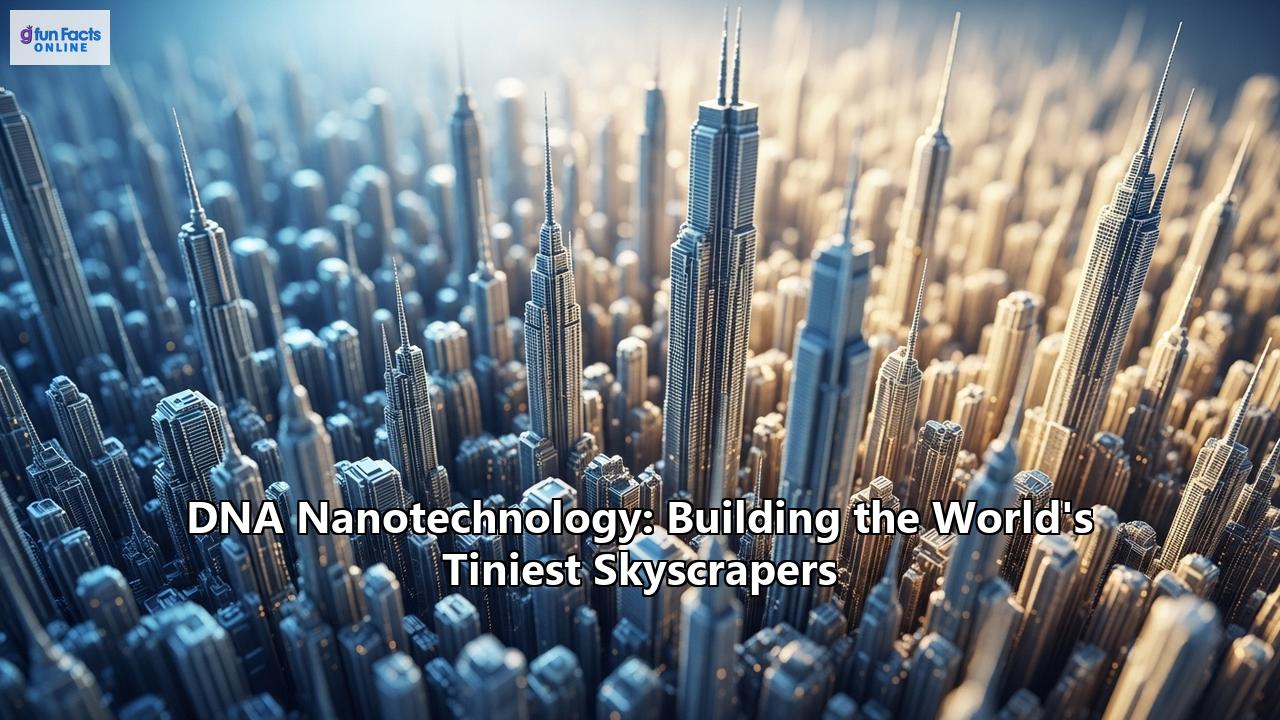
the ability to build with atomic precision. The "tiniest skyscrapers" of today are just the first structures in what will become a sprawling, functional nano-metropolis with capabilities that are still difficult to fully comprehend.
The Era of Molecular RoboticsThe vision of molecular robotics is perhaps the most captivating. It's a future where swarms of intelligent DNA robots, no bigger than a virus, navigate our bodies as a second immune system. These nanobots could be programmed to seek out and destroy cancer cells with targeted toxins, act as microscopic surgeons to repair damaged tissues, or constantly monitor our biochemistry for the earliest signs of disease. Researchers are already taking the first steps, developing DNA nanorobots that can carry molecular cargo and release it in response to specific cellular signals.
*Building with Life Itself: In Vivo Fabrication
The ultimate paradigm shift in DNA nanotechnology will be to move from fabricating these structures in a lab and injecting them into the body, to programming our own cells to build them on demand. Imagine a future where a therapeutic is delivered not as a drug, but as a genetic circuit that, when activated, instructs a patient's cells to produce the specific DNA nanorobots needed to fight their disease. This would create a truly personalized and adaptive form of medicine.
Merging Biology and Electronics
The precision of DNA origami makes it an ideal candidate for bridging the gap between the wet, messy world of biology and the clean, ordered world of electronics. By using DNA scaffolds to arrange nanowires, carbon nanotubes, and other electronic components with nanometer precision, we may be able to create true hybrid bio-electronic circuits. This could lead to new types of biosensors that are directly integrated with electronic readouts, or even computers that use biological molecules for processing information.
Artificial Life?*
The ability to construct the components of a cell from the bottom up using DNA nanotechnology raises profound questions and opens up awe-inspiring possibilities. As scientists gain the ability to build artificial cell membranes, synthetic cytoskeletons, and programmable channels, they are getting closer to constructing a simple, synthetic cell. This endeavor will not only teach us immense amounts about the fundamental principles of life but may also represent the dawn of a new, designed biology.
From a chemist's curious observation of an Escher print to a global research effort building molecular robots, the field of DNA nanotechnology has come an astonishingly long way. The skyscraper is a powerful symbol of human ambition and ingenuity, our ability to shape our environment by assembling simple materials into magnificent, complex structures. Today, that ambition has been turned inwards, to a scale a billion times smaller. We are no longer just dreaming of building at the nanoscale; we are laying the foundations for a new world of technology, one DNA brick, one folded strand, one tiny skyscraper at a time.
Reference:
- https://pmc.ncbi.nlm.nih.gov/articles/PMC3599551/
- https://www.mr.mpg.de/14598435/ring-of-dna-nanotubes
- https://bioengineering.illinois.edu/news/nanorobot
- https://pmc.ncbi.nlm.nih.gov/articles/PMC11128300/
- https://www.labmanager.com/dna-nanorobots-can-alter-artificial-cells-33415
- https://samueli.ucla.edu/dna-nanotechnology-creates-dynamic-cytoskeleton-for-artificial-cells/
- https://singularityhub.com/2014/01/27/dna-origami-to-nanomachines-building-tiny-robots-for-the-body-and-beyond/
- https://www.mdpi.com/2072-666X/13/2/315
- https://en.wikipedia.org/wiki/DNA_nanotechnology
- https://pmc.ncbi.nlm.nih.gov/articles/PMC8071251/
- https://www.researchgate.net/profile/Ajay-Khanna-2/publication/323414085_DNA-Origami_DNA_as_a_construction_material/links/5a95169f45851535bcdb0f8c/DNA-Origami-DNA-as-a-construction-material.pdf
- https://www3.hbcse.tifr.res.in/research-development/vsr/as-jr-dnastudy-to-be-published.pdf
- https://www.pks.mpg.de/de/future-trends-in-dna-based-nanotechnology/scientific-report
- https://www.slideshare.net/slideshow/dna-nanotechnology-concept-and-its-applications-238476245/238476245
- https://sassafras13.github.io/DesigningDNAOrigamiStructures/
- https://bionano.physics.illinois.edu/sites/default/files/origamiprotocols_0.pdf
- https://www.youtube.com/watch?v=ZmA8BwKabPA
- https://pmc.ncbi.nlm.nih.gov/articles/PMC9869343/
- https://pmc.ncbi.nlm.nih.gov/articles/PMC11060068/
- https://www.caltech.edu/about/news/molecular-self-assembly-can-think-like-a-neural-network
- https://pubs.acs.org/doi/10.1021/ja505101a
- https://pmc.ncbi.nlm.nih.gov/articles/PMC10176269/
- https://www.advancedsciencenews.com/a-dna-robot-that-walks-on-the-surface-of-cells/
- https://wyss.harvard.edu/news/evolving-how-we-use-dna-through-nanotechnological-innovations/
- https://www.researchgate.net/publication/363094935_Construction_of_Artificial_Cells_Utilizing_DNA_Nanotechnology
- https://academic.oup.com/nar/article/48/6/2791/5742838
- https://www.mdpi.com/2310-2861/10/1/16
- https://foresight.org/swarms-of-dna-nanorobots-execute-complex-tasks-in-living-animal/
- https://ankatherahub.com/news/shaping-the-future-of-cancer-with-dna-nanotechnology-ankatherahub-held-its-6th-scientific-meeting/
- https://pmc.ncbi.nlm.nih.gov/articles/PMC7304434/
- https://www.mdpi.com/2076-3417/11/6/2624
- https://www.pnas.org/doi/10.1073/pnas.2406769121
- https://www.kavlifoundation.org/news/dna-origami-twisting-basis-life-new-directions
- https://par.nsf.gov/servlets/purl/10560387