
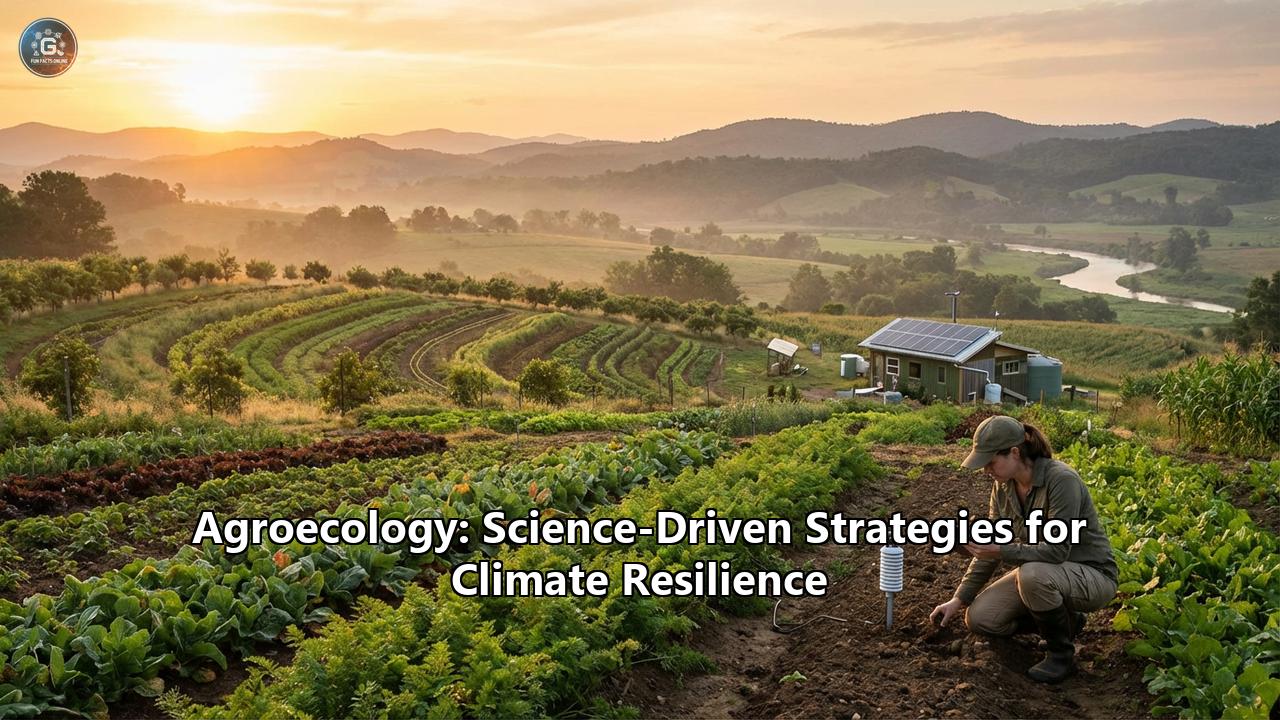
The dawn of the mid-21st century has brought agriculture to a precipice. For decades, the industrial model—characterized by monocultures, synthetic inputs, and mechanization—promised food security through yield maximization. Yet, as climate volatility intensifies, this system has revealed its fragility. Extreme weather events, shifting pest dynamics, and soil degradation are dismantling the stability upon which conventional farming relies. In this context, agroecology has emerged not merely as a return to traditional farming, but as a rigorous, science-driven paradigm for climate resilience. It is a discipline where ecology converges with agronomy, sociology, and economics to engineer food systems that are not only productive but regenerative. By leveraging biological complexity, agroecology offers a suite of strategies capable of mitigating greenhouse gas emissions while fortifying crops against the erratic pulse of a warming planet.
The Soil Carbon Sponge: Engineering the Underground Climate Engine
The most critical interface for climate resilience lies beneath our feet. Modern soil science has shifted its focus from viewing soil as a mere substrate for N-P-K chemistry to understanding it as a dynamic living ecosystem and a massive carbon sink. The degradation of agricultural soils has released gigatons of carbon into the atmosphere, but agroecological strategies aim to reverse this flow, turning potential sources into sinks.
Central to this strategy is the management of Soil Organic Carbon (SOC). SOC is not just a carbon ledger; it is the master variable of soil health, influencing water retention, nutrient cycling, and structural stability. Recent meta-analyses covering global datasets indicate that agroecological practices can sequester between 0.8 to 1.2 gigatons of CO2 annually. This sequestration is achieved through the "liquid carbon pathway," where photosynthesizing plants pump carbon-rich exudates (sugars, amino acids) into the rhizosphere to feed soil microbes. In exchange, these microbes—particularly mycorrhizal fungi—solubilize minerals for the plant. This microbial biomass eventually dies and stabilizes into recalcitrant carbon forms, effectively locking carbon in the soil matrix.
Biochar represents one of the most promising technological interventions within this domain. Produced by the pyrolysis of organic biomass in oxygen-limited environments, biochar is a stable form of carbon that can persist in soils for centuries. Beyond sequestration, the science of biochar is nuanced; its porosity and surface charge allow it to act as a "coral reef" for soil microorganisms, protecting them from predation and desiccation. Engineered biochars, produced at specific temperatures (e.g., high-temperature pyrolysis above 700°C for alkaline properties), are now being used to remediate acidic soils while simultaneously boosting water holding capacity. In sandy soils, biochar has been shown to increase water retention by up to 18%, a critical buffer during flash droughts.Furthermore, Conservation Agriculture (CA)—specifically the triad of minimal soil disturbance (no-till), permanent soil cover, and crop rotation—has shown robust results in carbon stabilization. While early studies on no-till were mixed regarding total carbon sequestration, recent deep-profile sampling reveals that when combined with cover crops, no-till systems prevent the oxidation of organic matter. In vineyard ecosystems, for example, the combination of organic amendments and no-till has been documented to sequester over 11 Mg of CO2-equivalent per hectare per year. This is not passive preservation; it is active ecosystem engineering that restores the soil's "sponge" effect, allowing it to absorb intense rainfall and reduce erosion, a primary threat in a changing climate.
Above-Ground Architecture: Agroforestry and Microclimate Regulation
Moving from the soil to the canopy, agroforestry stands as the premier example of structural complexity enhancing resilience. The integration of trees into crop and livestock systems is not random; it is a calculated manipulation of the microclimate.
The physics of microclimate regulation in agroforestry systems is well-documented. Trees act as windbreaks, reducing the vapor pressure deficit (VPD) over the crop canopy. By slowing wind speed and shading the understory, trees can reduce crop transpiration rates and soil evaporation. During extreme heat waves, the air temperature under an agroforestry canopy can be up to 6°C cooler than in open monocultures. This temperature buffering is critical for preventing heat sterilization of pollen in sensitive crops like maize and rice, where even short spikes in temperature during flowering can cause total yield failure.
A fascinating physiological mechanism at play in these systems is Hydraulic Lift (also known as hydraulic redistribution). This process involves deep-rooted trees absorbing water from moist, lower soil horizons and transporting it upwards. At night, when stomata close and transpiration ceases, the water potential gradient reverses, allowing water to passively exude from the tree roots into the drier, shallow soil layers. This "lifted" water then becomes available to shallow-rooted companion crops the following day. Research using stable isotopes has confirmed that understory crops in silvopastoral and alley-cropping systems effectively "drink" water lifted by their woody neighbors. This biological water redistribution system acts as a natural irrigation pump, significantly extending the survival of crops during dry spells.
Furthermore, agroforestry systems are potent carbon sinks. Unlike annual crops that release their carbon back to the atmosphere upon harvest and consumption, trees store carbon in their woody biomass for decades. When integrated into landscapes (e.g., silvopasture or alley cropping), these systems can sequester 0.5 to 5 Mg of carbon per hectare per year, bridging the gap between high-production agriculture and forest conservation.
Biodiversity as a Physiological Firewall
In industrial agriculture, uniformity is viewed as efficiency. in agroecology, uniformity is viewed as vulnerability. The science of biodiversity in agroecosystems is rooted in the "portfolio effect," a concept borrowed from economics which suggests that a diversity of assets stabilizes returns over time. In biological terms, this means that diverse cropping systems are less likely to suffer total failure under stress because different species have different response curves to drought, heat, and pests.
Push-Pull Technology, developed by the International Centre of Insect Physiology and Ecology (icipe), is a quintessential example of chemical ecology applied for climate resilience. Originally designed to control stemborers and the parasitic weed Striga in maize, the system involves intercropping cereals with a repellent plant (the "push," such as Desmodium) and planting an attractive trap plant (the "pull," such as Napier grass or Brachiaria) around the border.- The Science: Desmodium roots release allelopathic chemicals (isoflavonoids) that induce "suicidal germination" of Striga seeds, causing them to germinate but preventing them from attaching to the maize root, effectively cleaning the soil bank of this devastating weed. Simultaneously, volatile organic compounds released by Desmodium repel moths, while the border grasses attract them.
- Climate Adaptation: As climate change exacerbates pest ranges and reduces the window for successful cultivation, "Climate-Smart Push-Pull" has been developed using drought-tolerant companion plants like Desmodium intortum and Brachiaria cultivars. These systems not only maintain pest control under water stress but also provide high-quality fodder for livestock, decoupling farmers from reliance on rain-fed pasture alone.
Water Wisdom: Managing the Green Water Flux
Climate change manifests primarily through the water cycle—too much or too little. Agroecology shifts the focus from "blue water" (irrigation from rivers/aquifers) to "green water" (soil moisture derived from rainfall).
The primary metric here is Saturated Hydraulic Conductivity (Ksat)—the rate at which soil can absorb water. Industrial tillage creates a plow pan—a compacted layer that seals the soil, leading to runoff and flash floods. Agroecological soils, rich in organic matter and bioturbation (tunnels created by earthworms and roots), exhibit vastly superior infiltration rates. Studies have shown Ksat to be up to 14 times higher in agroforestry systems compared to conventional croplands.
This porosity allows agroecological farms to harvest rainfall effectively. During heavy downpours, water infiltrates and recharges the groundwater rather than eroding the topsoil. During droughts, the high organic matter content acts as a reservoir. For every 1% increase in soil organic matter, an acre of soil can hold upwards of 20,000 gallons of additional plant-available water. This capacity is the difference between a crop surviving a three-week dry spell or withering before harvest.
Emerging technologies like microalgae bio-fertilizers are also entering the fray. Microalgae capture CO2 at rates 10 to 50 times higher than terrestrial plants and can be processed into soil amendments that improve soil structure and water retention. These "third-generation" bio-stimulants represent the frontier where biotechnology meets ecological principles, offering new pathways to close nutrient loops and enhance water use efficiency.
The Socio-Economic Resilience: Beyond Yields
Science-driven agroecology recognizes that resilience is not just biological but also social and economic. A farm that produces high yields but bankrupts the farmer is not resilient.
Economic Diversification: Agroecological systems often produce a diversity of marketable products—timber, fruit, fodder, grains, and livestock. This diversity insulates farmers from price crashes in any single commodity. For instance, in shade-grown coffee systems, if coffee prices plummet, farmers can rely on income from fruit trees or timber. This economic stability prevents distress sales of land and migration, keeping farmers on the land to manage the ecosystem. Food Sovereignty and Local Knowledge: Agroecology validates and utilizes local, indigenous knowledge systems which are often finely tuned to local microclimates. Landraces (local crop varieties) often possess genetic traits for drought tolerance and pest resistance that high-yielding commercial hybrids lack. By maintaining in-situ seed banks, agroecological farmers preserve the genetic library needed for future adaptation. Social Equity: The labor-intensive nature of some agroecological practices is often cited as a drawback, but in many contexts, it drives rural employment. Moreover, systems like push-pull reduce the burden of manual weeding—a task that disproportionately falls on women in many developing nations—thereby freeing up labor for other economic activities.The Policy Frontier: Scaling Up for a Warming World
Despite the overwhelming scientific evidence supporting agroecology, it faces significant barriers to scaling. The current global subsidy architecture heavily favors synthetic inputs and commodity monocultures. Transitioning requires a seismic shift in policy.
The years 2024 through 2030 are pivotal. The Agroecology Coalition, a global alliance formed to accelerate the transformation of food systems, has launched a strategy to embed agroecology into national policies. The upcoming COP30 in Belém (2025) and COP16 in Cali are viewed as critical windows of opportunity. Countries are being urged to integrate agroecological targets into their Nationally Determined Contributions (NDCs) under the Paris Agreement.
Brazil’s updated NDC 3.0, for example, explicitly targets the agroecological transformation of food systems to meet greenhouse gas reduction targets. This involves recognizing the dual role of agriculture: as a sector that must decarbonize (mitigation) and as a sector that must survive (adaptation).
Policies are beginning to shift from subsidizing inputs to subsidizing outcomes—paying farmers for carbon sequestration, water filtration, and biodiversity maintenance. "Payment for Ecosystem Services" (PES) schemes are being piloted globally to financially reward farmers who adopt agroecological practices that benefit the wider community.
Conclusion: The Logic of Life
Agroecology is not a retreat to the past; it is a sophisticated application of biological intelligence. It replaces fossil-fuel-intensive inputs with knowledge-intensive interactions. By understanding the chemical ecology of pest repression, the hydraulic physics of tree-crop interactions, and the microbial dynamics of the carbon cycle, we can design farming systems that are resilient by definition.
As the climate crisis deepens, the illusion of control provided by industrial agriculture is shattering. We can no longer force nature to comply with a factory model. Instead, we must align our production systems with the immutable laws of ecology. The science is clear: diversity creates stability, soil carbon creates resilience, and biological complexity is the only viable shield against the uncertainty of the future. The transition to agroecology is no longer just an alternative; it is a biological imperative for the survival of our food systems.
Reference:
- https://www.tandfonline.com/doi/full/10.1080/21683565.2022.2076184
- https://zerocarbon-analytics.org/nature/agroecological-practices-support-climate-change-resilience/
- https://www.frontiersin.org/journals/soil-science/articles/10.3389/fsoil.2024.1376159/full
- https://www.researchgate.net/publication/348051897_Soil_organic_carbon_sequestration_rates_in_vineyard_agroecosystems_under_different_soil_management_practices_A_meta-analysis
- https://eu-st01.ext.exlibrisgroup.com/32RUG_INST/storage/alma/F2/A1/02/9E/31/1C/45/BA/6E/30/EA/85/E4/9C/A4/72/RUG01-003146594_2023_0001_AC.pdf?Expires=1769391228&Signature=LmwQejp82Qc0OGU~sgEUEXvgbAx~zwQaug~j82wNdKVm-gyPzplga1hNo3iaVMvWwNGq7wZ54JTr6h5WxksstL4W4bywMCLBzpoGhr14HeWKGw66uIvVNzC9R3txu8rvqWUGPlTymjmhH4H7QFV2iQgiDERtQJSUli~S8NWLUduORChatfbjVELYHtP5Re53vBRi-Fp4AYCrT8wUovt8o9eWOEAnmYX84VcHnn-PSZnxGHYlR~PyY2bPV6oY7pA9p9hssq4-v0UNAHzSC5uEOnLNxVjLJ5G--GJFncEkYSoHjOpYzfha8CLuAw9y-qDVv8XDXG19lO-TnRy-vBsn5Q__&Key-Pair-Id=APKAJ72OZCZ36VGVASIA
- https://scispace.com/papers/hydraulic-lift-processes-methods-and-practical-implications-zixfxj3is3?references_page=4
- https://www.researchgate.net/publication/222495914_Hydraulic_lift_A_potentially_important_ecosystem_process
- https://www.researchgate.net/publication/350212616_Hydraulic_lift_processes_methods_and_practical_implications_for_society
- https://www.mdpi.com/1999-4907/17/2/159
- https://www.siwi.org/wp-content/uploads/2020/02/Agroforestry-for-adapation-and-mitigation-to-climate-change_web.pdf
- https://www.climatehubs.usda.gov/sites/default/files/Agroforestry_Climate-Change-Resource-Center.pdf
- https://www.push-pull.net/Climate%20smart%20Push-pul.pdf
- https://en.wikipedia.org/wiki/Push%E2%80%93pull_agricultural_pest_management
- https://pmc.ncbi.nlm.nih.gov/articles/PMC4320064/
- https://www.frontiersin.org/journals/agronomy/articles/10.3389/fagro.2025.1534370/full
- https://www.researchgate.net/publication/372350692_Push-Pull_Technology_in_Climate-Smart_Agriculture_A_Strategy_for_Sustainable_Agriculture
- https://gca.org/wp-content/uploads/2020/12/TheContributionsOfAgroecologicalApproaches.pdf
- https://agroecology-coalition.org/the-road-to-belem-and-beyond-how-agroecology-can-support-the-global-climate-agenda/