
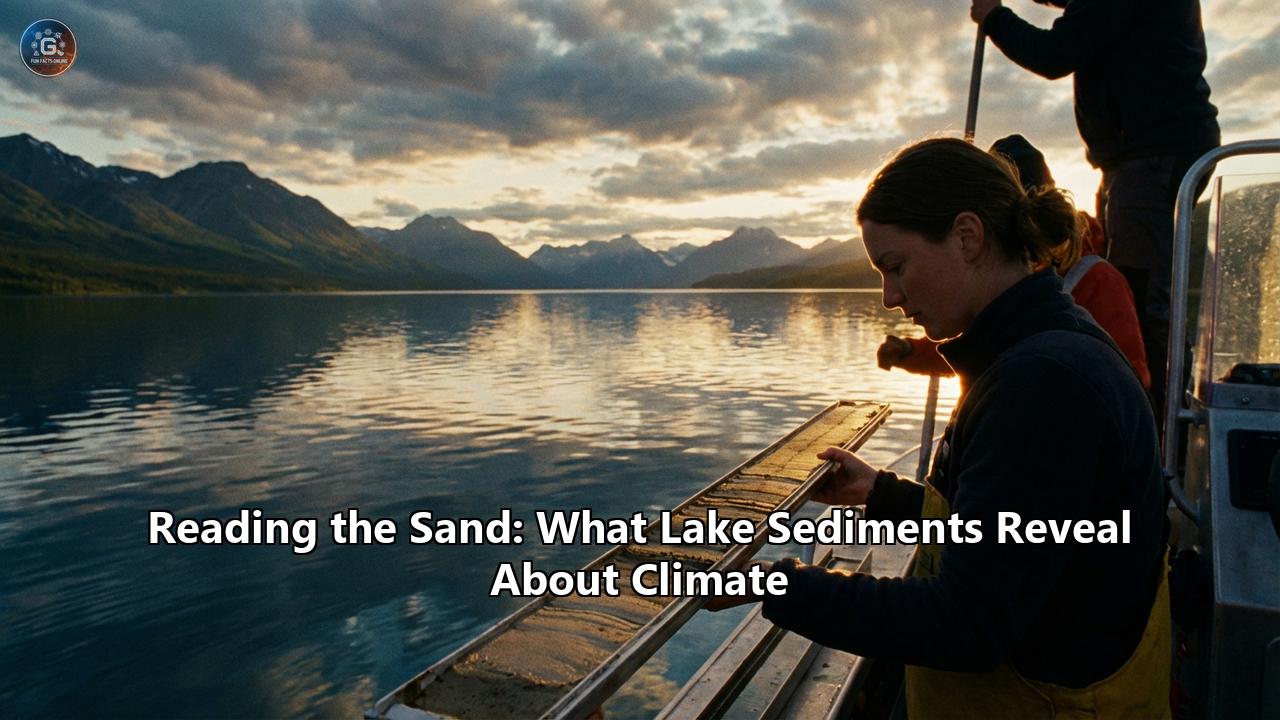
Beneath the placid, shimmering surfaces of the world’s lakes lies one of the most remarkable and closely guarded archives of our planet's history. While we often look to the skies to understand the weather, or to the sweeping movement of glaciers to comprehend the ice ages, some of the most profound answers about Earth’s climatic past are buried in the dark, silent depths of lakebeds. Here, in the slow, relentless accumulation of sand, silt, mud, and microscopic debris, lies a continuous diary of the Earth. Every flood, every drought, every volcanic eruption, and every subtle shift in temperature over millions of years has been meticulously recorded in these underwater vaults.
To the untrained eye, a core sample pulled from the bottom of a lake is just a tube of wet, smelly mud. But to a paleoclimatologist, it is a stack of ancient manuscripts. By "reading the sand" and the microscopic clues hidden within it, scientists can reconstruct lost worlds, track the rise and fall of ancient ecosystems, and, most importantly, forecast the future of our rapidly warming planet.
This is the science of paleolimnology—the study of inland waters' history—and it represents a frontier of discovery that merges geology, biology, chemistry, and climatology into a single, breathtaking narrative.
The Architecture of the Abyss: How Lakes Trap Time
To understand how a lake becomes a time machine, we must first understand the anatomy of a lakebed. Lakes act as massive topographic bowls, naturally catching everything that falls into them or is washed down from their surrounding watersheds. Every year, billions of tons of sediment accumulate in the world’s aquatic basins. Dust blown in from distant deserts, ash from volcanic eruptions, leaves and pollen from local forests, and the microscopic skeletons of algae that bloom and die in the water all drift down to the bottom.
In ideal conditions—particularly in deep lakes where the bottom waters are completely depleted of oxygen (anoxic)—there are no burrowing worms, insects, or bottom-feeding fish to disturb the sediment. The material simply falls and settles, layer by microscopic layer, century after century.
In some of these undisturbed lakes, the sediments form distinct, visually striking bands known as "varves". A varve is an annual layer of sediment, representing a single year in the life of the lake. Much like the concentric rings of a tree, varves can be counted to establish a precise, year-by-year chronology of the past. A typical varve might consist of a light-colored layer of mineral sand and silt washed in during the high-energy runoff of spring snowmelt, followed by a dark, organic-rich layer of dead algae and plant matter that settled during the quiet freeze of winter. By analyzing these alternating stripes, scientists can pinpoint exact years of extreme rainfall, severe drought, or sudden cooling with astonishing precision.
But even in lakes that do not form perfect varves, the steady accumulation of sediment provides a continuous timeline. Extracting this timeline requires complex engineering. Scientists venture out onto frozen lakes in the dead of winter, or anchor large floating barges in the summer, to drill deep into the lakebed. They drive hollow metal tubes hundreds of meters into the earth, pulling up long, continuous cylinders of sediment. These core samples are immediately sealed, refrigerated, and transported to laboratories, where the painstaking process of deciphering the mud begins.
The Alphabet of the Mud: Decoding Climate Proxies
Because we cannot travel back in time to measure the temperature or rainfall of the Pleistocene epoch with a thermometer or a rain gauge, scientists must rely on "proxies". Proxies are preserved physical, chemical, or biological characteristics of the environment that stand in for direct measurements. Lake sediments are arguably the most proxy-rich environments on Earth, holding a diverse alphabet of clues that, when read together, tell a comprehensive story.
The Pollen Record: Ghosts of Ancient ForestsAll flowering plants and conifers produce pollen, and these microscopic grains are encased in a remarkably durable organic polymer called sporopollenin. This coating allows pollen to survive in anoxic lake mud for millions of years. Because pollen grains have distinct, highly complex shapes that are unique to their parent plant families, scientists can look at a layer of sediment under a microscope and identify exactly what kinds of plants were growing around the lake at the time the layer formed.
If a core sample from a North American lake shows a sudden transition from oak and hickory pollen to spruce and fir pollen, scientists know that the regional climate experienced a dramatic cooling, shifting from a temperate deciduous forest to a cold, boreal environment. The pollen record allows researchers to map the migration of entire biomes across continents as ice ages waxed and waned.
Diatoms: The Glass Houses of AlgaeDiatoms are single-celled algae that form intricate, microscopic shells out of silica (glass). They are incredibly sensitive to the chemical and physical conditions of the water they live in, including temperature, pH, salinity, and nutrient levels. When diatoms die, their glass houses sink into the sediment, creating a permanent fossil record. By identifying which species of diatoms dominated the lake in a given century, scientists can deduce the exact water conditions of the era. For example, a spike in diatoms that thrive in highly saline water indicates a period of severe drought, where intense evaporation concentrated the lake's salts.
Chironomids: Insect ThermometersOne of the most precise temperature proxies found in lake sediments comes from an unlikely source: the disembodied jaws of non-biting midges, known as chironomids. During their larval stage, midges live in the mud of lakes, and their tough, chitinous head capsules are preserved perfectly in the sediment. Different species of midges have highly specific summer temperature requirements. By tracking the changing assemblages of midge head capsules layer by layer, scientists can reconstruct past summer temperatures with an accuracy of within a single degree Celsius.
Isotopes and Geochemistry: The Atomic ArchiveBeyond the visual remains of plants and insects, the sand and silt contain an invisible, atomic archive. Scientists analyze the ratios of stable isotopes—particularly oxygen and carbon—trapped in the calcium carbonate shells of tiny aquatic organisms or within the organic matter itself.
The ratio of Oxygen-18 to Oxygen-16 in lake sediments is a powerful indicator of the global hydrological cycle. Because water containing the lighter Oxygen-16 evaporates more readily, periods of high evaporation (often driven by warmer, drier climates) leave the remaining lake water enriched in the heavier Oxygen-18. By extracting lipids from ancient leaf waxes preserved in the mud, scientists can measure hydrogen and carbon isotopes to track the exact rainfall patterns, humidity, and even the type of photosynthetic pathways used by the plants growing on the shores thousands of years ago.
Charcoal: The Chronicle of FireWoven through the mineral and organic layers of lake cores are microscopic flecks of charcoal. These dark specks are the remnants of ancient wildfires, blown into the water by the wind or washed in by rain. By quantifying the amount of charcoal in each sediment layer, researchers can construct a high-resolution history of fire frequency and intensity. This allows us to understand how wildfire regimes respond to changing temperatures and varying moisture levels, offering critical lessons for managing today's increasingly fiery world.
Sedimentary Ancient DNA (sedaDNA): The Next FrontierPerhaps the most revolutionary advancement in reading lake sediments is the extraction of environmental DNA (eDNA). As organisms live, bleed, excrete, and die in and around a lake, they shed tiny fragments of their genetic code. These fragmented strands of DNA bind to clay and mineral particles in the dark, cold sediment, which shields them from degradation.
Today, utilizing next-generation sequencing, scientists can analyze sedimentary ancient DNA (sedaDNA) to detect the "ghosts" of organisms that left no physical fossils. From a single teaspoon of ancient lake mud, researchers have successfully identified the genetic signatures of extinct woolly mammoths, giant ground sloths, cave bears, and early humans that drank from the water's edge tens of thousands of years ago. SedaDNA is also allowing scientists to track changes in microscopic life, such as bacteria and viruses, painting a picture of ancient food webs with an unprecedented level of detail. It bridges the gap between purely environmental history and profound evolutionary biology.
The Epics Written in the Mud: Extraordinary Case Studies
To truly appreciate the power of lake sediments, we must look at the specific lakes that have revolutionized our understanding of Earth's history. These lakes are the "Rosetta Stones" of paleoclimatology.
Lake El'gygytgyn: The 3.6-Million-Year Time Capsule
In the brutal, frozen expanse of northeastern Siberia lies Lake El'gygytgyn (pronounced EL-gih-git-gin), which translates from the indigenous Yup'ik language as "the lake that never thaws". Approximately 3.6 million years ago, a massive meteorite slammed into the Arctic tundra, blasting a crater 18 kilometers wide. Over time, water filled the crater, creating a deep lake.
What makes Lake El'gygytgyn globally unique is that, unlike most of the Arctic, this specific region of Siberia was never scoured away by the massive continental ice sheets of the Pleistocene ice ages. While advancing glaciers acted like giant bulldozers across North America and Europe, erasing older sedimentary records, Lake El'gygytgyn sat undisturbed, quietly collecting sediment year after year, cycle after cycle, for 3.6 million years.
In 2009, an international team of scientists executed a daring mission to drill into the lakebed from an ice-bound rig. They extracted a continuous sediment core nearly 318 meters long. When they analyzed this core, they unlocked the longest continuous record of climate change ever retrieved from the terrestrial Arctic.
The "El'gygytgyn core" fundamentally altered our understanding of Earth's climate system. It revealed that during "super interglacial" periods roughly 1 million and 400,000 years ago, the Arctic was vastly warmer than it is today—up to 4 to 5 degrees Celsius warmer in the summer, surrounded by dense forests rather than barren tundra. Most alarmingly, the mud proved that these periods of extreme Arctic warming occurred under carbon dioxide levels similar to or even lower than what human activity has created today. The lake's sediment proved that the Arctic climate is capable of profound, non-linear amplifying feedbacks. If the Earth could get that warm under natural forcing in the past, the implications for our modern, greenhouse-gas-driven future are staggering. The core also offered crucial clues to the "Mid-Pleistocene Transition," a mysterious epoch when the Earth's ice-age cycles suddenly shifted from occurring every 40,000 years to every 100,000 years, providing data on ancient vegetation and temperature shifts that was completely unavailable from ice cores.
Lake Suigetsu: The Ultimate Yardstick of Time
While Lake El'gygytgyn provides incredible depth of time, Lake Suigetsu in Japan provides unparalleled precision. Located in the Hokuriku region near the coast of the Sea of Japan, Lake Suigetsu is a deep, tranquil basin with no large inflowing rivers to violently disturb its bottom. Furthermore, its deep waters are completely anoxic, meaning no life exists at the bottom to churn up the mud.
Because of these perfect conditions, Lake Suigetsu has laid down pristine, alternating light and dark varves every single year for over 150,000 years.
In 2006, scientists pulled an unbroken, 76-meter-long core from the lake. Because the surrounding Japanese landscape is heavily forested, tens of thousands of fossilized leaves, twigs, and insects blew into the lake and were trapped perfectly within specific, countable annual layers. This created a scientific holy grail. Researchers carefully counted the varves one by one under microscopes—tens of thousands of them—to establish an absolute calendar. They then extracted the organic leaves embedded within those layers and subjected them to radiocarbon (Carbon-14) dating.
Radiocarbon dating is notoriously difficult to calibrate because the amount of Carbon-14 in the Earth's atmosphere fluctuates over time due to solar activity and variations in the Earth's magnetic field. Before Lake Suigetsu, scientists had to rely on tree rings, which only went back about 12,000 to 14,000 years, or marine records, which are notoriously messy. The Lake Suigetsu core provided a flawless, direct, year-by-year calibration for the radiocarbon clock stretching back more than 50,000 years.
Because of the mud at the bottom of Lake Suigetsu, every archaeologist, paleontologist, and climate scientist in the world can now accurately date Neanderthal bones, ancient human settlements, and late Quaternary climate events. The Japanese lake sediment was formally integrated into "IntCal13," the international benchmark dataset for radiocarbon calibration, quite literally resetting the clock on human history.
The African Rift Lakes: The Crucible of Humanity
Though less focused on deep ice ages, the massive, ancient lakes of the East African Rift Valley—such as Lake Malawi, Lake Tanganyika, and Lake Victoria—hold another monumental chapter of the Earth's story. The sediments here stretch back millions of years and are intricately tied to the evolution of our own species, Homo sapiens.
By drilling cores into the beds of these vast tropical lakes, scientists discovered that human evolution did not happen against a backdrop of stable, slowly drying savannas, as was once believed. Instead, the proxies in the lake sediment—dust levels indicating drought, and shifting pollen showing the rapid expansion and contraction of forests—revealed that East Africa underwent periods of violent, rapid climate oscillation. Extremely wet, deep-lake periods rapidly gave way to catastrophic droughts.
Many evolutionary biologists and paleoanthropologists now believe that this intense climatic instability, recorded in the lakebed mud, was the driving force behind human evolution. It was not a stable environment, but a wildly unpredictable one that forced our hominid ancestors to develop larger brains, invent versatile stone tools, and adapt to rapidly changing food sources. The very intellect that allows us to drill lake cores and read the climate may have been forged by the climatic chaos recorded within them.
Reading the Past to Survive the Future
One might ask: why spend millions of dollars and brave freezing temperatures to pull mud from the bottom of a lake? Why does the temperature of a Siberian summer three million years ago matter to us today?
The answer lies in the limitations of our own modern instruments. The widespread use of thermometers, satellites, and rain gauges only dates back about 100 to 150 years. In the grand scope of Earth's history, a century is less than the blink of an eye. If we only look at the instrumental record, we are trying to understand the plot of an epic, thousand-page novel by only reading the last sentence on the final page.
Lake sediments provide the rest of the book.
Today, the world is warming at an unprecedented rate due to anthropogenic greenhouse gas emissions. As we attempt to predict what will happen to our coastal cities, our agriculture, and our global weather patterns, we rely on massively complex computer simulations known as Global Climate Models (GCMs). But how do we know if these models are accurate? We test them against the past.
If a climate model is fed the atmospheric conditions of the Mid-Holocene (about 6,000 years ago) or the Eemian interglacial period (125,000 years ago), it should be able to accurately simulate the global temperatures and rainfall patterns of those eras. Scientists use the hard data extracted from lake sediment proxies—the chironomid temperatures, the pollen vegetation maps, the isotopic rainfall records—to verify the computer models. If the models can accurately "predict" the past as recorded in the mud, we can trust them to predict the future.
Furthermore, lake sediments provide a stark warning about the "tipping points" of the Earth's climate system. The varves and biological proxies often show that climate change does not always happen slowly or smoothly. The sediment records periods, such as the Younger Dryas event roughly 12,900 years ago, where regional temperatures plummeted or spiked by several degrees in a matter of decades, or even single years. They show us that biological ecosystems, once pushed past a certain thermal threshold, can collapse and transform rapidly. They show us how quickly wildfires can take over a drying continent, and how long it takes for a forest to recover from drought.
By analyzing ancient DNA (sedaDNA) alongside traditional proxies, modern conservationists are even using lake sediments to guide ecological restoration. If we know precisely what a regional ecosystem looked like for the 10,000 years before human industrialization, we have a scientifically accurate baseline for what we should be striving to protect or restore today.
The Library of Mud
To hold a core of lake sediment is to hold time itself. It is a humbling reminder of the sheer age of our planet and the relentless, cyclical forces of nature that govern it. The sand, the silt, the glass shells of dead algae, and the invisible genetic whispers of vanished beasts all come together to form a grand, sweeping narrative of survival, change, and resilience.
Every lake is a quiet observer, keeping a meticulous diary of the sky above and the land around it. As we face an uncertain climatic future, one of our greatest hopes lies in our ability to decipher these aquatic archives. By looking down into the dark, anoxic depths, and painstakingly reading the stories written in the sand, we are granted the extraordinary ability to look forward, forewarned and forearmed, into the centuries to come.
Reference:
- https://climatedataguide.ucar.edu/climate-data/overview-paleoclimate-information-high-resolution-lake-sediment-records-strengths
- https://epic.awi.de/id/eprint/59181/1/Using%20ancient%20sedimentary%20DNA%20to%20forecast%20ecosystem%20trajectories%20under%20climate%20change.pdf
- https://www.socsci.ox.ac.uk/japanese-lake-sediment-unlocks-150000-years-of-history
- https://thenaturalhistorian.com/2012/11/12/varves-chronology-suigetsu-c14-radiocarbon-callibration-creationism/
- https://www.researchgate.net/publication/253669600_Sedimentation_in_Lake_El'gygytgyn_Northeastern_Siberia_During_the_Past_Three_Climate_Cycles
- https://tos.org/oceanography/article/millennial-scale-arctic-climate-change-of-the-last-3.6-million-years-scient
- https://www.ncei.noaa.gov/news/what-are-proxy-data
- https://www.spaam-community.org/intro-to-ancient-metagenomics-book/introduction-to-edna.html
- https://www.usgs.gov/centers/spcmsc/science/paleoclimate-reconstruction-marine-and-lake-sediments
- https://pubmed.ncbi.nlm.nih.gov/37994249/
- https://pubblicazioni.unicam.it/bitstream/11581/489774/2/2015%20Ancient%20and%20modern%20environmental%20DNA.pdf
- https://cp.copernicus.org/articles/9/2413/2013/cp-9-2413-2013.pdf
- https://scitechdaily.com/million-year-old-arctic-sedimentary-record-sheds-light-on-climate-mystery-that-has-puzzled-scientists/
- https://pubmed.ncbi.nlm.nih.gov/22722254/
- https://research.aber.ac.uk/en/publications/sg06-a-fully-continuous-and-varved-sediment-core-from-lake-suiget/
- https://repository.arizona.edu/handle/10150/654443
- https://www.youtube.com/watch?v=FH_F4YVJHRM