
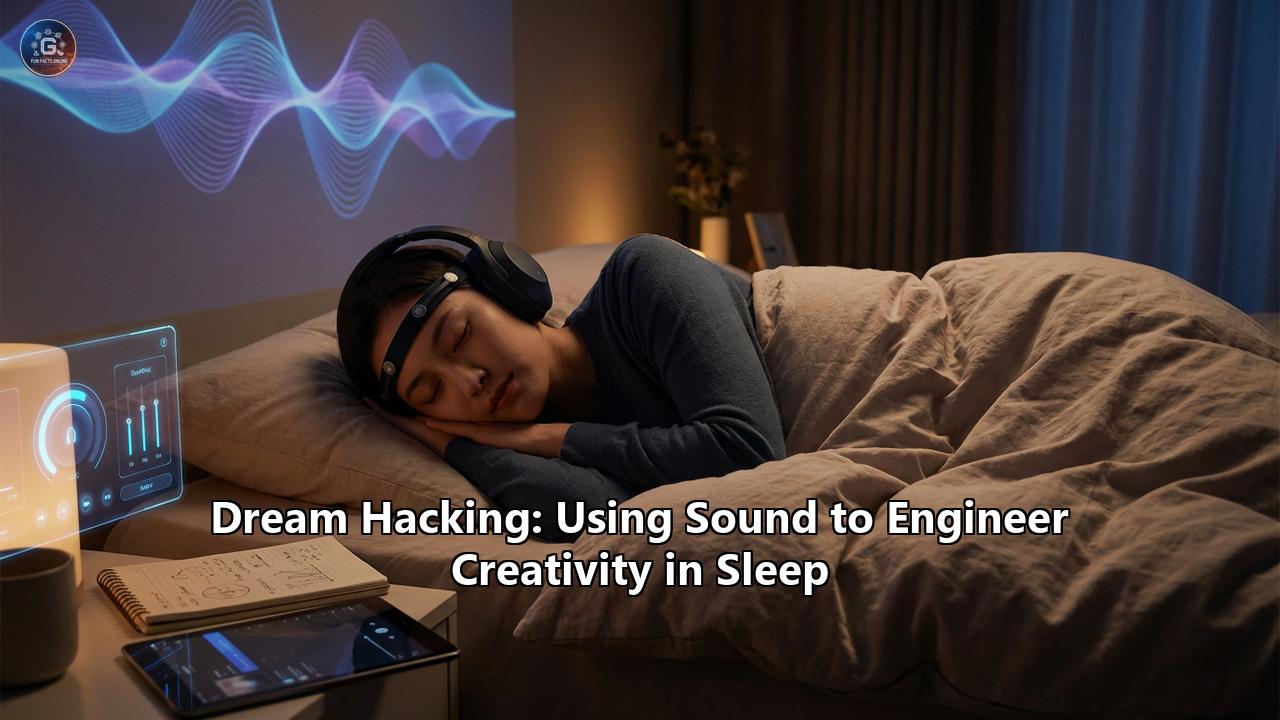
In the quiet hum of a laboratory at the Massachusetts Institute of Technology, a student drifts into the twilight zone between wakefulness and sleep. On their hand sits a strange, glove-like device heavily laden with sensors. Just as their brain waves begin to flatten into the characteristic Theta rhythms of hypnagogia—the surreal, fluid state where reality dissolves into dream—the device detects the shift. A robotic voice whispers a single word: "Tree."
The student doesn't wake up. Instead, their mind, untethered from the constraints of logic, takes the suggestion and runs with it. Roots sprout from their fingers; leaves unfurl in a timelapse of impossible biology. They are dreaming of trees, not because of some random firing of neurons, but because they were programmed to.
This is not a scene from a cyberpunk novel. This is the reality of Targeted Dream Incubation (TDI), a rapidly evolving field that is shattering the age-old assumption that sleep is a passive "offline" mode for the brain. We are standing on the precipice of a new frontier in human engineering: the ability to hack, direct, and harvest the creative power of our own dreams.
From the ancient "steel ball" techniques of Thomas Edison to the cutting-edge "Dormio" device at MIT, and from the sacred practices of Tibetan Dream Yoga to the dystopian potential of "dream advertising," this article explores the science, the tools, and the ethics of Dream Hacking.
Part I: The Twilight Zone of the Mind
To understand how we can engineer dreams, we must first understand the architecture of sleep itself. For decades, the popular understanding of sleep was binary: you are either awake and conscious, or asleep and unconscious. But neurobiology paints a far more complex picture.
Hypnagogia: The Creative Sweet Spot
The gateway to the dream world is a liminal state known as hypnagogia (or N1 sleep). This is the transitional phase that occurs just as you are falling asleep. It is characterized by a unique cocktail of brain activity: the alert Beta waves of wakefulness fade away, replaced by relaxing Alpha waves and, eventually, the drowsy, hallucinatory Theta waves.
It is in this state that the brain's "executive control" centers—the prefrontal cortex that governs logic, planning, and censorship—begin to go offline. Yet, the sensory cortices remain active. You are loose, associative, and hyper-creative. This is why you might have a brilliant idea just as you nod off, only to forget it by morning.
Historical geniuses intuitively understood the value of this state. Thomas Edison, the wizard of Menlo Park, famously napped with a steel ball in each hand. As he drifted into hypnagogia, his muscle tone would relax (a phenomenon called atonia), and the balls would crash to the floor, waking him up. He would immediately record the surreal images and solutions that his hypnagogic mind had conjured. Surrealist painter Salvador Dalí used a similar technique with a heavy key and a metal plate. They were, in effect, the first dream hackers.
REM Sleep: The Heavy Lifting
While hypnagogia is the spark, Rapid Eye Movement (REM) sleep is the forge. Occurring later in the night, REM sleep is where our most vivid, narrative dreams happen. Neurologically, the brain is almost as active during REM as it is when awake, but the body is paralyzed to prevent us from acting out our dreams.
During REM, the brain engages in a process called synaptic pruning and memory consolidation. It takes the disparate information you learned during the day and weaves it into existing networks of knowledge. This is "associative processing" on steroids. The brain tests wild, illogical connections that the waking mind would instantly reject. This is why "sleeping on it" actually works: you aren't just resting; you are running millions of simulations to find a solution that logic missed.
Part II: The Science of Targeted Memory Reactivation (TMR)
The breakthrough that turned dream hacking from an art into a science is a technique called Targeted Memory Reactivation (TMR).
The premise is elegantly simple: the sleeping brain is deaf to most of the outside world, but it is not dead to it. The auditory cortex remains vigilant, acting as a sentinel. While the thalamus—the brain's sensory relay station—dampens most input (a process called "sensory gating"), it doesn't block everything. Significant stimuli can slip through the cracks.
The Biological Backdoor
Research has shown that if you pair a specific sound (like a bell) or a smell (like roses) with a learning task while a person is awake, and then replay that same cue while they are in Slow Wave Sleep (SWS) or REM sleep, the brain will "reactivate" the neural pathways associated with that memory.
In a landmark study at Northwestern University, neuroscientists Ken Paller and Karen Konkoly used TMR to boost puzzle-solving skills. Participants attempted to solve complex problems accompanied by unique sound cues. Later, while they slept, the researchers played the sounds associated with the unsolved puzzles. The result? Participants were 55% more likely to solve the cued puzzles the next morning compared to the uncued ones.
The sound didn't wake them up; it simply nudged their sleeping brains: "Hey, remember this problem? Work on it."
This is the core mechanic of dream hacking. It is not about Inception-style architecture of entire worlds, but rather about providing the brain with a seed—a prompt—and letting the natural creative engines of sleep grow the forest.
Part III: The Tools of the Trade
You don't need a million-dollar lab to start experimenting with your dreams. The democratization of sleep tech has brought dream hacking into the bedroom.
1. The MIT Dormio
The "Dormio" device, developed by the MIT Media Lab's Fluid Interfaces Group, is the gold standard of modern dream incubation. It is a glove equipped with sensors that track heart rate, skin conductance, and muscle tone.
- How it works: Dormio detects the precise moment a user slips into hypnagogia. It then triggers a robot to say a pre-recorded cue (e.g., "fork"). The user might dream of a fork made of clouds or a road that forks into infinity. Moments later, the device wakes them up to record a "dream report" before letting them drift back off.
- The Result: In controlled studies, virtually all participants reported dreaming about the prompt, and their post-sleep creativity on tasks related to the prompt skyrocketed.
2. Consumer Lucid Dreaming Masks
For the DIY enthusiast, several "smart masks" attempt to replicate this effect, though with varying degrees of success.
- Remee: One of the earliest consumer masks, Remee is relatively low-tech. It uses a timer to flash LED lights against your closed eyelids during the night. The hope is that the flashing lights will bleed into your dream (e.g., you see a police car or a strobe light), triggering you to realize, "Wait, I'm dreaming!" However, its lack of real-time REM detection makes it hit-or-miss.
- LucidMe & Somni: Newer entrants like the LucidMe mask claim to use AI and more advanced sensors to detect REM sleep accurately before delivering light or audio cues. While reviews are mixed—often citing comfort issues or app connectivity glitches—they represent the next generation of "active" sleep wearables.
3. The App Ecosystem
Your smartphone is a surprisingly potent dream hacking tool, provided you use the right software.
- Oniri: Widely regarded as the top app for 2025, Oniri focuses on dream journaling (essential for recall) and offers "reality check" reminders. It also has features to play audio cues during the night.
- Awoken: A favorite for Android users, this app pairs reality checks (totems) with audio cues that play while you sleep, attempting to trigger Pavlovian lucidity.
- Shape of Dreams: Note: While searching for apps, you may encounter "Shape of Dreams." This is actually a roguelite video game, not a sleep utility. Beware of digital placebos!
4. Audio Hacks: Binaural Beats and Hemi-Sync
The Monroe Institute has spent decades researching "Hemi-Sync" (hemispheric synchronization), a technology that uses binaural beats—playing slightly different frequencies in each ear—to entrain the brain into specific states.
- Theta Beats (4–8 Hz): Listening to Theta binaural beats can help induce the hypnagogic state, making it easier to enter a lucid dream directly from wakefulness (a technique known as WILD or Wake-Induced Lucid Dreaming).
Part IV: Practical "DIY" Protocols
If you want to engineer your own creativity tonight, you don't need to buy a $300 mask. You can use the WBTB (Wake Back To Bed) protocol combined with MILD (Mnemonic Induction of Lucid Dreams).
The Protocol:- Set an Alarm: Wake up after roughly 4.5 to 6 hours of sleep. This targets your longest REM cycles.
- Stay Awake (Briefly): Stay up for 15–30 minutes. Read about dreams, journal, or just meditate. Do not look at bright blue screens (phones/TVs) which ruin melatonin production.
- Set the Intention (MILD): As you go back to sleep, repeat a mantra: "Next time I'm dreaming, I will remember I'm dreaming."
- Visualize: Imagine yourself back in a recent dream, but rewrite the ending so that you become lucid. See yourself solving the problem you are stuck on.
- The Drop: As you drift off, hold that intention. You are priming your brain's prospective memory to activate when the dream begins.
For the serious "oneironaut" (dream explorer), the supplement Galantamine is a powerful, albeit controversial, tool. Originally used for Alzheimer's, it inhibits the breakdown of acetylcholine, a neurotransmitter crucial for REM sleep. Taken during a WBTB interruption, it can induce hyper-vivid, long-lasting lucid dreams. Warning: It can also cause sleep paralysis and nausea, and tolerance builds up quickly. It is not for casual use.
Part V: The Dark Side – The Corporate Invasion of Sleep
If scientists can insert "trees" into your dreams to boost creativity, corporations can insert "beer" to boost sales. This is not a hypothetical scenario; it has already happened.
The Coors Light Experiment
In 2021, on the eve of the Super Bowl, Molson Coors launched a "dream incubation" campaign. Since they were locked out of buying TV airtime during the game, they decided to advertise in the one place that was unregulated: your subconscious.
They released a specific "soundscape" and visual video designed to be watched before bed. The goal? To incubate refreshing dreams of mountain streams, waterfalls, and—conveniently—Coors Light. They partnered with Dr. Deirdre Barrett, a legitimate dream psychologist, which drew sharp criticism from the academic community.
The "Nightmare" Burger
Burger King took a darker approach. In 2018, they released the "Nightmare King," a green-bunned burger they claimed was "clinically proven" to increase the frequency of nightmares by 3.5 times. They even conducted a "sleep study" (though largely a marketing stunt) to prove it. While tongue-in-cheek, it normalized the idea that a brand's goal could be to physically alter your sleep architecture.
Xbox: "Made From Dreams"
Xbox used "Targeted Dream Incubation" to record the dreams of gamers after they played the Series X console. They then used those recordings to generate video content. While framed as a celebration of creativity ("Power Your Dreams"), it fundamentally treated the dreamscape as a mine for content generation.
The Ethical Alarm Bells
These campaigns triggered a massive backlash. A group of 40 prominent sleep researchers, including active members of the Dream Engineering Investigators, signed an open letter warning that "Dream Advertising" is a slippery slope.
The concerns are terrifying:
- No Consent: If a smart speaker or a phone app plays a high-frequency cue that you can't consciously hear but your sleeping brain registers, have you consented to that ad?
- Addiction Manipulation: Dreams are powerful emotional drivers. If a company incubates dreams about cigarettes, gambling, or junk food in a recovering addict, the consequences could be devastating.
- Privacy: Apps like Pokémon Sleep gamify sleep tracking, but they also collect massive amounts of biometric data. Who owns the data of your sleep cycles? If an algorithm knows you are in a vulnerable emotional state based on your REM patterns, can it sell that data to advertisers?
Nita Farahany, author of The Battle for Your Brain, argues that we are facing a crisis of "Cognitive Liberty." We need a new set of human rights that protects the sanctity of our inner lives from neuro-surveillance and manipulation.
Part VI: Ancient Wisdom vs. Modern Tech
It would be arrogant to assume the West invented dream hacking. For over a thousand years, Tibetan Buddhists have practiced Dream Yoga (Milam).
Unlike Western lucid dreaming, which often focuses on hedonism (flying, sex, fantasy fulfillment), Dream Yoga is a spiritual discipline. The goal is not to control the dream for fun, but to realize the illusory nature of the dream—and by extension, the illusory nature of waking reality.
- The Practice: Monks train to maintain unbroken awareness from wakefulness into deep sleep. They perform tasks in dreams, such as meditating or changing the size of objects, to prove to the mind that reality is malleable.
- The Science Connection: The Dalai Lama has actively engaged with Western neuroscientists (via the Mind & Life Institute) to explore these states. Studies on long-term meditators show they generate high-amplitude Gamma waves (associated with insight and binding) even during sleep, suggesting a "super-conscious" state that modern tech is only just beginning to peek at.
Similarly, the ancient Indian practice of Yoga Nidra ("psychic sleep") induces a state of deep relaxation where the body sleeps but the mind remains aware. Modern EEGs confirm that Yoga Nidra practitioners can sustain Theta and Delta waves while conscious—a physiological paradox that boosts creativity and healing.
Where the West seeks to hack the dream for productivity or profit, the East seeks to honor the dream for enlightenment. Perhaps the future lies in synthesizing these approaches: using technology to access the state, but wisdom to navigate it.
Part VII: The Future of Sleep (2050 and Beyond)
Where does this lead? Futurists like Ray Kurzweil and Michio Kaku predict that by the 2030s and 40s, nanobots could interface directly with our neocortex.
- The "Braincation": Futurist Jack Uldrich suggests that we might eventually download "movies" to dream. Instead of watching Star Wars, you would be a Jedi for 8 hours.
- Sleep Optimization: Transhumanists view the 8-hour sleep requirement as a biological flaw. Future tech might compress the restorative benefits of sleep into 2 hours of super-charged, AI-managed REM, freeing up 6 hours of waking life.
- The Hackable Human: Historian Yuval Noah Harari warns that once algorithms understand our biology better than we do, we become "hackable animals." If an AI can monitor your dreams, predict your fears, and manipulate your desires while you sleep, the concept of "free will" may evaporate entirely.
Conclusion: The Last Sanctuary
Dream hacking is a double-edged sword. On one side, it offers a key to unlocking the deepest reservoirs of human creativity, solving complex problems, and healing trauma through TMR. On the other, it threatens to turn our last private sanctuary—the quiet darkness of our own minds—into just another billboard.
As we engineer our sleep, we must ask ourselves: Do we want to wake up smarter, or just more obedient? The technology is here. The choice, for now, is still yours.
Sleep tight.Reference:
- https://www.youtube.com/watch?v=bLCS8O9V9eY
- https://www.theyogacollective.com/the-scientific-basis-of-yoga-nidra-exploring-the-science-behind-this-deep-relaxation-technique/
- https://www.meer.com/en/92018-power-of-brain-waves-through-yoga-nidra
- https://www.youtube.com/watch?v=gMo58U7mk6A
- https://www.youtube.com/watch?v=LZRgJLvQBPE
- https://www.youtube.com/watch?v=FLmZzEtpG0s
- https://www.youtube.com/watch?v=jPcneTD60m0
- https://www.inverse.com/health/16055-want-to-know-how-to-sleep-better-wait-until-2040-and-you-ll-find-out
- https://www.youtube.com/watch?v=eZuJ4WyJNGQ