
In the annals of Mesopotamian archaeology, few sites command the reverence of Assur. Perched on a rocky promontory overlooking the Tigris River in northern Iraq, this ancient city was the spiritual and political heart of the Assyrian Empire, a metropolis where kings were crowned, gods were housed, and the fate of nations was decided for over two millennia. For more than a century, scholars believed they understood the origins of this great capital, tracing its rise to the period of the Akkadian Empire or the Ur III dynasty, around the 22nd or 21st century BCE. The narrative was one of a northern outpost gradually falling under the sway of southern Sumerian and Akkadian civilization, slowly evolving into the independent power that would one day rule the Near East.
But in the winter of 2024, that narrative was shattered—not by a monumental inscription or a trove of gold, but by a layer of sand.
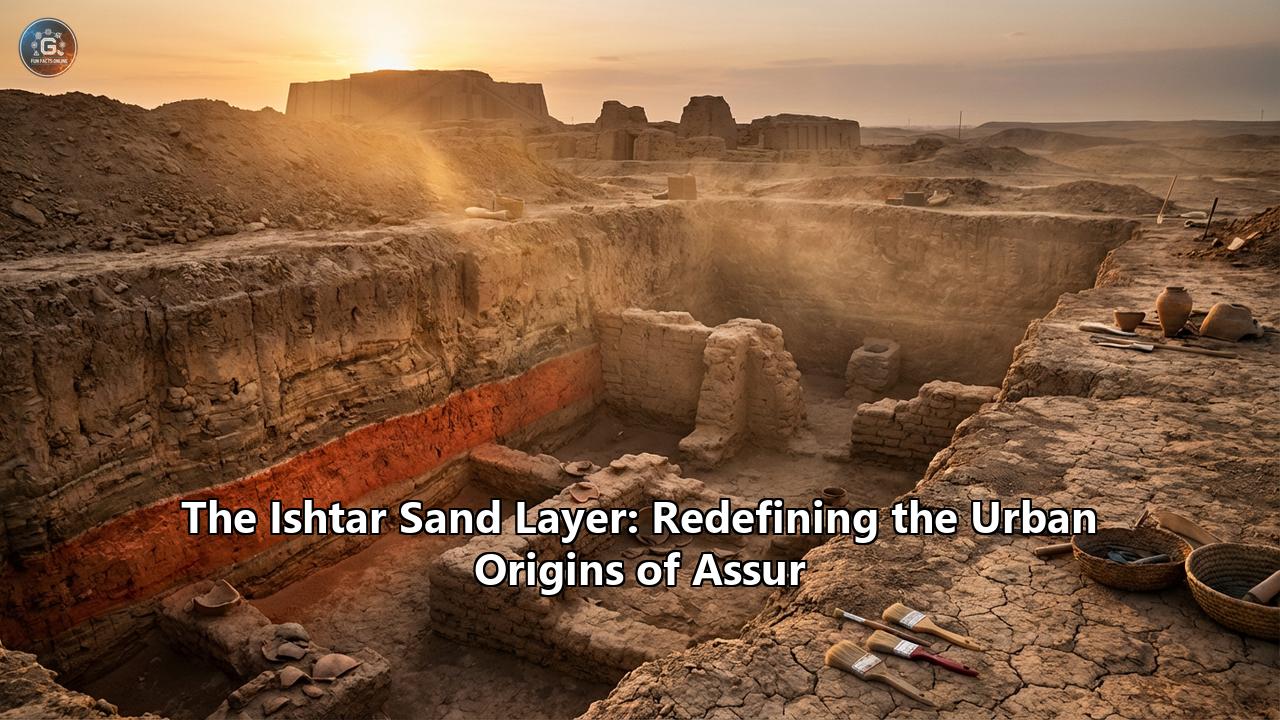
Buried deep beneath the ruins of the Temple of Ishtar, the city’s most enduring sanctuary, a team of archaeologists from Ludwig Maximilian University (LMU) of Munich uncovered a feature that had eluded excavation for over a hundred years: a one-meter-thick deposit of pristine, yellow sand. This was not the debris of a flood, nor the accumulation of wind-blown dust. It was a deliberate, engineered foundation, laid down with ritual precision by a society far more complex and ancient than history had given them credit for.
This discovery, known now as the "Ishtar Sand Layer," has done more than just push back the timeline of Assur’s founding. It has forced a radical re-evaluation of the origins of Assyrian civilization, the religious landscape of early Mesopotamia, and the very nature of the relationship between the "civilized" south and the "barbaric" north. It reveals a city that was not merely a follower of southern trends, but a vibrant, independent urban center in its own right, capable of massive logistical feats and possessing a unique, hybrid religious identity that bridged the worlds of the Sumerian plains and the Zagros Mountains.
Part I: The Discovery in the Deep
To understand the magnitude of the discovery, one must first understand the challenge of excavating Assur. When the German archaeologist Walter Andrae began his legendary excavations at the site in 1903, he was confronted with a massive tell—a man-made hill formed by thousands of years of continuous occupation. Layer upon layer of mudbrick temples, palaces, and houses had been built, destroyed, and rebuilt, creating a complex stratigraphy that reached down dozens of meters.
Andrae was a meticulous scholar, and his work on the Ishtar Temple remains a foundational text in Near Eastern archaeology. He identified a sequence of temples dedicated to the goddess, labeling them from the most recent (Temple A) back through time to the "Archaic Ishtar Temples" (Temples E, F, G, and H). However, the technology of the early 20th century had its limits. As he dug deeper, the stability of the trenches became precarious, and the ability to distinguish subtle changes in soil composition faded. Andrae reached what he believed to be the earliest phase, Temple H, a modest structure of mudbrick, but he could not go further. The foundations of the city, he assumed, lay just beneath, likely resting on the natural bedrock of the Tigris bluff.
For a century, Temple H stood as the absolute horizon of our knowledge of Assur’s origins. It was dated, based on pottery and typological comparisons, to the Early Dynastic period, perhaps around 2400 BCE, but the dating was fluid and debated.
Enter the Assur Excavation Project. In 2023 and 2024, a team led by Professor Karen Radner of LMU Munich returned to the site with a mission to explore the "New Town" but also to revisit the classic problems left unsolved by Andrae. Armed with modern geological insight and advanced coring technology, they turned their attention to the cella—the inner sanctum—of the Ishtar Temple.
The goal was simple: to see what lay beneath Temple H. Using a mechanical percussion corer, a device capable of driving a hollow tube deep into the earth and retrieving a pristine column of sediment, the team drilled through the floor of the ancient sanctuary.
What they pulled up was shocking. Instead of the chaotic mixture of ash, broken brick, and clay typical of settlement debris, or the solid limestone of the natural bedrock, the cores revealed a uniform, one-meter-thick band of fine sand.
"It was immediately clear that this was not natural," remarked Mark Altaweel, a co-author of the subsequent study. "The transition was too sharp, the material too clean. In archaeology, when you see something this distinct and this massive, it speaks of intent."
The team had found the kisu—a ritual foundation layer. But unlike the reed mats or clay packings found in other sites, this was a massive bed of sand. And it was old. Radiocarbon dating of charcoal fragments found at the interface between the sand and the first mudbrick course of Temple H yielded a date range of 2896 to 2702 BCE.
This date, firmly within the Early Dynastic I period, instantly added nearly five hundred years to the history of Assur. It meant that while the legendary Gilgamesh was said to be ruling Uruk in the south, and before the great pyramids were raised in Egypt, Assur was already a thriving city with a monumental temple, capable of organizing the labor and resources necessary to create a sacred foundation for its goddess.
Part II: The Sands of the Zagros
The discovery of the layer was only the first surprise. The second came when the geologists looked at the sand itself.
To the untrained eye, sand is sand. But to a sedimentary geologist, sand is a fingerprint of the landscape. Every grain carries the chemical and physical signature of the rock formation from which it eroded. If the builders of Assur had simply wanted a stable foundation, they could have used the abundant sandbars of the Tigris River, which flowed less than a hundred meters from the temple site. It would have been the logical, efficient choice.
But when the team analyzed the mineral composition of the Ishtar Sand Layer, they found something distinct. The sand was rich in epidote-group minerals, along with glaucophane, zoisite, and lawsonite.
These names may sound esoteric, but their implications are profound. Glaucophane and lawsonite are rare minerals formed only under high-pressure, low-temperature metamorphic conditions—specifically, in "blueschist" facies rocks. There are no such rocks in the vicinity of Assur. The geology of the Tigris valley is dominated by sedimentary limestone and gypsum.
The nearest source for these exotic minerals lies 30 to 50 kilometers away to the east, in the foothills of the Zagros Mountains. Specifically, these minerals are characteristic of the Injana Formation and the deposits carried by the Lesser Zab River, a tributary that flows out of the mountains and joins the Tigris south of Assur.
The implications of this geological forensic work are staggering. The builders of the first Ishtar Temple did not settle for the "convenient" local sand. Instead, they organized a logistical operation to transport tons of specific sand from a distant source. They likely traveled east, perhaps up the wadis or to the banks of the Lesser Zab, to collect this specific material.
Why? What possessed a Bronze Age society to haul sand over such a distance when the Tigris was right there?
The answer lies in the realm of the sacred. In the ancient Near East, the construction of a temple was not merely an architectural act; it was a cosmological one. The temple was the literal house of the deity. It could not stand on "profane" ground—earth that had been walked upon, dirtied by human waste, or inhabited by spirits of the dead. The ground had to be purified.
In southern Mesopotamia, in the great cities of Sumer like Uruk and Nippur, it was common practice to lay down a foundation of clean sand to create a tabula rasa—a blank slate for the god. This sand "wiped" the history of the site clean.
The builders of Assur were clearly aware of this southern tradition. By adopting the sand foundation, they were signaling their participation in the high culture of Mesopotamian urbanism. They were saying, "We, too, know how to build a house worthy of a god."
However, their choice of material signals a distinct, local identity. They did not import sand from the holy cities of the south. Instead, they looked east, to the mountains. The Zagros were not just a source of stone and timber; they were a landscape of power. To the people of the Assyrian plains, the mountains were the abode of wild, untamed forces. By bringing the "mountain sand" to the banks of the Tigris, they were physically grounding their temple in the power of the highlands.
This synthesis—a southern ritual form (the sand foundation) executed with northern, mountain materials (the Zagros blueschist sand)—perfectly encapsulates the emerging identity of Assur. It was a city at the crossroads, a "hybrid" civilization that would eventually grow to dominate both the mountains and the plains.
Part III: The House of the Goddess
The structure that rose upon this precious bed of sand, Temple H, was the first in a long lineage of sanctuaries that would define the spiritual life of the city for millennia.
Thanks to the stratigraphic work of Walter Andrae, refined by modern re-assessments, we can trace the evolution of this building. Temple H was likely a modest structure by later standards, built of sun-dried mudbrick. It followed the "bent-axis" plan common in early Mesopotamian shrines. In this layout, the entrance was not directly opposite the altar. Instead, a worshipper would enter through a side door and have to turn 90 degrees to face the deity's image. This architectural device created a sense of intimacy and mystery; the god was not exposed to the open street, but resided in a secluded, private court.
The deity worshipped here was Ishtar. But who was Ishtar in 2900 BCE?
In the south, she was Inanna, the Queen of Heaven, the goddess of the storehouse, love, and war, whose main cult center was Uruk. In the north, however, the religious landscape was heavily influenced by the Hurrians, a people who inhabited the arch of the Fertile Crescent from the Zagros to the Mediterranean. Their great goddess was Shaushka, a deity of war and healing often associated with mountains and lions.
The Ishtar of Assur was likely a syncretic figure from the very beginning. The "mountain sand" foundation strongly suggests a link to Shaushka and the highland traditions. Yet, the architectural form and the purification ritual point to Inanna. Thus, the "Archaic Ishtar" of Temple H was a goddess of the borderlands—a deity who held the "Mes" (the divine powers of civilization) of the Sumerians in one hand and the raw, martial power of the Zagros mountains in the other.
As the centuries passed, the temple grew, mirroring the rise of Assur itself.
- Temples G and F (Early Dynastic III / Akkadian): These layers show expansion. The walls became thicker, the courtyards larger. Votive offerings from this period include statues of worshippers with wide, staring eyes, clasping their hands in eternal prayer—a style identical to those found in the Royal Cemetery of Ur and the temples of Mari. This proves that by 2500 BCE, Assur was fully integrated into the "koiné" (shared culture) of Greater Mesopotamia.
- Temple E (Ur III / Old Assyrian): This phase corresponds to the rise of Assur as a merchant power. This was the era when Assyrian merchants established trading colonies (karum) as far away as central Turkey (Kanesh). The temple would have been enriched by the profits of the tin and textile trade.
- The Later Temples: By the Middle and Neo-Assyrian periods, the Ishtar Temple had become a monumental complex. Kings like Tukulti-Ninurta I and Shalmaneser III rebuilt it with baked bricks, glazed tiles, and cedar beams. They left inscriptions cursing anyone who would let the "house of their mistress" fall into disrepair.
Yet, despite the grandeur of these later phases, they all rested—literally and spiritually—on that first, invisible layer of yellow sand laid down in the dawn of the third millennium.
Part IV: Redefining Urban Origins
Why does a date of 2896–2702 BCE matter so much?
To answer this, we must look at the map of the Early Dynastic Near East. For decades, the dominant model of urbanization was the "Core-Periphery" theory. This model held that the "Urban Revolution" began in the south (Sumer), in cities like Uruk, Ur, and Eridu, driven by the unique agricultural potential of the alluvial plains. The north (Upper Mesopotamia), relying on rain-fed agriculture, was seen as a backwater—a periphery that only developed cities when southern colonists or conquerors arrived to exploit its resources (timber, metal, stone).
In this old view, Assur was founded as an outpost—perhaps by the Akkadian kings like Sargon or Naram-Sin (c. 2300 BCE)—to control the trade routes along the Tigris.
The Ishtar Sand Layer drives a stake through the heart of this theory.
If Assur was building monumental temples with complex ritual foundations in Early Dynastic I (c. 2800 BCE), it was contemporary with the great city-states of the south. It was not a colony; it was a peer.
This aligns Assur with other recent discoveries in Northern Mesopotamia, most notably at Tell Brak (ancient Nagar) in Syria. Excavations there have shown that urbanism in the north actually began as early, or perhaps even earlier, than in the south, driven by different social dynamics. The northern cities were "hollow cities," vast agglomerations of people and herds, structured around different principles than the dense, canal-dependent cities of Sumer.
Assur, situated at a strategic bottleneck of the Tigris where the river cuts through the Hamrin hills, was perfectly positioned to control the interface between these two worlds. It was the "lock" on the river. The early date suggests that the local population—likely a mix of Semitic-speaking ancestors of the Assyrians and Hurrian groups—recognized this strategic value and organized themselves into a state-level society centuries before Sargon of Akkad was born.
The sand transport implies a centralized authority. You do not move tons of material 50 kilometers for a community shrine. You do it because a King (or an Ensi or Ishshi’ak) commands it, and because the community has the surplus wealth to feed the workers who do the hauling. It implies a class of priests who know the rituals, and a class of specialized craftsmen who know where to find the "blue rocks" in the mountains. In short, it implies a city.
Part V: A Ritual of Resilience
The discovery of the Ishtar Sand Layer is more than a footnote in a chronology; it is a testament to the resilience of cultural memory.
In the later Assyrian texts, the king was often described as the "steward" of the god Ashur. The city itself was divine. The preservation of sacred space was an obsession. When later kings like Esarhaddon or Ashurbanipal restored temples, they would often search for the foundation deposits of their ancestors, terrified of changing the divine plan.
The builders of Temple H started this tradition. By laying down that sand, they were defining a space that would remain sacred for 3,000 years. Even as empires rose and fell, as the language changed from Old Akkadian to Assyrian to Aramaic, as the city was sacked by Babylonians and Medes, that spot remained the home of the Goddess.
The sand layer also speaks to a profound connection with the environment. We often think of ancient cities as dominating nature, but the Ishtar foundation shows a deep sensitivity to the landscape. They knew the geology of their world. They knew that the Tigris sand was "common" and the Zagros sand was "special." They mapped their sacred geography onto the physical earth.
Part VI: The Future of the Past
The work of the Assur Excavation Project is far from over. The coring of the Ishtar Temple is just one data point in a renewed effort to understand this critical site. The "New Town" excavations are shedding light on the domestic lives of the common people, while geophysical surveys are revealing the layout of the city's streets and defenses without lifting a shovel.
But the Ishtar Sand Layer will stand as a landmark discovery. It serves as a reminder that archaeology is not just about finding what is "there" in the visible ruins, but about probing the invisible histories hidden beneath our feet.
It tells us that the story of civilization is not a monologue spoken by the south, but a dialogue between the river plains and the mountain highlands. Assur, the city that would one day rule from the Nile to the Zagros, began not as a conquest, but as a construction—a deliberate, pious, and laborious act of creating a home for the divine on the banks of the Tigris, built upon the sands of the mountains.
In that layer of yellow sand, we find the grain of truth that rewrites history: Assur was not born of empire; empire was born of Assur.
EXTENDED ANALYSIS: THE CONTEXT OF THE FIND
To fully appreciate the narrative above, we must delve deeper into the specific historical, geological, and religious contexts that surround this discovery.
1. The Geological Detective Story: Why "Blueschist" Matters
The scientific weight of this discovery rests on the mineralogy. The term "blueschist facies" refers to rocks that have been subjected to high pressure but relatively low temperature—conditions typically found in subduction zones where one tectonic plate dives beneath another.
The Zagros Suture Zone, formed by the collision of the Arabian Plate with the Eurasian Plate, is exactly such a region. This geological violence created the metamorphic rocks that are the source of the glaucophane and lawsonite found in the temple sand.
The Injana Formation (Upper Miocene) is a sedimentary rock unit derived from the erosion of these rising Zagros mountains millions of years ago. The Lesser Zab River cuts through these formations, carrying the recycled minerals down towards the Tigris.
For the ancient Assyrians to select this specific sand, they had to be aware of its difference. It wasn't just "sand." It likely had a different color (perhaps a glittering quality due to the mica or the greenish-blue tint of the epidote/glaucophane grains) or a different texture than the silty, muddy sand of the Tigris.
This suggests a form of ancient geological knowledge. They didn't know about plate tectonics, but they knew that "Mountain Sand" was pure, powerful, and distinct from "River Sand." This aligns with the concept of Kù (Sumerian for pure/bright/holy). To build a holy place, you need holy materials. Materials from the mountains, which were seen as closer to the heavens and the gods, possessed this quality of holiness.
2. The Hurrian Connection: Shaushka and Ishtar
The identification of the goddess is a fascinating puzzle. In later Assyrian theology, Ishtar of Assur (often distinguished from Ishtar of Nineveh or Ishtar of Arbela) was the consort of the national god, Ashur.
But in the Early Dynastic period, the god Ashur (who is virtually identical to the city itself) was likely a local numen—a deified mountain or city-spirit. The female principle, Ishtar, was the active force.
The presence of the "Mountain Sand" strongly supports the theory that the early cult was heavily influenced by the Hurrians. The Hurrians were the dominant population in the Upper Tigris region during the late 3rd millennium (the time of the Urkesh kingdom). Their goddess Shaushka was a warrior-goddess, often depicted standing on a lion, and was explicitly linked to the Zagros highlands.
If the founders of Assur were a mix of Semitic and Hurrian peoples, the Ishtar Temple H might actually be a Shaushka-Inanna temple. The ritual technology (sand foundation) was Sumerian (Inanna), but the substance (Zagros sand) was Hurrian (Shaushka). This makes Assur a "Middle Ground," a place where different cultures met and fused to create something new: the Assyrian identity.
3. The "Hollow City" and Northern Urbanism
The mention of Tell Brak in the main text is crucial. For a long time, archaeologists looked for "Southern" style cities in the North—densely packed houses, narrow streets, a central ziggurat. When they didn't find them, they assumed the North was rural.
But recent work has defined a "Northern" style of urbanism. These cities were more spread out, often composed of a central citadel surrounded by a lower town that could be quite low-density—gardens, pastures, and houses mixed together.
The early date of the Ishtar Sand Layer suggests Assur fits this pattern. It wasn't a dense grid like Uruk. It was likely a strategic citadel (the temple and administration) surrounded by a sprawling community that managed the trade and the herds. The sand foundation proves that the citadel—the seat of ideological power—was already highly developed and capable of commanding labor.
4. The Legacy of Walter Andrae
We must give credit to Walter Andrae. Working in the early 1900s, he developed the method of Baugeschichte (architectural history), reading walls like pages in a book. He correctly identified the sequence of temples. He just couldn't see the sand.
It is a poetic irony that Andrae, who was also a talented artist and architect, would have appreciated this finding. He understood that architecture is an emotional and spiritual act. The idea that his "Temple H" was floating on a "sea" of mountain sand would likely have thrilled him, as it confirms his intuition that Assur was a place of deep, ancient magic.
Conclusion
The Ishtar Sand Layer is a small feature with massive implications. It anchors Assur in time, pushing its roots back into the fertile soil of the Early Dynastic period. It connects the city to the mountains of the East and the cities of the South. And it reminds us that in the ancient world, every stone, every brick, and every grain of sand was chosen with purpose, woven into a web of meaning that we are only just beginning to untangle.
For the visitor to the Pergamon Museum in Berlin, or the future tourist to a restored Qal'at Sherqat, the Ishtar Temple is no longer just a ruin. It is a monument to a specific moment 4,900 years ago, when a group of people stood on a bluff over the Tigris, poured out the golden sands of the Zagros, and decided to build a city that would last forever.
Reference:
- https://archaeologymag.com/2026/02/sand-layer-beneath-ishtar-temple-in-assur/
- https://en.wikipedia.org/wiki/Uruk
- https://www.labrujulaverde.com/en/2026/01/an-unexpected-discovery-beneath-the-ishtar-temple-in-assur-reveals-the-citys-founding-date-and-its-relationship-with-a-hurrian-goddess/
- https://en.wikipedia.org/wiki/Inanna
- https://www.britannica.com/topic/Hurrian-religion
- https://en.wikipedia.org/wiki/Early_Assyrian_period
- https://shaynalamour1.wordpress.com/2018/09/30/inanna-ishtar/
- https://dash.harvard.edu/bitstreams/7312037c-4f76-6bd4-e053-0100007fdf3b/download
- https://en.wikipedia.org/wiki/Early_Dynastic_Period_(Mesopotamia))
- https://digitalcommons.andrews.edu/cgi/viewcontent.cgi?article=1014&context=papers