
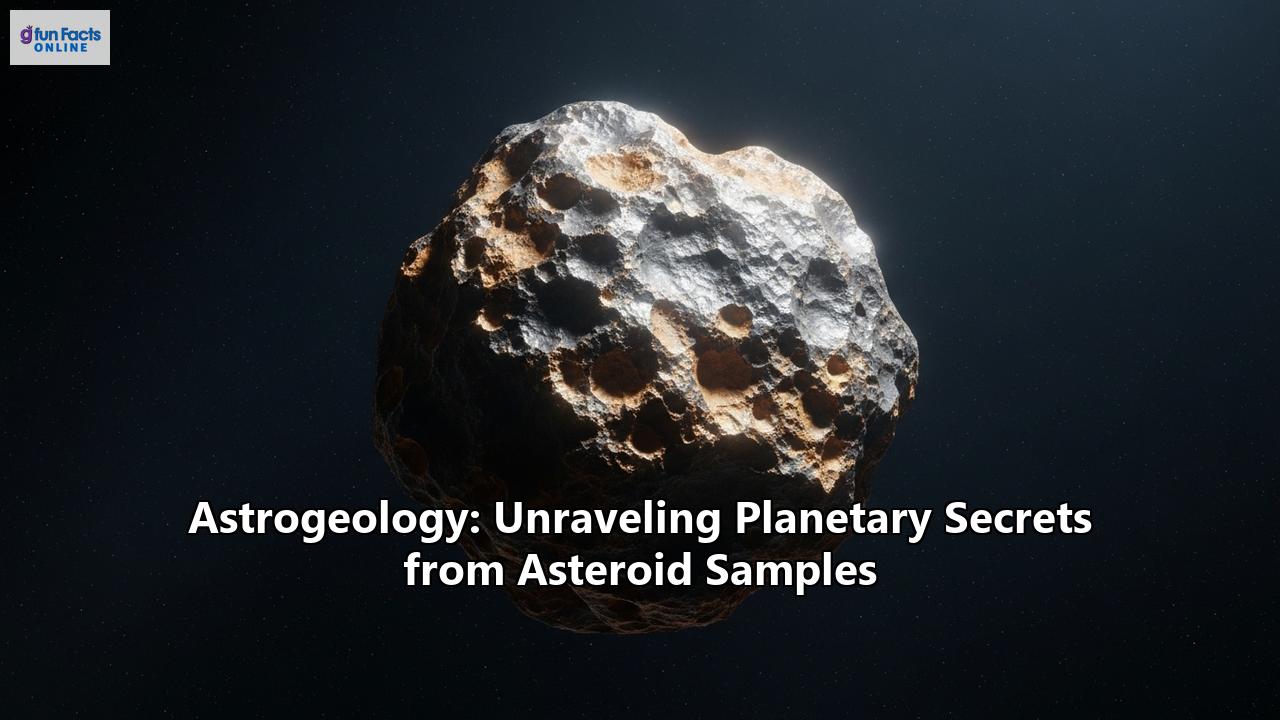
Astrogeology: Unraveling Planetary Secrets from Asteroid Samples
A New Era of Cosmic Exploration
In the vast, silent expanse of our solar system, a quiet revolution is taking place. It's a revolution not of conquest, but of understanding, a quest to decipher the 4.6-billion-year-old story of our cosmic origins. At the forefront of this endeavor is the burgeoning field of astrogeology, a captivating discipline that blends the principles of geology and astronomy to study the solid bodies that populate our celestial neighborhood. From the towering volcanoes of Mars to the icy plains of Europa, astrogeologists are the detectives of the cosmos, piecing together the history of planets, moons, and the enigmatic wanderers of our solar system: asteroids.
For centuries, our knowledge of these celestial bodies was limited to what we could glean from the faint light they reflected back to our telescopes. But today, we are in the midst of a golden age of planetary exploration. We are no longer passive observers; we are active explorers, reaching out to touch, and even bring back, pieces of other worlds. This remarkable feat, the return of pristine asteroid samples to Earth, has opened a new frontier in astrogeology, providing us with tangible evidence of the building blocks of planets and, perhaps, of life itself.
This article will embark on a comprehensive journey into the heart of astrogeology, exploring how the analysis of asteroid samples is unlocking the deepest secrets of our solar system. We will delve into the groundbreaking missions that have made this possible, the sophisticated techniques used to analyze these extraterrestrial materials, and the profound discoveries that are reshaping our understanding of our place in the universe.
The Dawn of Astrogeology: From Telescopes to Touchdowns
The roots of astrogeology can be traced back to the early days of telescopic observation, when astronomers first began to map the surfaces of our celestial neighbors. However, the field truly came into its own with the dawn of the Space Age. The robotic emissaries we sent to other worlds, from the Soviet Luna probes to NASA's Mariner missions, transformed our understanding of planetary surfaces from abstract points of light into tangible landscapes.
A pivotal figure in the formal establishment of astrogeology was Eugene Merle Shoemaker, a geologist with a vision that extended far beyond the confines of our own planet. In the early 1960s, Shoemaker founded the Astrogeology Research Program within the United States Geological Survey (USGS), a testament to the growing recognition that the principles of geology could be applied to other worlds. His groundbreaking work on impact craters, both on Earth and the Moon, laid the foundation for much of what we know about the dynamic and often violent history of our solar system.
The Apollo missions to the Moon marked a watershed moment for astrogeology. For the first time, humans walked on another celestial body, and, crucially, they brought back samples. The analysis of these lunar rocks provided a wealth of information about the Moon's formation, composition, and geological history, solidifying the importance of sample return missions in planetary science.
Why Asteroids? The Allure of Primordial Remnants
While the Moon provided our first taste of extraterrestrial geology, asteroids hold a unique and profound allure for astrogeologists. These small, rocky bodies are the leftovers from the formation of our solar system, primordial remnants that have remained largely unchanged for billions of years. They are, in essence, time capsules, preserving a record of the conditions and ingredients that existed in the early solar nebula.
By studying asteroids, we can hope to answer some of the most fundamental questions about our cosmic origins:
- How did the planets form? Asteroids are the building blocks of planets, and their composition can tell us about the materials that accreted to form Earth and its neighbors.
- Where did Earth's water come from? Some asteroids are rich in water-bearing minerals, suggesting they may have delivered a significant portion of Earth's oceans.
- What is the origin of life? Carbonaceous asteroids, in particular, are known to contain organic molecules, including the amino acids that are the building blocks of proteins. Studying these pristine samples can provide clues as to whether the ingredients for life were delivered to Earth from space.
However, not all sources of asteroidal material are created equal. For decades, our only tangible pieces of asteroids were meteorites, fragments that have survived the fiery journey through Earth's atmosphere and landed on its surface. While invaluable, meteorites are inherently compromised. They are heated and altered during their atmospheric descent, and once on the ground, they are subject to terrestrial contamination. Furthermore, it is often difficult to pinpoint the exact parent body of a meteorite, making it challenging to place it in a specific context within the solar system.
This is where robotic sample return missions have revolutionized the field. By traveling to a specific, well-characterized asteroid and bringing back a pristine, unadulterated sample, these missions provide an unprecedented opportunity to study the solar system's primordial materials in their most authentic state.
The Trailblazers: Hayabusa2 and OSIRIS-REx
Two recent missions have stood at the forefront of this new era of asteroid exploration: Japan's Hayabusa2 and a NASA's OSIRIS-REx. These ambitious endeavors, targeting two different near-Earth carbonaceous asteroids, have provided a wealth of data and, most importantly, have returned precious cargo to Earth.
Hayabusa2 and the Secrets of Ryugu
Launched by the Japan Aerospace Exploration Agency (JAXA) in 2014, Hayabusa2 set its sights on Ryugu, a C-type (carbonaceous) asteroid approximately 900 meters in diameter. The primary scientific objectives of the mission were to understand the origin and evolution of the solar system and the building blocks of life by studying an asteroid thought to be rich in organic matter and water.
Hayabusa2's exploration of Ryugu was a masterclass in robotic precision. The spacecraft not only orbited the asteroid, mapping its surface in detail, but also deployed a series of small landers and rovers. The mission's most daring feat was the collection of two samples from the asteroid's surface. One of the samples was collected after firing a small impactor into the asteroid, creating an artificial crater to access subsurface material that had been shielded from the harsh environment of space.
In December 2020, after a six-year journey, the Hayabusa2 sample return capsule made a dramatic re-entry into Earth's atmosphere, landing safely in the Australian outback. Inside was a precious cargo of just over 5 grams of material from Ryugu, a small amount that would prove to be a scientific treasure trove.
OSIRIS-REx and the Mysteries of Bennu
Not to be outdone, a NASA launched its own asteroid sample return mission, OSIRIS-REx (Origins, Spectral Interpretation, Resource Identification, Security-Regolith Explorer), in 2016. Its target was another C-type asteroid, Bennu, a slightly smaller body with a diameter of about 500 meters. The scientific goals of OSIRIS-REx were remarkably similar to those of Hayabusa2: to understand the early solar system, the origin of water and organic molecules, and to provide a detailed characterization of a potentially hazardous near-Earth asteroid.
After arriving at Bennu in 2018, OSIRIS-REx spent over two years meticulously mapping the asteroid's surface, revealing a surprisingly rugged and boulder-strewn landscape. This presented a significant challenge for the mission team, who had to find a safe and scientifically interesting location for sample collection.
In October 2020, the spacecraft executed a daring "Touch-And-Go" (TAG) maneuver. It descended to the surface of Bennu, and its robotic arm briefly made contact, releasing a puff of nitrogen gas to stir up surface material, which was then captured in a collection head. The maneuver was a resounding success, collecting an estimated 250 grams of material.
In September 2023, the OSIRIS-REx spacecraft flew by Earth and released its sample return capsule, which landed safely in the Utah desert. The arrival of the Bennu samples marked the culmination of a seven-year journey and the beginning of a new chapter of scientific discovery.
Inside the Lab: Analyzing Cosmic Dust
The return of samples from Ryugu and Bennu was just the beginning of their scientific journey. Back on Earth, these precious extraterrestrial materials were carefully curated and distributed to laboratories around the world for intensive analysis. To study these minuscule grains of cosmic dust, scientists employ a suite of sophisticated analytical techniques, each providing a unique window into the asteroids' composition and history.
- Electron Microscopy: Techniques like Scanning Electron Microscopy (SEM) and Transmission Electron Microscopy (TEM) are used to create highly magnified images of the samples, revealing their texture, mineralogy, and the relationships between different components. SEM provides detailed surface images, while TEM allows scientists to see the internal structure of the materials at the atomic scale.
- Spectroscopy: A variety of spectroscopic techniques are used to determine the chemical and mineralogical composition of the samples. For example, near-infrared spectroscopy can identify the presence of water-bearing minerals and organic compounds. X-ray spectroscopy can be used to map the distribution of different elements within the samples.
- Mass Spectrometry: This powerful technique is used to measure the isotopic composition of the samples. Isotopes are atoms of the same element with different numbers of neutrons. By analyzing the ratios of different isotopes, scientists can determine the age of the materials and trace their origins back to the early solar system and even to the interstellar medium that predated it.
- Thermal Analysis: Techniques like thermogravimetry and differential thermal analysis heat the samples to determine their water and carbon content, providing insights into their thermal history and the processes they have undergone.
The meticulous analysis of the Ryugu and Bennu samples, often conducted in clean rooms to prevent terrestrial contamination, has yielded a wealth of groundbreaking discoveries.
Revelations from Ryugu and Bennu: A Tale of Two Asteroids
The analysis of the samples from Ryugu and Bennu has confirmed that both asteroids are indeed carbonaceous chondrites, similar in composition to the most primitive meteorites found on Earth. However, the pristine nature of the returned samples has allowed for a level of analysis never before possible, leading to a number of startling revelations.
The Watery Past of C-Type Asteroids
One of the most significant findings from both missions is the overwhelming evidence for a watery past on the parent bodies of Ryugu and Bennu. The samples from both asteroids are rich in clay minerals, which form through the interaction of rock and liquid water. The analysis of Bennu's samples also revealed the presence of a variety of salts, including carbonates, sulfates, and chlorides, which are the tell-tale signs of evaporated brines.
These findings paint a picture of a dynamic early solar system, where the parent bodies of these asteroids were not inert rocks but geologically active worlds with subsurface pockets of liquid water. This water, warmed by the decay of radioactive elements, would have created a chemical reactor, a "briny broth" where organic molecules could form and interact.
The Building Blocks of Life from the Cosmos
Perhaps the most tantalizing discoveries from both Ryugu and Bennu are the presence of a diverse array of organic molecules, the essential ingredients for life as we know it. Scientists have identified numerous amino acids in the samples, including many of the 20 that are used to build proteins in living organisms on Earth. They have also found all five of the nucleobases that make up DNA and RNA, the molecules that carry the genetic instructions for life.
The discovery of these prebiotic molecules in pristine asteroid samples provides strong support for the hypothesis that the building blocks of life were delivered to the early Earth by asteroids and comets. It suggests that the raw materials for life are not unique to our planet but are widespread throughout the cosmos.
A fascinating detail from the analysis of Bennu's amino acids is that they were found in roughly equal proportions of left-handed and right-handed forms. On Earth, life almost exclusively uses left-handed amino acids. The reason for this "homochirality" is a major unsolved mystery in science. The fact that the Bennu samples contain a mix of both suggests that this preference for one "handedness" over the other emerged later in the history of life on Earth.
A Comparative Look at Two Distant Worlds
While the samples from Ryugu and Bennu share many similarities, there are also subtle but important differences that highlight the diversity of C-type asteroids. For instance, the reflectance spectra of the two asteroids are different, with Ryugu appearing redder and Bennu bluer. The samples also show differences in the extent of aqueous alteration, suggesting their parent bodies had slightly different histories.
These comparisons are crucial for understanding the range of compositions and evolutionary pathways of carbonaceous asteroids. They provide a more nuanced picture of the early solar system than could be obtained from studying a single asteroid alone. The collaboration between the Hayabusa2 and OSIRIS-REx teams, including the exchange of samples, has been instrumental in maximizing the scientific return from these missions.
The Future of Astrogeology: New Horizons and Next-Generation Technologies
The success of Hayabusa2 and OSIRIS-REx has ushered in an exciting new era of asteroid exploration, and space agencies around the world are already planning the next generation of missions that will push the boundaries of our knowledge even further.
China's Ambitious Plans: Tianwen-2 and Beyond
China has emerged as a major player in planetary exploration, with an ambitious program that includes several upcoming asteroid missions. The Tianwen-2 mission, expected to launch in the mid-2020s, will target a near-Earth asteroid for sample return and then continue on to study a main-belt comet. This mission will build on China's growing expertise in deep space exploration and will provide valuable new data on the diversity of small bodies in our solar system. China is also planning a future Mars sample return mission, Tianwen-3, which aims to bring back the first samples from the Red Planet.
Europe's Focus on Planetary Defense and Comet Exploration
The European Space Agency (ESA) is also actively involved in asteroid research, with a strong focus on planetary defense. The Hera mission, set to launch in the mid-2020s, will visit the binary asteroid system Didymos, which was the target of NASA's DART (Double Asteroid Redirection Test) mission. Hera will study the aftermath of the DART impact, providing crucial data on the effectiveness of kinetic impactors for deflecting potentially hazardous asteroids.
ESA is also looking to the future with ambitious plans for a cryogenic comet sample return mission, a concept known as AMBITION. Comets are even more pristine than asteroids, containing frozen water and other volatile materials that have been preserved in the deep freeze of the outer solar system. A cryogenic sample return, which would keep the samples at extremely low temperatures throughout their journey back to Earth, would provide an unprecedented look at the earliest materials of the solar system. However, such a mission presents significant technological challenges, from drilling into a comet's icy nucleus to maintaining the cryogenic conditions of the sample container.
Next-Generation Technologies
The future of astrogeology will be driven by the development of new and innovative technologies for exploring and analyzing celestial bodies. These include:
- Advanced Propulsion Systems: More efficient propulsion systems will be needed to reach more distant and challenging targets, such as comets and asteroids in the outer solar system.
- Autonomous Navigation: As missions venture further from Earth, they will need to become more autonomous, with the ability to navigate and make decisions without constant input from ground control.
- Novel Sampling Techniques: The challenges of collecting samples from a variety of surfaces, from loose regolith to solid rock and ice, will require the development of new and more versatile sampling tools. Cryogenic coring drills, for example, will be essential for future comet sample return missions.
- Advanced Laboratory Instruments: On Earth, the development of even more sensitive and precise analytical instruments will allow scientists to extract ever more information from the precious returned samples.
The Endless Frontier: Unraveling the Story of Our Solar System
The study of asteroid samples is more than just an academic exercise; it is a journey into our own past, a quest to understand the origins of our planet and the life it harbors. The pristine materials returned by missions like Hayabusa2 and OSIRIS-REx have provided us with a direct link to the dawn of our solar system, a time when the planets were still forming and the seeds of life were being scattered among the stars.
As we continue to push the boundaries of exploration, with new missions and new technologies, we can expect even more profound discoveries in the years and decades to come. The field of astrogeology, once the realm of science fiction, has become a vibrant and essential part of our quest to understand the cosmos. The secrets of the planets, locked away in the rocky hearts of asteroids, are finally being unraveled, and with each new discovery, we come one step closer to understanding our own place in the grand cosmic narrative.
Reference:
- https://www.ncbi.nlm.nih.gov/books/NBK540827/
- https://www.frontiersin.org/journals/space-technologies/articles/10.3389/frspt.2022.1054360/full
- https://www.google.com/search?q=time+in+CN
- https://www.research-collection.ethz.ch/handle/20.500.11850/499237
- https://www.cosmos.esa.int/documents/3273648/3495481/5_02_DBockelee_Ambition-Madrid-newversion.pdf/c9ae97c9-0311-9739-7434-bd885881a670?t=1573596626703
- https://www.planetary.org/articles/planetary-defense-in-esa
- https://www.cnsa.gov.cn/english/n6465645/n6465648/c6806206/part/6781076.pdf
- https://www.rnz.co.nz/news/national/537850/from-new-commercial-moon-landers-to-asteroid-investigations-expect-a-slate-of-exciting-space-missions-in-2025
- https://meetingorganizer.copernicus.org/EPSC2020/EPSC2020-25.html
- https://kiss.caltech.edu/workshops/comet/presentations/Backes.pdf
- https://science.nasa.gov/solar-system/asteroids/exploration/
- https://kiss.caltech.edu/workshops/comet/comet.html
- https://www.space.com/china-return-mars-samples-earth-2031
- https://www.chinadailyhk.com/hk/article/613408
- https://www.planetary.org/the-china-national-space-administration-cnsa
- https://skyandtelescope.org/astronomy-news/china-launches-tianwen-2-asteroid-sample-return-mission/
- https://www.planetary.org/space-missions/hera
- https://www.hou.usra.edu/meetings/acm2023/pdf/2029.pdf
- https://ntrs.nasa.gov/api/citations/20180002990/downloads/20180002990.pdf
- https://www.esa.int/Space_Safety/Planetary_Defence/Will_asteroid_2024_YR4_hit_the_Moon
- https://english.spacechina.com/n17212/c4308641/content.html
- https://www.cnsa.gov.cn/english/n6465652/n6465653/c10573596/content.html
- https://timesofindia.indiatimes.com/science/why-china-is-going-behind-the-asteroids-with-its-tianwen-2-mission/articleshow/121479932.cms
- https://www.sustainability-times.com/research/nasa-didnt-see-this-coming-chinas-tianwen-2-asteroid-mission-stuns-u-s-scientists-and-sparks-urgent-high-level-space-response/