
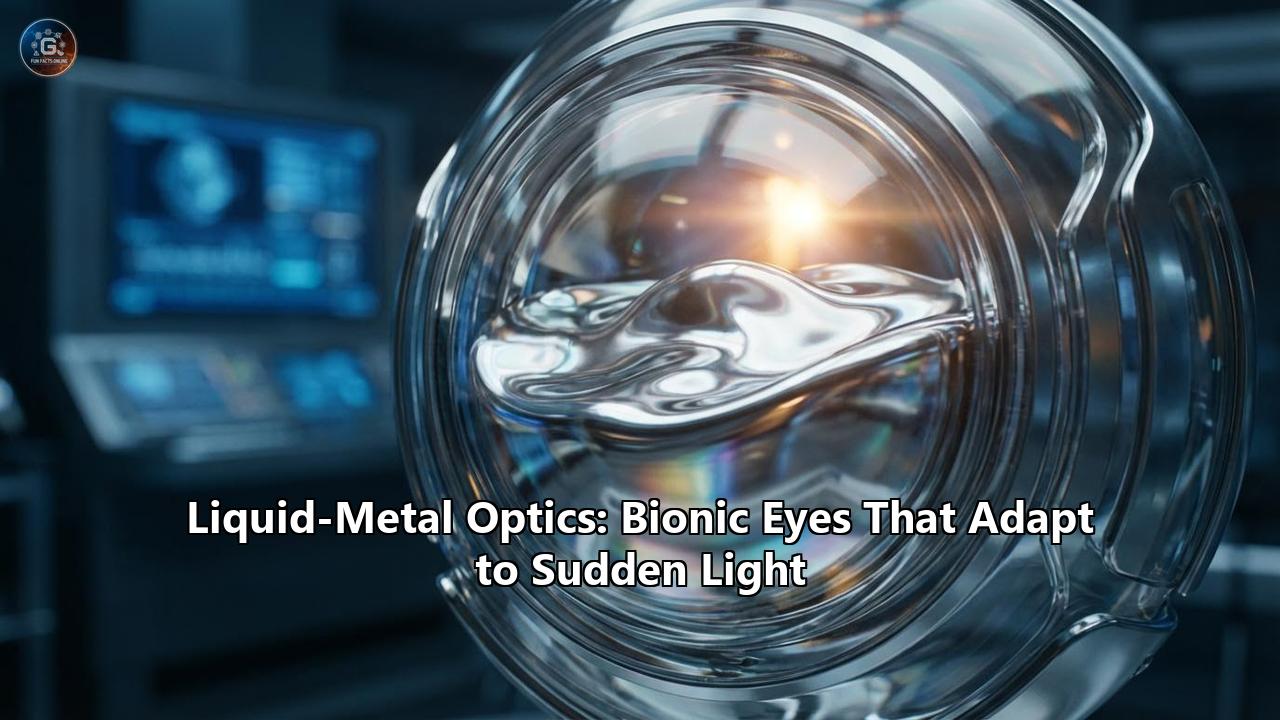
anatomically correct artificial eye. Because liquid metals are flexible and soft, they integrate far more naturally with biological tissue than rigid silicon chips and metal wires. In the future, a bionic eye replacement could be surgically implanted directly into the ocular cavity. The liquid-metal pupil would seamlessly adapt to the ambient light, while the liquid-metal neurons translate the photons into electrical spikes that interface directly with the human optic nerve. We are rapidly approaching the day when an artificial eye will not just restore sight, but offer vision that is sharper, faster, and more adaptable than natural human eyesight.
The Obsolescence of Solid-State Optics
What we are witnessing is the beginning of the end for purely solid-state, mechanical optics. For centuries, our mastery of light has been dictated by our ability to grind glass and precisely machine metal. From Galileo’s telescope to the multi-lens array on the back of the latest smartphone, the fundamental architecture of the camera has remained rigid.
But the universe is not rigid. Light is dynamic, environments are chaotic, and biological life thrives because it is fluid and adaptable.
The liquid-metal bionic eye represents a philosophical shift in engineering. By mimicking the soft, adaptable, and self-regulating systems of biological organisms, we are creating machines that no longer just record the world passively. They interact with it actively. They feel the sting of a sudden bright light, and they instinctively squint. They sense the encroaching darkness, and they widen their gaze to pull every available photon from the shadows.
The integration of electrowetting dynamics, liquid-metal conductivity, and quantum dot neural pre-processing has bridged the gap between the camera and the brain. As this technology scales down in cost and ramps up in production, it will inevitably find its way into our smartphones, our drones, our cars, and our homes. The bulky, fragile, and slow camera mechanisms of today will soon look as archaic as the hand-cranked film cameras of the 1920s.
A New Way of Seeing
As AI continues to evolve, it requires senses that can keep up with its processing power. An artificial intelligence is only as smart as the data it receives, and for too long, machine vision has been looking at the world through a broken window—one that glares out in the sun and blacks out in the dark.
The liquid-metal pupil has finally shattered that window. By allowing artificial eyes to adapt to sudden light changes with the effortless grace of a biological organism, we have untethered machines from the limitations of human engineering and plugged them directly into the brilliance of evolutionary design.
We are standing on the precipice of a world where our cars will never be blinded by the sun, our rescue robots will never be lost in the dark, and our machines will see the universe with a clarity and resilience that we can only dream of. The future of vision is no longer made of glass and gears. The future of vision is liquid.
Reference:
- https://opg.optica.org/ol/abstract.cfm?uri=ol-38-13-2336
- https://lifeboat.com/blog/2026/03/liquid-metal-pupil-helps-an-artificial-eye-adapt-to-sudden-light-changes
- https://nationaltoday.com/us/nc/chapel-hill/news/2026/03/07/liquid-metal-tech-promises-better-eyes-for-robots-and-cars/
- https://pubmed.ncbi.nlm.nih.gov/23811920/
- https://www.corning.com/media/worldwide/csm/documents/Improving_iris_recognition_liquid_lens_newformat_.pdf
- https://www.sciencedaily.com/releases/2022/01/220119155224.htm
- https://pubmed.ncbi.nlm.nih.gov/28589679/
- https://www.researchgate.net/publication/264460665_Adaptive_liquid_crystal_iris