
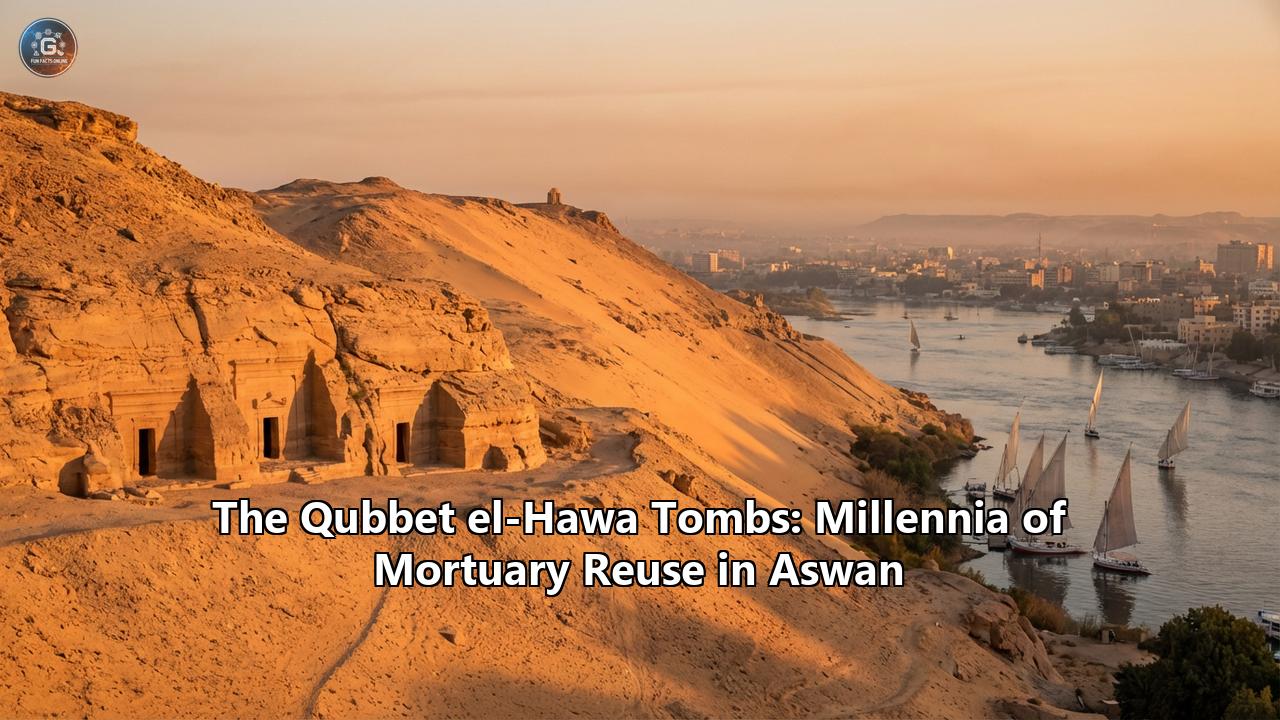
High above the western bank of the Nile, where the golden sands of the Sahara meet the life-giving waters of the river, stands a rugged sandstone and limestone cliff that has silently watched over Egypt’s southern frontier for more than four thousand years. Crowned today by the domed tomb of a local Islamic saint—which gives the site its modern Arabic name, Qubbet el-Hawa, or the "Dome of the Wind"—this elevated vantage point is far more than a scenic overlook. Beneath its wind-sculpted surface lies a labyrinth of subterranean rock-cut tombs (hypogea) that form one of the most significant, yet uniquely complex, necropolises in the ancient world.
To step into the shadowy, pillared halls of Qubbet el-Hawa is to step into a chronological palimpsest. Unlike many ancient cemeteries that were utilized for a single dynasty and then abandoned to the sands, Qubbet el-Hawa is a masterclass in millennia of mortuary reuse. For centuries, generation after generation of ancient Egyptians returned to this very cliff face. They carved new chambers, usurped old ones, pushed aside the bones of their ancestors, and continuously reshaped the architecture of death to suit the shifting religious and political landscapes of their times. From the pioneering explorers of the Old Kingdom to the powerful regional governors of the Middle Kingdom, and from Graeco-Roman cultists hiding giant mummified crocodiles to Coptic monks seeking ascetic isolation, the Dome of the Wind has hosted a ceaseless parade of humanity.
The Geological Canvas and the First Architects
The story of Qubbet el-Hawa begins with its geography. Situated just opposite the modern city of Aswan and the ancient settlement of Elephantine Island, the necropolis overlooks the First Cataract of the Nile. In antiquity, this was the absolute southern border of Egypt—a vital military garrison and a bustling trade hub where the wealth of Nubia and the African interior (gold, ivory, ebony, and exotic animals) flowed into the pharaonic state.
The geological and topographical conditions of the hill were perfectly suited for the construction of elaborate funerary structures. The elites of Elephantine, known as nomarchs (provincial governors), required tombs that reflected their immense power and autonomy. During the Old Kingdom, particularly the 6th Dynasty (circa 2345–2181 BCE), these intrepid governors initiated the first major phase of construction. Prominent figures like Harkhuf, Sabni, and Mekhu carved their resting places into the cliff face, adorning them with biographical inscriptions that read like ancient adventure novels, detailing their perilous trade expeditions deep into unexplored African territories.
Recent archaeological campaigns have dramatically expanded our understanding of these early pioneers. In early 2026, an Egyptian archaeological mission from the Supreme Council of Antiquities unearthed a spectacular new group of Old Kingdom rock-cut tombs. Although the original builders of these newly discovered tombs may have lacked the vast economic resources to richly decorate their walls, they adhered strictly to traditional funerary architecture, equipping their eternal homes with vertical burial shafts, small open courtyards, offering tables, and false doors—the magical thresholds through which the soul (the ka) could travel to receive sustenance.
Most astonishingly, deep inside the burial chambers of these Old Kingdom tombs, archaeologists recovered approximately 160 ceramic vessels, many found completely intact. Bearing cursive hieratic inscriptions that likely recorded their ownership and contents, these jars were systematically arranged to store the liquids and grains necessary to sustain the deceased in the afterlife. The incredible preservation of these vessels offers unprecedented, direct evidence of how food and drink were prepared, labeled, and stockpiled for eternity over four thousand years ago.
The First Intermediate Period: A Time of Transition
As the centralized power of the Old Kingdom pharaohs collapsed around 2181 BCE, Egypt plunged into the First Intermediate Period—an era of political fragmentation, climate stress, and social upheaval. Yet, at Elephantine, the local nomarchs did not fade into obscurity; instead, they leveraged the power vacuum to become essentially independent princes.
During this turbulent era, the mechanics of mortuary reuse at Qubbet el-Hawa truly began. The recently discovered Old Kingdom tombs containing the 160 pottery vessels did not end their operational lives when the 6th Dynasty fell. Stratigraphic evidence and the changing placement of blocking stones reveal that subsequent generations returned to these exact shafts during the First Intermediate Period, carefully navigating the ancient burials to inter their own dead.
Why did they reuse these spaces? The answer lies in a blend of practicality and spiritual continuity. Carving a new tomb into the solid bedrock of the cliff was an exceptionally labor-intensive and expensive endeavor, especially when the geological "prime real estate" of the hill had already been claimed by earlier ancestors. Furthermore, being buried in close proximity to the venerated nomarchs of the past lent a powerful aura of legitimacy and divine protection to the newly deceased. The necropolis was not viewed as a static, closed museum, but rather as an active, living community of spirits where space could be renegotiated.
The Middle Kingdom Renaissance and the Sarenput Dynasty
When Egypt was eventually reunified under the Middle Kingdom (circa 2055–1650 BCE), Qubbet el-Hawa experienced its golden age. The 12th Dynasty pharaohs heavily fortified the southern border, and the governors of Elephantine—most notably the illustrious Sarenput I, Sarenput II, and the deified Heqaib—enjoyed a degree of wealth and autonomy that allowed them to act as minor sovereigns.
These Middle Kingdom lords constructed breathtaking funerary complexes. Tomb QH33, for instance, represents one of the grandest governoral tombs, built during a time when the region was heavily tied to the royal court in Itj-Tawy. However, the elite did not just build new monuments; they actively interacted with the old. In the outer courtyards of the newly discovered Old Kingdom tombs, modern archaeologists have unearthed a treasure trove of Middle Kingdom artifacts: gleaming copper alloy mirrors, delicate alabaster containers used for kohl (eye makeup), and beautifully crafted bead necklaces and amulets. These artifacts prove that Middle Kingdom citizens actively re-entered the ancient Old Kingdom complexes, either to bury their own family members or to leave votive offerings for the ancestral spirits.
The University of Jaén’s Qubbet el-Hawa Project, which has been rigorously excavating the site since 2008, has brought the Middle Kingdom elite vividly back to life. In a spectacular 2017 discovery, the Spanish team uncovered the completely intact burial of a man named Shemai in tomb QH34bb. Shemai was the younger brother of the great governor Sarenput II. Found at the bottom of a previously unexcavated shaft, Shemai’s mummy had rested undisturbed for 3,800 years. He was discovered adorned with a stunning cartonnage mask and a broad collar, encased in a magnificent outer wooden coffin. The east side of this coffin featured large, painted wedjat (Eye of Horus) eyes, perfectly aligned with the mummy's face so that Shemai could magically look out toward the sunrise each morning, sharing in the sun god's daily triumph over death.
Another fascinating Middle Kingdom development at the site was the evolution of the "soul house." In tombs like QH33—which dates to the late 12th Dynasty but was reused continuously through the 17th, 18th, 26th, and 27th Dynasties—archaeologists have found fragmented pottery offering trays. These votive objects, placed in the public areas or shafts of the tombs during post-burial rituals, evolved from simple flat trays equipped with drainage channels for liquid libations into intricate, miniature terracotta "soul houses" complete with architectural models of huts, staircases, and courtyards. They were designed to magically provide the soul with both endless food and a physical refuge.
The Mechanics of Usurpation: New Kingdom to Late Period
As the Middle Kingdom gave way to the New Kingdom (circa 1550–1069 BCE) and the capital of Egypt shifted to Thebes (modern Luxor), the massive governoral tomb construction at Qubbet el-Hawa slowed. Yet, the site’s prestige remained magnetic. Because the best locations on the cliff face were already taken, New Kingdom officials engaged in outright tomb usurpation.
A prime example is Tomb QH32. Originally constructed and utilized during the mid-12th Dynasty (likely during the reign of Amenemhat II), this grand tomb was later claimed by a New Kingdom official named Aku in the early 18th Dynasty. Aku did not simply reuse the space; he actively redecorated the ancient walls to reflect his own identity and status. The pillared halls of QH32, complete with deep burial shafts, became a multigenerational vault that saw continuous use and plundering. Later still, at the twilight of the 22nd Dynasty and the dawn of the Third Intermediate Period, the tomb was reused once again, its shafts reopened to accept new occupants in a vastly different political era.
This perpetual cycle of use, looting, and reuse created a complex archaeological puzzle. Modern researchers must carefully disentangle the stratigraphy of these shafts. For example, in Tomb QH35n, an originally late Middle Kingdom tomb was found to contain burials dating through the 13th Dynasty, demonstrating that even lower-ranking elites continued to squeeze their deceased into the available monuments long after the grand governoral complexes had ceased being built.
Sacred Beasts and Graeco-Roman Cults
As Egypt transitioned into the Graeco-Roman period, the nature of religious worship and mortuary practice underwent profound transformations. While the classic pharaonic elite burials faded, Qubbet el-Hawa adapted to the new spiritual demands of the Ptolemaic and Roman eras. Recent joint Egyptian-Italian missions near the Aga Khan Mausoleum on the West Bank have discovered entirely new rock-cut Graeco-Roman tombs, proving the site's ongoing expansion.
However, the most astonishing evidence of late-period reuse came to light during the 2019 excavations by the University of Jaén in a tomb designated QH34ll. Initially constructed during the First Intermediate Period or early Middle Kingdom, this small, unassuming rock-cut tomb was later repurposed for a radically different kind of burial. Beneath a Byzantine-era dump, archaeologists discovered an extraordinary cache of crocodile mummies.
These were not the small, heavily wrapped, resin-soaked animal mummies typically found in Late Period catacombs. The deposit consisted of five large, more or less complete adult crocodiles—ranging up to a staggering 3.5 meters (11.5 feet) in length—along with five massive severed crocodile heads. Strikingly, these beasts were mummified without the use of black resin; they were simply wrapped in linen and buried in the sand. Because insects had consumed much of the linen over the centuries, researchers were left with perfectly preserved osteological remains, providing a rare and unprecedented look at the morphology of these sacred reptiles.
The presence of these apex predators in a Middle Kingdom governor's tomb highlights a fascinating theological shift. By the Late and Ptolemaic periods, the cult of Sobek (the crocodile god of water and fertility) had reached immense popularity. The ancient, gaping shafts of Qubbet el-Hawa, long since robbed of their pharaonic gold, provided perfect, ready-made catacombs for the sacred animals of the gods. The ancient human occupants were brushed aside, and the space was consecrated to the divine reptiles of the Nile.
The Monks, the Sheikh, and the Modern Era
The final ancient transformation of Qubbet el-Hawa occurred during the Byzantine and early Islamic periods. As the old gods of Egypt were eclipsed by Christianity, communities of Coptic monks sought refuge in the desert. Looking at the honeycombed cliffs of Aswan, they saw readymade monastic cells. Several of the grand hypogea were radically repurposed: hieroglyphs were plastered over, offering niches were transformed into altars, and the tombs of the nomarchs became vibrant Coptic churches and ascetic dwellings. The site remained an active religious focal point until the Islamic era, when the titular domed tomb of a local sheikh was constructed at the very summit of the hill, giving the necropolis its enduring modern name.
Today, Qubbet el-Hawa is not a place of the dead, but a bustling laboratory of the living. The modern era of excavation, which began with figures like Wallis Budge, Labib Habachi, and Elmar Edel, has evolved into a highly sophisticated scientific endeavor. The current Qubbet el-Hawa Project, directed by Dr. Alejandro Jiménez-Serrano of the University of Jaén, alongside the Supreme Council of Antiquities and various international teams, utilizes cutting-edge technology to unravel the site's tangled history.
Archaeologists now employ advanced geomatics to map the complex, intersecting geometry of the hypogea. 3D metrological analysis and Raman spectroscopy are used to test the pigments on ancient cartonnage, revealing stark differences in the quality of materials used by different social classes. The meticulous analysis of botanical remains, insect damage, and shifting blocking stones allows historians to read the tombs like a book, identifying exactly when a tomb was built, when it was robbed, and when it was reused.
The ongoing discoveries—from the 160 Old Kingdom pottery jars found in 2026 to the pristine mummy of Shemai and the giant sacred crocodiles—prove that Qubbet el-Hawa has not yet surrendered all its secrets. It stands as one of the most remarkable monuments in Egypt: a place where the boundaries between generations blur. By continuously reusing, redecorating, and reclaiming this single cliff face, the ancient inhabitants of Aswan inadvertently created a monumental time capsule. Qubbet el-Hawa is the ultimate testament to the human desire to be remembered, showcasing a profound, multi-millennial dialogue between the living and the dead.
Reference:
- https://en.wikipedia.org/wiki/Qubbet_el-Hawa
- https://the-past.com/feature/precise-construction-of-funerary-structures-at-qubbet-el-hawa-aswan/
- https://archaeologymag.com/2026/02/old-kingdom-tombs-at-qubbet-el-hawa/
- https://pmc.ncbi.nlm.nih.gov/articles/PMC9848469/
- https://fundacionpalarq.com/en/qubbet-el-hawa/
- https://www.finestresullarte.info/en/archaeology/discovery-in-aswan-egypt-s-new-rock-tombs-from-the-old-kingdom-at-the-site-of-qubbet-el-hawa
- https://english.ahram.org.eg/News/548813.aspx
- https://archaeology.org/news/2026/02/26/old-kingdom-tombs-discovered-in-upper-egypt/
- https://www.nilemagazine.com.au/2017-march/2017/3/24/intact-middle-kingdom-tomb-discovered-in-aswan
- https://lens.idai.world/?url=/repository/MDAIK_79/MDAIK_79_Bardonova_et_al.xml
- https://aedeweb.com/wp-content/uploads/6-CRISTINA-LECHUGA-IBANEZ-POTTERY-OFFERING-TRAYS-AND-SOUL-HOUSES_STABLISHING-THE-DIFFERENCE.pdf
- https://editorial.ujaen.es/media/editorialujaen/files/sample-159161.pdf
- https://the-past.com/magazines/ancient-egypt-magazine-150/
- https://archaeologymag.com/2025/04/house-of-life-discovered-at-the-ramesseum/