
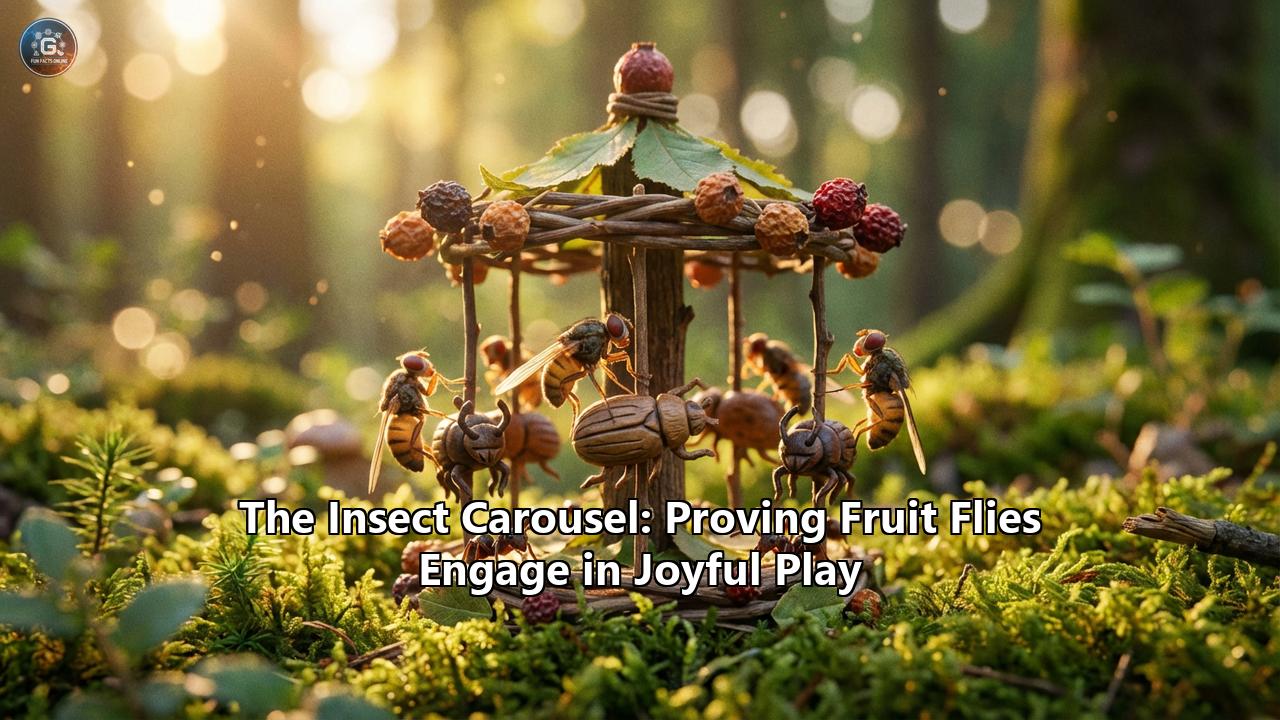
It is a scene that belongs in a Pixar movie, yet it is happening in a sterile laboratory at Leipzig University: a tiny fruit fly, arguably the most studied organism in the history of science, voluntarily steps onto a spinning platform. It spins, exits, pauses, and then—defying all traditional biological expectations of efficiency and survival—turns around and jumps back on for another ride.
For over a century, science has viewed the fruit fly, Drosophila melanogaster, as a biological automaton—a complex but soulful collection of reflexes driven solely by the need to eat, mate, and survive. They were the "biological test tubes" of genetics, devoid of an inner life. But a groundbreaking study published in Current Biology has shattered this assumption. Led by neurobiologist Dr. Wolf Hütteroth and his team, researchers have provided the first concrete evidence that insects engage in "locomotor play."
The study, centering on a device affectionately dubbed the "Insect Carousel," suggests something profound: these tiny creatures may not just be surviving; they might be having fun. This discovery does not just rewrite the textbooks on insect behavior; it challenges our understanding of the origins of joy, the purpose of play, and the evolution of consciousness itself.
The Paradigm Shift: From Automaton to Acrobat
To understand the magnitude of the "Insect Carousel" experiment, one must first appreciate the scientific dogma it disrupts. For decades, the definition of "play" was gated by a velvet rope, reserved exclusively for vertebrates with complex brains—mammals and birds. We accept that a dog chases a ball for fun, or that a crow slides down a snowy roof for the thrill. These behaviors are metabolically expensive and risky, yet animals do them because they feel good.
Insects, however, were thought to be too simple for such frivolity. Their brains, containing roughly 100,000 neurons compared to a human's 86 billion, were seen as efficiency engines. Every movement was calculated for survival. If a fly was moving, it was assumed to be searching for food or a mate, or escaping a predator.
"Insects have long been viewed as tiny robots," says Dr. Hütteroth, now an Associate Professor at Northumbria University. "But we are finding that their brains, though small, are capable of subjective experiences that we are only just beginning to understand."
The "Insect Carousel" experiment was designed to test a radical hypothesis: if given a safe environment with no survival pressure, would a fruit fly do something just for the sake of doing it?
The Experiment: Building a Theme Park for Flies
The experimental setup was deceptively simple, yet rigorous in its design. The researchers created a "carousel arena"—a small, controlled environment topped with a transparent dome. Inside, the flies had access to everything they needed: food, water, and space to roam.
But the centerpiece of the arena was a rotating disk—a spinning floor that offered no food, no mates, and no shelter. It was, for all intents and purposes, a playground ride.
The researchers, led by first author Dr. Tilman Triphan, tracked the movements of 190 individual flies over several days, recording their interactions with the spinning disk. They also set up control groups with stationary disks to ensure the flies weren't just attracted to the visual texture or the location of the platform.
The results were immediate and striking. While some flies (the "avoiders") steered clear of the spinning chaos, a distinct group of flies (the "seekers") emerged. These individuals didn't just stumble onto the carousel; they sought it out.
The "Seeker" Phenotype
The behavior of the "seeker" flies was remarkably consistent and deliberate. A seeker fly would approach the spinning disk, step onto it, and ride the rotation. After a few seconds or minutes, it would hop off. But instead of wandering away to eat or rest, it would turn around and re-enter the carousel.
"We saw flies that would spend up to 5 minutes on the wheel, jump off, and immediately jump back on," notes Dr. Clara H. Ferreira, a co-author of the study. "They were trading valuable time that could be spent eating for time spent spinning."
Crucially, the researchers analyzed how the flies entered the carousel. If the visits were accidental, one would expect the flies to land on the disk randomly or clumsily. Instead, the analysis showed that the seekers were "deliberately walking" onto the apparatus. It was a controlled, intentional entry. They weren't being trapped; they were buying a ticket.
The Five Pillars of Play
To scientifically classify this behavior as "play," it had to meet strict ethological criteria established by pioneers like Gordon Burghardt. The Insect Carousel passed all five benchmarks:
- Voluntary: The flies were not forced onto the disk. They had ample space to stay in the stationary zones. They chose the spin.
- Repeated but Not Stereotyped: The behavior wasn't a rigid, robotic loop (like a moth flying into a flame). The flies varied their time on the disk, their entry points, and their body positions. It was flexible behavior.
- Non-Functional: The carousel offered no food, no mating partners, and no protection. In fact, it was "non-ethotypical"—it didn't mimic any natural survival behavior like foraging or fighting. In the short term, it was a waste of energy.
- Stress-Free: The behavior only occurred when the flies were comfortable. If the researchers introduced stressors (like lack of food or perceived threats), the carousel visits stopped. Play is a luxury of safety.
- Rewarding (Joyful): This is the most elusive but critical criterion. The animal must do it because the activity itself is reinforcing. The fact that flies sacrificed feeding time to spin suggests that the sensation of spinning was, in itself, the reward. In human terms, we call this "fun."
The Neuroscience of the Spin: Why Do They Do It?
If the flies are playing, the immediate question is why? Evolution rarely retains behaviors that waste energy without a benefit.
The researchers propose that this "locomotor play" serves a vital neurodevelopmental function: Proprioceptive Calibration.
Proprioception is the "sixth sense"—the awareness of where your body is in space. For an aerial acrobat like a fruit fly, which must navigate complex 3D environments at high speeds, a finely tuned sense of body position is life-or-death.
"We propose that this kind of locomotor play is particularly well suited to shape our body self-perception," Dr. Hütteroth explains.
Think of a human child spinning in circles until they fall over dizzy. It seems pointless, but that child is stress-testing their vestibular system. They are learning how their brain processes chaotic motion signals. Similarly, the fruit fly on the carousel is likely flooding its nervous system with "error signals"—mismatches between what it sees and what it feels. By intentionally inducing this sensory chaos in a safe environment, the fly is training its brain to handle unexpected movements during flight.
It is "joy" with a purpose: the brain rewards the animal for training its own sensory systems. The fly feels "good" on the carousel for the same reason a skier feels "good" navigating a mogul field—it is the satisfaction of mastery and sensory integration.
The "Joy" in the Machine: Insect Emotion
The carousel study adds a critical piece to the growing puzzle of insect sentience. For years, the scientific community has been hesitant to use words like "emotion" or "feeling" for invertebrates. However, the evidence is becoming undeniable.
- Optimistic Bees: In 2016, researchers discovered that bumblebees given a surprise sugar treat exhibited "optimism"—they were more likely to check ambiguous flowers and recovered faster from scary stimuli. They showed a positive cognitive bias, a hallmark of happiness.
- Depressed Flies: Conversely, studies have shown that fruit flies experience "learned helplessness" and depression-like states when exposed to uncontrollable vibration stress, showing changes in their walking patterns and motivation.
- Pain and Anxiety: Research has identified persistent anxiety-like states in crayfish and nociception (pain detection) modulation in insects that hints at a subjective experience of suffering.
The Insect Carousel provides the positive counterpart to these studies. If flies can be depressed or anxious, the carousel proves they can also seek positive stimulation. They can experience a state of being that is distinct from mere survival—a state of engagement and, arguably, joy.
This suggests that the capacity for "valence"—the ability to feel that a situation is inherently good or bad—is not a recent evolutionary invention of the mammalian brain. It is an ancient, fundamental circuit. The "spark" of joy may have been lit hundreds of millions of years ago, long before the first dinosaur walked the earth.
Broader Implications: Ethics and Consciousness
The realization that a fruit fly can "play" has profound ethical and philosophical implications.
1. The Ethics of ResearchBillions of fruit flies are used in research annually. They are the workhorses of genetics, often discarded without a second thought. While this discovery won't stop their use in science—their contribution to curing human disease is too valuable—it may change how they are treated. The concept of "insect welfare" is moving from a fringe idea to a serious scientific consideration. If a fly can suffer and can experience joy, do we have an obligation to minimize the former and enable the latter?
2. The Evolution of ConsciousnessThis research blurs the line between "us" and "them." We often define humanity by our "higher" traits: creativity, play, art. Finding the roots of play in an insect suggests that these traits are not top-down additions to a complex brain, but bottom-up fundamentals of a nervous system. Consciousness may not be a light switch that flipped on with humans, but a dimmer switch that has been slowly turning up for 500 million years.
3. Artificial Intelligence and RoboticsDr. Hütteroth’s findings are also being watched closely by roboticists. If a simple brain with limited neurons can "learn" body awareness through play, this could be a model for training AI. Instead of programming robots to walk perfectly, perhaps we should program them to "play"—to experiment with their own movements in a safe simulator to "learn" their own physics, just as the flies do.
Conclusion: The Spinning Fly
It is easy to look at a fruit fly buzzing around a kitchen fruit bowl and see a pest. But the next time you see one, pause for a moment. Consider the "Insect Carousel."
That tiny speck of life possesses a brain capable of making choices. It can decide to engage in something frivolous. It can trade a meal for a thrill. It can learn about its own body through the sheer fun of movement.
The study by Hütteroth, Triphan, and Ferreira has given us a glimpse into a world we thought was dark and mechanical, revealing it to be vibrant and possibly even joyful. The fruit fly is no longer just a genetic calculator; it is a tiny being that, given the chance, will choose to jump on a merry-go-round, spinning in the dark, driven by an ancient, universal impulse to feel alive.
The carousel is spinning, and the insects are riding. The question is no longer "do they play?" but rather, "what else are they capable of that we have yet to imagine?"
Reference:
- https://www.sciencedaily.com/releases/2025/02/250214123727.htm
- https://nachrichten.idw-online.de/2025/02/13/flies-play-too-researchers-find
- https://bioengineer.org/researchers-discover-that-flies-engage-in-playful-behavior/
- https://www.earth.com/news/flies-like-to-play-and-have-fun-like-other-animals-according-to-a-fascinating-new-study/
- https://www.northumbria.ac.uk/about-us/news-events/news/flies-play-study/
- https://www.youtube.com/watch?v=N4zUNb9dHSY
- https://awrn.co.uk/2016/10/02/insect-emotion-and-consciousness/
- https://adamwilkins.substack.com/p/do-bees-affect-each-others-moods
- https://findanexpert.unimelb.edu.au/news/97492-%E2%80%98one-of-the-most-important-species-for-science%E2%80%99--how-the-humble-fruit-fly-transformed-4-fields-of-research