
Imagine a terrestrial creature abruptly plunged into a suffocating, alien world where the oxygen supply is slashed to a fraction of its normal levels, and the very medium it moves through threatens to flood its respiratory system. For the vast majority of terrestrial insects, falling into water is a death sentence. Yet, across millions of years of evolution, a remarkable subset of insects has not only returned to the aquatic environments of their distant ancestors but has absolutely thrived there. From the deepest, oxygen-starved mud of stagnant lakes to the rushing, freezing torrents of alpine streams, aquatic insects have conquered the underwater realm.
Their success is a masterclass in evolutionary engineering. To survive underwater, these insects have had to fundamentally hack their own biology, developing bizarre and brilliant adaptations to stave off hypoxia—a state of oxygen deprivation. They use everything from temporary scuba tanks and microscopic permanent air shields to jet-propelled rectal gills and biochemical factories that produce rare respiratory pigments. Understanding how these submerged insects breathe underwater offers a fascinating glimpse into the limits of life on Earth and the incredible resilience of the insect respiratory system.
The Aquatic Paradox: Why Breathing Underwater is so Difficult
To understand the sheer magnitude of the challenge aquatic insects face, we must first look at how typical insects breathe. Unlike vertebrates, insects do not have lungs. Instead, they rely on a highly branched network of tubes called the tracheal system. Air enters the insect's body through small, valve-like openings on their exoskeleton called spiracles. From the spiracles, oxygen travels through increasingly smaller tubes (tracheae and tracheoles) until it is delivered directly to individual cells in the form of a gas. Simultaneously, carbon dioxide diffuses out through the same pathway.
This system is wildly efficient on land, where the atmosphere is composed of roughly 21% oxygen. However, water is a hostile medium for gas exchange. First, water contains about 30 times less dissolved oxygen than the atmosphere. Second, oxygen diffuses approximately 10,000 times slower in water than it does in air. To make matters worse, the solubility of oxygen in water is heavily dependent on temperature: as water warms up, it holds even less oxygen.
When a terrestrial insect is submerged, water pressure threatens to force liquid into the spiracles, collapsing the tracheal system and drowning the animal. To survive, aquatic insects—all of which evolved from terrestrial ancestors and subsequently returned to the water—had to modify this terrestrial lung-equivalent into something that could operate in a dense, oxygen-poor liquid. The solutions they developed fall into two broad categories: keeping the air-filled tracheal system open to the surface, or closing the system entirely and extracting dissolved oxygen directly from the water.
The Snorkelers: Staying Tethered to the Sky
The simplest method for surviving underwater is to bypass the aquatic medium entirely. Many aquatic insects are equipped with specialized anatomical extensions that act exactly like a swimmer's snorkel.
Mosquito larvae (often called "wigglers") and water scorpions (family Nepidae) are classic examples of this strategy. These insects possess an open tracheal system, meaning their spiracles are still functional, but they are concentrated at the end of a specialized breathing tube or siphon located at the posterior end of their abdomen. When the insect needs to breathe, it simply hangs upside down just below the water's surface, breaking the surface tension with the tip of its siphon.
To prevent water from rushing down the tube when the insect inevitably dives to avoid predators, the tip of the siphon is surrounded by specialized hydrofuge (water-repelling) hairs. When submerged, these hairs fold inward, effectively sealing the tracheal system with an impenetrable, hydrophobic cap. While this method is highly effective and guarantees access to atmospheric oxygen, it heavily restricts the insect's habitat. Snorkelers are forever tethered to the surface and are usually confined to still, calm waters where the surface tension remains unbroken.
The Scuba Divers: Compressible Gas Gills
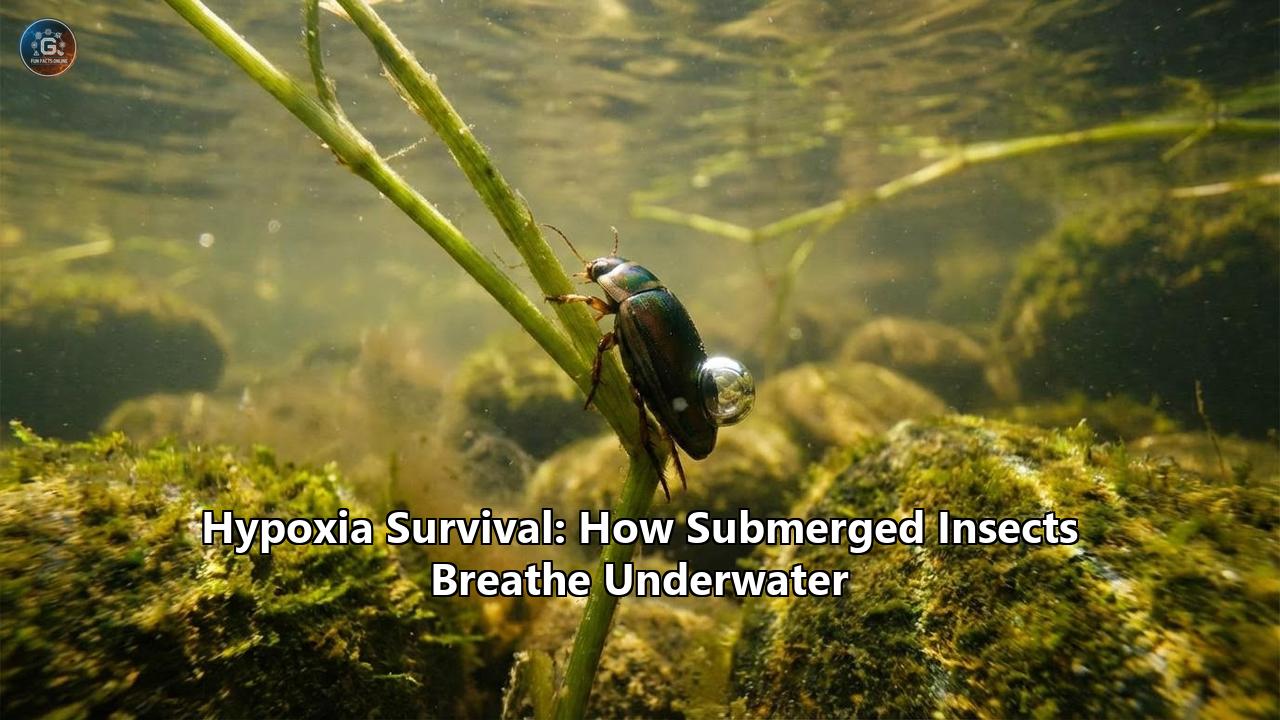
For insects that need to dive deeper and hunt more actively, a snorkel is insufficient. Instead, insects like the predatory diving beetles (family Dytiscidae) and backswimmers (family Notonectidae) have developed a way to take the atmosphere with them. Before diving, these insects capture a bubble of air from the surface, trapping it under their wings or against their abdomen using specialized hairs.
At first glance, this air bubble appears to be a simple, temporary oxygen tank, much like a scuba diver's cylinder. However, the bubble functions as something much more sophisticated: a "physical gill" or a compressible gas gill. As the submerged insect consumes the oxygen inside the bubble, the partial pressure of oxygen within the trapped air drops below the partial pressure of dissolved oxygen in the surrounding water. Because gases naturally diffuse from areas of high pressure to low pressure, oxygen from the surrounding water actually diffuses into the bubble.
Thanks to this inward diffusion, the insect can extract significantly more oxygen from the bubble than was originally present when it left the surface. Unfortunately, this ingenious system has a fatal flaw. The atmosphere, and thus the bubble, is mostly composed of nitrogen. As oxygen is consumed and carbon dioxide is expelled (which dissolves very rapidly into the water), the relative concentration of nitrogen inside the bubble increases. The nitrogen then slowly diffuses outward into the surrounding water. As the nitrogen escapes, the physical volume of the bubble shrinks until it is entirely depleted. The insect is therefore racing against a ticking clock; once the bubble collapses, the physical gill ceases to function, forcing the insect to abandon its hunt and swim back to the surface for a fresh gulp of air.
The Submarines: Incompressible Gas Gills (Plastrons)
Evolution rarely settles for a temporary fix when a permanent one is possible. Enter the plastron, an incompressible gas gill that allows certain aquatic insects to remain submerged for their entire adult lives without ever visiting the surface.
The plastron is utilized by insects living in fast-flowing streams, such as riffle beetles (family Elmidae) and certain water bugs (like Aphelocheirus). Instead of a temporary, shrinking bubble, these insects possess a permanent, microscopic layer of air trapped tightly against their bodies. This is achieved through an extraordinarily dense carpet of hydrofuge hairs—sometimes numbering in the millions per square millimeter. These hairs are structurally reinforced and bent at precise angles to create a rigid, water-repellent canopy.
Because the hairs hold the water interface at bay mechanically, the trapped air layer cannot be compressed, even under significant hydrostatic pressure, and the nitrogen cannot escape to the point of collapsing the volume. The plastron acts as a permanent, continuous physical gill. Oxygen constantly diffuses from the highly oxygenated, fast-flowing water into the plastron, while carbon dioxide diffuses out. These insects can sleep, mate, and overwinter entirely submerged. The only limitation of the plastron is that it requires well-oxygenated water to function efficiently; if placed in stagnant water, a plastron-breathing insect will eventually suffocate as it depletes the local dissolved oxygen faster than it can be replenished.
Anatomical Wonders: Tracheal Gills
While snorkeling and bubble-carrying rely on open tracheal systems, the true masters of underwater hypoxia survival have closed tracheal systems. In these insects, the spiracles are permanently sealed or entirely absent. Instead, they rely on cutaneous respiration—breathing directly through their skin. To maximize the absorption of dissolved oxygen, these insects have evolved spectacular, specialized outgrowths of their body wall known as tracheal gills.
Tracheal gills are primarily found in the larval (nymph or naiad) stages of insects like mayflies (Ephemeroptera), stoneflies (Plecoptera), dragonflies, and damselflies (Odonata). These gills are essentially localized areas of extremely thin cuticle heavily packed with dense networks of microscopic tracheoles. The thinness of the barrier minimizes the distance oxygen must travel to diffuse from the water into the insect's respiratory network.
Interestingly, tracheal gills evolved independently multiple times across different insect lineages, meaning they are analogous rather than homologous structures. Because of this independent evolution, the placement and function of tracheal gills vary wildly:
- Mayflies (Ephemeroptera): Mayfly nymphs possess paired, leaf-like or filamentous gills lining the sides of their abdomen. Evolutionary biologists believe these abdominal gills may be derived from the ancestral legs of early arthropods. What makes mayflies remarkable is their degree of respiratory control. Species like Ecdyonurus insignis possess musculature that allows them to actively beat or flick their gills. When oxygen levels in the water drop (a hypoxic event), the mayfly beats its gills faster. This creates a localized current, sweeping away oxygen-depleted water and pulling a fresh supply of oxygenated water over the respiratory surface.
- Damselflies (Zygoptera): Damselfly naiads feature three prominent, feather-like appendages at the very tip of their abdomen, known as caudal lamellae. While these serve as excellent tracheal gills for gas exchange, they double as efficient paddles for swimming.
- Dragonflies (Anisoptera): Dragonfly nymphs exhibit perhaps the most bizarre and spectacular respiratory adaptation in the animal kingdom: the rectal branchial chamber. A dragonfly nymph's gills are entirely internal, lining the inside of its highly muscular rectum. To breathe, the insect expands its abdomen, drawing water in through its anus and bathing the internal tracheal gills in oxygen-rich water. It then forcefully contracts its abdomen, expelling the water back out. This internal gill system offers unparalleled protection from predators and abrasive river sediments. Furthermore, in an emergency, the nymph can violently expel the water from its rectum, propelling itself forward in a rapid burst of jet propulsion to escape danger.
The Hypoxia Champions: Biochemical Mastery and Hemoglobin
While physical gills and tracheal gills are morphological marvels, they generally require relatively clean, oxygenated water. But what about the most extreme, hostile aquatic environments? At the bottom of deep, stagnant lakes, or in highly polluted rivers, oxygen levels can plummet to near zero (severe hypoxia) or vanish entirely (anoxia). Here, morphological adaptations fail. Survival in these toxic, suffocating muds requires a biochemical revolution.
The undisputed champions of extreme hypoxia survival are the larvae of non-biting midges (family Chironomidae). While the vast majority of insects rely solely on the gaseous diffusion of oxygen and do not use respiratory pigments in their blood, certain chironomid larvae are a massive exception. They synthesize massive amounts of a respiratory pigment akin to human hemoglobin, dissolving it directly into their hemolymph (insect blood). This hemoglobin gives the larvae a bright, ruby-red coloration, earning them the common name "bloodworms".
The presence of hemoglobin in insects is extraordinarily rare. Chironomid hemoglobin has an incredibly high affinity for oxygen, meaning it can capture and bind oxygen molecules even in environments where oxygen is practically nonexistent. The larvae live in U-shaped tubes built into the anoxic benthic mud. By performing rhythmic, undulatory movements with their bodies, they pump the faintly oxygenated water from the water column above down into their burrows. The hemoglobin acts as a biological sponge, pulling the scarce oxygen across the larval cuticle and storing it for times of severe stress.
Research has shown that Chironomus hemoglobin acts as a short-term oxygen battery. When environmental oxygen drops below 5% saturation, the bloodworm can rely on its hemoglobin stores to sustain aerobic respiration. But what happens when the battery runs out?
When absolute anoxia sets in, chironomids deploy a secondary, biochemical failsafe: they switch to anaerobic metabolism. Unlike humans, who produce toxic lactic acid when our muscles run out of oxygen, many chironomid larvae degrade their stored glycogen into ethanol (alcoholic fermentation). Because ethanol is relatively non-toxic and easily diffuses out of the insect's body into the surrounding water, the larvae do not suffer from severe metabolic acidosis. This allows them to survive for days or even weeks in completely oxygen-free environments.
Another closely related group, the phantom midges (family Chaoboridae), display equally fascinating adaptations. Chaoborid larvae are transparent predators that undergo extreme daily vertical migrations. During the day, to hide from fish, they sink into the completely anoxic mud at the bottom of lakes. During this daylight anoxia, they rely on a different biochemical pathway called malate fermentation, producing succinate as an end-product to generate ATP without oxygen. Under the cover of darkness, they migrate back up to the oxygen-rich surface waters to hunt zooplankton, clear their metabolic debt, and replenish their biochemical stores before the next day's dive into the suffocating depths.
The Ecological Threat: The Oxygen Squeeze of Global Warming
The incredible adaptations of aquatic insects have allowed them to conquer freshwater ecosystems globally, making them foundational pillars of aquatic food webs. Because different species possess vastly different tolerances to hypoxia, entomologists and ecologists frequently use aquatic insects as bioindicators to monitor the health of rivers and lakes. The famous EPT index, which measures the abundance of Ephemeroptera (mayflies), Plecoptera (stoneflies), and Trichoptera (caddisflies), is the gold standard for assessing water quality. These insects generally require highly oxygenated, pristine waters; their disappearance is an immediate red flag for pollution or hypoxia. Conversely, a dominance of Chironomus bloodworms indicates a heavily polluted or eutrophic, oxygen-starved environment.
However, the delicate respiratory physiology of these insects is currently under severe threat from global climate change. Aquatic insects are caught in a deadly, two-front war known as the "oxygen squeeze." Because aquatic insects are ectotherms (cold-blooded), their body temperature and metabolic rate are directly dictated by the temperature of the surrounding water. As global temperatures rise, waters become warmer, which drastically increases the insects' metabolic demand for oxygen.
Simultaneously, the physical laws of water chemistry dictate that warmer water holds less dissolved oxygen. Just as the insects' bodies are screaming for more oxygen to fuel their accelerated metabolisms, their environment is actively stripping that oxygen away.
Recent physiological studies have revealed that an insect's specific mode of underwater breathing strictly dictates its vulnerability to this warming threat. Researchers examining species pairs across four orders of aquatic insects found that those with high "respiratory control" are much better equipped to survive global warming. For example, mayfly nymphs that can actively beat their gills, or dragonfly nymphs that can pump water through their rectal chambers, can compensate for the lower oxygen levels in warmer water by simply increasing their mechanical ventilation. In contrast, insects with "immovable" or static gills—those that rely entirely on passive diffusion from the water—are highly vulnerable to even slight temperature increases. As the water warms and hypoxia sets in, they lack the physical mechanics to force more water over their respiratory surfaces, leading to suffocation.
The Submerged Pioneers
From the high-tech, permanent physical gills of the riffle beetle to the jet-propelled, rectal breathing of the dragonfly, the adaptations of aquatic insects represent a triumph of evolutionary innovation. They are terrestrial pioneers that conquered an alien, suffocating world by re-engineering their bodies at the morphological, physiological, and biochemical levels.
Their continued survival is a testament to the elasticity of life, but it is also intimately tied to the fragile chemistry of our planet's freshwaters. As we witness shifting climates and warming waters, understanding the intricate mechanisms of hypoxia survival in these submerged insects is no longer just a biological curiosity—it is a critical necessity for predicting the future health of our global freshwater ecosystems.
Reference:
- https://uq.pressbooks.pub/insect-science/chapter/living-with-water/
- https://www.animalfunfacts.net/knowledge/senses-and-abilities/332-how-do-animals-breathe-under-water.html
- https://royalsocietypublishing.org/rsbl/article/9/5/20130473/34920/Respiratory-control-in-aquatic-insects-dictates
- https://insecta.bio.spbu.ru/z/antidictionary/tergalii&gills.htm
- https://www.researchgate.net/figure/Abdominal-tracheal-gills-in-fossil-and-recent-larvae-of-Ephemeroptera-and-retention-of_fig5_335601730
- https://www.ephemeroptera-galactica.com/pubs/pub_s/pubsoldant1997p514.pdf
- https://www.jlimnol.it/jlimnol/article/view/jlimnol.2016.1377/1185
- http://kosmos.icm.edu.pl/PDF/2011/53-ang.pdf
- https://www.rroij.com/open-access/design-and-fabrication-of-a-hypoxiainducing-chamber-for-simulation-studies-in-environmental-biomonitoring-using-chironomus-larvae-.php?aid=86240
- https://repository.library.noaa.gov/view/noaa/69705/noaa_69705_DS1.pdf
- https://www.researchgate.net/publication/227615547_Respiration_of_midges_Diptera_Chironomidae_in_British_Columbian_lakes_Oxy-regulation_temperature_and_their_role_as_palaeo-indicators