
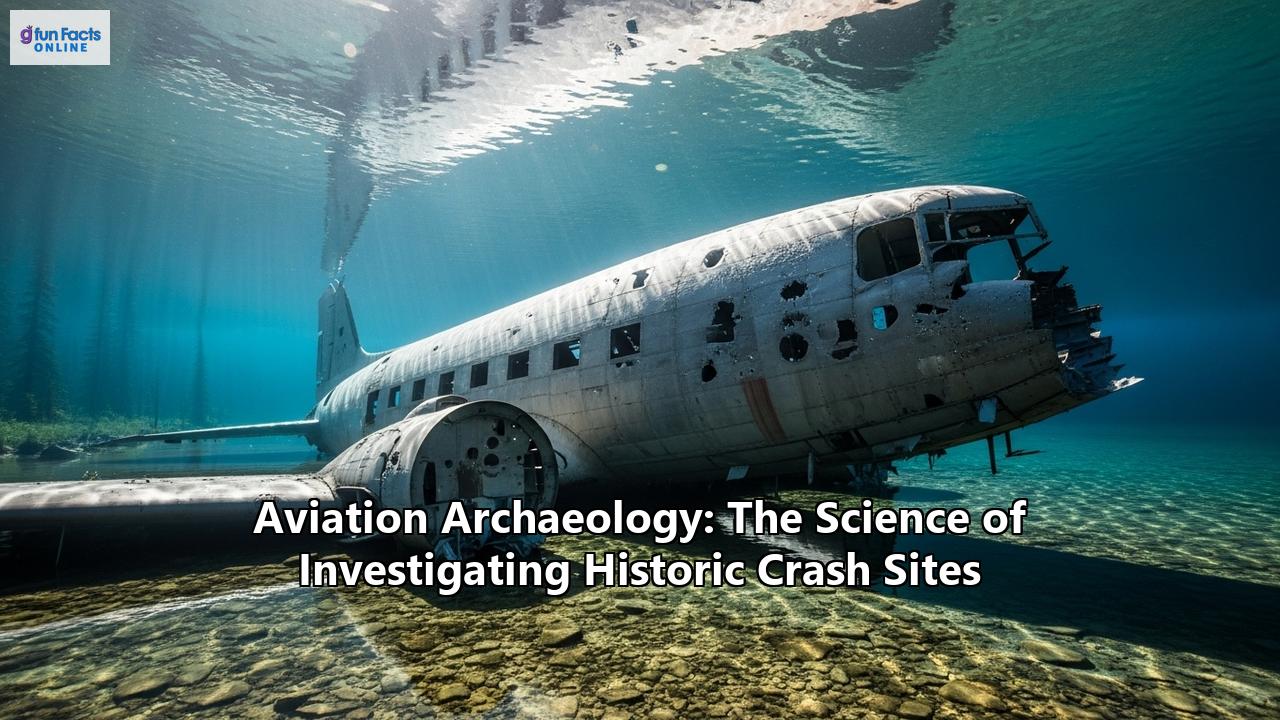
An airplane crash site is more than a scar on the landscape or a ghost on the seabed. It is a moment frozen in time, a complex archaeological puzzle holding stories of technological ambition, human courage, and, often, tragedy. To the uninitiated, it may seem like a field of twisted metal. To the aviation archaeologist, it is a rich historical text waiting to be read.
Aviation archaeology is the scientific discipline dedicated to the investigation of historic aircraft crash sites and other aviation-related locations. It is a field that combines the meticulous techniques of traditional archaeology with the high-tech tools of modern forensics and exploration, delving into everything from World War II battlefields to the remote, icy expanses of the Cold War and the silent depths of the world's oceans. Practitioners are not treasure hunters; they are historians, scientists, and storytellers who unearth, document, and preserve the physical remnants of humanity's journey into the sky. Their work provides closure to families, corrects the historical record, and offers profound insights into the human side of aviation history.
From Souvenir Hunting to Scientific Discipline
The origins of aviation archaeology are rooted in the aftermath of World War II. Across the countryside of Europe, particularly in Great Britain, the landscape was peppered with the wreckage of thousands of military aircraft. In the 1950s and 60s, this gave rise to a new hobby: "wreck hunting." Enthusiastic amateurs, driven by a mix of historical curiosity and a desire for souvenirs, began seeking out and excavating these sites. This early phase was often focused on the recovery of impressive artifacts like engines, propellers, and cockpit instruments.
The transition from an amateur hobby to a recognized academic sub-discipline was gradual but decisive. The 1970s saw the publication of the first dedicated literature, such as Bruce Robertson's 1977 "Aviation Archaeology: A Collector's Guide to Aeronautical Relics," which, while aimed at collectors, began to formalize the practice. The 1980s marked a critical turning point. A growing recognition emerged that the work should be less about simple "acquisition" and more about "inquisition"—a shift from collecting things to answering questions. The first academic mention of archaeological methods at an aviation site appeared in 1981, noting the use of side-scan sonar to locate a Vickers Wellington bomber in Loch Ness.
A key catalyst for this professionalization was the enactment of protective legislation. Incidents involving the disturbance of human remains and the accidental detonation of unexploded ordnance at crash sites in the UK prompted the passage of the Protection of Military Remains Act in 1986. This law made it an offense to interfere with the remains of any military aircraft without a license from the Ministry of Defence, effectively curbing unregulated digging and demanding a more structured, respectful, and scientific approach. In the United States, the Sunken Military Craft Act (SMCA) of 2004 would later serve a similar purpose, protecting all US government-owned sunken military craft, including aircraft, worldwide.
By the 2000s, with the establishment of university courses, dedicated research projects, and professional organizations, aviation archaeology had firmly established itself as a legitimate field of study. It is practiced by academics, museum professionals, and dedicated avocational groups, all working to systematically find, document, recover, and preserve these important historical sites.
The Archaeologist's High-Tech Toolkit
Modern aviation archaeology is a technologically advanced pursuit that begins long before a shovel ever breaks ground. The investigation of a site is a multi-phased process that employs a sophisticated array of tools to locate, identify, and understand a crash site with minimal initial disturbance.
Desktop Archaeology: The First reconnaissance
Every investigation starts not in the field, but in the archives. This crucial first phase, known as desktop archaeology, involves scouring historical documents to build a complete picture of the incident. Official accident reports, such as the US Air Force's Form 14, provide the foundation, offering details on the aircraft, crew, and the military's initial investigation. Researchers then expand their search to include newspaper archives, coroners' reports, squadron operational records, and personal diaries and letters.
Oral history is another vital component. Interviewing eyewitnesses, members of the original search parties, or the families of the crew can provide invaluable details and personal context that official documents lack. This documentary evidence helps pinpoint a potential search area and establishes the key historical questions the archaeological investigation will seek to answer.
Seeing the Unseen: Remote Sensing and Geophysical Surveys
Once a general location is identified, archaeologists deploy a suite of non-invasive technologies to survey the area without disturbing the site. These remote sensing techniques are designed to detect anomalies on or below the surface that could indicate buried wreckage.
- Aerial Photography and Satellite Imagery: Examining historical and modern aerial photographs can reveal tell-tale signs of a crash. Crop marks, where buried wreckage affects the growth of vegetation, or subtle depressions in the landscape can become visible from the air. High-resolution satellite imagery serves a similar purpose, allowing for the survey of vast and remote areas.
- LiDAR (Light Detection and Ranging): This technology has revolutionized archaeology, particularly in forested or densely vegetated areas. Mounted on an aircraft or drone, a LiDAR system fires thousands of laser pulses at the ground, measuring the time it takes for them to return. This creates a highly accurate 3D model of the terrain. By digitally "stripping away" the vegetation, archaeologists can reveal the true ground surface and identify subtle earthworks, impact craters, or the scattered signature of a debris field that would be invisible to the naked eye on the ground.
- Geophysical Surveys: Once on site, archaeologists use ground-based tools to peer beneath the surface.
Magnetometers are used to detect variations in the Earth's magnetic field caused by ferrous metals, making them ideal for locating large iron-based components like engine blocks or landing gear.
Ground-Penetrating Radar (GPR) sends radar pulses into the ground. These pulses reflect off buried objects, allowing archaeologists to create a map of subsurface anomalies and understand their depth and shape before excavation begins. This is particularly useful for defining the boundaries of a debris field and planning a targeted excavation strategy.
Exploring the Depths: Underwater Survey Techniques
For the thousands of aircraft lost at sea, a specialized set of underwater technologies is required. These investigations are often conducted by organizations like Project Recover, which collaborates with the US Defense POW/MIA Accounting Agency (DPAA) to find missing service members.
- Side-Scan and Multibeam Sonar: These are the primary tools for searching large areas of the seabed. Towed behind a surface vessel or mounted on an Autonomous Underwater Vehicle (AUV), sonar systems emit fans of acoustic pulses. The returning echoes create a detailed image of the seafloor, much like an aerial photograph. This allows archaeologists to identify anomalies—shapes that are inconsistent with the natural geology—that could be aircraft wreckage. Multibeam sonar provides bathymetric data (depth), while side-scan sonar excels at producing near-photographic imagery.
- Remotely Operated Vehicles (ROVs): Once a potential target is identified with sonar, an ROV is deployed for visual confirmation. These tethered, unmanned submersibles are equipped with high-definition cameras and robotic arms. They provide the first "eyes" on the wreck, allowing archaeologists to assess its condition, confirm its identity, and document the site without risking human divers in deep or hazardous waters.
Breaking Ground: The Science of Excavation and Recovery
When non-invasive methods have yielded their secrets and an excavation is deemed necessary and legally permissible, the on-the-ground archaeological work begins. The excavation of an aircraft crash site is a slow, meticulous process, far removed from the crude digging of early relic hunters.
The site is first laid out in a grid system, allowing the precise location of every single discovery to be recorded. The excavation proceeds layer by layer, carefully documenting the position and context of each artifact, from large structural components like wings and fuselage sections down to the smallest fragments. This painstaking process is essential for reconstructing the sequence of the crash—how the aircraft broke apart and how the wreckage was distributed upon impact. This forensic analysis of the debris field can provide crucial clues about the cause of the crash, corroborating or even correcting the initial accident report.
The recovery of artifacts is handled with extreme care. Items are photographed and logged in situ before being removed. Special considerations are required depending on the environment. Artifacts recovered from peat bogs or underwater are often remarkably well-preserved due to the anaerobic (low-oxygen) conditions. However, once exposed to air, they can deteriorate rapidly. These items require immediate stabilization and specialized conservation treatments to prevent their decay.
The Story in the Artifacts: Post-Recovery Analysis
Once recovered, the artifacts begin to tell their stories in the laboratory. The goal extends far beyond simply identifying pieces of an airplane.
- Forensic Metallurgy: The scientific analysis of metal components can reveal a wealth of information. Stress fractures, metal fatigue, or evidence of battle damage on the wreckage can help investigators determine the cause of the crash with greater certainty. The composition and manufacturing techniques of the alloys themselves offer insight into the technological capabilities and industrial processes of the era.
- Artifact Conservation: Conservation is a critical step to ensure the long-term preservation of recovered items. This can involve complex chemical treatments to remove corrosive salts from items submerged in seawater or carefully controlled drying processes for waterlogged materials. The aim is to stabilize the artifact so it can be studied and potentially displayed.
- Reconstructing the Human Element: Often, the most poignant discoveries are the personal effects of the crew. A wallet, a photograph, a letter, or a simple wrist-watch stopped at the moment of impact connect the abstract history of the event to the real human lives that were lost. These items are treated with the utmost respect and, whenever possible, returned to the families of the crew members. The location of life-support equipment, like parachutes and flight helmets, in relation to the cockpit can also provide forensic anthropologists with crucial information when searching for and recovering human remains.
- Digital Preservation: Modern technology allows for the creation of highly detailed 3D models of artifacts and even entire crash sites. Using techniques like photogrammetry, thousands of photographs are stitched together by software to create a virtual replica. These models serve as an invaluable record for future research, allow for detailed analysis without physically handling fragile artifacts, and can be used to create virtual museum exhibits accessible to a global audience.
Case Files: Stories from the Field
The true value of aviation archaeology is revealed in the stories it uncovers. Each crash site is a unique case study, presenting its own challenges and yielding its own insights.
The "Intact" Wreck and a Tale of Survival: The B-23 Dragon at Loon Lake
Deep within Idaho's Payette National Forest lies the remarkably preserved wreckage of a Douglas B-23 Dragon bomber. On January 29, 1943, caught in a blizzard and low on fuel, the eight-man crew made a forced landing on the frozen surface of Loon Lake. The plane skidded into the trees, shearing off its wings but leaving the fuselage largely intact and the crew with only minor injuries. What followed was a harrowing 15-day survival story in the brutal winter conditions, culminating in their rescue.
Because the aircraft was not completely destroyed and the crew survived, the site was never the subject of a major military recovery operation. Today, it remains one of the most intact WWII crash sites in the continental US. This has made it a popular but challenging destination for hikers and a long-term case study in site management. The site illustrates the conflict between preservation and public access; while interpretive signs tell the crew's story, the wreckage has suffered from vandalism and the removal of small parts by souvenir hunters over the decades. The Loon Lake B-23 is a powerful testament to a crew's resilience and a reminder of the fragility of these historic sites, even those that are well known.
Deep in the Peat: The Donegal Spitfire
In November 1941, Pilot Officer Roland "Bud" Wolfe, an American volunteer in the Royal Air Force, was forced to bail out of his Spitfire P8074 over County Donegal, Ireland. The fighter plane nosedived into a peat bog and vanished. Because Wolfe landed in neutral Ireland, he was briefly interned before eventually rejoining the fight.
For 70 years, the Spitfire lay hidden and preserved in the oxygen-free, acidic environment of the bog. When its location was finally pinpointed, a licensed archaeological excavation was organized in 2011, filmed for a BBC documentary series. The recovery was extraordinary. The soft peat had cushioned the impact, and teams unearthed large, incredibly well-preserved sections of the aircraft, including the iconic Rolls Royce Merlin engine, rudder pedals still bearing the "Supermarine" logo, and the Browning machine guns, which were later restored to firing condition by the Irish Army. The project highlights the exceptional preservation potential of certain environments and the power of archaeology to connect with the human story, culminating in an emotional visit to the site by the pilot's daughters.
A Grave in a Belgian Field: Lancaster NN775
On March 5, 1945, just weeks before the end of the war in Europe, an RAF Avro Lancaster bomber, NN775, was hit by flak over Germany and crashed in a field in Glabbeek, Belgium, killing all seven crew members. An initial recovery in 1947 was incomplete due to the swampy ground conditions.
In 2016, a new investigation was launched by the local government in collaboration with avocational groups like the Planehunters Recovery Team and professional archaeologists. A magnetometric survey revealed that a large portion of the bomber remained buried. The subsequent excavation was a profound act of recovery and remembrance. It was treated with the scientific rigor of an archaeological dig and the solemnity of an exhumation. The team recovered not only significant parts of the aircraft but also the remains of the missing crewmen. Personal items were found, including a watch that had stopped at the exact moment of impact. The recovered remains allowed the crew to be buried together with full military honors, bringing closure to their families after more than 70 years. A memorial was erected, and the excavated wreckage was later put on display at the Overloon War Museum in the Netherlands, illustrating how archaeology can serve the dual purpose of historical investigation and profound human remembrance.
Bringing Them Home: Halifax LW682 and Project Recover
For many, the most urgent mission of aviation archaeology is the recovery of service members listed as Missing in Action (MIA). Handley Page Halifax bomber LW682 of the Royal Canadian Air Force was shot down over Belgium on May 12, 1944. The crash killed all eight crew members, but due to the marshy terrain, the remains of only five could be recovered at the time.
Decades later, in 1997, a project sponsored by the 426 Squadron Association and involving both Canadian and Belgian archaeology groups, excavated the site. The team successfully recovered the remains of the three missing Canadian airmen, who were then buried alongside their crewmates. Aluminum from the recovered wreckage was later incorporated into the Bomber Command Memorial in London, physically linking the modern act of remembrance to the historical sacrifice.
This mission ethos is exemplified by organizations like Project Recover. This collaborative group of scientists, historians, and volunteers uses cutting-edge technology to search for and document underwater crash sites, primarily in the Pacific, with the goal of repatriating American MIAs. Working with the DPAA, they have located numerous WWII aircraft, including a B-24 bomber named "Heaven Can Wait" in Hansa Bay, Papua New Guinea, which led to the recovery of its bombardier. Project Recover's work in deepwater environments, using AUVs and advanced sonar, demonstrates the technological frontier of the discipline and its profound ethical commitment to providing closure for the families of the fallen.
The Enduring Mystery: The Search for Amelia Earhart
Not all aviation archaeology deals with military sites or known crashes. The International Group for Historic Aircraft Recovery (TIGHAR) has for decades applied archaeological principles to one of the 20th century's greatest mysteries: the 1937 disappearance of Amelia Earhart and Fred Noonan.
TIGHAR's central hypothesis is that Earhart and Noonan, unable to find their target of Howland Island, landed on the reef of then-uninhabited Nikumaroro atoll. Over numerous expeditions, TIGHAR has conducted systematic surveys of the island and its surrounding waters. Their methodology involves documenting and recovering artifacts that could be consistent with the presence of two castaways from that era. Finds have included fragments of aircraft aluminum, pieces of a woman's shoe from the 1930s, and shards of a jar that may have contained a brand of freckle cream Earhart was known to use.
The search remains inconclusive, and TIGHAR's methodology has faced criticism for starting with a conclusion and seeking evidence to fit it. However, their work serves as a fascinating case study in applying archaeological survey and artifact analysis to a historical cold case, pushing the boundaries of what the discipline can investigate and demonstrating the immense challenge of interpreting ambiguous evidence.
The Law and the Lore: Navigating the Legal and Ethical Maze
The work of an aviation archaeologist is governed by a complex web of laws, regulations, and profound ethical responsibilities. The days of unregulated digging are long gone, replaced by a framework that recognizes aircraft wrecks as protected historical and, in many cases, sacred sites.
Who Owns the Wreck?
A primary legal question is one of ownership and jurisdiction. In the United Kingdom, the Protection of Military Remains Act 1986 is paramount. It protects all military aircraft crash sites—British or foreign—in UK territory and its waters. The Act establishes two tiers of protection: "protected places," which includes all military aircraft wrecks automatically, and "controlled sites," which are specifically designated areas around a wreck where any disturbance, including diving, is prohibited without a license. To obtain a license from the Ministry of Defence's Joint Casualty and Compassionate Centre (JCCC), an applicant must conduct thorough research, and a license will not be issued if human remains or unexploded ordnance are likely to be present.
In the United States, the legal landscape is similarly complex. The Sunken Military Craft Act (SMCA) of 2004 asserts that the US government retains ownership of all its sunken military craft, including ships and aircraft, regardless of where they are in the world or how much time has passed. The US Navy, through the Naval History and Heritage Command, manages a permitting program for any activity that would disturb these sites, prioritizing non-intrusive research for archaeological, historical, or educational purposes. The act also protects foreign military wrecks within US waters.
International Waters and Global Heritage
For the thousands of aircraft that lie in international waters, the UNESCO 2001 Convention on the Protection of the Underwater Cultural Heritage provides a critical international framework. Ratified by many nations, the convention defines underwater cultural heritage to include aircraft that have been submerged for at least 100 years. Key principles of the convention include prioritizing in-situ preservation (leaving sites undisturbed as the first option), prohibiting the commercial exploitation of sites, and promoting international cooperation. It also explicitly states that proper respect must be given to any human remains.
The Sanctity of the Site: Handling Human Remains
The most profound ethical responsibility in aviation archaeology is the treatment of human remains. Many military crash sites are war graves, the final resting place of individuals who died in service. Archaeologists and recovery groups must operate with the understanding that these are not just historical sites but are sacred ground.
Modern archaeological practice mandates that human remains be treated with the utmost care, dignity, and respect. In the UK, a license to excavate will not be granted if remains are expected to be found. In cases involving the search for MIAs, such as those undertaken by Project Recover or the DPAA, the recovery of remains is the primary objective, but it is carried out with forensic and anthropological expertise to ensure respectful and scientific handling. Collaboration with the families of the deceased is often a central part of the process, providing them with information and, ultimately, closure.
Preservation vs. Restoration: A Contentious Debate
Perhaps the most significant philosophical conflict within the broader field is the tension between preservation and restoration. On one side are academic and state archaeologists who, guided by principles like the UNESCO convention, advocate for in-situ preservation. They argue that a crash site is a finite archaeological resource. Its value lies not just in the aircraft itself, but in its context—the distribution of the wreckage, the environmental effects on the materials, and the entire story of the site's formation. To recover an aircraft for restoration is to destroy that archaeological context forever.
On the other side are "warbird" enthusiasts, restorers, and some museums. Their goal is to recover wreckage, often from multiple sites, to restore a rare aircraft to its former glory, either for static museum display or, in some cases, to flying condition. They argue that a restored, flying aircraft is a more powerful educational tool and a more dynamic tribute than a wreck left unseen on a remote mountainside or seabed. This debate raises difficult questions: Does a rare aircraft better serve history preserved as an archaeological site or as a rebuilt, tangible object for public display? There is no easy answer, and the field continues to navigate this fundamental disagreement about how best to honor and learn from the past.
More Than Wreckage: The Significance of Aviation Archaeology
Aviation archaeology is far more than an obscure sub-discipline. Its contributions are significant and wide-ranging, offering unique windows into our recent past. The field is a powerful tool for MIA repatriation, providing answers and closure to families who have waited for decades. It plays a vital role in correcting and enriching the historical record, as the physical evidence at a crash site can often challenge or clarify the accepted narrative of an event.
Furthermore, these sites are time capsules of technological evolution. An aircraft wreckage reveals the materials, construction techniques, and design philosophies of its time, showing how technology performed under the ultimate stress. By studying a multitude of sites, archaeologists can trace the rapid innovations driven by the pressures of conflict and competition.
Above all, aviation archaeology is about connecting with profound human stories. It moves beyond the dates and statistics of history to the personal experiences of the aircrews. By investigating these final flights, archaeologists ensure that the individuals involved—their skill, their bravery, their sacrifice—are not forgotten. They transform scattered wreckage into a lasting memorial, giving voice to the silent stories written across the sky.
The Future of the Field
The future of aviation archaeology promises even greater capabilities. Advances in artificial intelligence may soon allow for the rapid analysis of vast amounts of satellite and sonar data to predict and identify potential sites with greater accuracy. The use of environmental DNA (eDNA) could help in the sensitive detection of human remains without disturbance. As technology evolves, so too will the archaeologist's ability to explore, document, and understand these sites.
Yet, the fundamental challenge remains the same: these are finite, non-renewable resources. Each crash site is a unique and fragile piece of our shared heritage. The continuing mission of aviation archaeology is to investigate these sites with scientific rigor and profound respect, ensuring that the stories they hold—of innovation, of conflict, of exploration, and of humanity—are preserved for generations to come.
Reference:
- https://aviationarchaeology.com/listPages/tour_us/asp/toursus07_b23.asp
- https://en.wikipedia.org/wiki/Aviation_archaeology
- https://www.researchgate.net/publication/383277936_Aviation_Archaeology
- https://blogs.wessexarch.co.uk/aircraftcrashsitesatsea/files/2008/03/aircraft_crash-sites_at_sea_report.pdf
- https://www.usni.org/magazines/naval-history-magazine/2021/december/sunken-plane-wrecks-mediterranean
- https://www.aviationarchaeology.com/
- https://www.lowapproach.be/events-trips-spotting/2017/recovery-of-avro-lancaster-nn775-a2-f-royal-air-force-glabbeek/
- https://www.ww2wrecks.com/portfolio/aviation-archaeology-solving-the-mystery-of-the-lancaster-nn775/
- https://www.google.com/search?q=time+in+Contae+Dh%C3%BAn+na+nGall,+IE
- https://wingleader.co.uk/television-dig-in-eire/
- https://www.google.com/search?q=time+in+Lancaster+County,+US
- https://acia.co.uk/
- https://en.wikipedia.org/wiki/Project_Recover
- https://www.niwarmemorial.org/collections/blog/aviation-archaeology-in-ulster-a-personal-overview
- https://www.ww2wrecks.com/portfolio/planehunters/
- https://whatsondonegal.com/inishowen-spitfire/
- https://taskandpurpose.com/history/project-recover-missing-servicemembers/
- https://www.oorlogsmuseum.nl/en/the-museum/exhibitions/lancaster-unique-in-the-world/
- https://www.researchgate.net/publication/282132084_Underwater_Archaeology_of_a_Pacific_Battlefield_The_WWII_Battle_of_Saipan
- https://en.wikipedia.org/wiki/Speculation_on_the_disappearance_of_Amelia_Earhart_and_Fred_Noonan
- https://core.ac.uk/download/pdf/33557139.pdf
- https://www.backpackingtechnology.com/blog/2007/10/8/loon-lake-idaho-and-the-wrecked-douglas-b-23-dragon-bomber
- https://airfactsjournal.com/2013/09/crash-of-the-b-23-dragon-bomber/
- https://www.eastidahonews.com/2018/08/outdoors-hike-in-wilderness-near-mccall-offers-a-wwii-era-bomber-with-a-view/
- https://travelforaircraft.wordpress.com/2023/10/12/the-true-story-of-the-donegal-spitfire-by-jonny-mcnee/
- https://books.google.com.hk/books/about/The_Story_of_the_Donegal_Spitfire.html?id=yPpeLwEACAAJ&redir_esc=y
- https://www.vensteropglabbeek.be/nl/node/352
- https://bombercommandmuseumarchives.ca/s,halifaxlw682.html
- https://www.ww2wrecks.com/portfolio/shot-down-but-not-forgotten-the-search-for-lost-ww2-airmen-and-their-crashed-aircraft-photos-and-video/
- https://climateadapt.ucsd.edu/project-recover-finds-missing-wwii-aircraft/
- https://oceanexplorer.noaa.gov/explorations/22saipan-surveys/features/benefits/benefits.html
- https://tighar.org/Projects/Earhart/Overview/AEoverview.html
- https://enableit.com/archeological-exploration-tighar-amelia-earhart/
- https://slate.com/technology/2012/07/amelia-earhart-disappearance-the-search-for-evidence-on-nikumaroro-island.html
- https://www.slideshare.net/slideshow/amelia-earhart-on-nikumaroro-a-summary-of-the-evidence/259621957
- https://airandspace.si.edu/air-and-space-quarterly/issue-12/aviation-archaeology