
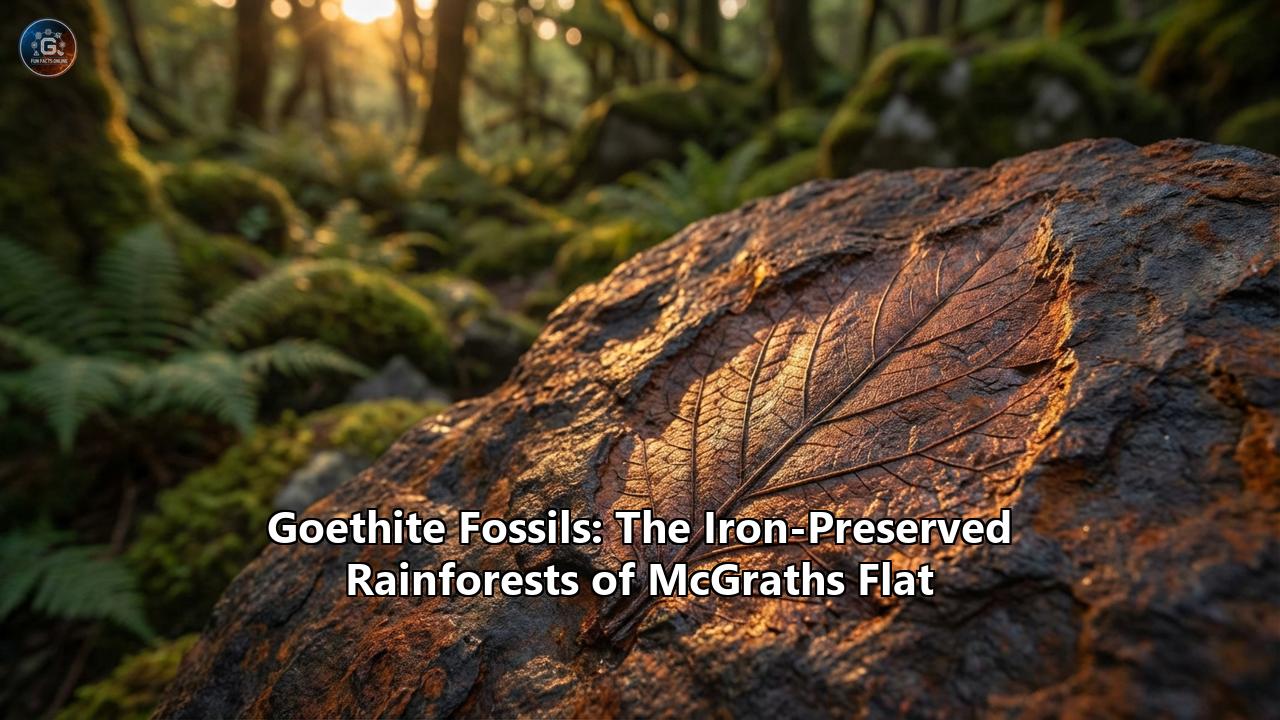
Rust is the color of decay. In our modern world, when we see the flaky, orange-red crust of iron oxide spreading across a metal surface, we instinctively recognize it as the end of something. It is the chemical signature of entropy, the slow burning of structure into dust. We do not look to rust for preservation; we look to it for destruction.
But in the central tablelands of New South Wales, Australia, nature has pulled off a magnificent chemical paradox. Here, amidst the dry sclerophyll forests and grazing lands near the town of Gulgong, rust has not destroyed the past; it has immortalized it. In a geological formation known as McGraths Flat, scientists have uncovered a treasure trove of fossils preserved in goethite—an iron oxyhydroxide mineral that gives the rock a striking, blood-red hue.
These are not the typical flattened shadows of bone found in limestone or the carbonized films of leaves found in shale. These are three-dimensional, high-fidelity specters of a lost world. Spiders with their delicate hairs intact, fish with their stomachs still full of their last meal, and sawflies dusted with the pollen of flowers that bloomed over eleven million years ago. They are entombed in the very element we associate with corrosion, locked away in a "red vault" that has kept the secrets of the Miocene epoch safe for millennia.
The discovery of the McGraths Flat fossil site is not just a triumph for Australian paleontology; it is a global game-changer. It forces us to rewrite the textbooks on how and where fossils form, challenges our understanding of ancient ecosystems, and even offers tantalizing clues for the search for life on the red planet, Mars.
The Accidental Time Traveler
The story of McGraths Flat begins not in a university laboratory, but in the field. Like many great paleontological discoveries, it owes its existence to the sharp eyes of a dedicated individual who knew the land. Nigel McGrath, a local farmer and amateur fossil hunter, had spent years walking the rugged terrain of the Central Tablelands. The region, known for its gold rush history and rolling hills, was not traditionally considered a hotspot for "Lagerstätte"—a German term used by paleontologists to describe fossil sites of exceptional preservation.
Lagerstätten (the plural of Lagerstätte) are the holy grails of paleontology. Sites like the Burgess Shale in Canada or the Messel Pit in Germany are famous because they preserve soft tissues—skin, organs, feathers, and eyes—rather than just hard bone and shell. But these famous sites usually share a common geological recipe: the fossils are found in fine-grained shales, limestones, or volcanic ash, typically formed in anoxic (oxygen-free) lake bottoms or rapid mudslides.
What Nigel McGrath found was different. He cracked open rocks that looked like nothing more than common ironstone or "ferricrete"—hard, rusty, weathering crusts that are ubiquitous in the Australian outback. To most, these rocks are road base material, gravel to be crushed and spread on driveways. But inside these iron stones, McGrath saw something impossible: the intricate vein network of a rainforest leaf, preserved in shocking detail against the red matrix.
He brought his finds to the Australian Museum in Sydney. Dr. Matthew McCurry, a paleontologist at the museum, and Dr. Michael Frese, a virologist-turned-paleontologist from the University of Canberra, were initially skeptical. Iron-rich rocks are notoriously poor at preserving fossils because the oxidation process that creates the iron minerals usually destroys organic matter. But as they examined the specimens under the microscope, their skepticism turned to astonishment.
The preservation was not just good; it was microscopic. They could see individual cells. They could see the ommatidia (individual lenses) of insect eyes. They could see the textures of spider legs. The iron had not destroyed the biology; it had replaced it, molecule by molecule, with a fidelity that rivaled the finest amber.
This was the beginning of the McGraths Flat project, a multidisciplinary effort that would eventually involve researchers from around the world, including geologists, botanists, and even astrobiologists.
The Chemistry of Immortality
To understand why McGraths Flat is so special, one must understand the unique "alchemy" that created it. The fossils date back to the Miocene epoch, specifically between 11 and 16 million years ago. At that time, this part of New South Wales was not a dry, eucalyptus-dominated landscape. It was a lush, temperate rainforest, teeming with life and watered by a complex river system.
The geological stage was set by local volcanoes. The region is dotted with ancient basalt flows, remnants of volcanic activity that occurred millions of years prior. As these basalt rocks weathered under the warm, humid Miocene rain, they leached iron into the groundwater.
This iron-rich, acidic groundwater flowed underground until it discharged into a surface water body—likely an oxbow lake or a "billabong" (a cut-off river channel) that was stagnant and slow-moving. When this dissolved iron (specifically ferrous iron, Fe2+) met the oxygenated water of the lake, it underwent a rapid chemical reaction. It oxidized and precipitated out of the water column as goethite (iron oxyhydroxide).
The key to the preservation lies in the particle size. The goethite particles that rained down on the dead leaves, insects, and fish at the bottom of the billabong were incredibly small—about 0.005 millimeters in diameter. These particles were so fine that they didn't just coat the organisms; they infiltrated them. They filled every nook and cranny, molding themselves around individual cells and wrapping delicate structures in a rigid iron cast.
This process happened rapidly, likely before the soft tissues had time to decay. The organisms were essentially "plated" in iron. Over millions of years, the organic material eventually degraded, but the iron ghost remained, preserving the exact shape and surface texture of the life it once smothered.
This mode of preservation is rare. In most environments, the presence of oxygen (required to rust the iron) also fuels bacteria that eat the soft tissue. At McGraths Flat, the precipitation must have been catastrophic for the microbes but gentle on the carcasses, sealing them away in a sterile mineral tomb before the bacteria could do their work.
A Window into the Miocene Rainforest
The fossils of McGraths Flat provide a stunningly clear window into a specific moment in Australia's history: the transition from the "Greenhouse" world to the "Icehouse" world.
During the early Miocene, Australia had separated from Antarctica and was drifting north. The climate was warm and wet, supporting vast rainforests that covered much of the continent. But by the middle Miocene (around 14 million years ago), the climate began to change. The Antarctic Circumpolar Current established itself, locking up water in polar ice caps and cooling the global climate. Australia began to dry out. The great rainforests retreated, giving way to the arid shrublands and eucalyptus forests that dominate today.
McGraths Flat captures the tail end of this golden age. The flora preserved in the red rocks tells the story of a "mesic" (moderately wet) rainforest that was just beginning to feel the stress of a drying continent.
Botanists have identified leaves from rainforest trees similar to those found today in the Daintree of Queensland or the cloud forests of New Guinea. They found Nothofagus (southern beech) pollen, a hallmark of Gondwanan rainforests. But crucially, they also found pollen from sclerophyllous plants—hard-leaved, drought-adapted species like acacias and ancient eucalypts. This suggests that while the billabong itself was surrounded by rainforest, the hinterlands were already drying out, creating a mosaic of habitats that drove evolution.
The Bestiary of Rust
While the plants set the scene, the animals steal the show. The fauna of McGraths Flat is spectacular, offering the first high-quality look at the smaller inhabitants of the Miocene Australian rainforest.
*The Trapdoor Spider (Megamonodontium mccluskyi)
Perhaps the most iconic fossil from the site is the large trapdoor spider. Fossil spiders are incredibly rare in Australia; before this discovery, only a handful of partial specimens were known from the entire continent. Spiders have soft bodies that usually rot away completely.
The McGraths Flat specimen, named Megamonodontium mccluskyi (honoring the finder of the specific specimen, Dr. Simon McClusky), is breathtaking. It is a large, brush-footed trapdoor spider belonging to the Barychelidae family. The preservation is so exquisite that researchers could examine the setae (hairs) on its legs and the structure of its pedipalps.
This spider tells a story of evolutionary stasis and change. Its closest living relatives are now found in the wet forests of Southeast Asia and northern Australia, thousands of kilometers away from the dry paddocks of Gulgong. This confirms that as the rainforests retreated north, the spiders went with them—or died out in the south, leaving this iron ghost as a testament to their former range.
The Sawfly and the PollenOne of the most biologically significant finds is a sawfly (a relative of wasps and bees). The insect itself is beautifully preserved, but the real treasure is what it was carrying. Using scanning electron microscopy, researchers found clumps of pollen grains stuck to the sawfly’s head and legs.
This is virtually unprecedented in the fossil record. It provides direct, physical evidence of pollination behavior from millions of years ago. It allows scientists to link a specific insect to a specific plant, reconstructing the ecological web of the Miocene rainforest. It proves that this sawfly was visiting flowers, likely feeding on nectar and inadvertently transporting pollen, just as its descendants do today.
The Fish (Ferruaspis brocksi)
The billabong was home to a new species of fish, Ferruaspis brocksi. These small, perch-like fish are found in abundance, suggesting they were a staple of the aquatic ecosystem. But the goethite preservation reveals more than just their bones.
In some specimens, the stomach contents are preserved. We can see what they ate—dragonfly larvae and other aquatic insects. Even more remarkably, we can see what ate them. One specimen has a tiny larval mussel (a glochidium) attached to its tail fin. Freshwater mussels today have a parasitic larval stage where they clamp onto fish fins to hitch a ride upstream. This fossil freezes that parasitic interaction in time, proving that this complex life cycle has existed in Australian waters for at least 15 million years.
The Feathers and the Colors of the PastBirds are notoriously difficult to fossilize, usually leaving only hollow bones. At McGraths Flat, the feathers are preserved. But the iron did something even more incredible: it preserved the shape of the melanosomes.
Melanosomes are microscopic organelles that contain melanin, the pigment responsible for black, brown, grey, and iridescent colors. Different shapes of melanosomes correspond to different colors (sausage shapes for black/brown, meatballs for reddish/yellow). By analyzing the shape and arrangement of the melanosomes in the fossilized feathers, researchers can mathematically reconstruct the color of the ancient bird.
The analysis suggests these Miocene birds were not drab. They likely had iridescent, glossy feathers, flashing blues and blacks in the dappled sunlight of the rainforest canopy. This adds a layer of sensory reality to our reconstruction of the past—we are not just looking at shapes, but at the actual colors of a vanished world.
The CicadasThe rainforest would have been noisy. The site has yielded giant cicadas, species like Tithopsaltria titan and Laopsaltria ferruginosa*. These insects, much larger than many modern varieties, would have filled the humid air with a deafening drone. Their preservation includes the delicate wing veins and the robust bodies adapted for piercing tree bark to drink sap.
The Mars Connection
The significance of McGraths Flat extends beyond biology and into the realm of astrobiology. One of the key researchers on the project is Tara Djokic, an expert in early life and astrobiology who has previously worked on the ancient rocks of the Pilbara.
Her involvement highlights a fascinating crossover: the "search image" for life on Mars.
Mars is the Red Planet because it is covered in iron oxide—rust. For decades, NASA rovers have been scouring the Martian surface for signs of ancient life. The preservation at McGraths Flat provides a terrestrial blueprint for what Martian fossils might look like if they exist.
If Mars ever had standing water (which we know it did) and if that water was rich in dissolved iron from volcanic rocks (which is highly likely on a volcanic planet), then the conditions at McGraths Flat could theoretically have been replicated on Mars.
The goethite preservation mechanism—precipitation of fine iron particles in acidic to neutral waters—is a plausible scenario for ancient Martian crater lakes. The McGraths Flat fossils show that this chemical environment can preserve cellular structures with high fidelity. It suggests that future Mars missions shouldn't just look for silica deposits or clays; they should be cracking open the ironstones. The "blueberries" (hematite concretions) found by the Opportunity rover and the iron-rich sediments in Jezero Crater might be the kinds of places where a Martian equivalent of a microbe—or something more complex—could be entombed in rust.
Rewriting the Rules
The most immediate impact of the McGraths Flat discovery is on the practice of paleontology itself. For two centuries, fossil hunters have walked past ironstones. They are difficult to work with, often hard as concrete, and "ugly" compared to the smooth sheets of shale used in textbook excavations.
McGraths Flat teaches us that we have been looking in the wrong places. It suggests that the Australian landscape, which is geologically ancient and heavily weathered (and thus full of ironstones), might be hiding dozens of other "Lagerstätten" in plain sight.
The site challenges the bias towards aquatic environments. Most exceptional fossil sites preserve lake or ocean bottoms. McGraths Flat is a terrestrial snapshot—a billabong in a forest. It preserves the things that rarely make it to the lake bottom: the spiders that lived in the canopy, the insects that flew through the air, the leaves that fell on the bank.
A Warning from the Past
Finally, McGraths Flat serves as a poignant ecological baseline. The Miocene was the last time Australia was truly lush. The drying trend that began then has continued to this day, creating the arid continent we know.
By studying the species that lived there—and seeing which lineages survived the great drying and which went extinct—we can understand how ecosystems respond to climate change. The rainforests of the Miocene collapsed as the world warmed and dried (or cooled and dried, in the complex dynamics of the Miocene). Today, as we face rapid anthropogenic climate change, understanding the resilience and vulnerability of rainforest species is more critical than ever.
The sawflies, the spiders, and the fish of McGraths Flat are not just curiosities. They are data points in a 15-million-year-long experiment in climate adaptation.
Conclusion
The "Red Rocks" of McGraths Flat are a paradox of preservation. They are composed of the very substance we associate with the degradation of metal and the passage of time—rust. Yet, through a unique quirk of chemistry and geology, they have acted as a shield against time.
They have given us an "Iron Rainforest," a frozen moment from the Miocene where we can see the individual hairs on a spider's leg and the pollen on a pollinator's brow. They have connected the deep past of the Australian bush with the future of space exploration on Mars.
As researchers continue to split the red stones of Gulgong, we can only wonder what other ghosts are waiting to be released from their iron tombs. The rust, it turns out, does not sleep; it remembers.
Reference:
- https://www.unsw.edu.au/newsroom/news/2025/10/unusual-red-rocks-australia-reweiring-rules-exceptional-fossil-sites
- https://mappingignorance.org/2025/10/15/unusual-red-rocks-in-mcgraths/
- https://astrobiology.com/2025/10/unusual-red-rocks-in-australia-are-rewriting-the-rules-on-exceptional-fossil-sites.html