
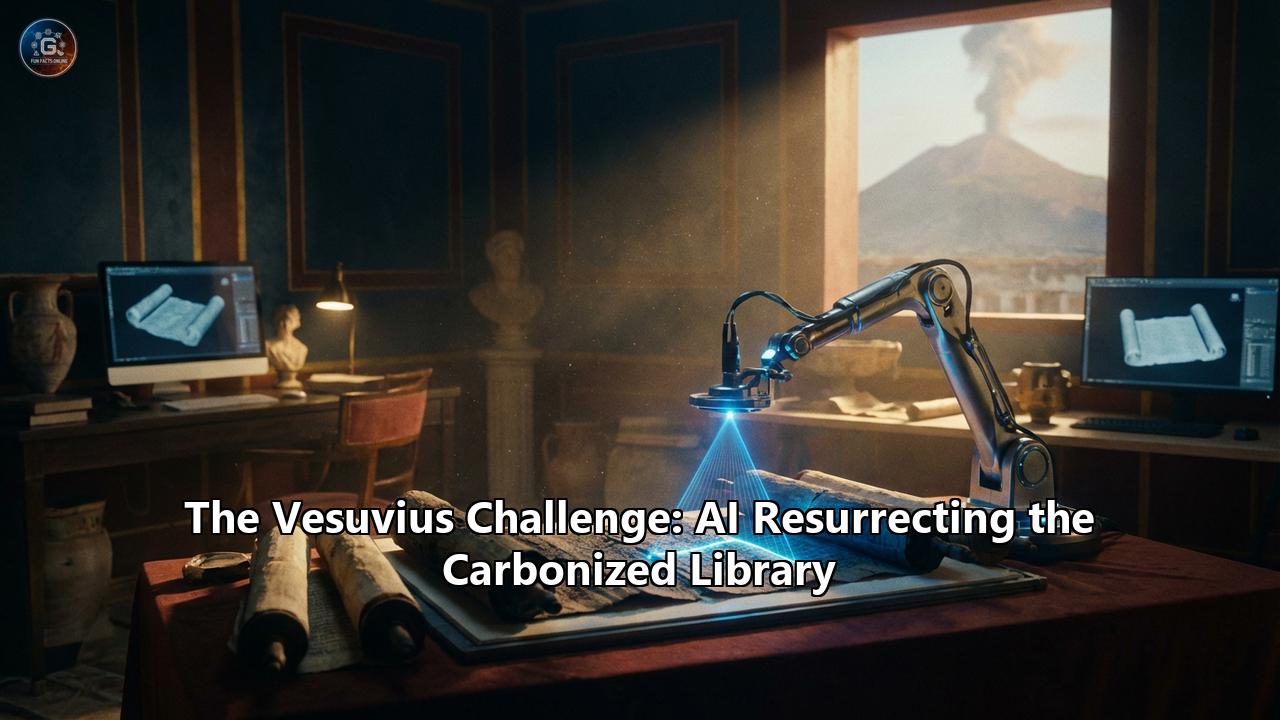
In the shadow of Mount Vesuvius, overlooking the Bay of Naples, lies a ghost library. For nearly two thousand years, it has held the thoughts of the ancient world in a grip of fire and ash. When the volcano erupted in 79 AD, it didn’t just bury the Roman town of Herculaneum; it flash-fried a luxurious villa and its vast collection of papyrus scrolls. The intense heat carbonized the scrolls instantly, turning them into fragile lumps of charcoal that looked more like burnt logs than books.
For centuries, these scrolls were the ultimate tantalizing mystery of the classical world. We knew they were there—excavated in the 18th century from the "Villa of the Papyri"—but we couldn't read them. Every attempt to physically open them resulted in their destruction, the ancient pages crumbling to black dust. They were a library of the lost, a locked room of history.
Until now.
We are living through a historical singularity. Through a convergence of particle physics, artificial intelligence, and a fiercely competitive global contest known as the Vesuvius Challenge, the library is finally speaking. What started as a "moonshot" project in 2023 has, by early 2026, evolved into a systematic resurrection of lost literature. We have read philosophical treatises on pleasure, music, and food. We have peered inside scrolls housed in Oxford to find treatises on "evil" and "disgust." And we are standing on the precipice of recovering the lost works of Aeschylus, Sappho, and perhaps the early histories of Rome itself.
The 275-Year-Old Puzzle
To understand the magnitude of this achievement, one must appreciate the sheer intractability of the problem. When the Villa of the Papyri was discovered by well-diggers in 1750, the scrolls were initially mistaken for charcoal briquettes and thrown away. Once their true nature was realized, the "unrolling" attempts began.
Early explorers used knives, mercury, and gas. A Vatican priest, Antonio Piaggio, invented a machine in 1753 that used silk threads to pull the layers apart at a rate of millimeters per day. It worked, barely, but left the scrolls in tattered, blackened fragments. By the 20th century, archaeologists had largely given up. The remaining 600+ scrolls in the National Library of Naples were left in their cabinets, deemed unreadable.
The problem wasn't just that the scrolls were fused together. It was the ink. Ancient scribes used carbon-based ink (lampblack and gum arabic). When you write with carbon ink on papyrus (which is carbonized plant matter) and then burn the whole thing into charcoal, you are left with carbon on carbon. To a standard X-ray or CT scan, the ink and the paper look chemically identical. There is no contrast. The letters are invisible.
The Silicon Key: Virtual Unwrapping
The deadlock was broken by Dr. Brent Seales, a computer scientist at the University of Kentucky. Seales spent two decades developing a technique called "Virtual Unwrapping." The idea was to CT scan the scroll in high resolution, creating a 3D block of data (a "voxel" grid), and then use software to mathematically model the curved sheets of papyrus and flatten them out.
He proved it worked in 2015 by reading the En-Gedi scroll, a charred lump from the Dead Sea region, revealing the Book of Leviticus. But the En-Gedi scroll was written with metallic ink, which glows bright white in an X-ray. The Herculaneum scrolls, with their invisible carbon ink, remained stubborn.
Seales theorized that even if the ink didn't show up in density scans, it must have left a physical trace. Perhaps the ink sat on top of the fibers, creating a microscopic ridge (morphology). Perhaps the drying ink caused the papyrus fibers to crack in a specific pattern.
In 2023, tech entrepreneurs Nat Friedman (former CEO of GitHub) and Daniel Gross partnered with Seales to launch the Vesuvius Challenge. They scanned four scrolls at a particle accelerator in Oxford, releasing the petabytes of data to the world. The prize: over $1 million for anyone who could build the AI to find the ink.
The Miracle of 2023: "Purple" and Pleasure
The competition electrified the global AI community. In October 2023, a 21-year-old college student named Luke Farritor became the first person in history to see a word from inside an unopened Herculaneum scroll. Training a machine learning model on the subtle "crackle patterns" of the papyrus, his AI highlighted a cluster of pixels that formed the Greek word ΠΟΡΦΥΡΑϹ (porphyras), meaning "purple" or "purple dye."
That single word proved the concept. The race for the Grand Prize was on.
In February 2024, the Vesuvius Challenge awarded its first Grand Prize of $700,000. A super-team formed by Youssef Nader (an Egyptian biorobotics student), Luke Farritor, and Julian Schilliger (a Swiss robotics student) successfully unrolled and read about 5% of a scroll known as PHerc.Paris.4.
The text was a revelation. It wasn't a dry list of grain shipments. It was a philosophical work by Philodemus, the Epicurean philosopher who likely curated the library. In the text, Philodemus meditates on the nature of pleasure. He asks whether the scarcity of a good (like food or music) makes it more pleasurable than if it were abundant.
"As in the case of food, we do not immediately believe that things that are scarce are absolutely more pleasant than those which are abundant."
He playfully critiques his intellectual rivals (likely the Stoics), calling them "mockers," and ends with a promise to discuss his thoughts on specific pleasures in future books. It was, as Nat Friedman described it, "a 2,000-year-old blog post about how to enjoy life."
The "Silent" Year and the Segmentation Wall
Following the euphoria of the 2023 Grand Prize, the organizers set an audacious goal for 2024: read 90% of four scanned scrolls. The prize pot was $200,000.
The community dove in, but they hit a wall. While the ink detection AI was working beautifully, the segmentation—the process of tracing the crumpled, twisted layers of papyrus through the 3D scan—was agonizingly slow. The inside of a scroll isn't a neat spiral; it's a crushed mess, like a newspaper that has been twisted, stomped on, and baked in an oven.
Tracing these layers manually was taking weeks for just a few square centimeters. To read 90% of four scrolls, the process needed to be fully automated.
The 2024 Grand Prize deadline came and went without a winner. No one reached the 90% mark. However, the "failure" was a productive one. The "First Automated Segmentation Prize" yielded two runner-up solutions from teams led by Hendrik Schilling and Paul Henderson. They didn't solve the whole puzzle, but they built the "autopilot" tools that are now allowing researchers to map the scrolls much faster than human hands ever could.
The Bodleian Surprise: A New Scroll, A New Insight
Just as the community was regrouping, a major breakthrough was announced in February 2025 that shifted the narrative again.
While the main competition focused on the "Paris" scrolls, a parallel effort had been scanning PHerc. 172, a scroll gifted to the Bodleian Libraries in Oxford in the 19th century.
PHerc. 172 was an anomaly. When researchers processed the scan data, they noticed something shocking: visible ink. Unlike the Paris scrolls, where the ink was invisible to the eye and required complex AI to detect, the ink in PHerc. 172 showed up clearly in the X-ray data.
Why? Researchers hypothesize that the ink in this specific scroll was contaminated with lead, or perhaps used a different recipe entirely. This serendipitous "glitch" in the ancient scribe's workshop allowed the team to bypass the difficult ink-detection step and focus purely on unrolling.
The results were immediate and startling. The team deciphered a work titled ---On Evil---, also by Philodemus. The text is a treatise on moral corruption and the psychology of vice. One word, repeated twice in the opened columns, stood out starkly: διατροπή (diatropē), meaning "disgust" or "shame."
Here, Philodemus appears to be discussing the harsh realities of a life lived without philosophy—a life of fear, anxiety, and disgust. It serves as a dark counterpoint to the "pleasure" text found in 2023. We now have the Epicurean view on both the best life (pleasure) and the worst (evil/disgust), recovered from the same volcanic tomb.
The Road to 2030: Unlocking the Main Library
As we stand in early 2026, the Vesuvius Challenge has transitioned from a proof-of-concept into an industrial-scale operation. The "UnLost" project, funded by a massive $13.5 million European Research Council grant awarded to Brent Seales, is now building a dedicated scanning facility.
The "Master Plan" is no longer just to read a few paragraphs. The goal is to scan and read all 300+ intact scrolls sitting in Naples.
But the true dream lies deeper underground.
Archaeologists and classicists believe that the Villa of the Papyri has not given up all its secrets. The scrolls recovered so far are almost exclusively Greek philosophical texts—the working library of a specialist like Philodemus. But a Roman aristocrat of that era (the villa was likely owned by Julius Caesar's father-in-law, Calpurnius Piso) would have had a Latin library as well.
It hasn't been found.
Many believe the Latin library—and the "main" Greek library containing standard works of literature—is still buried in a lower, unexcavated level of the villa. If we can refine the technology to read the scrolls we have, we build the case to excavate the rest.
We are looking for the lost books of Livy, the missing plays of Sophocles and Euripides, the poems of Sappho, and perhaps even early Christian texts or contemporary accounts of the political chaos of the late Roman Republic.
Conclusion: The New Renaissance
The Vesuvius Challenge is more than a tech demo. It is a time machine. For 2,000 years, the eruption of Vesuvius was viewed as a tragedy that destroyed a civilization. We are now realizing that the volcano did not destroy the library; it saved it.
In the humid climate of Italy, papyrus rots in decades. Every other copy of Philodemus's works decayed and vanished before the fall of Rome. Only in the carbonized, oxygen-free tomb of Herculaneum did they survive. The fire that killed the town was the same fire that preserved its memory.
We have the tools. We have the team. We have the first words. The library is open.
Reference:
- https://engradm.engr.uky.edu/news/breakthrough-discovery-made-within-2000-year-old-herculaneum-scrolls
- https://www.i-programmer.info/news/204-challenges/17797-vesuvius.html
- https://scrollprize.org/
- https://archaeologymag.com/2025/02/ai-reveals-first-look-inside-herculaneum-scroll/
- https://www.unl.edu/no-place-like/vesuvius-scrolls/
- https://www.theguardian.com/science/2025/feb/05/ai-helps-researchers-read-ancient-scroll-burned-to-a-crisp-in-vesuvius-eruption
- https://www.finebooksmagazine.com/news/inside-herculaneum-scroll-seen-first-time-79-ad
- https://engr.uky.edu/news/vesuvius-challenge-grand-prize-winners-announced
- https://www.michelezanini.com/unlocking-the-past-inspiring-the-future-the-vesuvius-challenge-and-the-power-of-open-innovation/
- https://scrollprize.org/2024_prizes
- https://www.bodleian.ox.ac.uk/about/media/feb25/herculaneum-scroll
- https://www.jpost.com/archaeology/archaeology-around-the-world/article-852823
- https://scrollprize.org/master_plan
- https://news.ycombinator.com/item?id=39261861