
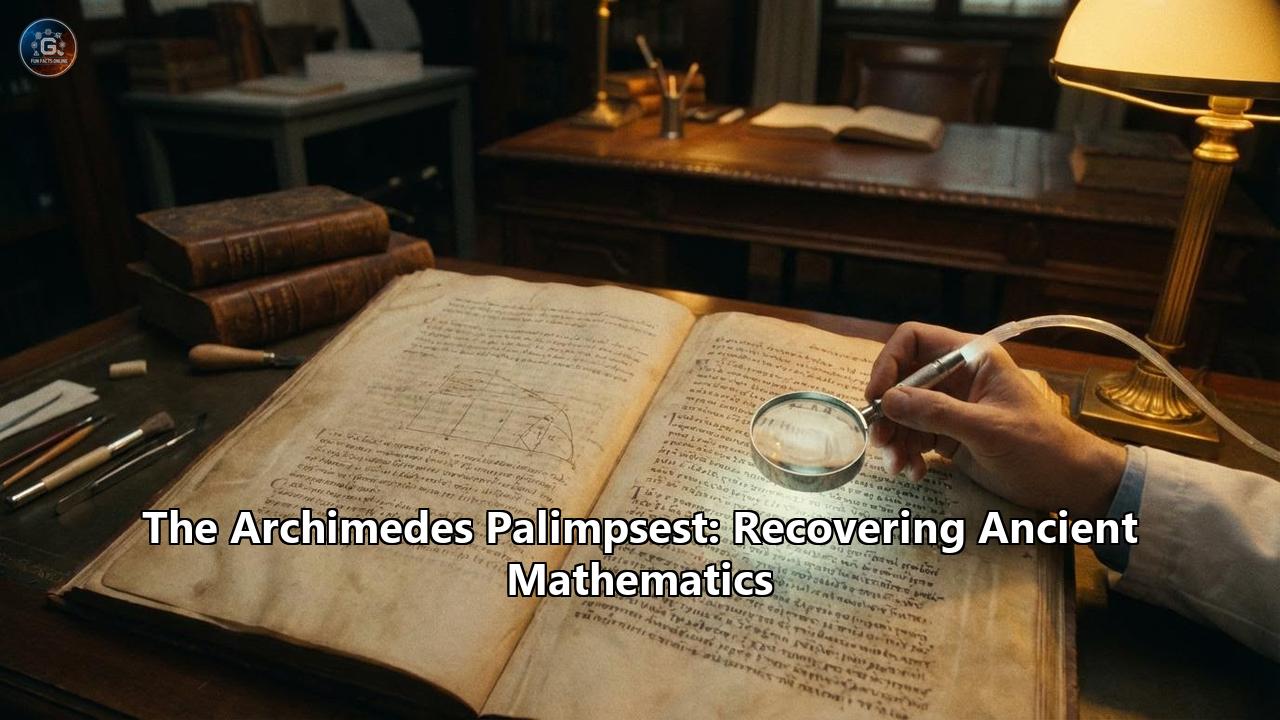
The story of the Archimedes Palimpsest is arguably the greatest scientific and historical thriller of the modern era. It is a sweeping saga that spans over two millennia, featuring the greatest mathematical genius of antiquity, crusading armies, a medieval monk in need of writing material, a greedy twentieth-century forger, and a twenty-first-century team of particle physicists and scholars. It is a narrative of staggering loss, miraculous survival, and the triumphant recovery of knowledge that fundamentally rewrote the history of mathematics.
To look at the manuscript before its restoration was to look at a ruined object. It was a small, unassuming book, roughly the size of a modern hardback novel, its pages scarred by fire, eaten by mold, and stiffened by age. Yet, locked within its battered goatskin parchment were secrets that proved the ancient Greeks had anticipated the foundations of modern calculus and combinatorics nearly two thousand years before Isaac Newton and Gottfried Leibniz.
The Genius of Syracuse and the Fragility of Knowledge
To understand the magnitude of the Palimpsest, one must first understand the mind of its original author. Archimedes of Syracuse (c. 287–212 BC) is widely regarded as the greatest mathematician, physicist, and engineer of the ancient world. While popular history remembers him as the eccentric who ran naked through the streets shouting "Eureka!" after discovering the principle of buoyancy, his true legacy lies in his staggering mathematical treatises. Archimedes did not just solve equations; he manipulated the physical universe through geometry.
In antiquity, knowledge was incredibly fragile. Texts were written on papyrus scrolls, which degraded in humidity, caught fire easily, and required constant, laborious copying by hand. Following the collapse of the Western Roman Empire, the survival of Greek scientific thought relied heavily on the scholars of the Byzantine Empire in the East and, later, the Islamic Golden Age. Archimedes’ original scrolls crumbled to dust centuries ago, but his words survived because scribes meticulously copied them onto parchment—treated animal skin that was far more durable than papyrus.
In the tenth century, during the Macedonian Renaissance—a period of intense revival of classical learning in Constantinople—an anonymous Greek scribe copied a collection of Archimedes' treatises onto a fresh parchment codex. For a time, this book served as a vital link in the chain of human knowledge. But history is rarely kind to the artifacts of peace.
The Birth of the Palimpsest
In 1204, the Fourth Crusade descended upon Constantinople, culminating in the brutal sack of the city. Amidst the looting and burning of libraries, the Archimedes manuscript was somehow spirited away, eventually finding refuge in the remote, fortified Mar Saba monastery near Bethlehem in the Judean desert.
By the thirteenth century, the intellectual climate had shifted. At Mar Saba, the dense, complex mathematical Greek of Archimedes was of little use to the ascetic monks. What they did need, however, was prayer books. Parchment was an expensive and labor-intensive commodity, so monks frequently recycled old books.
On April 14, 1229, a priest named Johannes Myronas finished repurposing the Archimedes manuscript. He unbound the codex, meticulously scraped away the tenth-century ink, and washed the pages. Because the original book was large, Myronas cut the pages down the center fold, rotated them ninety degrees, and folded them in half to create a smaller, thicker book. Over the faint, ghostly remnants of Archimedes' equations, he wrote a Byzantine liturgical text known as an Euchologion, or prayer book.
This process is called "palimpsesting" (from the Greek palimpsestos, meaning "scraped again"). For the next seven hundred years, the greatest mathematical insights of the ancient world were hidden beneath medieval prayers. It was an act of profound intellectual destruction, yet, in a supreme irony of history, it was this very act of vandalism that saved Archimedes. Had the parchment not been repurposed into a sacred text, it almost certainly would have been discarded or destroyed by the elements.
The First Recovery and the Decades of Darkness
The prayer book eventually made its way back to Constantinople, resting in the library of the Metochion of the Holy Sepulchre. In 1899, a Greek scholar named Papadopoulos-Kerameus cataloged the library's contents. In his description of the 13th-century prayer book, he noted a few lines of the faint underlying text. This catalog caught the eye of Johan Ludvig Heiberg, a Danish philologist and the world’s foremost authority on Archimedes.
In 1906, Heiberg traveled to Istanbul. Armed only with a magnifying glass and a rudimentary camera, he examined the manuscript and made the discovery of a lifetime. Straining his eyes against the faint, scraped text, he recognized it as Archimedes. Furthermore, he realized the book contained two works that had been lost to history entirely: The Method of Mechanical Theorems and the Stomachion, as well as the only surviving Greek version of On Floating Bodies.
Heiberg photographed the pages and published his transcriptions between 1910 and 1915, sending shockwaves through the mathematical community. However, because the erasure was thorough and his tools were limited, Heiberg could only read a portion of the text. Crucial diagrams and dense mathematical proofs remained utterly illegible.
Before Heiberg or anyone else could return with better technology, the world descended into chaos. World War I erupted, followed by the Greco-Turkish War. In the ensuing tumult and the evacuation of the library, the Archimedes Palimpsest vanished.
For over seventy years, scholars assumed it had been destroyed. In reality, it had been acquired—under murky circumstances—by a French businessman named Marie Louis Sirieix, who brought it to Paris. For decades, it languished in a damp cellar, suffering devastating damage from mold and water, which ate away at the edges of the pages and weakened the parchment.
Then came the ultimate desecration. Sometime after the 1920s, in a misguided attempt to increase the book's resale value, a forger painted crude, gold-leaf portraits of the Evangelists over four of the pages. The heavy medieval-style paintings completely obliterated the text beneath them. Not only had Archimedes been scraped, washed, and overwritten by a monk, but his most vital works were now smothered under twentieth-century gold leaf.
The Auction and the Dream Team
The Palimpsest finally re-emerged from the shadows in 1998, when Sirieix's descendants put it up for auction at Christie's in New York. The academic community was terrified that it would disappear into a private vault, never to be studied again. It was purchased for $2 million by an anonymous American billionaire. But in a stroke of incredible fortune for humanity, the anonymous buyer was not a hoarder; he was a benefactor. He deposited the fragile, mold-eaten book at the Walters Art Museum in Baltimore and funded a blank-check project to conserve, image, and study the manuscript.
The Archimedes Palimpsest Project was born, directed by Will Noel, the museum's Curator of Manuscripts, and managed by Michael B. Toth. They assembled a multidisciplinary "dream team" of over 80 scientists, conservators, and classical scholars.
The first hurdle was physical. Before the text could be read, the book had to be taken apart. Abigail Quandt, the Senior Conservator at the Walters Art Museum, faced a nightmare. Sometime in the twentieth century, the spine of the book had been slathered with polyvinyl acetate (PVA) wood glue. Using a stereomicroscope and precision tools, Quandt spent four agonizingly slow years painstakingly picking away the glue and disbinding the fragile, crumbling pages without destroying the text.
The Light and the Beam: Unlocking the Text
With the pages separated, the imaging scientists took over. The team, including Roger Easton, William Christens-Barry, and Keith Knox, pioneered advanced multispectral imaging techniques. They illuminated the manuscript with various wavelengths of light—from ultraviolet through the visible spectrum and into the infrared.
The monk's 13th-century ink and the original 10th-century scribe's ink responded differently to these wavelengths. The original iron-gall ink used for Archimedes fluoresced under specific ultraviolet conditions. By capturing digital images at different wavelengths and using complex algorithms to subtract the newer text from the older text, the scientists made the medieval prayers digitally fade away, allowing the ancient math to glow brightly on the computer screens.
Through this method, the scholars—led by Stanford classicist and historian of mathematics Reviel Netz, and Nigel Wilson of Oxford—were able to read vast sections of the text that had baffled Heiberg. They discovered that Heiberg had missed critical nuances, altered diagrams to fit his own assumptions, and failed to decipher the most revolutionary passages.
But multispectral imaging had its limits. It could not penetrate the thick layer of gold leaf applied by the twentieth-century forger. To read the pages hidden beneath the gold, the team had to turn to the realm of high-energy particle physics.
Enter Dr. Uwe Bergmann and the Stanford Linear Accelerator Center (SLAC). The team hypothesized that the original 10th-century ink contained iron. If they could shoot highly focused X-rays at the parchment, the X-rays would pass through the gold and strike the iron atoms in the hidden ink. The iron atoms would absorb the energy and emit a faint, characteristic glow—a process known as X-ray fluorescence (XRF).
To generate a beam powerful enough, they used SLAC's synchrotron, an underground particle accelerator where electrons are spun at nearly the speed of light, emitting intense radiation. Over several marathon sessions, the fragile parchment was mounted in the beamline. As the invisible X-rays scanned the pages point by point, detectors mapped the locations of the iron atoms.
Slowly, on the monitors in the control room, a miracle occurred. Through the impenetrable gold leaf, the iron atoms mapped out perfect Greek characters and mathematical diagrams. For the first time in a thousand years, the complete thoughts of Archimedes were brought into the light.
Rewriting the History of Mathematics: Infinity and Calculus
What Reviel Netz and the translation team found inside the Palimpsest fundamentally altered our understanding of human intellectual development. The most explosive revelation came from The Method of Mechanical Theorems.
In modern mathematics, calculus is the ultimate tool for understanding continuous change, calculating areas, and determining volumes. A core pillar of calculus is the concept of "actual infinity"—the idea that you can divide a shape into an infinite number of infinitely thin slices, calculate the properties of those slices, and add them together to find the property of the whole. Historians had long believed that the ancient Greeks, while brilliant at geometry, were terrified of the concept of actual infinity, relying instead on "potential infinity" (a limit that can be approached but never reached). It was widely accepted that actual infinity was not mathematically harnessed until Newton and Leibniz in the 17th century.
The Palimpsest proved this entirely wrong.
In Proposition 14 of The Method, Archimedes attempts to find the volume of a complex shape (a cylindrical wedge). To do this, he imagines slicing the shape into flat, two-dimensional cross-sections. He then slices a shape of known volume in the same way. In a breathtaking leap of imagination, Archimedes essentially places these two-dimensional slices on a theoretical balance scale—a lever—and uses the laws of physics (the center of gravity) to weigh the infinite slices of the unknown shape against the infinite slices of the known shape.
Crucially, as revealed by the Palimpsest, Archimedes explicitly states that the two sets of lines are "equal in multitude". He recognized that both sets contained an infinite number of slices, and he directly compared these two actual infinities to derive the volume of the 3D shape.
"This pushes the mathematical use of actual infinity nearly some 2,000 years back in time," noted Dr. Netz. Archimedes was not just doing geometry; he was doing the foundational mechanics of calculus. Had this text not been scraped away and lost, and had European mathematicians been able to build upon it during the Renaissance, the development of modern science, physics, and engineering might have occurred centuries earlier.
The Stomachion: The Dawn of Combinatorics
The second major revelation came from the Stomachion. Translated roughly as "The Bellyacher" (because it causes mental indigestion), it is a fragment of a treatise analyzing a puzzle made of 14 polygonal pieces that fit together to form a square.
For a long time, historians thought the Stomachion was merely a children's game, a geometric toy used to make shapes of animals or ships. But the Palimpsest revealed Archimedes' true intention. He was not interested in what shapes the pieces could make; he was trying to calculate how many different ways the 14 pieces could be arranged to form a perfect square.
This changes the classification of the work entirely. It is not just a geometry puzzle; it is the oldest surviving treatise on combinatorics—the branch of mathematics dealing with combinations, permutations, and the calculation of probabilities. Combinatorics is the bedrock of modern computer science, cryptography, and probability theory.
Prompted by the discoveries in the Palimpsest, modern mathematicians, including Persi Diaconis at Stanford University, used sophisticated computer algorithms to solve the puzzle Archimedes posed. They determined that there are 17,152 distinct ways to assemble the 14 pieces into a square (or 536 geometrically distinct solutions, accounting for symmetries). While the surviving pages of the Palimpsest cut off before Archimedes reveals his final answer, the complex mathematical groundwork laid out in the text suggests he likely solved it, confirming him as the father of combinatorial mathematics.
Hidden Treasures: Hyperides and Aristotle
While Archimedes was the star, the multispectral imaging revealed that Johannes Myronas had recycled parchment from at least six other books to make his prayer book.
Hidden among the pages were 10 pages containing lost speeches by Hyperides, a foundational Athenian orator and politician from the 4th century BC. Hyperides was a contemporary of Demosthenes and played a massive role in Greek democracy, yet much of his work had been lost to time. The Palimpsest yielded major portions of two lost speeches, including his speech Against Diondas, expanding the known corpus of Hyperides by a staggering 20 percent and providing priceless new insights into ancient Athenian law and politics.
Additionally, the imaging revealed a 2nd- or 3rd-century AD commentary on Aristotle’s Categories. Aristotle’s work is fundamental to Western philosophy, logic, and scientific classification. The discovery of this early commentary provides a missing link in how ancient scholars interpreted and debated the very nature of human thought and language before the Middle Ages.
A Legacy in the Digital Age
On October 29, 2008, exactly ten years after the anonymous billionaire purchased the manuscript, the Archimedes Palimpsest Project did something nearly as revolutionary as the discoveries themselves. Rather than locking the data behind expensive academic paywalls, the team uploaded every single raw image, processed image, and Greek transcription to the internet.
They released the entire digital archive under a Creative Commons CC-BY license, making it freely available to anyone in the world—from prestigious scholars to high school students, amateur mathematicians, and computer scientists.
The story of the Archimedes Palimpsest is a testament to the endurance of human knowledge. It is a sobering reminder of how easily the flame of intellectual progress can be snuffed out by war, religious dogma, or simple neglect. Yet, it is also a monument to human ingenuity. It took the combined efforts of a 10th-century scribe, an accidental preservation by a 13th-century monk, the sharp eyes of a 20th-century philologist, and the nuclear-powered X-rays of 21st-century scientists to hear the voice of a man who died by a Roman soldier's sword in 212 BC.
Through the ashes of burned edges, the rot of cellar mold, and the glint of a forger's gold, Archimedes speaks again, proving that true genius, though it may be scraped and washed away, can never be entirely erased.
Reference:
- https://en.wikipedia.org/wiki/Archimedes_Palimpsest
- https://www.theguardian.com/books/2011/oct/26/archimedes-palimpsest-ahead-of-time
- https://daily.jstor.org/archimedes-rediscovered-technology-and-ancient-history/
- https://www.smithsonianmag.com/science-nature/reading-between-the-lines-148131057/
- https://thewalters.org/news/lost-and-found-the-secrets-of-archimedes/
- https://goddessofhellfire.com/2014/07/17/deciphering-the-archimedes-palimpsest/
- https://www.archimedespalimpsest.org/links/news/press-release-2006.html
- https://surface.syr.edu/pres_brodsky/2/
- https://www.thebritishacademy.ac.uk/documents/457/16-noel.pdf
- https://www.historyofinformation.com/detail.php?id=3996
- https://muse.jhu.edu/verify?url=%2Farticle%2F519950&r=235955
- https://www.archimedespalimpsest.org/about/scholarship/method-infinity.php
- https://www.pbs.org/wgbh/nova/archimedes/infinity.html
- https://www.cambridge.org/core/journals/british-journal-for-the-history-of-science/article/abs/reviel-netz-william-noel-natalie-tchernetska-and-nigel-wilson-eds-the-archimedes-palimpsest-2-volume-set-volume-1-catalogue-and-commentary-volume-2-images-and-transcription-cambridge-cambridge-university-press-for-the-walters-art-museum-2011-pp-viii-342-x-344-isbn-9781107014572-15021500-hardback/A86C8E1B5C97A5CB5170049E3E8F4D14
- https://www.archimedespalimpsest.org/about/scholarship/combinatorics.php